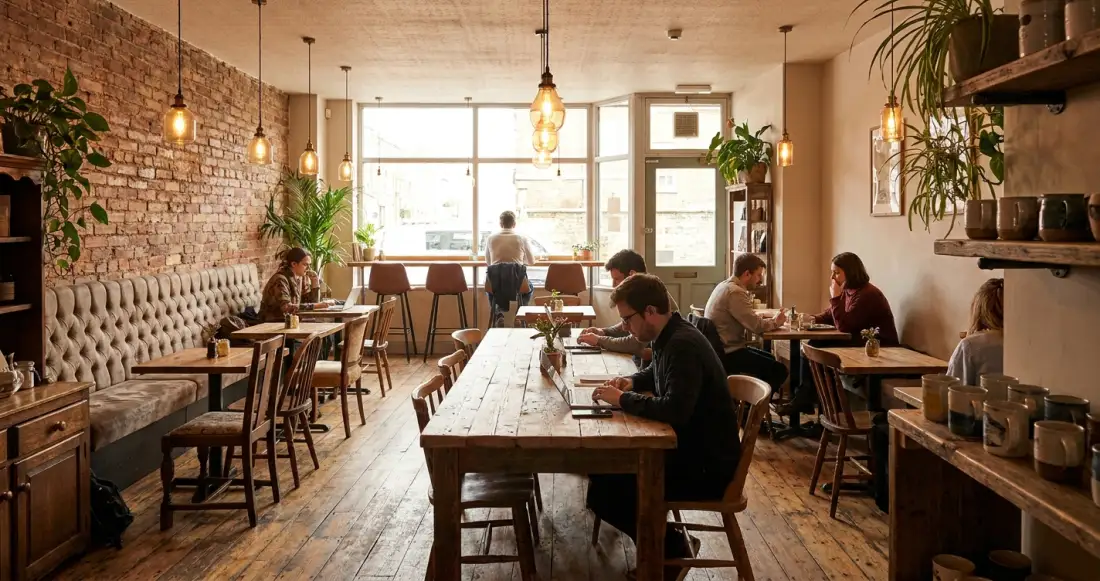
Coffee shop seating ideas that add covers and keep customers longer: a UK owner's guide to seating types, layout, comfort and outdoor space.
Coffee shop seating ideas are the seating types and layouts that add covers, suit different visits and keep customers comfortable enough to stay, and order again. The right mix turns a quick takeaway stop into the kind of all-day trade that fills your quiet afternoons.
You've got the coffee right, but the room empties by 2pm. Sound familiar? Often it isn't the coffee. It's the seating. The reality for most cafes is that the wrong chairs in the wrong places quietly send people elsewhere to settle in. 8 min read.
What You'll Learn
- The main coffee shop seating types and when to use each
- How to maximise seating in a small cafe without crowding it
- Seating that increases dwell time and second orders
- Outdoor coffee shop seating ideas for UK weather
- The seating mistakes that empty your room after the morning rush
The Main Coffee Shop Seating Types
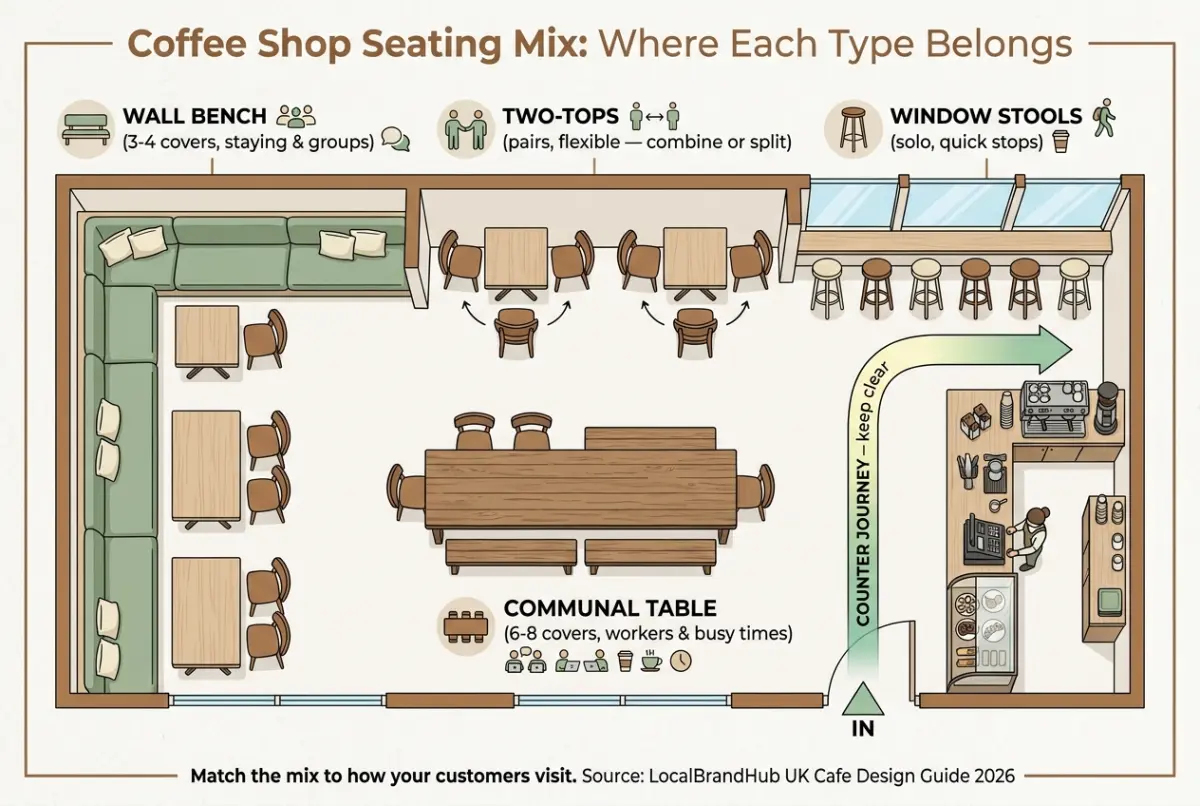
First, know your options. Most cafes only need 3 or 4 seating types, each doing a different job for a different kind of visit.
| Seating type | Best for | Covers in ~2m |
|---|---|---|
| Wall bench | Staying, groups | 3-4 |
| Two-tops | Pairs, flexibility | 2 (combine for more) |
| Window stools | Solo, quick stops | 2-3 |
| Communal table | Workers, busy times | 6-8 |
Rule of thumb only: match the mix to your customers: a laptop crowd needs different seating than a grab-and-go queue, so adapt these to your trade.
For example, a cafe in Manchester that added one 8-seat communal table reclaimed a dead central space and gave laptop workers somewhere to land: afternoon covers rose noticeably within a month.
How to Maximise Seating in a Small Cafe
Next, the small-space question every owner asks. The answer isn't more chairs. It's smarter ones. Push seating to the perimeter and keep the middle clear.
- Line the walls. A bench along one wall adds 4-5 covers and frees the floor.
- Go up at the window. Bar stools at a 30cm-deep counter seat solo customers in almost no space.
- Use fold-down shelves. They give solo workers a perch, then disappear at peak.
- Choose stackable two-tops. Combine them for groups, split them for pairs.
For example, a 35-square-metre cafe in Leeds added a 4-metre wall bench and 3 window stools and lifted its seated covers from 14 to 22, a 50% gain in the same floor space, just by moving seating to the edges.
If you can't tell whether your layout is working, watch where people hesitate at the door. That's usually a sign your seating is reading as full or awkward, even when tables are free. For more on tight units, see our small-space guide below.
Related: Small Cafe Interior Design Ideas
Seating That Keeps Customers Longer
Now that the layout works, here's the part that lifts revenue: dwell time. Comfortable seating earns second orders, and second orders are where thin margins get healthier.
Comfort beats quantity. A few well-padded seats with backs and a power socket nearby will out-earn a room packed with hard stools nobody lingers on. Aim for at least 2 comfortable "lingering" seats per 10 covers, and keep a plug socket within reach of each. For example, a cafe that added cushions, 2 cosy armchairs and 4 plug sockets found its average afternoon visit stretched from one coffee to two, roughly doubling that customer's spend.
Why this matters: a customer who stays for a second flat white can be worth twice the takeaway sale, and it costs you nothing but a comfier seat.
If you're reading this thinking your stools are putting people off staying, you're probably right, and you're not alone. It's one of the most common seating mistakes there is.
Outdoor Coffee Shop Seating Ideas
However, seating doesn't stop at the door. Even 2 or 3 outdoor tables can lift summer trade by a useful margin and act as a living advert: a full terrace of 4-6 tables pulls people in. For UK weather, plan for both sun and showers.
- Foldaway café tables for fine days, stored easily when it rains.
- Sturdy benches that handle a British summer and the odd shower.
- Parasols or a retractable awning for sun and light rain.
- Blankets and a heater to stretch the season into autumn.
For example, a cafe that added just 3 foldaway pavement tables found them full on every dry day through summer, effectively adding 6-12 covers at almost no fit-out cost. Check your local council's pavement licence rules before you put a single chair outside: most UK councils require one, often for a fee of around £100 a year.
Coffee Shop Seating Mistakes to Avoid
Knowing what to skip matters as much as what to buy. The biggest mistake is filling the room with one type of seat and hoping it suits everyone.
- All hard stools. If you're only chasing covers you'll always lose the lingering, second-order trade.
- Tables jammed too close. Under 45cm between chairs and nobody relaxes.
- No solo seating. Lone customers are huge for cafes: give them a window perch.
- Blocking the counter journey. A clever table is worthless if it jams the queue.
For example, a cafe that crammed in 6 extra chairs to reach 30 covers actually took less money, because the room felt cramped and the average visit dropped from 40 minutes to 15. They removed 4 chairs and takings rose.
Why this matters: covers you can't fill comfortably are worth less than fewer seats people linger in. Seating is about revenue per visit, not chair count.
The question isn't how many seats you can fit. It's how many people choose to stay. For the full picture, read the coffee shop interior design pillar.
Frequently Asked Questions
How do I maximise seating in a small cafe?
Push seating to the walls with a bench, add window stools on a shallow counter, and use combinable two-tops. A communal table can add 6-8 covers in dead central space. Keep the counter journey clear so extra seats don't choke the queue.
How do I make my coffee shop busier in the afternoon?
Make it somewhere people want to stay: comfortable seats, power sockets, and a quiet zone for workers. For example, a few armchairs and plug points often turn a dead afternoon into a steady work-and-coffee crowd.
What sells well in a cafe with the right seating?
Second orders and food. Comfortable, lingering seating lifts the average spend per visit, because a customer settled in for an hour buys more than one passing through in five minutes.
What outdoor seating works for UK cafes?
Foldaway tables, sturdy weatherproof benches, parasols and a heater for shoulder seasons. Always check your council's pavement licence first: most UK councils require one before you place seating on the footway.
Your Next Step
Seating is never finished: watch how people actually sit, then adjust.
Weekly Action
Work this coffee shop seating checklist once a week:
- Watch where customers hesitate or fail to find a seat
- Check there's at least 45cm between chairs
- Add or test one solo-friendly window perch
- Make sure a power socket is reachable from a comfy seat
- In summer, set out 2-3 outdoor tables
If you only have 30 minutes a week, do this: sit in your own worst seat for a full coffee and notice why nobody lingers there, then fix it before the weekend. That's enough: small, steady seating tweaks beat one big furniture splurge.
Ask yourself: would you choose to stay for a second coffee in your own cafe? If not, your seating is the place to start. Once the room invites people to linger, steady local marketing keeps them coming: the kind of weekly, done-for-you social posts that LocalBrandHub handles for independent cafes.
If you run a coffee shop and want to see how Local Brand Hub can support your marketing, explore our coffee shop marketing tools.
For restaurants, salons, and local businesses
Need help with your marketing?
We help UK businesses turn social media into real results, not busywork.
Start freeKey Takeaway
Key Takeaways: Coffee Shop Seating Ideas
The right seating mix is one of the cheapest ways to lift dwell time and afternoon trade.
- Use 3-4 seating types so every kind of visit has a home.
- Maximise small spaces with perimeter benches and window stools.
- Prioritise comfort: it earns second orders and longer visits.
- Add outdoor seating for summer trade, with a council licence.
- Design for lingering, not just maximum covers.
Get More Marketing Tips
Practical marketing tips for UK business owners, straight to your inbox. No spam, unsubscribe anytime.
About the Author
Local Brand Hub
Empowering UK Businesses
Local Brand Hub provides comprehensive business management tools designed specifically for UK local businesses to streamline operations, automate marketing, and grow revenue.
More articlesRelated Articles
 Business Growth
Small Cafe Interior Design Ideas for UK Cafe Owners
Small cafe interior design ideas that make a tiny unit feel bigger and busier: UK layout, seating, lighting and budget tips to fill afternoon tables.
 Business Growth
Low Budget Cafe Interior Design: A UK Owner's Guide
Low budget cafe interior design that looks anything but cheap: a UK owner's guide to decorating your cafe for a few hundred pounds, in priority order.
 Business Growth
Coffee Shop Window Display Ideas: A UK Owner's Guide
Coffee shop window display ideas that turn passers-by into customers: a UK owner's guide to seasonal displays, signage, lighting and budget DIY ideas.