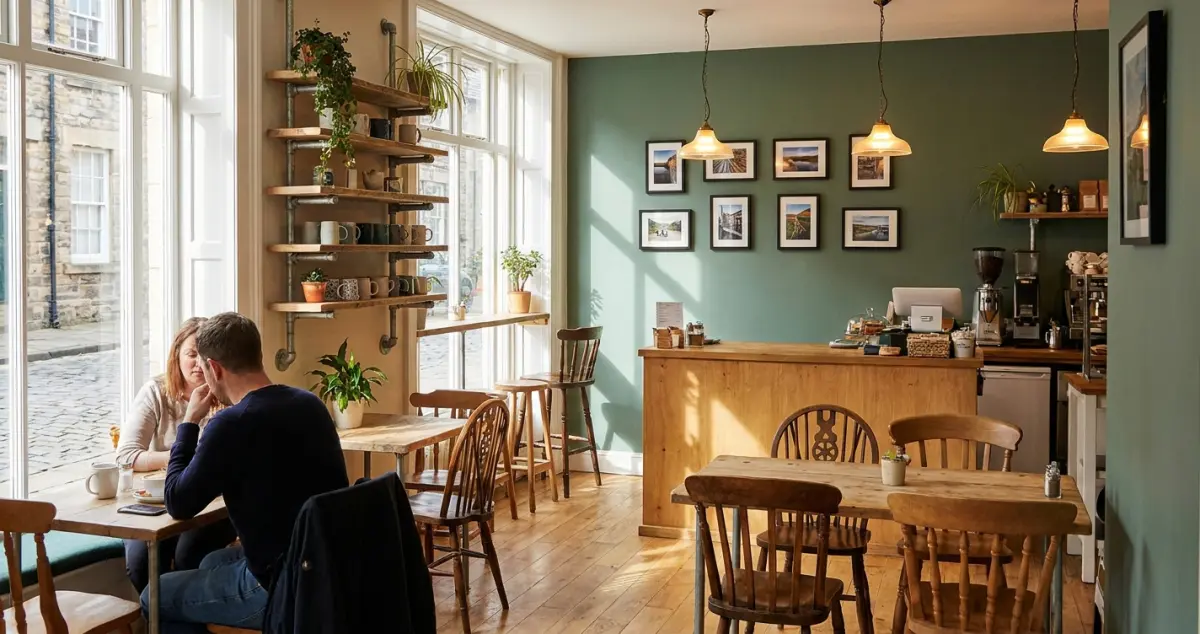
Low budget cafe interior design that looks anything but cheap: a UK owner's guide to decorating your cafe for a few hundred pounds, in priority order.
Low budget cafe interior design is the art of making a unit feel warm, considered and on-brand for a few hundred pounds rather than a few thousand. It works by spending on the things customers actually feel (lighting, colour, comfort and one strong feature) and skipping the rest.
You've spent the budget on the espresso machine and the fridge, and the room still looks like the last tenant's. Sound familiar? The reality for most independents is that the fit-out money runs out fast. The good news: the cheapest changes are usually the ones that change a room most. 8 min read.
What You'll Learn
- Where to spend your first £100, £300 and £500 for maximum effect
- Low budget cafe interior design ideas that look expensive
- How to use reclaimed and secondhand furniture without it looking scruffy
- The 70/30 rule that keeps a cheap fit-out looking deliberate
- The budget mistakes that make a cafe look cheap instead of charming
How to Decorate Your Cafe on a Budget
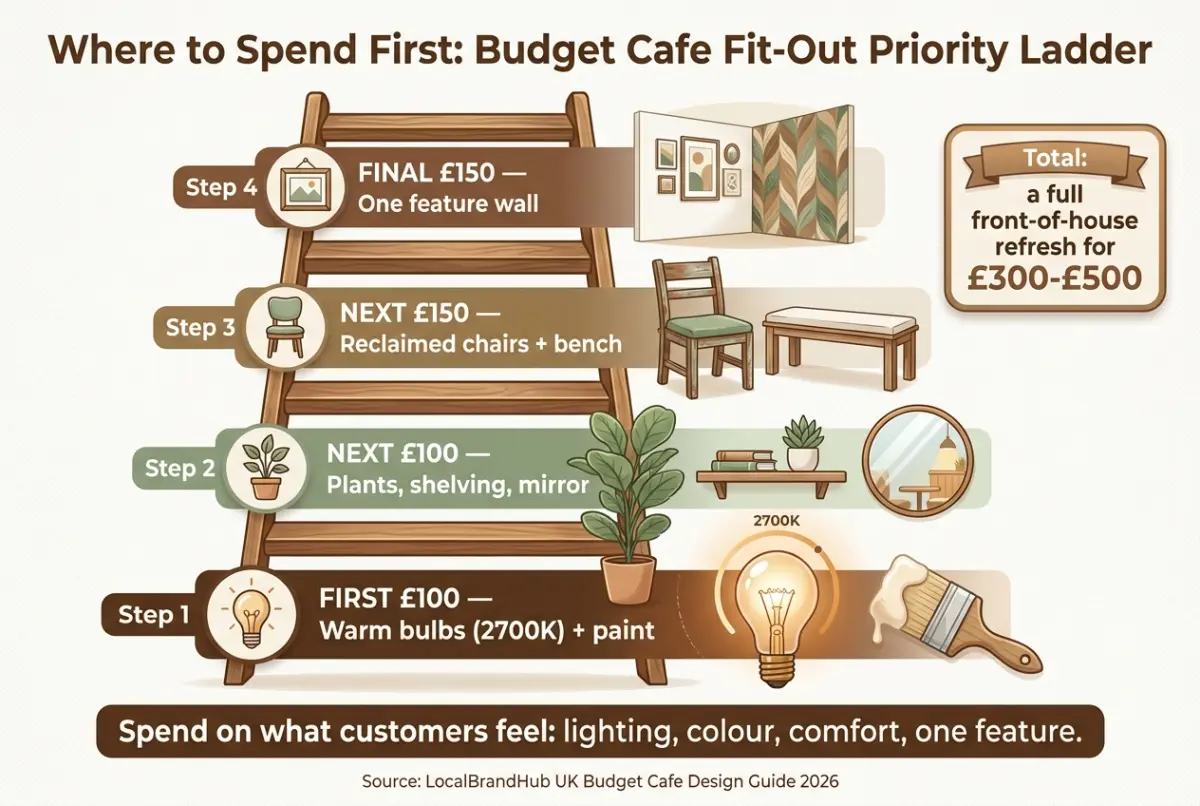
First, spend in the right order. Atmosphere isn't something you buy by spending more: it comes from a handful of cheap decisions pointing the same way. Work up this ladder and stop when the money runs out.
| Spend | What to do | Rough cost |
|---|---|---|
| First £100 | Warm bulbs (2700K) + a tin of paint | £80-£100 |
| Next £100 | Plants, shelving, secondhand mirror | £60-£120 |
| Next £150 | A few reclaimed chairs and a bench | £100-£200 |
| Final £150 | One feature wall: mural, tiles or art | £100-£300 |
Rule of thumb only: these are starting points: a rural unit and a city-centre one will spend very differently, so adapt to your space.
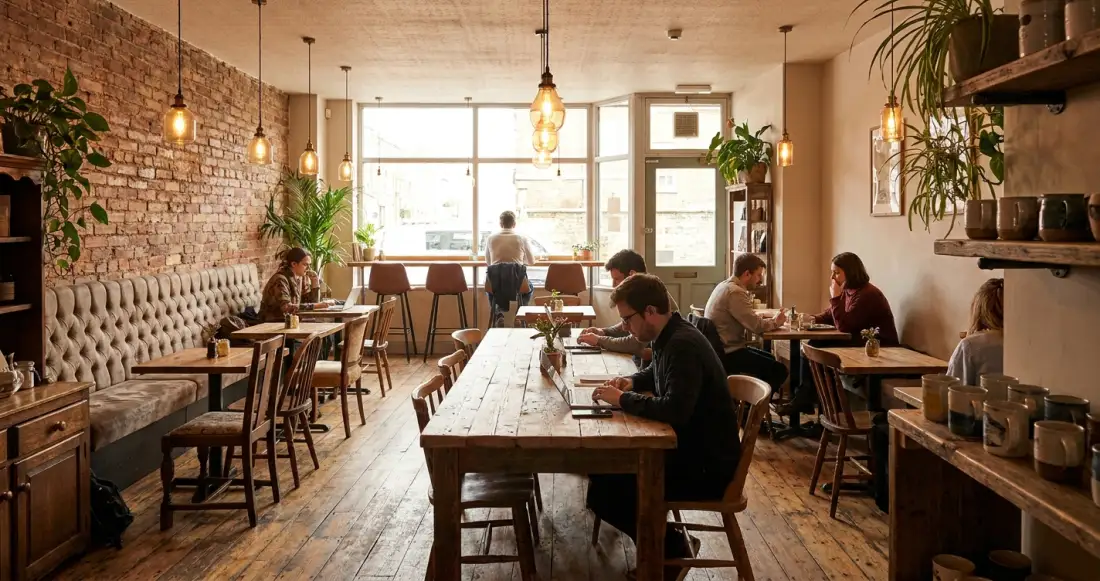
For example, a micro-roastery in Sheffield refitted its whole front-of-house for around £400: warm lighting, a clay-painted wall, a reclaimed bench and a dozen plants. Customers assumed they'd hired a designer.
Low Budget Cafe Interior Design Ideas That Look Expensive
Next, the cheap moves that punch above their price. None of these costs more than a weekend and a small spend.
- Swap the lighting. Warm 2700K bulbs instead of cold 5000K transform a room for under £5 a fitting.
- Paint one wall. A warm clay, sage or deep green base reads as considered, not cheap.
- Add real plants. A cluster of 3, 5 or 7 softens hard corners for £20-£40.
- Use reclaimed wood. A scaffold-board shelf or counter costs little and ages beautifully.
- Frame your own prints. Local photos or coffee maps in £5 frames beat generic wall art.
If you're only doing one of these this month, change the lighting. It shifts how a whole room feels more than any other pound you'll spend.
Use Reclaimed Furniture Without It Looking Scruffy
Now that the basics are sorted, here's how to make secondhand look styled rather than skip-sourced. The trick is curation, not matching.
Mismatched-but-curated usually beats flat-pack-but-uniform. Pick a loose palette (say, warm woods and one metal finish) and let pieces vary within it. For example, six different reclaimed chairs in similar wood tones read as charming and deliberate, while six clashing colours just read as broke.
Related: Small Cafe Interior Design Ideas
If you're reading this thinking your cafe already looks a bit thrown-together, you're not alone; most budget fit-outs start that way before a bit of curation pulls them together.
If you can't tell whether a secondhand piece will work, ask one question before you buy it: does it share a colour, material or era with what you already have? If the answer is no, it'll fight the room rather than join it.
The 70/30 Rule for a Cheap Fit-Out
However, cheap design goes wrong when everything competes. The 70/30 rule keeps it calm: roughly 70% of the room is your quiet, neutral base (walls, floor, most furniture) and 30% is character, colour and feature pieces.
That balance is why a £400 fit-out can look intentional while a £4,000 one looks chaotic. Spend most of your effort making the 70% calm and consistent, then let the 30% do the talking. One bold mural on a neutral room beats five competing features every time.
Budget Mistakes That Make a Cafe Look Cheap
Knowing what to skip saves both money and face. The biggest mistake is spreading a small budget thinly across everything instead of concentrating it where it shows.
- Cheap, cold lighting. It makes even nice furniture look grim.
- Too many competing features. If you're only chasing trends you'll always lose to owners who pick one strong idea and commit.
- Visible cost-cutting at the counter. This is where every customer looks: spend a little more here.
- Flat-pack everything. Uniform but soulless rarely beats characterful-but-cheap.
Why this matters: customers don't price up your fit-out; they feel whether the room was cared for. £300 of warmth beats £3,000 of generic every time you open the doors.
The question isn't how little you can spend. It's whether the room feels cared for.
Frequently Asked Questions
How can I decorate my cafe on a budget?
Spend in priority order: warm lighting first (under £100), then paint, then plants and shelving, then one feature wall. A full front-of-house refresh is achievable for £300-£500 if you focus on what customers feel rather than what they don't notice.
What is the 70/30 rule in interior design?
It's a balance principle: about 70% of a space stays neutral and calm, while 30% carries the colour, pattern and character. In a cheap cafe fit-out it stops the room looking busy: the neutral majority makes the few feature pieces look deliberate.
What is the 3-5-7 rule in interior design?
It's a styling guide that says objects look more natural grouped in odd numbers (threes, fives or sevens) than in even pairs. For example, three plants of different heights in a corner look styled, while two matching ones look like a showroom.
Does cheap cafe design always look cheap?
No, cheap and cheap-looking are different things. A warm-lit, well-curated room fitted out for a few hundred pounds often feels more characterful than an expensive, generic one. The key is concentrating spend where customers actually look.
Your Next Step
A cheap fit-out is never finished in one go. Improve one thing a week and the room compounds.
Weekly Action
Work this low budget cafe interior design checklist once a week:
- Replace one cold bulb with a warm 2700K one
- Add or rearrange one cluster of plants in odd numbers
- Tidy or upgrade one detail at the counter
- Check the room still follows the 70/30 balance
- Ask a regular whether the space feels cared for
If you only have 30 minutes a week, do this: pick the cheapest fix on your list (usually a bulb, a plant or a tidy) and complete it before the weekend. That's enough; consistency beats a one-off splurge every time.
Ask yourself: would you believe this room was decorated on a shoestring, or does it just look like one? Once the space feels right, steady local marketing keeps the tables full: the kind of weekly, done-for-you work LocalBrandHub handles for independent cafes. If you're weighing up whether that's worth it, you can work out how much time you'd save first.
If you run a coffee shop and want to see how Local Brand Hub can support your marketing, explore our coffee shop marketing tools.
For restaurants, salons, and local businesses
Need help with your marketing?
We help UK businesses turn social media into real results, not busywork.
Start freeKey Takeaway
Key Takeaways: Low Budget Cafe Interior Design
A small budget is no barrier to a warm, distinctive cafe: concentrated spending beats expensive sprawl.
- Spend in order: lighting, paint, plants, then one feature.
- Cheap moves look expensive when they're warm, curated and consistent.
- Curate secondhand around a loose palette, don't match it.
- Use the 70/30 rule to keep a cheap fit-out calm and deliberate.
- Concentrate spend where customers look, especially the counter.
Get More Marketing Tips
Practical marketing tips for UK business owners, straight to your inbox. No spam, unsubscribe anytime.
About the Author
Local Brand Hub
Empowering UK Businesses
Local Brand Hub provides comprehensive business management tools designed specifically for UK local businesses to streamline operations, automate marketing, and grow revenue.
More articlesRelated Articles
 Business Growth
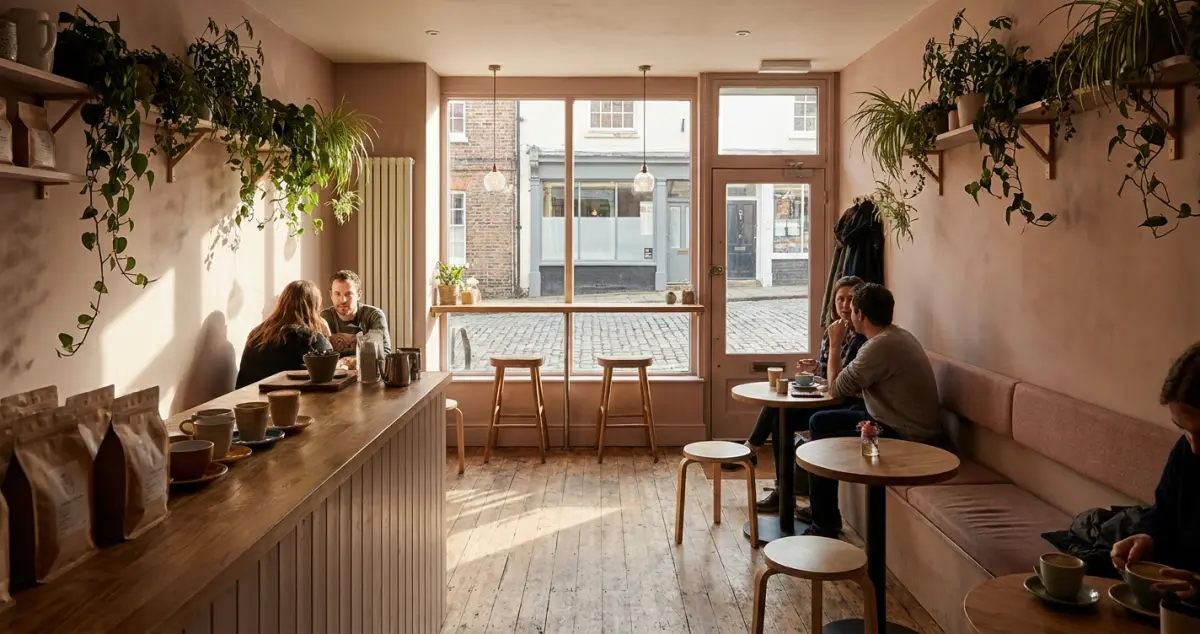
Small Cafe Interior Design Ideas for UK Cafe Owners
Small cafe interior design ideas that make a tiny unit feel bigger and busier: UK layout, seating, lighting and budget tips to fill afternoon tables.
 Business Growth
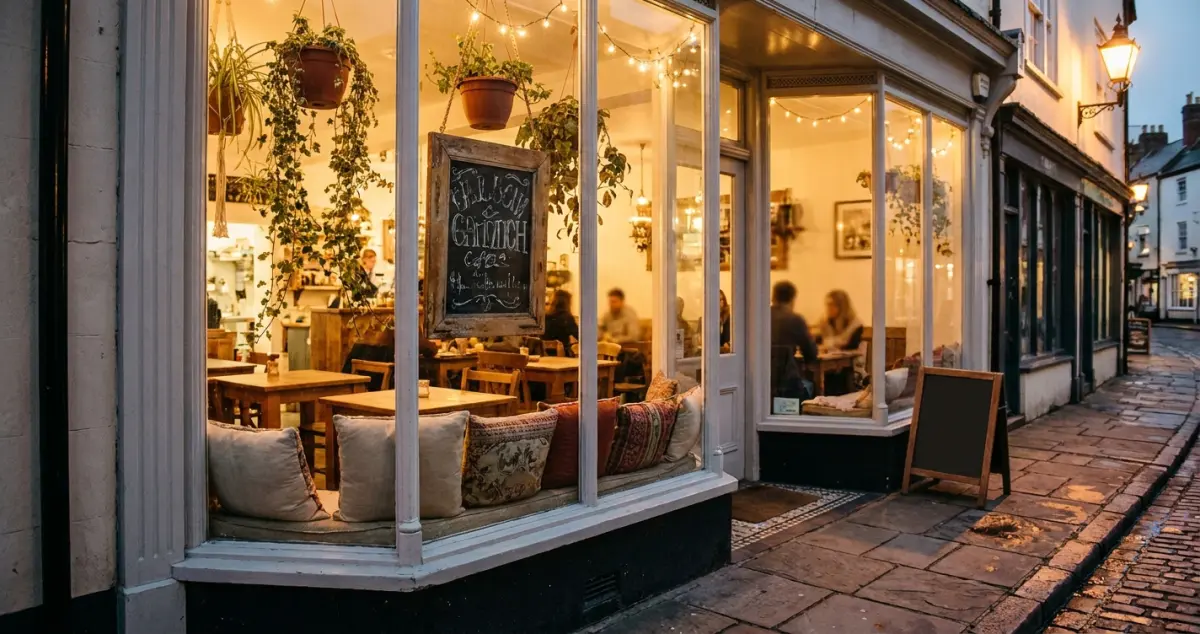
Coffee Shop Window Display Ideas: A UK Owner's Guide
Coffee shop window display ideas that turn passers-by into customers: a UK owner's guide to seasonal displays, signage, lighting and budget DIY ideas.
 Business Growth
Coffee Shop Seating Ideas: A UK Cafe Owner's Guide
Coffee shop seating ideas that add covers and keep customers longer: a UK owner's guide to seating types, layout, comfort and outdoor space.