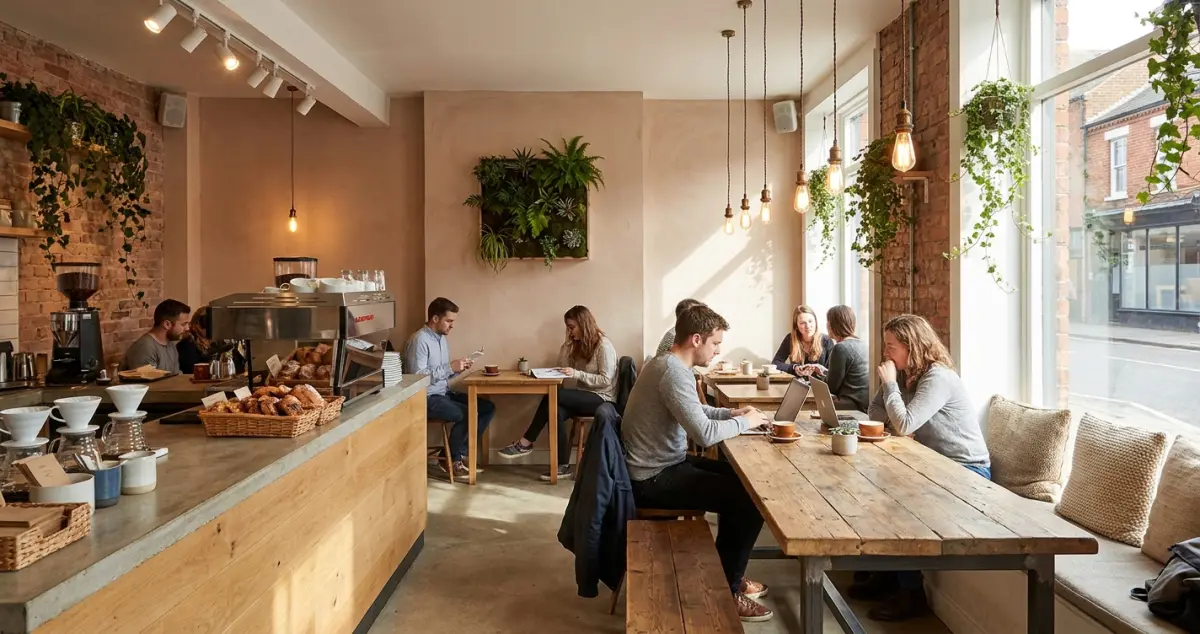
Coffee shop interior design that fills quiet afternoons: a UK cafe owner's guide to layout, seating, lighting, ambience and budget ideas.
Coffee shop interior design is the deliberate shaping of a cafe's layout, seating, lighting, materials and acoustics so the space guides how people behave: how long they stay, how often they come back, and whether they photograph it. Done well, it turns a morning-rush stop into an all-day neighbourhood destination.
You're standing in an empty unit, lease in hand, trying to picture where the counter goes. It's exciting and slightly terrifying. With more than 28,000 coffee outlets now competing across the UK (Allegra World Coffee Portal, 2025), the way your space feels has stopped being decoration. It's how you compete. 10 min read.
What You'll Learn
- What coffee shop interior design actually controls, and why it's a business lever, not a paint choice
- The 3-5-7 rule and the seven design basics, explained for a real cafe
- A step-by-step way to design your layout, lighting and ambience
- How to get a warm, photogenic space on a small budget
- The common cafe design mistakes that quietly cost you afternoon trade
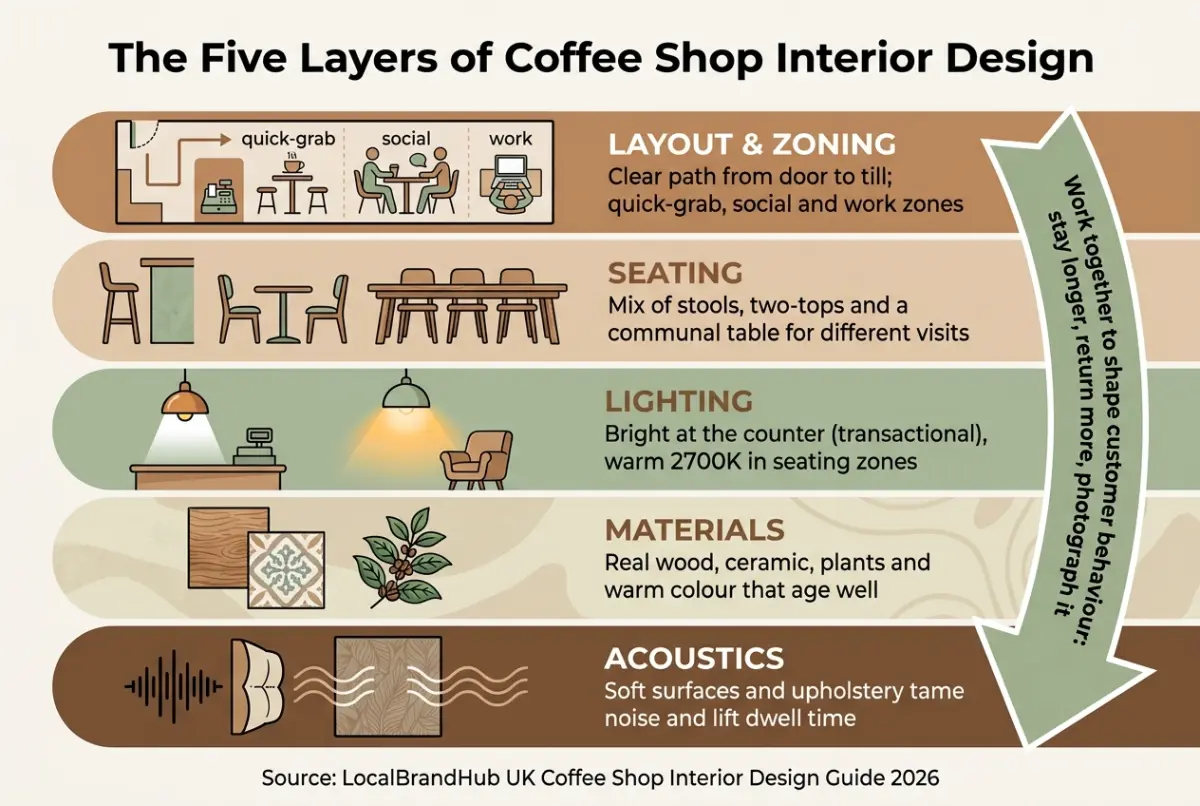
Table of Contents
- What Coffee Shop Interior Design Really Controls
- What Is the 3-5-7 Rule in Interior Design?
- The 7 Basics of Cafe Interior Design
- How to Design Your Cafe Interior, Step by Step
- How to Create Coffee Shop Ambience
- Coffee Shop Interior Design on a Budget
- Common Cafe Design Mistakes to Avoid
- Frequently Asked Questions
- Your Next Step
- Key Takeaways
What Coffee Shop Interior Design Really Controls
Coffee shop interior design is a system of five layers (layout and zoning, seating, lighting, materials, and acoustics) that work together to shape customer behaviour. It isn't about looking expensive. It's about making people comfortable enough to stay, and making the space distinctive enough that they remember it.
Related: How to Start a Coffee Shop
Think about your own day. The morning rush mostly wants speed and a clear path to the till. The quiet afternoon wants a corner, a plug socket, and a reason to order a second flat white. A space designed only for one of those moments leaves the other empty. For example, a cafe in Leeds that fills 20-plus covers at 8am but echoes by 2pm usually has a layout problem, not a coffee problem: every table sits in one open, noisy zone with nowhere to settle.
Here's the part most owners miss. Good coffee shop interior design isn't about impressing other designers. It's about giving regulars a reason to stay and strangers a reason to stop.
It's the cheapest marketing you'll ever buy. It works every hour you're open, on every customer, without a single post going out.
What Is the 3-5-7 Rule in Interior Design?
The 3-5-7 rule is a styling principle that says objects arranged in odd-numbered groups (threes, fives or sevens) look more natural and balanced than even-numbered ones. Our eyes read odd groupings as relaxed and deliberate, and even ones as stiff or showroom-like.
Quick version: group your décor in odd numbers (3, 5 or 7) and never in tidy matching pairs.
First, the practical version for a cafe. Group your shelf styling, your plants, and your wall art in odd numbers rather than tidy pairs:
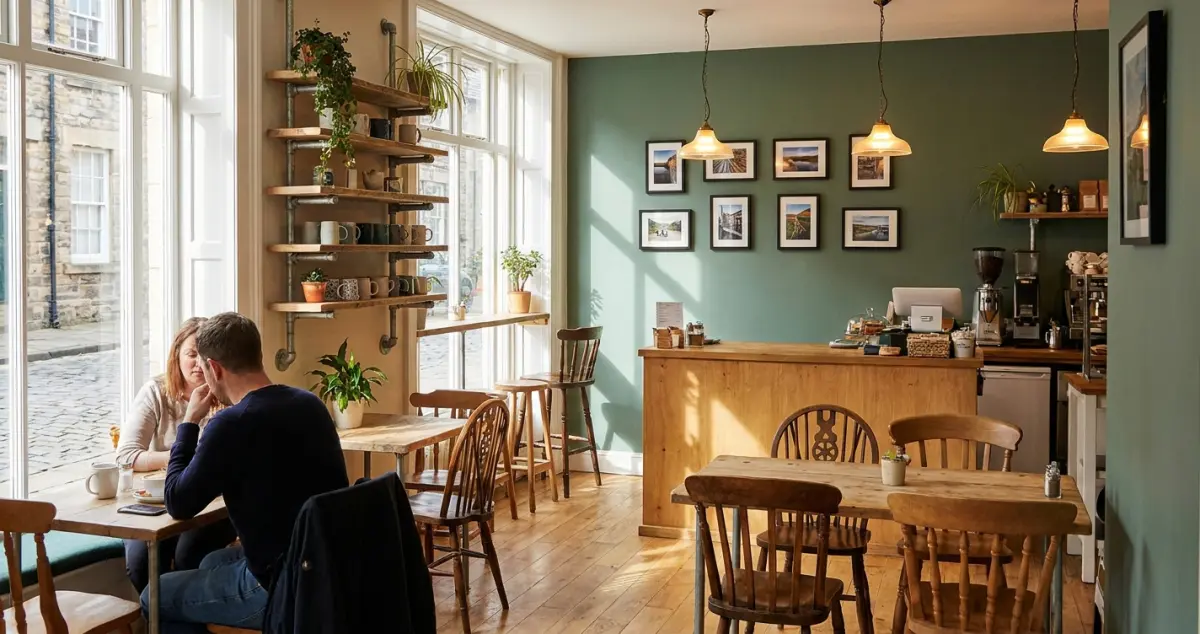
- Three pendant lights over the counter
- Five framed prints climbing a wall
- A cluster of seven trailing plants by the window
Here's what that looks like in practice: instead of two matching planters either side of the door, you set three different heights together, and the corner instantly feels styled rather than catalogue-ordered.
It's a small rule. But it's the kind of detail that makes regulars say your place "just feels nice" without knowing why. In coffee shop interior design, three or four of these tiny, deliberate choices compound into the difference between a unit that looks thrown together and one that looks designed, at no extra cost.
The 7 Basics of Cafe Interior Design
Next, the fundamentals. Interior design has seven classic elements, and every one of them shows up in a cafe whether you plan it or not. The question is whether you're directing them or leaving them to chance.
| Element | What it means in a cafe | Quick win |
|---|---|---|
| Space | How people move and where they pause | Keep a clear path from door to till |
| Line | Counters, shelves, bench edges | Use horizontal lines to feel calm |
| Form | The shape of furniture and fittings | Mix curved and square for warmth |
| Light | Natural and artificial layers | Bright at the till, soft in seating |
| Colour | Walls, wood, branding | One warm base, one accent |
| Texture | Wood, ceramic, fabric, plant | Add soft texture to hard rooms |
| Pattern | Tiles, prints, signage | One feature, not five competing |
Rule of thumb only: the quick wins above are a starting point, not fixed rules: adapt them to your unit and your customers.
For example, an espresso bar in a narrow Victorian unit barely 3 metres wide can feel cramped or cosy depending entirely on line and light: long horizontal shelving and a single bright counter zone make the same footprint read as intentional rather than tight. Master these seven elements of cafe interior design and you've covered most of what an agency would charge you four figures to tell you.
How to Design Your Cafe Interior, Step by Step
Now that you know the principles, here's the order to actually do them in. Work top to bottom: get the big decisions right before you spend a penny on the pretty ones.
- Map the journey first. Walk the route a customer takes from door to till to table. Remove anything that blocks it.
- Zone the room. Carve out a quick-grab area near the counter, a social middle, and a quieter work edge.
- Place seating for the zones, not evenly. A mix of stools, two-tops and a communal table serves different visits: our coffee shop seating ideas cover layouts that work.
- Layer the lighting. Bright and functional where money changes hands; warm and low where people linger.
- Choose materials that age well. Real wood, ceramic and plants forgive daily wear better than gloss.
- Tame the noise. Soft surfaces, rugs and upholstery stop a busy room turning into a headache.
- Add the personality last: art, signage and styling, grouped in odd numbers.
For example, a 30-cover cafe in Bristol that reordered its plan this way (counter journey first, zoning second) turned a dead back corner into its most-booked work nook simply by adding plug sockets, a bench and a softer light. Nothing was knocked down. The layout just started earning.
How to Create Coffee Shop Ambience
Here's where the layers come together. Ambience is the feeling a customer can't quite name but decides on within seconds of walking in. It comes from lighting temperature, sound, scent and comfort working in the same direction.
If you can't tell whether your own space feels warm or sterile, sit in it alone at 3pm and notice what you notice: the buzz of an over-bright bulb, a draught by the door, a table that wobbles. That's usually a sign your customers feel it too, even if they never mention it.
A few reliable moves build atmosphere fast:
- Lighting: warm bulbs around 2700K instead of cold 5000K white
- Sound: music kept low, roughly 60-70 decibels, so two people can talk without leaning in
- Scent: one signature smell that isn't cleaning spray
- Comfort: seating with backs and a bit of give, not just stools
For example, a cafe that swapped 6 harsh ceiling panels for warm pendants and a couple of table lamps found regulars lingering longer over a second coffee: the room finally felt like somewhere to stay, not somewhere to leave. That is coffee shop interior design doing its quietest, most profitable work.
Related: Barista Training: A UK Guide: great service is part of the atmosphere customers feel.
Coffee Shop Interior Design on a Budget
Let's be honest about money. Most independent owners are designing with whatever's left after the espresso machine, and that's fine: atmosphere isn't something you can simply buy by spending more. Some of the warmest, most-loved cafes around were fitted out on a shoestring of a few hundred pounds.
If you only pick one thing to spend on, make it lighting. It changes a room more than any other pound you'll part with, and warm bulbs cost the same as cold ones, often under £5 each. After that, work in this order:
- Paint: a warm base colour transforms a tired unit for under £100.
- Plants: soften hard corners and clean the air for very little.
- Secondhand and reclaimed furniture: mismatched-but-curated beats flat-pack-but-uniform.
- One feature wall: a mural, tiles or shelving, not five competing patterns.
Budget coffee shop interior design works when every choice points the same way: a small cafe can look genuinely considered for a few hundred pounds. For more on this, see our guide to low budget cafe interior design and ideas for small cafe interior design.
Common Cafe Design Mistakes to Avoid
However, knowing what to avoid matters as much as knowing what to buy. Most cafe design problems aren't about taste. They're about designing for a photo instead of a person, and they cluster around the same 4 traps.
The biggest mistake is chasing a trend that doesn't fit your unit or your customers. If you're only designing for what looks good on Instagram you'll always lose to owners who design for how people actually sit, queue and work. A wall of neon means nothing if there's nowhere comfortable to put a laptop, and a 3-second photo never paid a month's rent.
Watch for these traps:
- All-hard surfaces. Beautiful in photos, deafening by 11am, empty by noon.
- One lighting temperature everywhere. It flattens the room and kills the cosy corners.
- Furniture that blocks the journey. A clever table is worthless if it jams the queue.
- Five feature ideas at once. Pick one hero element; let the rest stay calm.
The question isn't whether your cafe photographs well. It's whether people want to stay once the photo is taken.
If you're reading this thinking your space already has two or three of these, you're not alone: almost every cafe does at first. The fix is rarely a refit. It's usually subtraction.
Related: Coffee Shop Loyalty Programs That Work: a space people love is the first step to getting them back.
Frequently Asked Questions
How much does it cost to design a coffee shop interior?
It varies enormously, from a few hundred pounds for a paint-and-lighting refresh to five figures for a full fit-out with a designer. The good news: lighting, paint, plants and layout changes deliver most of the visible improvement for the least money.
What is the best layout for a small cafe?
There's no single best layout, but a reliable approach is to keep a clear path from door to till, push seating to the edges, and use a mix of stools and small tables rather than one repeated type. A communal table can add 6-8 covers without crowding the room.
How do I make my cafe more Instagrammable without it feeling fake?
Build one genuine feature people want to photograph (a mural, a plant wall, or an eye-catching window display) and make sure the everyday experience around it is comfortable. For example, a corner banquette under a mural gives people a reason to photograph the space and a comfortable reason to stay in it.
What colours work best in a coffee shop?
One warm, neutral base (soft white, clay, sage or warm grey) with a single accent that matches your branding. Warm tones make a space feel inviting; too many competing colours make it feel restless.
Your Next Step: A Weekly Design Habit
Great spaces aren't designed once. They're tuned, week by week, as you watch how people actually use the room.
If you only have 30 minutes a week, do this:
- Day 1-2: Sit in your own cafe as a customer at your quietest hour and write down three things that feel off.
- Day 3-4: Fix the cheapest one: a bulb, a wobbly table, a blocked path.
- Day 5-7: Photograph the change and ask two regulars what they think.
That's enough. You don't need a refit or a designer on retainer: consistency beats a one-off blowout every time. For example, fixing one cold bulb and clearing one blocked walkway can change how a whole room feels by the weekend.
Weekly Action
Work this coffee shop interior design checklist once a week:
- Walk the customer journey from door to till
- Check every light is warm and working
- Clear one thing that blocks movement
- Group one styling cluster in odd numbers
- Ask a regular how the space feels
Ask yourself: would you walk past your own shop and choose to come in over the cafe next door? If the honest answer is "not sure," that's where your design work starts.
Getting consistent footfall from a great space still takes consistent marketing around it, and that's exactly the kind of weekly, done-for-you work LocalBrandHub handles for independent cafes, so the room you've designed actually gets discovered. If you're weighing the cost against a tight fit-out budget, you can compare the plans for a small cafe in a couple of minutes.
If you run a coffee shop and want to see how Local Brand Hub can support your marketing, explore our coffee shop marketing tools.
For restaurants, salons, and local businesses
Need help with your marketing?
We help UK businesses turn social media into real results, not busywork.
Start freeKey Takeaway
Key Takeaways: Coffee Shop Interior Design
Strong coffee shop interior design is a business lever, not a decorating exercise. Get the layers working together and the space earns its rent in every quiet hour.
- Design five layers, not a look: layout, seating, lighting, materials and acoustics.
- Use the 3-5-7 rule and the seven design basics to make choices feel deliberate.
- Spend on lighting first: it's the cheapest way to change how a room feels.
- Design for how people sit and work, not just how the space photographs.
- Tune it weekly: small, consistent changes beat one expensive refit.
Get More Marketing Tips
Practical marketing tips for UK business owners, straight to your inbox. No spam, unsubscribe anytime.
About the Author
Local Brand Hub
Empowering UK Businesses
Local Brand Hub provides comprehensive business management tools designed specifically for UK local businesses to streamline operations, automate marketing, and grow revenue.
More articlesRelated Articles
 Business Growth
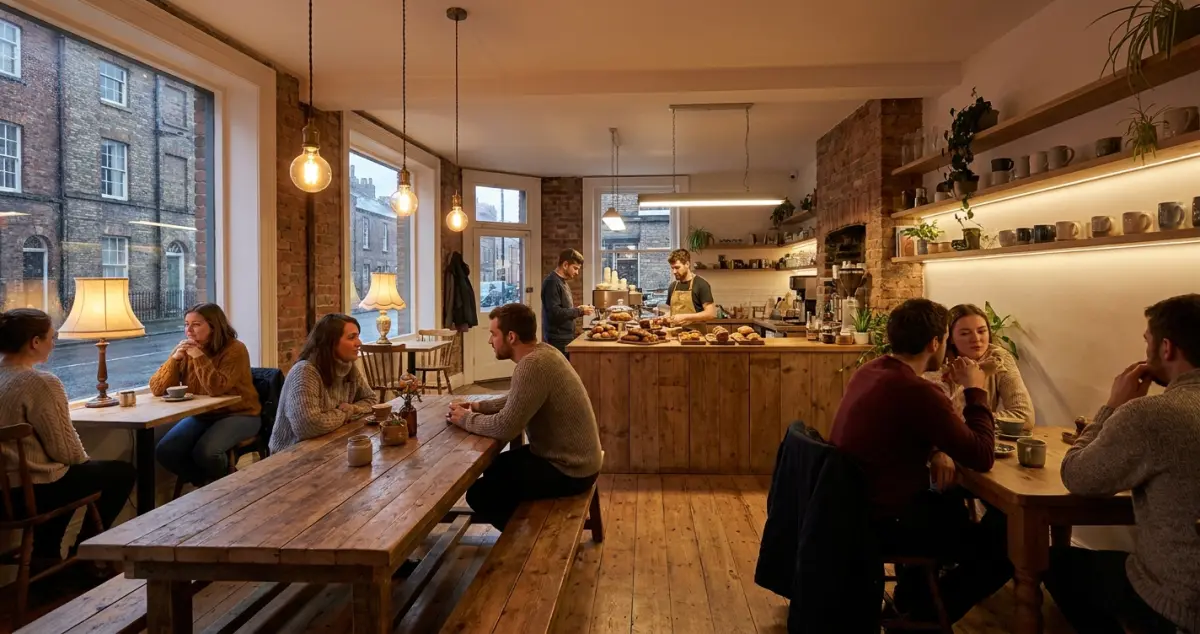
Coffee Shop Lighting Ideas: A UK Cafe Owner's Guide
Coffee shop lighting ideas that make a cafe feel warm and photograph beautifully: a UK owner's guide to layers, colour temperature and budget fixtures.
 Business Growth
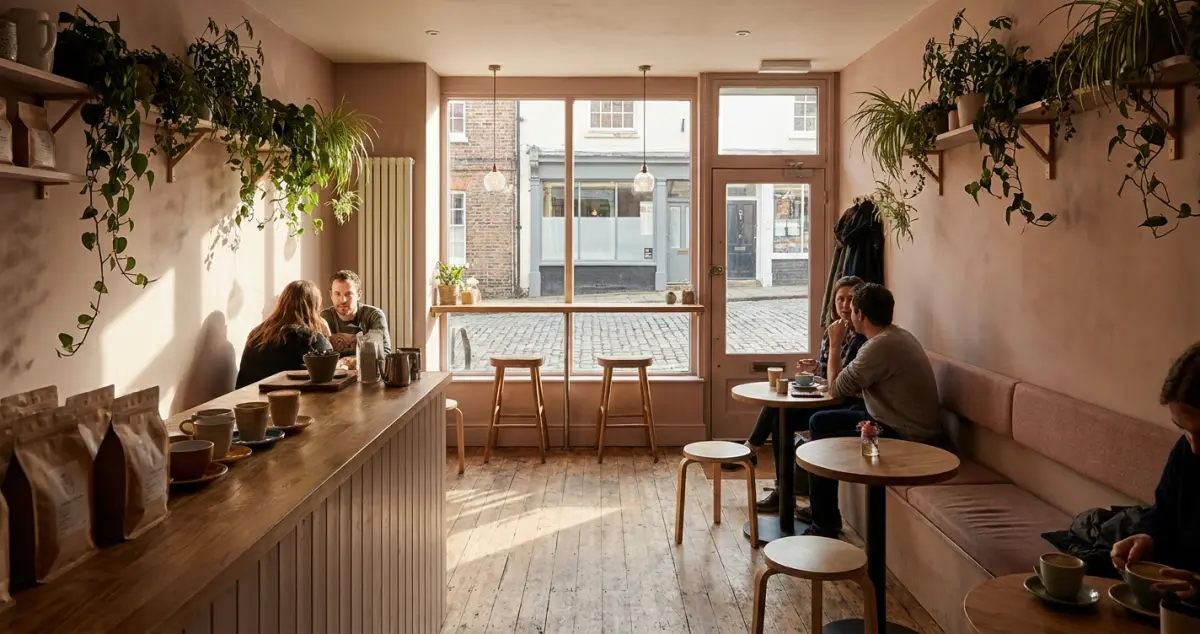
Small Cafe Interior Design Ideas for UK Cafe Owners
Small cafe interior design ideas that make a tiny unit feel bigger and busier: UK layout, seating, lighting and budget tips to fill afternoon tables.
 Business Growth
Low Budget Cafe Interior Design: A UK Owner's Guide
Low budget cafe interior design that looks anything but cheap: a UK owner's guide to decorating your cafe for a few hundred pounds, in priority order.