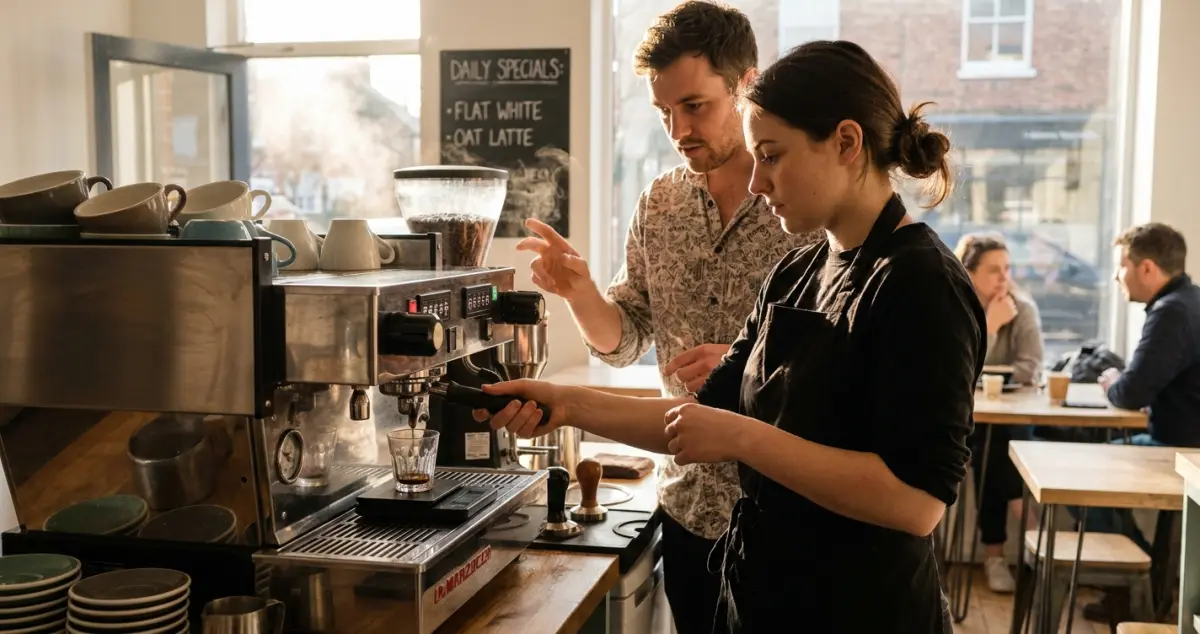
Barista training in the UK: Foundation to Professional levels explained, what good courses cost, where to find them, and how to train cafe staff.
Barista training is the structured development of espresso, milk-steaming, brewing and customer-service skills: covered by globally-recognised levels (Foundation, Intermediate and Professional) plus UK alternatives like apprenticeships and provider-specific courses. Training matters because consistent drinks make regulars, and regulars are what keeps an independent cafe alive.
You've watched a barista pour a wonky flat white and lost a customer in real time. Or maybe you're the barista, and you know the drinks you're making aren't quite what they should be. The honest question isn't whether to invest in training. It's which level, which provider, and whether to send your team away or train them in-house.
This guide walks through every UK training route, from a free Saturday afternoon on YouTube to a multi-week SCA Professional course, so you can pick the route that fits your shop, your team and your budget. 14 min read.
What You'll Learn
This guide is structured for the cafe owner staring at a rota with an inconsistent team, or the barista trying to decide where to invest their own development time. It's been built around the realities UK independents report year after year: early starts, regulars who notice when the milk is wrong, and the cost pressure that makes every training pound count.
By the end you'll know:
- The three internationally-recognised training levels and what each one teaches
- UK provider options including SCA, City & Guilds, apprenticeships and online courses
- Realistic costs and time investments for each pathway
- How to train your own coffee shop staff without sending them away
- Which level fits which kind of operator (brand-new starter, experienced barista, owner-trainer)
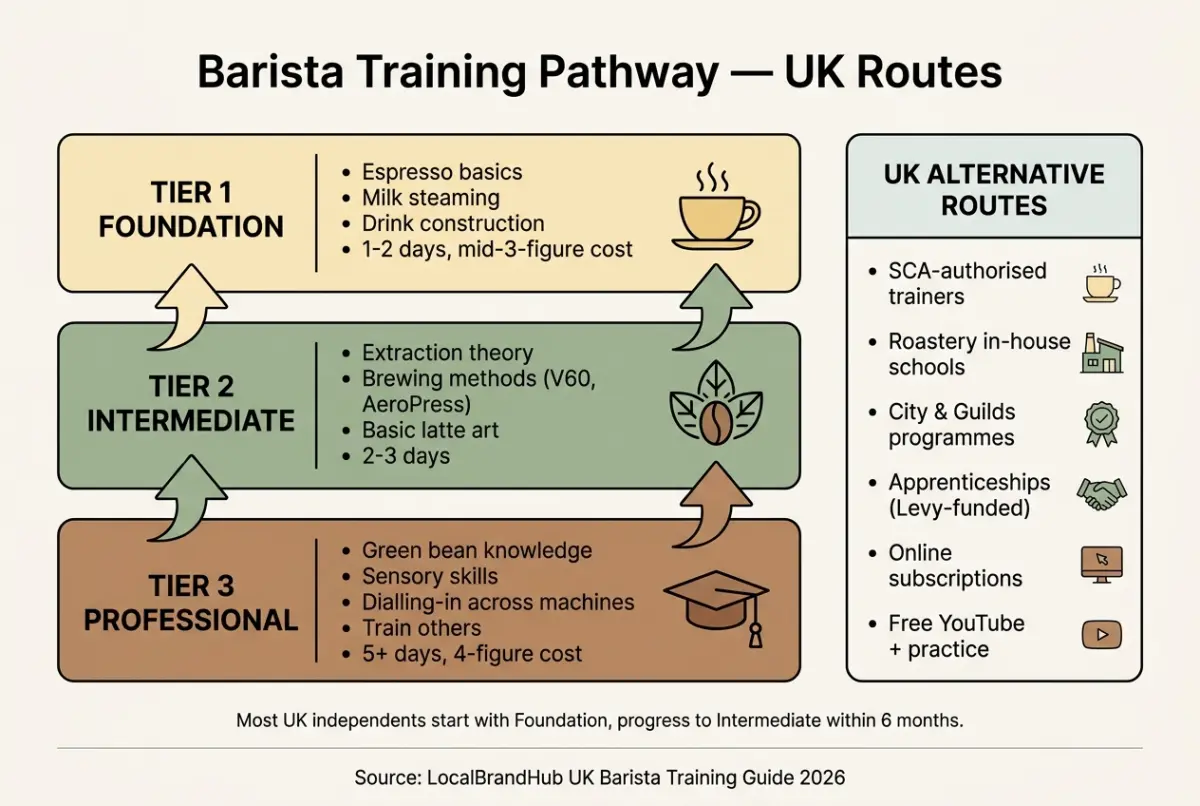
Table of Contents
- What Is Barista Training?
- The Three Levels: Foundation, Intermediate, Professional
- UK Barista Training Providers
- How Much Does Barista Training Cost?
- Online vs In-Person Training
- Training Your Own Coffee Shop Staff
- Apprenticeships & Free Routes
- Common Barista Training Mistakes
- FAQs About Barista Training
- Key Takeaways
What Is Barista Training?
It's a framework that builds four core skills. These are espresso extraction, milk steaming, brewing methods, and customer-facing service. The Speciality Coffee Association (SCA) sets the global benchmark with three structured levels. UK alternatives include City & Guilds and apprenticeship programmes.
Related: How to Start a Coffee Shop
The UK has more than 28,000 coffee outlets (Allegra World Coffee Portal, 2025). Speciality cafes keep growing as a share of that. Inconsistent drinks are the most-cited reason regulars stop coming back. That makes it a high-leverage investment. It's also one of the most-skipped, because it feels less urgent than rent. Those same consistent drinks earn the reviews and word of mouth that bring new customers in, so it is worth keeping your local SEO and reviews working just as hard.
For example, an independent owner in Bristol might find that one inconsistent barista costs three regulars in a fortnight, far more than the cost of an SCA Foundation course would have been.
From experience: Training isn't a course you take. It's a habit you build. The real result of a course is the muscle memory and the vocabulary. The hands-on practice has to keep going at the espresso machine in your shop.
The Three Levels: Foundation, Intermediate, Professional
Now that the basics are framed, the next thing to know is that the training comes in three structured tiers. The SCA pathway is the global benchmark, and most other UK providers map roughly onto these levels.
Foundation Level
Foundation is the entry point. It covers basic espresso extraction, milk steaming and drink construction (the standard set of flat white, cappuccino, latte and americano) alongside barista hygiene basics. Typical length is a single intensive day or two half-days.
For example, a brand-new hire on day one of a job in a Manchester cafe might come in with no industry experience and complete an SCA Foundation course in a single Saturday, enough to start pulling consistent shots by the following Monday.
Intermediate Level
Intermediate adds depth. It covers extraction theory, water variables, grind settings, and brewing methods beyond espresso (V60, AeroPress, batch brew), plus basic latte art. Typical length is two to three days.
This is the level most working baristas reach within their first six months in a shop. It's where the difference between "making a coffee" and "making a flat white worth £3.40" becomes visible.
Professional Level
Professional is for senior baristas, head baristas and trainers. It covers green-bean knowledge, sensory skills, dialling-in across multiple machines, advanced latte art, and the ability to train others. Typical length is a week or more, with assessment.
Why this matters: Most cafes only need a Foundation-level barista on opening day, but every shop benefits from at least one Intermediate-level person on shift. Professional is rarely required day-to-day but transforms how a shop dials in espresso.
UK Barista Training Providers
Now that the levels are clear, the next question is who delivers them. The UK training landscape splits into four broad provider types.
The Four UK Provider Types
Related: Barista Training UK Provider Guide
| Provider Type | What They Offer | Typical Cost |
|---|---|---|
| SCA-authorised trainers | Foundation/Intermediate/Professional certified courses | Mid-three-figure to four-figure per level |
| Roastery in-house schools | Brand-aligned training (Workshop, Square Mile, Origin) | Low-three-figure to mid-three-figure per day |
| City & Guilds providers | Hospitality-aligned training including barista skills | Variable; often subsidised |
| Online platforms | Self-paced theory plus video demos | Sub-three-figure to mid-three-figure |
Cost ranges and course lengths are typical for UK independent operators in 2026; your numbers will vary by city and provider.
For example, a head barista in Edinburgh might do a single-day SCA Foundation through a roastery's in-house school, then progress to Intermediate via a separate weekend course six months later, total spend a low four-figure sum.
Why this matters: The trainer's reputation matters as much as the certification. A team that respects the trainer learns faster and retains more.
If you're only choosing a provider on price alone you'll always lose to operators who picked one their team actually wants to learn from. That never works as a procurement decision in hospitality. Training works when the trainer is someone the team trusts.
How Much Does Barista Training Cost?
Now that provider types are covered, the next question is what each route costs. Those costs depend on the level, provider type and whether you're sending one person or training a whole team.
Per-Person Cost Ranges
- Foundation course (SCA-authorised): mid-three-figure sum for a single day
- Intermediate course: mid-to-high-three-figure sum, typically two to three days
- Professional course: four-figure sum, typically a week with assessment
- Roastery in-house day: low-to-mid-three-figure sum, often subsidised by the roastery's bean account
- Online subscription: sub-three-figure annual fee for self-paced programmes
- Apprenticeship route: typically free to the trainee, employer-funded via Apprenticeship Levy
For example, a small UK independent might budget a low four-figure sum to put two new hires through Foundation and the head barista through Intermediate, all within the first three months of opening.
What Drives the Cost
- Hands-on time with a real commercial espresso machine: the bigger this is, the more the course costs
- Group size: small groups cost more per head but learn faster
- Trainer credentials: SCA Authorised Trainers (ASTs) charge a premium because the certification is internationally portable
- Equipment included: some courses give you take-home tools and reference cards
From experience: Cheaper courses aren't always worse. A small, focused day with a roastery's head trainer can outclass a generic SCA Foundation if the roastery aligns with your bean choice anyway.
Online vs In-Person Training
Now that cost is in view, the next decision is format. Both online and in-person have a place in a modern training plan.
The Format Trade-Offs
Related: Online Barista Training Guide
| Aspect | Online | In-Person |
|---|---|---|
| Best for | Theory, vocabulary, palette training | Hands-on espresso, milk technique |
| Cost | Sub-three-figure to mid-three-figure | Low-three-figure per day to four-figure per course |
| Time flexibility | Self-paced | Fixed dates |
| Equipment access | None | Real commercial machines |
| Certification | Some platforms offer SCA online theory module | Many levels require in-person assessment |
If you pick just one format for a brand-new hire, in-person Foundation training is often the strongest choice: the muscle memory only comes from real machine time. Online theory makes a strong supplement once the hands know what they're doing.
Worked example: A Liverpool independent might pair an online SCA theory subscription (sub-three-figure annual cost across the team) with one in-person Foundation day per new hire, covering both the vocabulary and the hands-on practice.
Training Your Own Coffee Shop Staff
Now that format and cost are decided, here's a third route: skip external courses entirely and run training in-house. You don't have to send everyone away. Many UK independents build internal training programmes that develop staff faster than external courses can.
Build an In-House Training Day
Most owners can structure a credible internal programme around four core sessions:
- Session 1: Espresso extraction: grind, dose, tamp, shot timing, calibration
- Session 2: Milk steaming: temperature targets, texture, micro-foam, jugs
- Session 3: Drink builds: flat white, latte, cappuccino, americano, mocha
- Session 4: Service flow: order taking, queue management, latte art at speed
Each session runs 90 minutes to two hours and ends with the trainee making and serving real drinks under observation. Most independents run all four sessions across two quiet afternoon shifts in the first two weeks.
When In-House Isn't Enough
If you can't tell whether your in-house training is producing consistent drinks or just drinks that look right that's usually a sign the trainee needs an external assessment, typically an SCA Foundation. The external course gives them a benchmark and gives you confidence in the muscle memory.
For example, a small London cafe might run their own four-session in-house training for every new hire, then send the keepers (anyone who's still there at month three) to an external Foundation course as a small reward and skills audit.
Worked example: A 30-cover independent in Sheffield trained five new baristas through their in-house programme over a year, sent two to external Foundation courses, and saw their morning rush queue speed up by 40 seconds per drink, measurable on the till receipts.
Apprenticeships & Free Routes
Now that paid and in-house options are on the table, here's a fourth route worth considering. So paid training is the default, but there are real alternatives. Apprenticeships and free options can deliver Foundation-level skills at zero or near-zero cost.
Related: Free Barista Training Options
Apprenticeships
If you only have 30 minutes a week to invest in training, the apprenticeship application is the highest-leverage place to spend it. The UK Apprenticeship Levy funds hospitality apprenticeships including barista skills. For an independent paying into the Levy, this is essentially pre-funded training. For smaller employers, government co-funding covers most of the cost (gov.uk apprenticeship guidance).
Want to be paid while you learn? Plenty of UK employers fund barista training as part of the job rather than expecting you to arrive qualified: major chains run their own academies, roastery-owned cafes train on their own equipment, and hospitality groups put staff through SCA levels. The official gov.uk apprenticeship search lists hospitality apprenticeship vacancies, and when interviewing anywhere else, ask directly what structured training is included in the first three months; a vague answer is itself an answer.
Free Online Resources
YouTube channels run by SCA trainers, roasteries (Workshop Coffee, Square Mile) and individual baristas cover everything from grind theory to advanced latte art for free. The limitation is hands-on practice, but for theory and reference, free resources match or beat paid courses.
Library and Community Routes
Some UK colleges run heavily-subsidised hospitality training that includes barista skills, particularly in cities with strong cafe cultures (Bristol, Manchester, Brighton).
Common Barista Training Mistakes
Now that you've seen the routes, here's what tends to go wrong. The same handful of mistakes appear in most failed training programmes. Knowing them in advance is most of the cure.
- Sending one person, training nobody else: leaves a knowledge silo that breaks when that person calls in sick
- Choosing a course unrelated to your bean supplier: the dial-in advice may not apply to your machine and beans
- Skipping Foundation in favour of Intermediate: Intermediate assumes muscle memory the trainee doesn't have
- No follow-up practice after the course: skills decay within weeks if not used at the espresso machine daily
- Training only on opening day, never again: barista skills drift; refresh quarterly
The Quick Pre-Investment Checklist
Before booking any external course:
- Have you matched the course to your actual bean supplier and machine?
- Have you decided who's covering shifts while the trainee is away?
- Have you scheduled in-shop practice time for the week after the course?
- Have you planned a refresher in three months?
Why this matters: Training is an investment in muscle memory, not a certificate. A barista who came back from an SCA Foundation but never practised the milk technique is no better than one who didn't go. The course is the start of the work, not the end.
Frequently Asked Questions About Barista Training
Now that the workflow and mistakes are covered, here are the questions UK independents ask most often.
How long does it take to become a competent UK barista? Most UK baristas reach a competent service standard within six to eight weeks of working on a real espresso bar daily. Foundation training accelerates the first two weeks but the muscle memory only develops with shop hours. Without daily practice, even a Foundation graduate takes longer.
Do you need a qualification to work as a UK barista? No formal qualification is required to work as a barista in the UK. Many cafes train in-house from day one. However, SCA Foundation or an apprenticeship makes finding a job in a speciality cafe much easier: most independents prefer hires who already know the vocabulary.
Is SCA training worth the money for an independent cafe? For most UK independents, putting at least one team member through SCA Foundation typically pays back within the first quarter: through faster shifts, fewer wasted shots, and the credibility of a certified barista on the menu. Professional level only pays back if you're a head barista or trainer.
How do UK barista courses compare to certifications elsewhere? SCA certifications are globally recognised and portable, which matters if your team includes baristas trained in other countries. UK-specific routes like City & Guilds are equally credible domestically but don't carry the same international weight.
What's the most overlooked part of the training? Sensory training: actually tasting and describing coffee. Most Foundation courses cover it briefly, but it's the skill that separates a fast barista from a great one. Free SCA resources and individual cupping practice fill the gap.
How often should I refresh my team's skills? For most independents, a quarterly refresher works well: typically a 90-minute internal session focused on whatever's drifting (often milk consistency or extraction times). Annual external retraining for the head barista keeps standards calibrated. For example, a Birmingham cafe might run a "milk steaming Friday" each quarter where all baristas redo basic technique.
Can I deduct staff training as a business expense? Yes, staff training is typically a deductible business expense for UK cafes registered with HMRC. Apprenticeships have additional funding through the Apprenticeship Levy. Keep receipts and certificates for your accounts.
Should I train staff before or after a fit-out is finished? Most independents train new hires once the espresso machine is installed and dialled in, but at least a week before opening day. That timing lets staff practice on the actual machine they'll use, with the bean they'll serve, before paying customers arrive.
From experience: Block training time off in the rota the moment your espresso machine arrives. Treat it as a fit-out task, not a luxury: the team needs the practice before paying customers walk in.
Key Takeaways: Barista Training
Now that we've covered levels, providers, costs, formats, in-house options, and common mistakes, here's the pull-together. If you're reading this thinking "we'll train the team later, when the rush eases," that's exactly the trap. The reality for most independent owners is that training is the difference between regulars and one-off visits.
- Three internationally-recognised levels (Foundation, Intermediate, Professional) with the SCA pathway as the global benchmark
- UK provider options include SCA-authorised trainers, roastery in-house schools, City & Guilds and online platforms
- Cost ranges from sub-three-figure online subscriptions to four-figure Professional courses
- In-house training is genuinely viable for owners with the time and discipline to run a four-session programme
- Apprenticeships and free routes can deliver Foundation-level skills at zero cost via the Apprenticeship Levy or YouTube
Would you walk into your own cafe right now, order a flat white, and feel proud of the drink that came back? If the answer is "not always", training is where to start, and the cheapest first step is often a free SCA YouTube series watched by the whole team on the same afternoon.
If you'd like a hand mapping out your training programme alongside the rest of your shop's people plan, LocalBrandHub has free templates for independent cafes, useful if you're working solo and want one place to keep the development plan together.
Weekly Action
This week, do two things to move training from "we should" to "we are":
- Day 1 to 3: Audit your current team's level: who's at Foundation standard, who's not, and where the consistency gaps appear in actual drinks served.
- Day 4 to 7: Book one external course or schedule one in-house session for the next month, and lock the date in the rota so it actually happens.
If you run a coffee shop and want to see how Local Brand Hub can support your marketing, explore our coffee shop marketing tools.
For restaurants, salons, and local businesses
Need help with your marketing?
We help UK businesses turn social media into real results, not busywork.
Start freeKey Takeaway
UK barista training follows three globally-recognised levels (Foundation, Intermediate and Professional) with the SCA pathway as the benchmark and UK alternatives via City & Guilds, roastery schools and apprenticeships. Costs range from sub-three-figure online subscriptions to four-figure Professional courses, with apprenticeships funded by the Levy and free YouTube routes for theory. The fastest route from training to a confident first job is one in-person Foundation day plus daily practice on a real espresso machine. The certificate is the start of the work, not the end.
Get More Marketing Tips
Practical marketing tips for UK business owners, straight to your inbox. No spam, unsubscribe anytime.
About the Author
Local Brand Hub
Empowering UK Businesses
Local Brand Hub provides comprehensive business management tools designed specifically for UK local businesses to streamline operations, automate marketing, and grow revenue.
More articlesRelated Articles
 Tutorials
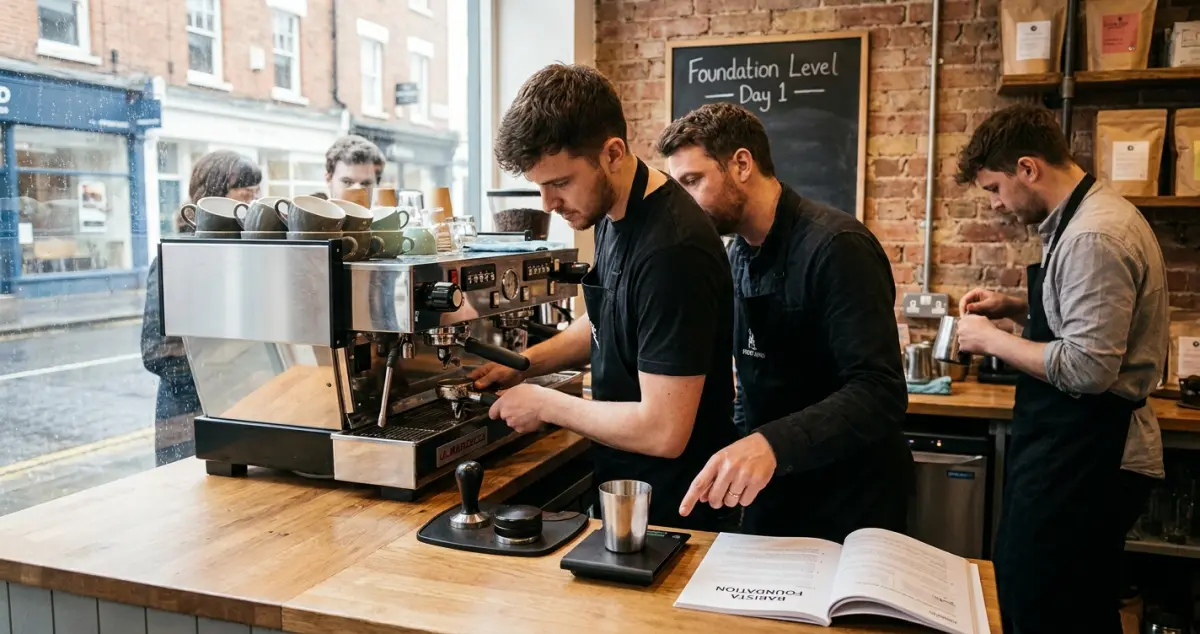
Barista Training Courses: UK Course Evaluation Guide
Barista training courses UK: how to choose a paid course by accreditation, hands-on hours, equipment, and trainer credentials, with real costs.
 Tutorials
Barista Training Free: UK Routes for Zero-Cost Learning
Barista training free options in the UK: apprenticeships, employer-funded courses, free YouTube channels and college routes that work.
 Tutorials
Online Barista Training: UK Self-Paced Learning Guide
Online barista training in the UK: what online courses can and can't teach, the best UK providers, and how to combine theory with hands-on practice.