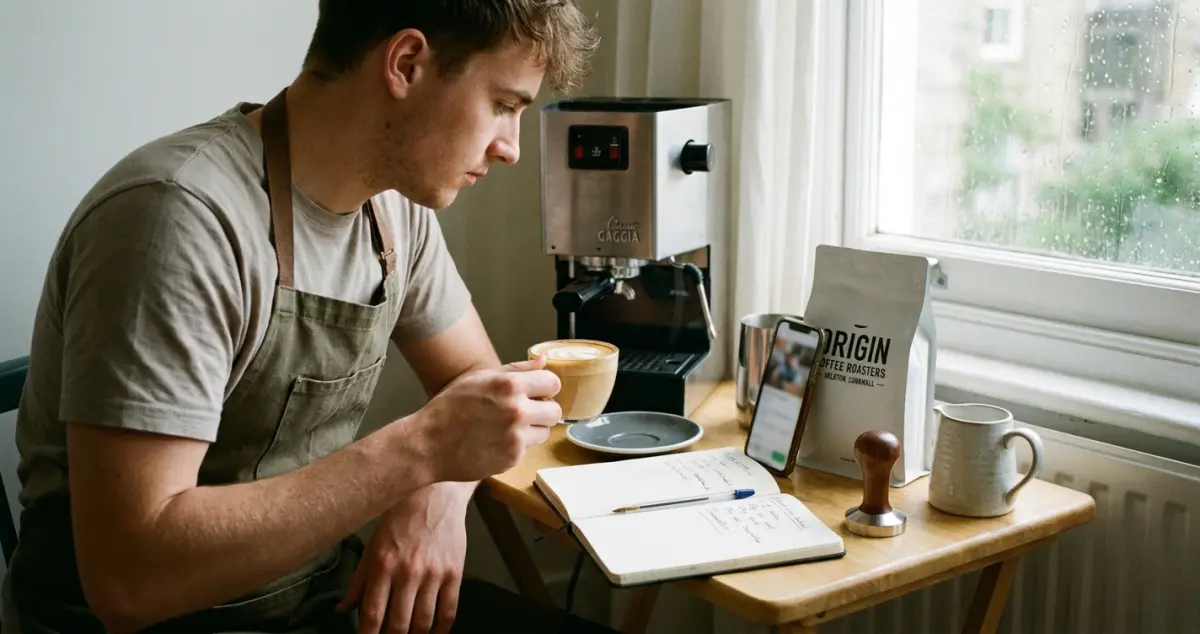
Barista training free options in the UK: apprenticeships, employer-funded courses, free YouTube channels and college routes that work.
Barista training free options in the UK include apprenticeships funded through the Apprenticeship Levy, employer-paid courses, and free YouTube channels run by speciality roasteries. The barista training free landscape also covers college hospitality programmes. None of these is "free" of time or effort. The cash cost is the part that can be zero.
You've costed up barista training and the figures aren't friendly to a small cafe budget. Or you're a working barista who can't justify a few hundred pounds for a single-day course. The honest question isn't whether free barista training is "as good" as paid. It's which free routes deliver real skill and which are marketing dressed as education.
This guide walks through the UK barista training free options that actually work. 10 min read.
What You'll Learn
This guide is structured for the cafe owner with a tight training budget and the barista who wants to develop without paying course fees. It's been built around the routes that actually deliver UK independent owners report: apprenticeships, employer schemes, and the free content that rivals paid courses.
By the end you'll know:
- The five UK routes to free or near-free barista training
- Which free YouTube channels rival paid online subscriptions
- How the Apprenticeship Levy can fund training at zero direct cost
- When free options aren't enough and you need to pay for assessment
- A weekly habit that turns free content into real skill
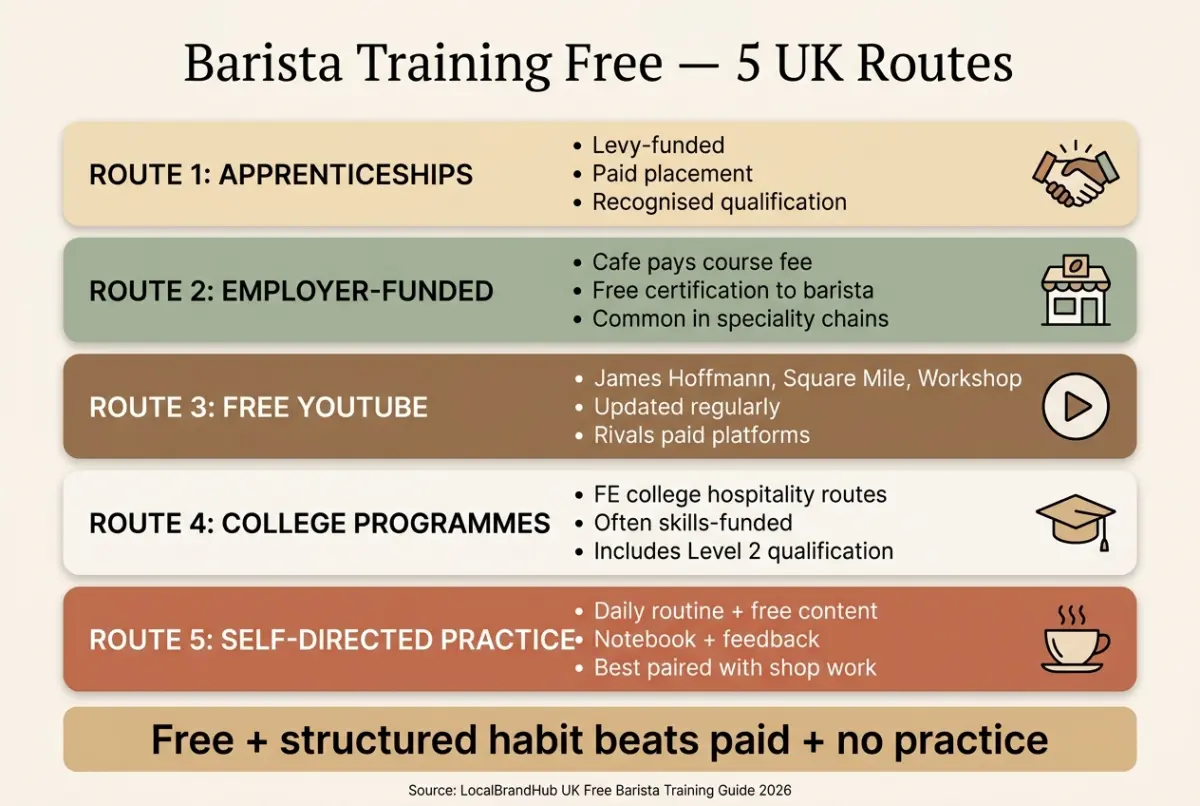
Table of Contents
- What Counts as Free Barista Training?
- Route 1: Apprenticeships
- Route 2: Employer-Funded Training
- Route 3: Free YouTube and Online Content
- Route 4: Library and College Programmes
- Route 5: Self-Directed Practice
- When Free Isn't Enough
- FAQs About Free Barista Training
- Key Takeaways
What Counts as Barista Training Free of Charge?
Barista training free of charge is a framework that delivers structured skill development at zero or near-zero cash cost. The key distinction isn't whether you pay a fee. It's whether the route is gatekept by money or only by time. Most UK options blur this line: apprenticeships pay the trainee while training; employer schemes cost the cafe but not the staff member; free YouTube costs nothing but rewards persistence.
Related: Barista Training Overview & Levels
The UK has more than 28,000 coffee outlets (Allegra World Coffee Portal, 2025), and the speciality side keeps growing. Most UK speciality roasteries publish substantial free content on YouTube, often more current than paid platforms, because publishing builds the brand and helps recruit baristas.
For example, a Newcastle independent might train new hires entirely through a structured weekly habit of free YouTube series, supplemented by in-shop practice. Total direct training cost: zero pounds across a year of new hires.
Why this matters: Free barista training isn't a poor cousin of paid courses. For many topics (extraction theory, sensory vocabulary, brewing methods), free content from speciality roasteries rivals or beats paid platforms. The catch is structure: free routes need a habit to make them stick.
Route 1: Apprenticeships
Now that the framework is in place, here's the strongest funded route. UK apprenticeships are paid placements that combine on-the-job barista work with structured learning. They end in a recognised qualification at zero direct cost to the trainee.
How Apprenticeship Funding Works
Employers paying into the UK Apprenticeship Levy can use those funds for hospitality apprenticeships including barista skills. Smaller employers (below the Levy threshold) get most of the cost co-funded by government (gov.uk apprenticeship guide).
For example, a Leeds independent paying into the Levy might fund two apprentices a year, gaining trained staff at near-zero direct training cost while the apprentices earn a wage and a qualification.
What an Apprentice Gets
- A paid placement (typically 12+ months)
- A recognised UK qualification (Level 2 or 3 hospitality)
- Mentorship from a senior barista or owner
- A clear career progression path
From experience: Apprenticeships are the most under-used route in UK barista training. Most owners assume they're complex; in practice, the application is a half-day of paperwork. Worth doing for any cafe employing more than two staff.
Route 2: Employer-Funded Training
Now that apprenticeships are covered, here's the second route. Many UK speciality cafes offer paid training as part of the employment package. The cafe pays the course fee while the barista gets the certification at zero personal cost.
Where to Find Employers That Train
- Speciality chains like Workshop Coffee, Square Mile-aligned cafes, Origin
- High-end independents in major cities (London, Manchester, Bristol, Edinburgh)
- Roastery-owned cafes that train all baristas in their own roastery school
- Hospitality groups running multiple cafes with structured training programmes
For example, a barista joining a Workshop Coffee-aligned cafe in Manchester might receive an SCA Foundation course paid in full by the employer in their first three months of work, a mid-three-figure value for zero personal outlay.
Questions to Ask in an Interview
- Does this role include any paid barista training in the first six months?
- Which roastery schools or SCA trainers does the cafe send staff to?
- Is there a training budget per barista per year?
- What's the path to a senior barista or head barista role here?
Route 3: Free YouTube and Online Content
Now that funded routes are mapped, here's the most accessible free route: structured YouTube content. UK speciality roasteries and individual baristas publish substantial training content for free, often updated monthly.
The Top UK Free Channels
- James Hoffmann: extraction theory, sensory, equipment reviews
- Square Mile Coffee Roasters: UK speciality theory and origin content
- Workshop Coffee: UK roastery training shorts and tutorials
- Lance Hedrick: brewing methods, dial-in technique
- Coffee Compass: brewing fundamentals, recipes
Together these channels cover everything from extraction yields to milk steaming to V60 technique, at a level that rivals paid online subscriptions.
For example, a Cornwall-based independent could build a 12-week training programme using only free YouTube content, allocating one James Hoffmann video weekly as homework before each shift's quiet-afternoon practice session.
If you can't tell whether a free YouTube series is delivering real skill that's usually a sign you need to pair it with structured shop practice. Watching alone never builds muscle memory.
Route 4: Library and College Programmes
Now that online options are covered, here's a route most owners overlook. Many UK colleges and adult learning centres offer subsidised hospitality programmes that include barista skills as part of broader catering qualifications.
Where to Look
- Local FE college websites: search "hospitality" or "barista" courses
- Adult learning centres in your council area
- Apprenticeship-route programmes delivered through colleges
- Skills funding for unemployed or returning workers
For example, a Sheffield-based career-changer might find that the local FE college runs a free Level 2 hospitality course that includes barista basics, eligible for skills funding because the learner is between jobs.
Worked example: A Birmingham independent might recruit two apprentices through a local college's hospitality programme, both arriving with foundational barista training at zero recruitment cost.
Route 5: Self-Directed Practice
Now that the four structured routes are clear, here's the fifth, and the one most owners forget. Self-directed practice combines free content with disciplined daily work at the espresso machine. It's the lowest-structure route, but for committed baristas it can match formal training.
The Weekly Self-Directed Habit
- Watch one free training video (15 minutes) before each shift
- Practise the technique covered during a quiet moment in the shift
- Get feedback from a senior barista or the cafe owner
- Log progress in a notebook or phone app
- Cup or taste at least one new coffee weekly
Most UK independents who follow this pattern report new hires reach competent service standard 30 to 40% faster than self-taught equivalents.
From experience: The barista who watches one free YouTube video before every shift, then practises the technique for 10 minutes during the quiet afternoon, develops faster than the one who attends a single Foundation course and never touches the theory again.
When Free Isn't Enough
Now that the five free routes are mapped, here's the honest limitation. Free barista training has gaps that paid options fill.
- Structured assessment: most free routes don't certify your skill at the end
- Globally portable certification: only SCA pathways carry international recognition
- Insurance and liability: some employers require specific certifications for senior barista roles
- Networking with other baristas: paid courses include cohort time that free routes lack
If you're only using free routes you'll always lose to baristas with at least one certified course. That never works as a long-term plan if you want senior roles or international portability.
For example, a working barista in Bristol might use only free routes for two years, then invest in a single SCA Foundation course before applying for a head barista role. The paid certification unlocks the senior pay band.
Frequently Asked Questions About Free Barista Training
Now that the routes are mapped, here are the questions UK independents and individual baristas ask most often.
Is free barista training worth doing if I want to work as a barista? Yes, free training is a strong starting point and can take you to junior barista standard. For senior roles, most UK speciality cafes prefer at least one paid certification on top.
Can I become a senior barista using only free training? For most UK speciality cafes, the answer is no. Senior roles typically expect at least an SCA Foundation. However, the route to that Foundation often runs through free content first, then the certification last.
How long does it take to learn barista skills from free YouTube content? For most learners, around 8 to 12 weeks of structured weekly viewing plus daily shop practice gets you to competent service standard. Self-taught without shop practice typically takes 6+ months.
Can my cafe employer fund my barista training even if I'm part-time? Yes, many UK independents fund part-time staff training as well as full-time. The Apprenticeship Levy can apply to part-time apprentices. Ask your employer about training budgets.
Is the SCA YouTube channel free? Yes, the Speciality Coffee Association publishes free educational content on YouTube alongside paid courses. The free content covers most theory at Foundation level. For example, a London barista might use the SCA YouTube series as primary theory before booking the paid certification day.
Does free barista training count toward an apprenticeship? Free YouTube watching doesn't count formally, but the knowledge gained makes apprenticeship coursework much easier. Most apprentices who pre-study via free content complete the qualification faster.
What's the most overlooked free barista training route? Apprenticeships. Most owners assume they're administratively complex, but the application is straightforward and the funding is substantial, for both Levy-paying employers and smaller cafes accessing co-funding.
Key Takeaways: Barista Training Free
Now that we've covered the five routes, the limitations and the path through, here's the pull-together. Free barista training in the UK is far more substantial than most owners realise: apprenticeships, employer-funded routes, free YouTube content, college programmes, and self-directed practice can deliver real skill at zero direct cost.
- Five UK routes: apprenticeships, employer-funded, free YouTube, college programmes, self-directed practice
- Apprenticeships are the most under-used: Levy-funded for larger employers, co-funded for smaller cafes
- Free YouTube content rivals paid platforms for theory and brewing methods
- The weekly habit matters more than the source: structured practice is what turns free content into real skill
- Pair free routes with one paid certification for senior roles or international portability
Would you walk into your own cafe right now and feel confident that every team member has a clear path forward, even on a tight budget? If the answer is "not quite", a free training plan for the team is one of the highest-leverage things you can build this month.
If you'd like a hand mapping out a free training programme for your team, LocalBrandHub has free templates for independent cafes, useful if you're working solo and want one place to keep the development plan together. If you want that same single home for your cafe's marketing, see how the plans compare.
Weekly Action
This week, do two things to start a free barista training programme:
- Day 1 to 3: Pick one free YouTube channel from this guide and watch one video as a team during a quiet afternoon shift.
- Day 4 to 7: Email your nearest FE college and your local apprenticeship provider to ask about hospitality programmes including barista skills.
If you run a coffee shop and want to see how Local Brand Hub can support your marketing, explore our coffee shop marketing tools.
For restaurants, salons, and local businesses
Need help with your marketing?
We help UK businesses turn social media into real results, not busywork.
Start freeKey Takeaway
Free barista training in the UK is more substantial than most owners realise. Apprenticeships, employer-funded courses, free YouTube channels from UK speciality roasteries, college hospitality programmes and self-directed practice all deliver real skill at zero direct cost. Pair any free route with one paid SCA certification when you need senior-role pay or internationally portable credentials.
Get More Marketing Tips
Practical marketing tips for UK business owners, straight to your inbox. No spam, unsubscribe anytime.
About the Author
Local Brand Hub
Empowering UK Businesses
Local Brand Hub provides comprehensive business management tools designed specifically for UK local businesses to streamline operations, automate marketing, and grow revenue.
More articlesRelated Articles
 Tutorials
Online Barista Training: UK Self-Paced Learning Guide
Online barista training in the UK: what online courses can and can't teach, the best UK providers, and how to combine theory with hands-on practice.
 Tutorials
Barista Training Courses: UK Course Evaluation Guide
Barista training courses UK: how to choose a paid course by accreditation, hands-on hours, equipment, and trainer credentials, with real costs.
 Tutorials
Barista Training: UK Levels, Costs & Provider Guide
Barista training in the UK: Foundation to Professional levels explained, what good courses cost, where to find them, and how to train cafe staff.