
Write a UK cafe business plan section by section, including financials, market analysis, and the cash flow forecast that matters most.
A business plan coffee shop owners actually use is a structured document that proves the cafe's numbers work before any cash leaves the account. It covers the executive summary, market analysis, menu and pricing, staffing, marketing strategy, and a month-by-month cash flow forecast, and is short enough to read in one sitting.
You've decided the model and signed nothing yet. Good. With more than 28,000 coffee outlets across the UK (Allegra World Coffee Portal, 2025), the cafes that survive year one almost all started with a working plan. The ones that don't tend to run out of cash in month seven. 11 min read.
What You'll Learn
- The seven sections every UK coffee shop business plan needs
- A worked example of each section with realistic UK numbers
- How to build the cash flow forecast that decides whether the cafe survives year one
- How long the plan should be (much shorter than you'd think)
- The mistakes that get business plans rejected by banks and finance providers
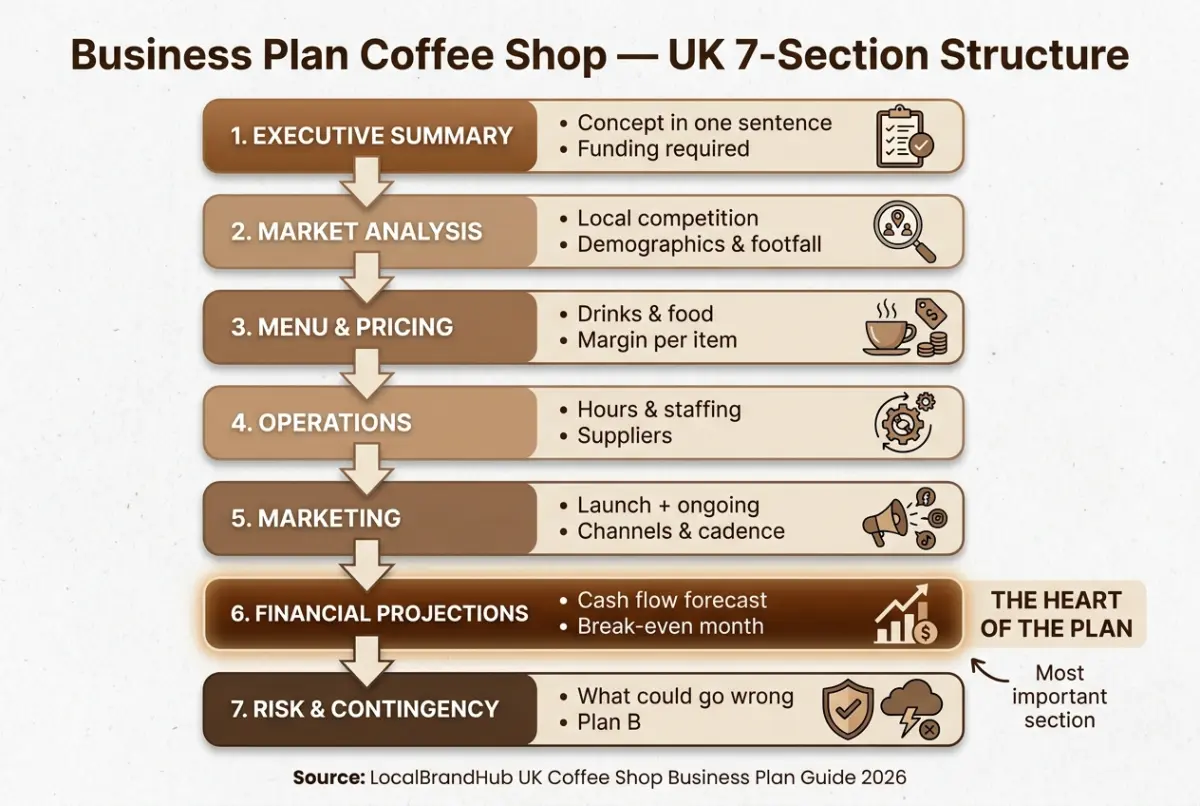
Table of Contents
- What a Business Plan Coffee Shop Owners Use Looks Like
- Section 1: Executive Summary
- Section 2: Market Analysis
- Section 3: Menu & Pricing
- Section 4: Operations Plan
- Section 5: Marketing Plan
- Section 6: Financial Projections
- Section 7: Risk & Contingency
- FAQs About Coffee Shop Business Plans
- Key Takeaways
What a Business Plan Coffee Shop Owners Use Looks Like
The business plan coffee shop framework is a seven-section document that takes most owners about two weeks of focused work. It's not a 60-page corporate document. It's a working plan that fits 10 to 15 pages, gets read end-to-end, and gets updated when reality diverges from forecast.
Related: How to Start a Coffee Shop
The UK has more than 28,000 coffee outlets (Allegra World Coffee Portal, 2025) and the Start Up Loans Company reports that completed business plans are a precondition for most UK small-business finance (gov.uk). Even self-funded launches benefit from the discipline: the plan is for you, not the bank.
| Section | Length | Purpose |
|---|---|---|
| Executive summary | ½ page | What you do, who you serve, why now |
| Market analysis | 1-2 pages | Competition, demographics, location |
| Menu & pricing | 1 page | What you sell, margin per item |
| Operations plan | 1 page | Hours, staffing, suppliers |
| Marketing plan | 1-2 pages | Launch and ongoing channels |
| Financial projections | 3-4 pages | Costs, revenue, cash flow, break-even |
| Risk & contingency | ½-1 page | What could go wrong and your plan B |
For example, a coffee shop owner in Bath might spend two weeks writing a 12-page business plan: three pages of financials, two of market analysis, and short, sharp content for everything else.
Pro Tip: Treat the plan as a living document. Print it, mark it up as month one becomes reality, and rewrite it after month three.
Section 1: Executive Summary
With the structure clear, let's walk each section. The executive summary is the first thing readers see and the last thing you write. It's a one-page distillation of the whole plan.
What to Include
- The cafe concept in one sentence
- Target customer in one sentence
- Location and opening date
- Total funding required
- Year-one revenue forecast
- Why you're the right person to run this
Worked Example
Northgate Coffee will be a 30-cover speciality cafe on Northgate Street, opening October 2026, serving an office and student catchment. Total funding required: £42,000 (£20,000 owner equity, £22,000 Start Up Loan). Year one forecast: £165,000 revenue, break-even month nine. Founder has worked five years in UK speciality coffee including two years as head barista at a 4.7-star independent.
From experience: Write the rest of the plan first, then come back to the executive summary. It's much easier when you know what you're summarising.
Section 2: Market Analysis
So the executive summary opens the plan. The market analysis section is where you prove the demand exists in your specific catchment. Generic UK industry stats aren't enough.
What to Include
- Local competition: every cafe within a one-mile radius
- Footfall data for the location
- Target customer demographics
- What's missing in the local market
- Pricing benchmarks against competitors
For example, a coffee shop business plan for a Brighton cafe might map nine competing cafes within a half-mile, identify that none serve a proper batch-brew filter at lunchtime, and price flat whites slightly above the local average to position as speciality.
Coffee House Business Plan Differences
If you're writing a business plan for a coffee house concept rather than a takeaway-led shop, the market analysis needs to lean harder on dwell time, food revenue, and weekend trade. Coffee houses typically depend more on regulars than walk-ins, so the local demographic story matters more.
If you can't tell whether your market analysis is grounded in real local data or just generic UK stats that's usually a sign you haven't walked your future high street with a notebook yet.
Section 3: Menu & Pricing
With the local market mapped, the next section converts the concept into revenue. The menu and pricing section turns the cafe idea into actual revenue numbers. Keep it short and specific.
What to Include
- Drinks menu with prices (flat white, latte, americano, filter, tea)
- Food offer (pastries, sandwiches, brunch if applicable)
- Cost of goods sold (COGS) per item
- Gross margin per item
- Average expected ticket size
Worked Example: Cost Per Drink
A flat white selling for £3.40 might break down as: bean cost around 50p, milk around 35p, cup and lid around 12p, leaving a gross margin in the £2.40 range before labour and overheads.
Why this matters: The menu section is where your financial projections start. Get the average ticket and COGS wrong here and every later number will be wrong too.
Section 4: Operations Plan
So with revenue logic in place, the next section is how the cafe actually runs. Operations is the practical "how the cafe runs" section. It links the cafe concept to staffing, suppliers and opening hours.
What to Include
- Opening hours (weekday, weekend, peak times)
- Staffing structure and rotas
- Supplier list and delivery schedule
- Equipment and maintenance contracts
- Health and safety / HACCP plan summary
For example, a small UK coffee shop business plan might detail opening hours of 7am to 4pm Monday to Friday and 8am to 4pm Saturday and Sunday, with two baristas on weekday mornings, one on weekday afternoons, and three on Saturday, totalling around 80 staff hours per week.
If you're only thinking about peak operations and ignoring the quiet hours you'll always lose to operators who staffed accurately. That never works as a plan: every rota needs a Tuesday-afternoon view.
Section 5: Marketing Plan
With operations sketched, the marketing plan covers how customers will actually find you. For a cafe this is mostly local and visual, and mapping out a simple social media calendar keeps the posting cadence realistic rather than aspirational.
Launch Marketing
- Opening week promotion
- Local press release
- Instagram countdown (3 to 4 weeks pre-opening)
- Influencer outreach to 3 to 5 local accounts
- Window signage with opening date
Ongoing Marketing
- Google Business Profile management
- Instagram posting cadence (3 to 5 times per week)
- Loyalty programme (card or app)
- Community partnerships with neighbouring businesses
For example, a coffee shop business plan in Liverpool might budget £500 for opening week marketing and £150 per month ongoing, covering Instagram boosts and occasional printed flyers.
Related: Coffee Shop Opening Week Plan
Section 6: Financial Projections
With marketing planned, we hit the heart of the document. The financial projections are the heart of any business plan coffee shop owners actually use. Banks and finance providers read this section first.
What to Include
- Startup costs: premises, equipment, working capital, contingency (linked to your coffee shop cost guide)
- Monthly P&L for year one: month-by-month revenue, COGS, wages, rent, utilities
- Cash flow forecast: cash in, cash out, closing balance per month
- Break-even analysis: at what monthly revenue you cover all costs
- Year two and three: revenue, profit, owner draw
The Cash Flow Forecast
This is the single most important table in the whole plan. Build it month by month for the first 18 months. Show every cash inflow and outflow.
For example, a typical UK independent might forecast revenue starting around £8,000 in month one, climbing to £14,000 by month six, and stabilising at £18,000 to £20,000 by month twelve, with break-even reached around month seven.
If you pick just one section to spend extra time on, the cash flow forecast is non-negotiable: it tells you whether you'll actually have cash in the bank when bills land.
Section 7: Risk & Contingency
With the financials in place, the final section closes the loop on what could go wrong. Risk and contingency is where you show the reader you've thought ahead.
Common UK Coffee Shop Risks
- Slower opening trade than forecast: most cafes open below forecast for the first 60 to 90 days
- Equipment breakdown: espresso machine failures lose a day's trade
- Staff turnover: losing a key barista in month three
- Energy costs rising: UK utility prices are volatile
- Local competition opening nearby: a chain coffee shop arriving within a year
Contingency Plans
For each risk, document a clear plan: who you'd call, what you'd do, what cash buffer you'd draw on. Banks specifically look for this.
For example, a business plan for a Manchester cafe might note that if revenue tracks 20% below forecast for two months, the owner takes no salary, reduces staff hours, and increases Instagram marketing spend.
Frequently Asked Questions About Coffee Shop Business Plans
With the seven sections explained, here are the questions UK independents ask most often when writing their plan.
How long should a coffee shop business plan be? Most UK independent coffee shop business plans are between 10 and 20 pages. The Start Up Loans Company's free template runs around 14 pages filled in. Anything over 30 pages typically isn't read end-to-end.
Do I need a coffee house business plan if I'm self-funding? Yes, even more so. The plan forces you to face the numbers before you commit your own capital. Self-funded launches without a plan typically run out of cash in month seven or eight.
What's the most important section? The cash flow forecast in the financial projections section. Banks read it first; self-funders should too. Every other section feeds into the cash flow.
How realistic should my year-one revenue forecast be? Conservative. Most first-time UK cafe owners overestimate year-one revenue by 20 to 40%. A safer approach is to forecast based on local competitor footfall, then take 60 to 70% of that for your first year.
What kind of funding can I get with a coffee shop business plan? The most common UK funding routes are the British Business Bank's Start Up Loans programme (typically up to £25,000 per founder), high-street bank loans, and family or founder equity. Many cafes blend two or three sources. Government guidance on writing a plan is at gov.uk/write-business-plan.
Will a bank lend on a coffee shop business plan? High-street banks have tightened hospitality lending in recent years. Most UK independents now blend a Start Up Loan with personal equity rather than relying on a single bank loan.
Key Takeaways: Business Plan Coffee Shop
If you're reading this thinking "I haven't written one yet", that's the most common reason new cafes fail. The reality for most independent owners is that the plan is the difference between a controlled launch and a panic.
- Seven sections, 10 to 20 pages: short and sharp, not corporate
- The cash flow forecast is the heart of the plan; build it month by month
- Local market analysis beats generic UK stats every time
- Risk and contingency show the reader you've thought ahead
- Update the plan after month three: the document is for living with, not filing
If you'd like to see a worked example before you start, our coffee shop business plan example walks through what a finished plan looks like section by section.
If you'd like a hand mapping out your coffee shop business plan in one place, LocalBrandHub has free templates for independent cafes, useful if you're working solo and want one place to keep the document together.
Weekly Action
This week, do two things to start your business plan coffee shop document:
- Day 1 to 3: Open a Google Doc, add the seven section headings as H2s, and write the executive summary in 200 words even if rough.
- Day 4 to 7: Build the cash flow forecast template: month-by-month columns covering 18 months, with rows for revenue, COGS, wages, rent, utilities, and closing cash.
If you run a coffee shop and want to see how Local Brand Hub can support your marketing, explore our coffee shop marketing tools.
For restaurants, salons, and local businesses
Need help with your marketing?
We help UK businesses turn social media into real results, not busywork.
Start freeKey Takeaway
A working coffee shop business plan is seven sections totalling 10 to 20 pages, with the cash flow forecast as its heart, built month by month for the first 18 months. Ground your market analysis in real local footfall and competitor data rather than generic UK stats, and update the document after month three when reality diverges from forecast.
Get More Marketing Tips
Practical marketing tips for UK business owners, straight to your inbox. No spam, unsubscribe anytime.
About the Author
Local Brand Hub
Empowering UK Businesses
Local Brand Hub provides comprehensive business management tools designed specifically for UK local businesses to streamline operations, automate marketing, and grow revenue.
More articlesRelated Articles
 Tutorials
Coffee Shop Business Plan Example: Walkthrough Guide
A coffee shop business plan example walkthrough: see what each section looks like in a real-style UK plan, with fictional Northgate Coffee numbers.
 Business Growth
How Much Does It Cost to Open a Coffee Shop in the UK
How much does it cost to open a coffee shop in the UK? Realistic startup costs by category, sample budgets, and where owners overspend.
 Business Growth
Launch a Coffee Shop: 12-Month UK Timeline
Launch a coffee shop with a 12-month UK timeline: month-by-month milestones from idea to opening day, plus the practical checklist independents use.