
A coffee shop business plan example walkthrough: see what each section looks like in a real-style UK plan, with fictional Northgate Coffee numbers.
A coffee shop business plan example is a worked walkthrough showing what each section of a UK plan looks like in practice. This example uses a fictional cafe, Northgate Coffee in a regional UK town, to demonstrate realistic content, structure and numbers. The aim is something concrete to model from rather than starting at a blank page.
You've read the structure guide. You know there are seven sections. But staring at a blank document and writing "executive summary" at the top is where most people freeze. This is the example you'd want to read before you start. 11 min read.
What You'll Learn
- What a complete UK coffee shop business plan example looks like, section by section
- Realistic numbers for a fictional 30-cover regional UK cafe
- How to phrase each section so it reads as a working document, not corporate filler
- Where most plans go wrong and what good ones do differently
- How to use this example as a template for your own plan
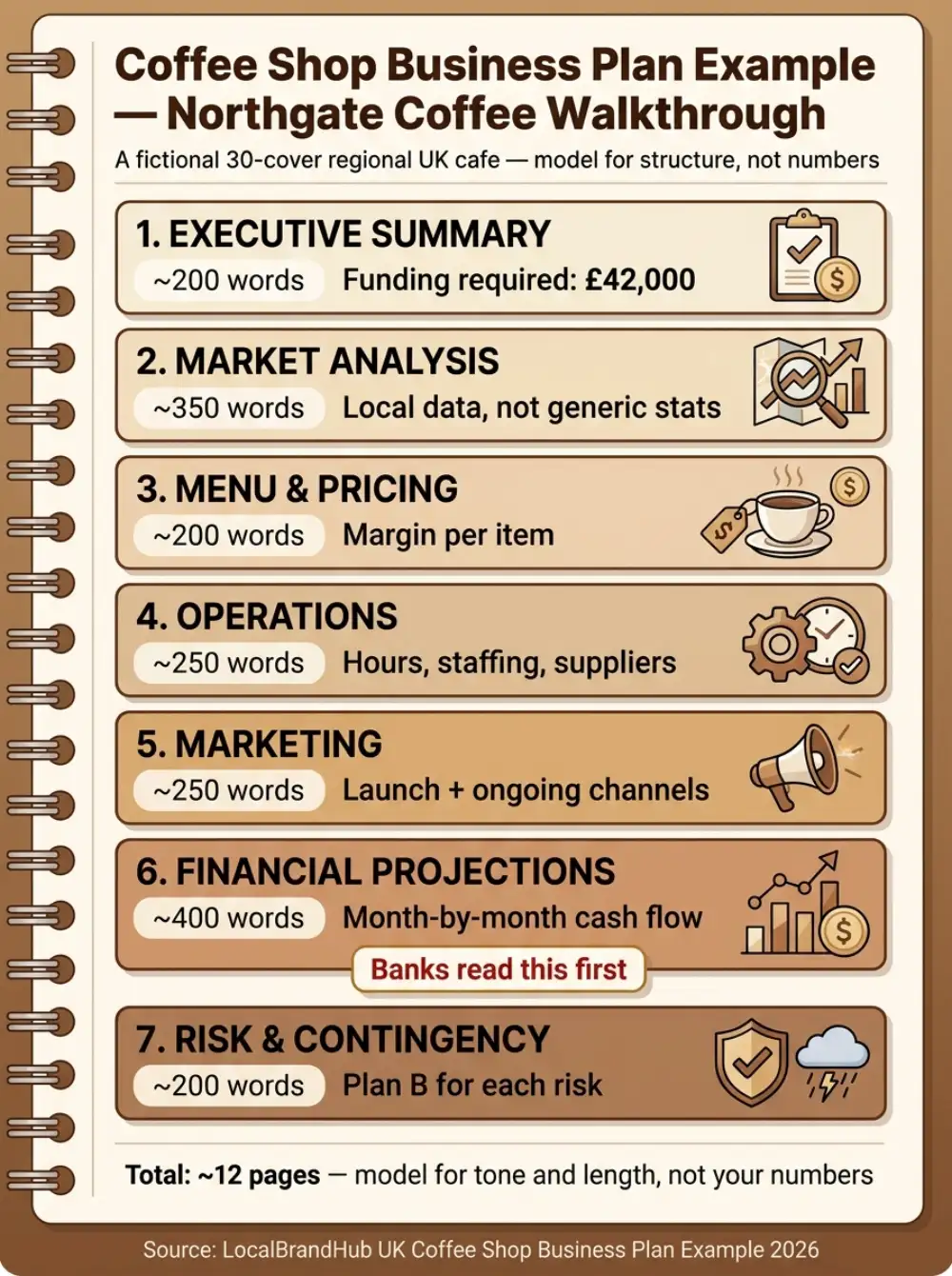
Table of Contents
- About This Coffee Shop Business Plan Example
- Section 1: Executive Summary (Example)
- Section 2: Market Analysis (Example)
- Section 3: Menu & Pricing (Example)
- Section 4: Operations Plan (Example)
- Section 5: Marketing Plan (Example)
- Section 6: Financial Projections (Example)
- Section 7: Risk & Contingency (Example)
- What Makes This Example Work
- FAQs About Coffee Shop Business Plan Examples
- Key Takeaways
About This Coffee Shop Business Plan Example
The coffee shop business plan example below is a fictional walkthrough, not a downloadable template. It demonstrates what working content looks like in each of the seven sections, using realistic UK numbers for a 30-cover regional independent cafe called Northgate Coffee.
Related: How to Start a Coffee Shop
The UK has more than 28,000 coffee outlets (Allegra World Coffee Portal, 2025) and the British Business Bank publishes free UK plan templates at gov.uk. Most first-time owners benefit from seeing a worked example before opening one of those templates: a blank page is much harder to fill than one with reference content.
The Northgate Coffee plan in this guide is not a real business and the numbers shouldn't be copied directly into your plan. Treat it as a model for tone, length, and how the sections connect.
For example, a real coffee shop business plan example might describe a 25-cover unit on a different high street, but the structure of the executive summary and the way the financial projections are laid out would mirror the Northgate Coffee approach. The point is the format, not the figures.
| Section | Example Length | What It Demonstrates |
|---|---|---|
| Executive summary | ~200 words | Tight summary of the whole plan |
| Market analysis | ~350 words | Local data, not generic UK stats |
| Menu & pricing | ~200 words | Margin per item, average ticket |
| Operations | ~250 words | Hours, staffing, suppliers |
| Marketing | ~250 words | Launch + ongoing channels |
| Financial projections | ~400 words | Cash flow + break-even month |
| Risk & contingency | ~200 words | What could go wrong + plan B |
Pro Tip: Read the whole walkthrough end to end before opening your own document. The sections connect: you'll write each one faster knowing where the next is going.
Section 1: Executive Summary (Example)
With the structure clear, let's walk each section in turn. The executive summary is half a page and gets written last. Here's what Northgate Coffee's looks like in a coffee shop business plan example.
Northgate Coffee will be a 30-cover speciality cafe on Northgate Street, opening October 2026, serving an office and student catchment. The cafe will focus on speciality espresso, a tight food offer (pastries plus three rotating brunch dishes) and a welcoming community feel. Total funding required: a five-figure mix of owner equity and a Start Up Loan. Year one forecast: break-even reached in month nine. The founder has worked five years in UK speciality coffee, including two years as head barista at a strong-reviewed independent in the same city. Northgate Coffee will be the only speciality-led cafe within a half-mile radius.
Why this matters: A good executive summary makes the reader want to read the rest. A poor one makes them stop. Spend disproportionate time on this 200 words.
Section 2: Market Analysis (Example)
So the executive summary sets the scene. The market analysis section is where most first-time plans go wrong by relying on generic UK industry stats. The Northgate Coffee example shows what local data looks like instead.
Northgate Street sits in the heart of the city's office and student belt. Within a half-mile radius there are three university buildings, four large office blocks (combined headcount around 3,200), and a 600-seat lecture theatre. Footfall along Northgate Street is highest 8 to 10am (commuters and students arriving), 12 to 2pm (lunchtime), and 3 to 5pm (study and post-work).
The competing cafes within a half-mile are: Costa (chain, ~150m away, takeaway-led), a Greggs (chain, ~200m away, food-led), and one independent, Three Bean, operating a small 12-cover unit four streets away. Three Bean focuses on brunch and is closed by 3pm. None of the four currently offer a speciality batch-brew filter or extended afternoon trade. Costa and Greggs do not source from speciality roasters.
The Northgate Coffee opportunity is the gap between the chains' convenience and Three Bean's brunch focus. Office and student dwell-time customers want a quality afternoon coffee shop with reliable Wi-Fi and good filter. None of the existing four serve that need.
For example, a Northgate Coffee market analysis section that listed "the UK coffee market is worth billions" would tell the reader nothing they couldn't Google. The local-specific version above tells them the founder has done the homework.
Section 3: Menu & Pricing (Example)
With the local market mapped, the next section converts the concept into actual revenue. The menu and pricing section converts the cafe concept into revenue numbers. Northgate's coffee shop business plan example shows the format.
Espresso menu: flat white, latte, cappuccino, americano, espresso (priced in line with local speciality cafes). Filter coffee: batch brew and a single-serve V60.
Food: pastries, three rotating brunch dishes served 9am to 2pm, and a sandwich offer served 11am to 4pm.
Average ticket forecast: a mid-single-figure ticket for drink + food, lower for drink-only.
Cost of goods sold per drink: bean cost ~50p, milk ~35p, cup and lid ~12p (if takeaway), leaving a gross margin in the £2.40 range on a flat white before labour and overheads. Brunch COGS is forecast at 28% of menu price, leaving a 72% gross margin on food.
From experience: Don't just list prices in the example. Show the margin maths. Banks specifically want to see that you understand the cost-to-price relationship.
Section 4: Operations Plan (Example)
The operations section maps the cafe concept to staffing, hours and suppliers.
Opening hours: Monday to Friday 7:30am to 4:30pm, Saturday 8am to 4pm, Sunday closed (review at six months).
Staffing: founder + one head barista (full-time), two part-time baristas (Monday to Friday split shifts), one weekend barista. Total weekly staff hours forecast: ~110.
Suppliers: bean supplier: Workshop Coffee (UK speciality roaster, ~£26/kg wholesale, weekly delivery). Milk supplier: local independent dairy, £1.10/litre, three deliveries weekly. Pastry supplier: local bakery within walking distance, daily delivery. Packaging: generic compostable cups and lids via Vegware-style supplier.
Equipment service contracts in place from day one: espresso machine and grinder via the Workshop Coffee supplier network. POS system: Square with loyalty programme integration.
If you can't tell whether your operations section is grounded in real supplier conversations or just generic plan language that's usually a sign you haven't called your supplier shortlist yet.
Section 5: Marketing Plan (Example)
With operations sketched, the marketing plan covers how customers will actually find Northgate Coffee. The marketing section in a coffee shop business plan example needs both launch and ongoing detail. When you write your own, a tool like an AI social post generator makes the ongoing Instagram commitment realistic rather than aspirational.
Launch marketing (Months -1 to 1): Instagram countdown reels three times weekly from Month -1, Google Business Profile verified Month -1, local press release sent ten days pre-opening, soft launch invites to 40 friends and neighbouring businesses, opening day promotion (free pastry with every coffee on opening day only), influencer brunch in opening week (four local Instagrammers, 1k to 10k followers).
Ongoing marketing (Month 2 onwards): Instagram four times weekly (drinks, behind-the-counter, regulars with permission), Google review responses within 24 hours, monthly community partnership with the yoga studio next door (their members get 10% off, our customers get a discount on classes), seasonal menu push every quarter via Instagram and email.
Marketing budget: £500 for opening week, £150/month ongoing covering occasional Instagram boosts and printed flyers.
Related: Coffee Shop Opening Week Plan
Section 6: Financial Projections (Example)
The financial projections are the heart of any coffee shop business plan example. This is where banks read first.
Startup Costs
Total launch budget: a five-figure spend split across four buckets. Premises and fit-out (lease deposit, first month rent, shop fitter, decor) takes the largest share. Equipment (refurbished espresso machine, grinder, fridges, dishwasher, POS, furniture) is the second-biggest line. Working capital covers the first eight weeks of stock, wages and marketing. A 10% contingency sits across the top.
Year One Cash Flow
Month 1: revenue starts modest, costs run higher than revenue, closing cash balance dips slightly from launch. Month 3: revenue lifts, costs steady, closing balance still positive. Month 6: revenue continues climbing, closing balance now stable. Month 9 (break-even): revenue covers all monthly costs for the first time. Month 12: revenue comfortably ahead of costs, closing balance growing.
Break-Even
Break-even is forecast around month nine. The founder draws a small monthly salary from month nine onwards, with full owner draw delayed until month fifteen.
If you pick just one section in your coffee shop business plan example to obsess over, the cash flow forecast is non-negotiable: every other section feeds into it, and banks read it first.
Section 7: Risk & Contingency (Example)
With the financials in place, the final section shows the reader you've thought about what could go wrong. The risk and contingency section is where banks judge whether the plan is realistic.
Key risks: (1) Slower opening trade than forecast: most cafes open below forecast for 60 to 90 days. Plan B: cut founder salary to zero, reduce staff hours, increase Instagram marketing. (2) Espresso machine breakdown: service contract in place from day one with ~24-hour callout. Plan B: backup pour-over kit and a known temporary-hire supplier. (3) Three Bean reopens longer hours and competes for afternoon trade. Plan B: deepen Northgate's afternoon offer (new filter menu, study-friendly seating layout). (4) Energy cost spike: UK utility prices remain volatile. Plan B: small price increase phased over two menu refreshes; back-of-house energy audit at month six.
Cash buffer: Northgate Coffee will hold £15,000 separate from the working capital line, untouched unless three consecutive months trade below 70% of forecast.
If you're only planning the upside scenario you'll always lose to operators who planned the downside too. That never works as a single-scenario plan.
What Makes This Example Work
The Northgate Coffee coffee shop business plan example reads as a working document because it does five things most failed plans skip.
- Specific local data, not generic UK industry stats
- Real supplier names and prices in the operations section
- Month-by-month cash flow, not just a year-end revenue forecast
- A clear founder credibility paragraph in the executive summary
- Risk plans with specific Plan Bs, not just "we'll respond to challenges"
For example, a plan that says "the UK coffee market is growing" tells the reader nothing. A plan that says "Costa and Greggs are within 200m and don't serve speciality" tells them the founder has walked the street.
Frequently Asked Questions About Coffee Shop Business Plan Examples
Format Questions
How long should my coffee shop business plan be compared to this example? This Northgate Coffee example would total around 12 pages when typed up properly. Most UK independent coffee shop plans land between 10 and 20 pages. Anything over 30 pages typically isn't read end-to-end by anyone who matters.
Should I copy these example numbers into my own plan? No: the Northgate Coffee numbers are a model for structure, not your specific business. Copy the format, not the figures. Your local market, location costs, and supplier prices will all differ.
Content Questions
Where do I find real local data for my market analysis? Walk the street. Count footfall at peak hours. Photograph the menus and prices of competing cafes. Talk to other independent operators. Local council websites also publish footfall studies for some high streets.
Do I need to write the example sections in full prose like this? No: many UK plans use bullet points for operations and marketing, and prose only for executive summary and market analysis. Use whatever format makes the content clearest to a reader.
Funding Questions
Will this example look professional enough to a bank? Yes: the Northgate Coffee structure is similar to what high-street banks and the Start Up Loans Company expect. The level of specific detail (real local context, supplier names, month-by-month cash flow) is what they read for.
What if my numbers don't look as healthy as the Northgate Coffee example? That's normal. The Northgate Coffee example is intentionally optimistic to show what a fundable plan looks like. Your numbers may differ, and the plan should be honest. Banks prefer realistic conservative numbers to optimistic ones that miss target.
Key Takeaways: Coffee Shop Business Plan Example
If you're reading this thinking "my plan won't look this polished", that's the right reaction. The reality for most independent owners is that the first draft is rough, and the third draft starts to look like an example.
- Use the Northgate Coffee structure as a model for tone and length
- Replace every detail with your specifics: location, suppliers, numbers
- Local data beats generic UK stats every time
- Show the cash flow month by month: banks read this first
- Plan B for each major risk: don't leave the contingency section vague
For the underlying section-by-section guide on writing a plan from scratch, see our coffee shop business plan walkthrough.
If you'd like a hand mapping out your coffee shop business plan in one place, LocalBrandHub has free templates for independent cafes, useful if you're working solo and want one place to keep the document together.
Weekly Action
This week, do two things to start your own plan inspired by this coffee shop business plan example:
- Day 1 to 3: Open a Google Doc, write the seven section headings, and draft your executive summary using the Northgate Coffee format with your own specifics, even if rough.
- Day 4 to 7: Walk your future high street with a notebook, photograph competing cafes' menus and prices, and replace generic stats in your market analysis with the local data you collect.
If you run a coffee shop and want to see how Local Brand Hub can support your marketing, explore our coffee shop marketing tools.
For restaurants, salons, and local businesses
Need help with your marketing?
We help UK businesses turn social media into real results, not busywork.
Start freeKey Takeaway
A coffee shop business plan example like the Northgate Coffee walkthrough gives you a concrete model for tone, length and structure across all seven sections. Use it as scaffolding, replace the specifics with your own location, suppliers and numbers, and lean hardest on the cash flow forecast and risk plans, since that's where UK banks read first.
Get More Marketing Tips
Practical marketing tips for UK business owners, straight to your inbox. No spam, unsubscribe anytime.
About the Author
Local Brand Hub
Empowering UK Businesses
Local Brand Hub provides comprehensive business management tools designed specifically for UK local businesses to streamline operations, automate marketing, and grow revenue.
More articlesRelated Articles
 Tutorials
Business Plan Coffee Shop: UK Step-by-Step Guide
Write a UK cafe business plan section by section, including financials, market analysis, and the cash flow forecast that matters most.
 Business Growth
How Much Does It Cost to Open a Coffee Shop in the UK
How much does it cost to open a coffee shop in the UK? Realistic startup costs by category, sample budgets, and where owners overspend.
 Business Growth
Launch a Coffee Shop: 12-Month UK Timeline
Launch a coffee shop with a 12-month UK timeline: month-by-month milestones from idea to opening day, plus the practical checklist independents use.