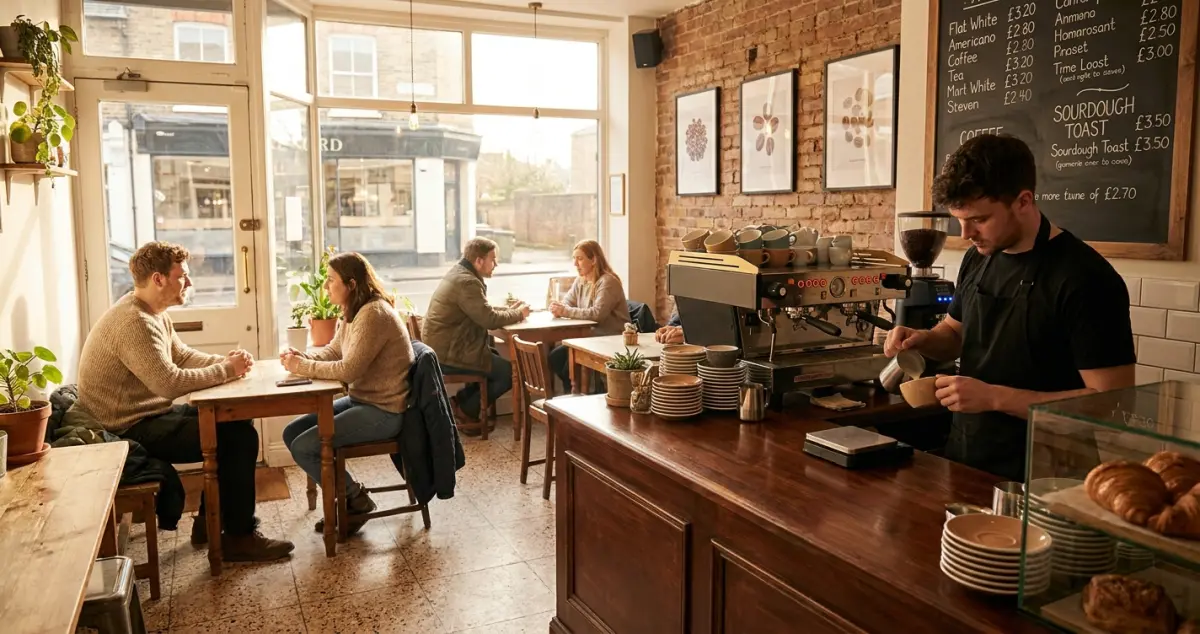
How to start a coffee shop in the UK: choose your model, work out startup costs, register with the FSA, write a plan and open the doors.
How to start a coffee shop in the UK is the process of choosing a business model, registering your food business with the local council, writing a plan that proves the numbers work, sourcing equipment and beans, and building a brand that brings customers back beyond the morning rush.
You've been thinking about this for months: early mornings spent in cafes, working out how to start a coffee shop of your own. You know how one should feel. You can taste when the milk's been overheated. You know the difference between a good flat white and a bad one. But turning that into a business (the lease, FSA paperwork, a P&L that actually balances) is a different game entirely.
This guide shows you how to start a coffee shop in the UK from the first decision to your opening day, with links to detailed guides on each stage. 16 min read.
What You'll Learn
- The decisions you need to make before signing a lease or buying any kit
- Realistic UK startup costs and where the money actually goes
- Legal and food safety requirements most UK coffee shops must meet
- How to choose between a shop, a van, an online business or a roastery
- A step-by-step path from idea to opening day
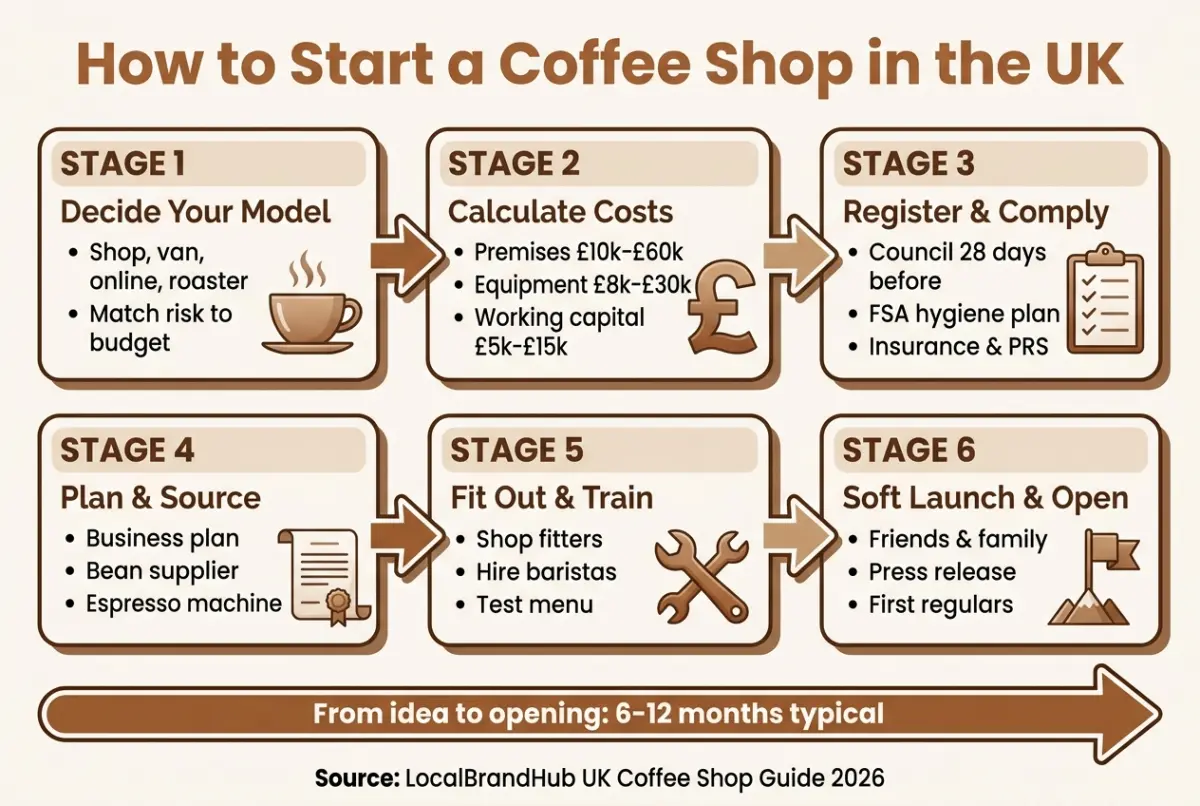
Table of Contents
- Is Opening a Coffee Shop Right for You?
- How Much Does It Cost to Start a Coffee Shop?
- What Do You Legally Need to Open a Coffee Shop?
- Choose Your Business Model
- Writing Your Coffee Shop Business Plan
- Sourcing Beans, Equipment and Suppliers
- Marketing Your New Coffee Shop
- Your Coffee Shop Opening Day
- What Is the 80/20 Rule for Coffee?
- FAQs About How to Start a Coffee Shop
- Key Takeaways
Is Opening a Coffee Shop Right for You?
Before you learn how to start a coffee shop, it's worth deciding whether the work suits your life right now.
Related: Coffee Shop Business Plan
The UK has more than 28,000 coffee outlets and the branded chain market alone turns over billions each year (Allegra World Coffee Portal, 2025). The audience is there. What you're competing for is attention, location and consistency. Chains often have all three sorted on day one and you don't.
That's sobering, not discouraging. The strongest independents typically win on what chains can't replicate: personality, community, and one or two genuinely brilliant drinks.
Pro Tip: Spend a full week visiting cafes within a mile of your planned location. Sit in each one for thirty minutes. Note what works and what's missing, that gap is your opening.
For example, a coffee shop owner in Bristol might spend a week visiting eight competing cafes, noticing that none of them serve a proper filter coffee at lunchtime, and use that gap as the differentiator on opening day.
Before you commit, ask three questions:
- Can you handle a 5am start six days a week? Coffee shop hours are early and unforgiving. The morning rush is often the bulk of your trade.
- Do you have a runway? Most independent cafes need 6 to 12 months before they break even. You'll need savings on top of startup capital.
- What's your hook? "Good coffee" isn't a hook anymore. Every chain says that. You need a reason regulars walk past three other cafes to reach yours.
If you're thinking "I can't answer all of these yet," nobody can on day one. The point of learning how to start a coffee shop is to start asking these before you sign anything binding.
If you can't tell whether regulars come back for your coffee or just for the friendly hello that's usually a sign your brand isn't doing its job yet, and that's a fixable problem before you sign a lease, not after.
Why this matters: A coffee shop isn't a hobby with a till. It's a business with brutally tight margins where small operational decisions decide whether you make rent.
How Much Does It Cost to Start a Coffee Shop?
With your motivation tested, the next step in how to start a coffee shop is the money. To start a coffee shop in the UK typically costs between £15,000 and £100,000 depending on size, location and fit-out, with most independent owners spending £30,000 to £60,000 on a small high-street unit.
The Three Cost Buckets
The costs split into three buckets:
| Cost Bucket | Typical Range | What's Included |
|---|---|---|
| Premises & fit-out | £10,000-£60,000 | Deposit, first month's rent, shop fitters, plumbing, flooring, decor |
| Equipment | £8,000-£30,000 | Espresso machine, grinders, fridge, dishwasher, POS, furniture |
| Working capital | £5,000-£15,000 | Initial stock, marketing, staff wages for the first 8 weeks, contingency |
For example, a small bakery cafe in a regional UK town might land around £30,000 all-in by combining a refurbished espresso machine, modest fit-out on a 40-cover unit, a deposit, and two months of staff wages.
The Espresso Machine Decision
The most expensive single item is almost always the espresso machine. New two-group commercial machines typically start at around mid-four-figure prices and run into five figures for high-end models.
Pro Tip: Refurbished from a reputable supplier can cut that meaningfully if you're confident about service support, but never buy refurbished without a service contract.
If you want a full UK breakdown, including hidden costs like Phase 1 surveys, EPC reports and council fees, see our detailed coffee shop startup costs guide.
What Do You Legally Need to Open a Coffee Shop?
Once the costs are clear, the next part of how to start a coffee shop is the paperwork. You must register your food business with your local council at least 28 days before you start trading, comply with food hygiene law, take out public liability insurance, and register with HMRC (and Companies House if you're a limited company). Settle the name before you register anything: our coffee shop naming checklist includes searching the Companies House register for clashes.
Here's the practical checklist every UK coffee shop owner has to work through:
- Food business registration with your local council, free, at least 28 days before opening (gov.uk)
- Food Hygiene Rating Scheme: your council inspects within weeks of opening and rates 0 to 5
- HACCP-based food safety plan documenting how you control food risks (Food Standards Agency)
- Allergen labelling for everything you serve, including prepacked-for-direct-sale items under Natasha's Law
- Premises licence if you sell alcohol or play recorded music after 11pm
- PRS for Music & PPL licence for playing music in public, even radio
- Public liability insurance, typically £1m to £2m cover
- Employer's liability insurance if you hire even one part-time barista
- HMRC registration: Self Assessment if sole trader, Corporation Tax if Ltd
- VAT registration if your turnover exceeds the current threshold
Pro Tip: Don't try to memorise the regulations. Download the FSA's Safer Food, Better Business pack, it's free and walks you through HACCP without the jargon.
For example, a new cafe owner might block out 30 minutes a day for three weeks to work through compliance: registering with the council on day one, drafting the HACCP plan over week two, and arranging public liability insurance and PRS for Music in week three. Tackled as a daily habit rather than a single sprint, the paperwork is far less daunting than it first looks.
If you're thinking "this list looks terrifying", the reality for most independents is that you can work through it in about three weeks if you tackle one item a day. The council registration is genuinely simple. The longer job is documenting your food safety plan in a way that survives an inspection.
Choose Your Business Model: Shop, Van, Online or Roaster
How you start a coffee shop is shaped most by which model you choose. The four common routes have very different cost profiles and very different routes to profit.
| Model | Startup Cost | Profit Driver | Best Suited To |
|---|---|---|---|
| High-street shop | £25k-£100k | Footfall + dwell time | Owners who want a local destination |
| Mobile coffee van | £8k-£40k | Events + corporate gigs | Lower-risk first venture |
| Online subscription / direct-trade | £3k-£15k | Repeat orders, margin per bag | Roasters and home-baristas with strong branding |
| Coffee roaster + wholesale | £20k-£80k | B2B contracts | Owners who love the bean side more than serving customers |
For most first-time UK owners, a small high-street shop or a mobile van often offers a strong balance of risk and trade. The shop tests whether you can run an operation; the van tests whether your coffee and brand stand up before you take on a lease.
For example, a first-time owner might run a coffee van at weekend markets for six months, prove the brand works, and only then sign a lease on a small bricks-and-mortar shop.
The Lowest-Risk Entry Point
If you pick just one model to start with, a mobile coffee van is often the lowest-risk entry point: you can test your coffee, brand and operations without taking on a lease. When the numbers stack up, the lease decision is much easier.
Pro Tip: Treat your van season as paid market research. Track which events sell, which drinks move fastest, and which postcodes your customers come from, that data shapes your eventual shop location.
If you're not yet sure which model fits your life, our non-shop coffee business guide walks through vans, online and roasting in more detail.
Writing Your Coffee Shop Business Plan
So you've chosen a model. The next step in how to start a coffee shop is the plan. Even if you're self-funding, the plan forces you to face the numbers before you commit to a lease.
A workable UK coffee shop business plan covers:
- Executive summary: what you do, who you serve, why now
- Market analysis: local competition, footfall, demographic fit
- Menu & pricing: drinks, food, margin per item, average spend
- Financial projections: startup costs, monthly P&L, break-even month
- Operations plan: opening hours, staffing, suppliers, deliveries
- Marketing plan: launch campaign, ongoing channels, loyalty
For example, a UK coffee shop targeting around a thousand weekly cups at a typical independent ticket size needs roughly five-figure monthly turnover, and you back-solve from there to staffing, cost of goods, and rent affordability.
The most useful section for first-time owners is often the cash flow forecast: month one, two, three through twelve. It tells you how much cash you actually need to survive a slow opening summer.
Our coffee shop business plan guide walks you through each section with UK templates. If you'd rather see a worked example first, our coffee shop business plan example breaks down a real-style UK plan section by section.
Sourcing Beans, Equipment and Suppliers
With your plan signed off, sourcing decisions begin. This is where most first-time owners get the romance and the maths confused.
Choosing Your Bean Supplier
Your bean supplier is the single biggest call. A UK speciality roaster typically charges a wholesale price per kilo that works out to roughly 40 to 60p of bean cost per drink before milk, cup or labour.
For example, a busy independent might find that beans alone cost more than £100 a day on a strong trading day. Get the bean wrong and you're stuck with it for weeks of brand reputation.
Pro Tip: Ask three roasters for samples and run a blind cupping with two regulars and a barista before you commit. Speciality Coffee Association (SCA) members tend to maintain consistent quality batch to batch.
Equipment Hierarchy
Equipment hierarchy for a high-street shop, in order of importance:
- Espresso machine + grinder: your most-used pieces of kit, treat as one purchase
- Refrigeration: undercounter fridge for milk, plus a display fridge if you sell food
- POS system: Square, Lightspeed and SumUp dominate UK independents
- Dishwasher: commercial glass and crockery cycles save hours weekly
- Water filter: protects your machine and improves shot quality
Most UK suppliers offer service contracts for the espresso machine and grinder. Take one, a dead grinder on a Saturday morning costs you the day's trade.
Marketing Your New Coffee Shop
Sourcing sorted, your next move is making sure people know you exist. Marketing for a coffee shop has three jobs: tell people you're open, give them a reason to come, and turn first-timers into regulars.
For most UK coffee shops, Instagram and a properly built Google Business Profile often offer a strong combination of local discovery and visual appeal. Instagram shows your latte art, brunch plate and interior; Google gets you found when someone searches "coffee near me" at 9am. Keeping that Instagram feed fed is far easier with a social post generator that turns a single photo into a week of captions.
For example, a new cafe in Manchester might post one Instagram Reel a week of behind-the-counter morning prep, ask each happy regular for a Google review, and respond to every review within 24 hours, building a 4.8-star average inside three months.
The minimum stack:
- Google Business Profile with photos, hours, menu, posts and review responses
- Instagram with daily-ish posts: drinks, regulars (with permission), behind-the-counter
- Local press release for opening week: "new independent cafe opens on [street]"
- Loyalty card or app so first-timers have a reason to come back nine times
- Community partnerships: yoga studio next door, gallery up the road
If you're only posting when it's quiet you'll always lose to competitors who post anyway. The independents that win local discovery typically post at least three times a week, every week, and that never works as a one-off effort.
Why this matters: Footfall is everything. A coffee shop with no marketing relies entirely on the street, and the street is unreliable. Posting consistently and responding to every review buys you the second visit you need to build regulars.
Your Coffee Shop Opening Day
Marketing in place, the next step in how to start a coffee shop is the opening week itself. This is the marketing event you only get once. Get it right and you build a base of regulars in eight weeks. Get it wrong and you're playing catch-up for six months.
The basic opening playbook:
- Soft launch first: invite friends, family, and a few local Instagram accounts for a free coffee day before paid trade
- Real opening day: a launch promotion (free pastry with every coffee, or a charity tip jar) gives press a story
- Press notification: local papers, hyperlocal Facebook groups, and parish newsletters love an opening
- Influencer breakfast: three or four local Instagrammers with 1k to 10k followers, fed brunch in exchange for honest posts
For example, a city-centre cafe might run a soft opening on the Monday, full opening on the Tuesday, an influencer brunch on Wednesday, and have stable trade by Friday. The weekend then runs at full capacity.
For the full launch playbook (including a 30-day pre-opening checklist), see our coffee shop opening guide, and for the longer view, our 12-month launch timeline shows what to do every week of the year before you open.
What Is the 80/20 Rule for Coffee?
The 80/20 rule for coffee is a framework that says roughly 80% of your revenue typically comes from 20% of your menu: usually a small handful of drinks (flat white, latte, cappuccino, americano) plus one or two food items. The lesson is to make those few items perfect rather than chase a 40-line menu.
For example, a busy independent cafe might find that flat whites, lattes and a single banana bread account for the bulk of daily trade, while half a dozen other drinks together bring in next to nothing. Cutting the long tail and perfecting the top items is often the single biggest profit lever.
Practical Implications
In practical terms, the 80/20 rule for coffee means trimming your menu before you open:
- Fewer drinks, executed better. A coffee shop with eight perfect drinks will typically out-earn one with twenty mediocre options.
- Speed at peak. Every extra menu option slows your queue at 8am, and a slow queue at 8am is lost trade.
- Easier training. Smaller menus mean new baristas get to consistency faster.
Frequently Asked Questions About How to Start a Coffee Shop
Legal & Setup Questions
Do you need a licence to sell coffee in the UK? You don't need a special "coffee licence", but you must register your food business with your local council at least 28 days before opening. This registration is free and applies whether you sell coffee, food, or both.
Can you start a coffee shop with no money? Realistically, no. Even a mobile coffee van needs a four-figure setup budget. What you can do is start lean (a small van, a market stall, or a single pop-up) and reinvest profits into a fixed unit later.
Operational & Business Questions
How long before a UK coffee shop becomes profitable? Most independent UK cafes take roughly a year to eighteen months to reach break-even, depending on location, opening hours, and whether you serve food. Many owners draw little to no salary in the first year.
What's the most important first hire for a new coffee shop? A second skilled barista. The early months will run you ragged. A second pair of hands you trust to make the coffee right means you can take a day off without the shop closing.
How many cups a day does a typical UK independent coffee shop serve? Most independents serve a few hundred drinks a day on weekdays, climbing higher at weekends in busy locations. Hitting the daily-cost-cover threshold is roughly where many shops break even on the day.
Should I serve food when I open my coffee shop? For most UK independents, a small food offer (pastries, sandwiches, banana bread) typically lifts the average ticket and dwell time without much extra complexity. Full hot kitchens are a different operation entirely and add staffing, ventilation and food safety overhead, only worth it if your model needs it. For example, a city-centre breakfast spot might find that adding three brunch dishes lifts the average spend significantly while keeping the coffee operation simple.
Do I need to be a trained barista to open a coffee shop? You don't need a formal qualification, but you do need to know what good coffee tastes like and how to make it consistently. Many UK owners take an SCA (Speciality Coffee Association) foundation course before opening: it's typically a few days, gives you the vocabulary to brief suppliers, and makes hiring much easier.
Key Takeaways: How to Start a Coffee Shop
If you run a coffee shop and want to see how Local Brand Hub can support your marketing, explore our coffee shop marketing tools.
For restaurants, salons, and local businesses
Need help with your marketing?
We help UK businesses turn social media into real results, not busywork.
Start freeKey Takeaway
Starting a coffee shop in the UK comes down to five honest decisions: pick your model (shop, van, online or roaster) before anything else, budget realistically (£30k to £60k for most small high-street units), register your food business with the council at least 28 days before opening, choose one bean supplier and one espresso machine you trust with service contracts on both, and run a soft launch before your real opening week. Most successful owners spend 6 to 12 months in planning before unlocking the door, start there, work back from the experience you want to create, and build the plan around it.
Get More Marketing Tips
Practical marketing tips for UK business owners, straight to your inbox. No spam, unsubscribe anytime.
About the Author
Local Brand Hub
Empowering UK Businesses
Local Brand Hub provides comprehensive business management tools designed specifically for UK local businesses to streamline operations, automate marketing, and grow revenue.
More articlesRelated Articles
 Business Growth
Launch a Coffee Shop: 12-Month UK Timeline
Launch a coffee shop with a 12-month UK timeline: month-by-month milestones from idea to opening day, plus the practical checklist independents use.
 Business Growth
Coffee Shop Opening: Soft Launch & First Week Plan
Coffee shop opening: plan a soft launch, run your first trading week, market the launch, and turn first visitors into loyal regulars.
 Business Growth
How Much Does It Cost to Open a Coffee Shop in the UK
How much does it cost to open a coffee shop in the UK? Realistic startup costs by category, sample budgets, and where owners overspend.