
Launch a coffee shop with a 12-month UK timeline: month-by-month milestones from idea to opening day, plus the practical checklist independents use.
Launch coffee shop operations the right way and the work fits a 12-month timeline. The four phases (exploration, commitment, build, launch) break the year into decisions that compound. The launches that survive year one almost all run a structured plan. The ones that don't tend to compress everything into a frantic six weeks.
You've got a date in mind. Maybe a friend has mentioned a unit coming up. Maybe redundancy money is sitting in the account. With more than 28,000 coffee outlets across the UK (Allegra World Coffee Portal, 2025), the market is competitive, and the launches that survive almost all share a planned 12-month run-up rather than a frantic six weeks.
The real question isn't whether you could open a cafe: it's whether you should run the next twelve months as a structured plan or wing it. 12 min read.
What You'll Learn
- A month-by-month timeline to launch a coffee shop in the UK
- The four phases every launch goes through and what to fix in each
- Which decisions in months 1 to 3 set the financial ceiling for the whole business
- How to use the year before opening day as paid market research
- A weekly checklist for the final 90 days so nothing slips
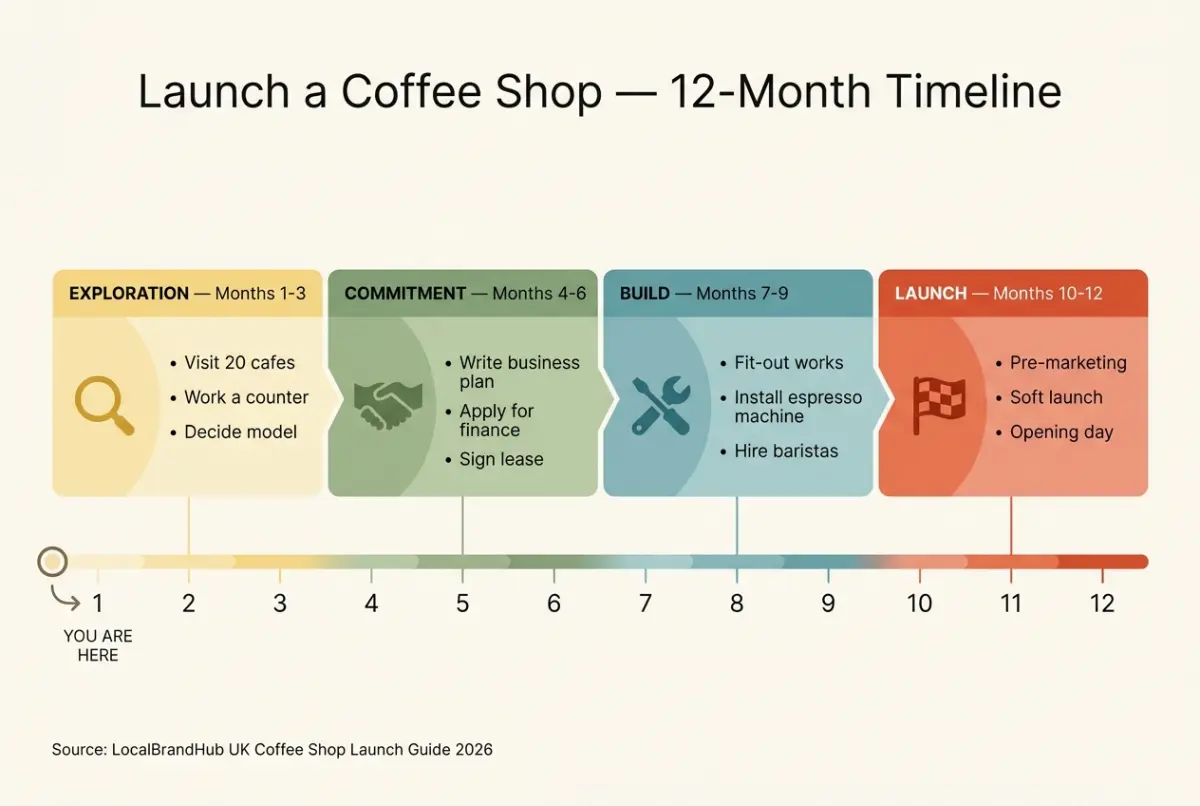
Table of Contents
- The 12-Month Launch Framework
- Months 1 to 3: Exploration
- Months 4 to 6: Commitment
- Months 7 to 9: Build & Fit-Out
- Months 10 to 12: Launch
- The Final 90-Day Checklist
- Common Launch Timeline Mistakes
- FAQs About Launching a Coffee Shop
- Key Takeaways
The 12-Month Launch Coffee Shop Framework
The launch coffee shop framework is a structured 12-month timeline that breaks the work into four phases (exploration, commitment, build, and launch) so you spend the first nine months making decisions that compound rather than firefighting in the final fortnight.
Related: How to Start a Coffee Shop
Related: Coffee Shop Business Plan Guide
The UK has more than 28,000 coffee outlets (Allegra World Coffee Portal, 2025) and the market grows year on year. The independents that survive their first year almost all report planning across at least nine months: most of them twelve. The launches that fail typically compress the first three phases into a few weeks of frantic decisions, then run out of cash in month seven.
| Phase | Months | Focus | Outcome |
|---|---|---|---|
| Exploration | 1-3 | Test the idea, learn the market | Decision: shop, van, online or roaster |
| Commitment | 4-6 | Plan, finance, location | Lease signed, plan funded |
| Build | 7-9 | Fit-out, staff, supply chain | Operationally ready |
| Launch | 10-12 | Pre-marketing, soft launch, opening | Doors open, first regulars |
For example, a Bristol cafe owner might spend months 1 to 3 visiting twenty cafes, working two weekends as a barista at a friend's shop, and reading three UK coffee shop business books before deciding the model, then commit to a high-street unit in month four with the conviction that comes from doing the homework.
Pro Tip: Treat the 12-month plan as a wall calendar with sticky notes you move every Sunday. Digital tools work but a wall planner you walk past every morning is harder to ignore.
Months 1 to 3: Exploration
With the framework in mind, let's walk through each phase. The first three months of any launch coffee shop plan test whether the launch should happen at all. Spend the time learning, not committing.
Month 1: Reading & Visiting
- Visit twenty coffee shops in your target catchment: note opening hours, busiest moments, what they sell most of
- Read three UK-specific coffee shop business books (skip the US ones, different licensing entirely)
- Sit in five cafes for two hours each and watch operations end-to-end
Month 2: Working the Counter
- Arrange to spend two weekends working as a paid or volunteer barista at an independent
- Take an SCA foundation barista course (Speciality Coffee Association)
- Have ten conversations with operating cafe owners about what they wish they'd known
Month 3: Numbers & Decisions
- Build a rough P&L on a spreadsheet for three different scales of cafe
- Decide your model: shop, van, online or roaster
- Decide your geographic catchment: town, postcode area, specific street
For example, a couple in Manchester might spend month 2 each working a Saturday morning at a friend's cafe, and emerge from month 3 having decided that a 30-cover unit in Chorlton is achievable but a 60-cover unit in town centre isn't.
If you can't tell whether your idea is genuinely fundable or just exciting that's usually a sign your spreadsheet hasn't met enough reality yet.
Months 4 to 6: Commitment
So exploration confirmed the idea. With that decided, the next phase of your launch coffee shop plan is commitment: when you stop thinking and start spending.
Month 4: Plan & Finance
- Write the full business plan with month-by-month cash flow (gov.uk has free UK business plan templates)
- Apply for finance if you need it: Start Up Loans, bank loan, or family
- Decide your legal structure: sole trader vs limited company
Month 5: Location & Lease
- Shortlist three to five units in your chosen catchment
- Get a Phase 1 desktop survey on each
- Negotiate the lease with a solicitor reviewing every clause
Month 6: Sign & Register
- Sign the lease (typically a 5 to 10 year term with a break clause)
- Register your food business with the council (gov.uk)
- Register your limited company with Companies House if going that route
From experience: Negotiate a rent-free period of one to three months at the start of the lease: landlords will often agree, especially on units that have been empty.
For example, a launch in Edinburgh might secure a 10-year lease with a 5-year break clause and a two-month rent-free period, saving £6,000 of cash to redirect into the espresso machine.
Months 7 to 9: Build & Fit-Out
With the lease signed, the build phase of your launch coffee shop programme begins: when the cafe becomes physical. Most launches lose budget control here.
Month 7: Fit-Out Begins
- Engage shop fitters with a fixed-price quote, never time-and-materials
- Order the espresso machine and grinder (lead times can be 6 to 8 weeks)
- Plan your menu and pricing in detail
Month 8: Equipment & Staff
- Take delivery of espresso machine; install with service contract from day one
- Hire baristas (allow four weeks for notice periods)
- Set up your POS system with menu, prices and loyalty programme
Month 9: Suppliers & Soft Launch Date
- Confirm bean supplier with samples cupped against alternatives
- Confirm milk, pastry and packaging suppliers with delivery slots
- Set the soft launch date and send save-the-date invitations
For example, a launch in Leeds might engage a fitter on a £18,000 fixed-price quote covering plumbing, flooring, counter build and wiring: finishing on time because the fixed price prevented mid-job scope creep.
If you're only watching the espresso machine and ignoring the supply chain you'll always lose to competitors who locked in their bean and milk slots months ahead. That never works as a last-minute scramble.
Months 10 to 12: Launch
With the unit physically ready, the final quarter of your launch coffee shop plan is about marketing and operational rehearsal.
Month 10: Pre-Marketing
- Launch Instagram with a 12-week countdown of fit-out, training, and team posts
- Set up Google Business Profile with photos, hours and address
- Send press releases to local papers and hyperlocal Facebook groups
Month 11: Final Prep
- Final menu printed
- Staff training week run end-to-end
- Soft launch invitations confirmed (30 to 50 friends, family, neighbours)
Month 12: Open
- Soft launch on a day matching your busiest expected trading day
- Operational debrief with the team within 24 hours
- Public opening 1 to 2 days after soft launch
- Influencer brunch in opening week
For the full opening playbook, see our coffee shop opening guide. For the cost breakdown that sits behind this whole timeline, our coffee shop cost guide covers each phase. To keep that 12-week Instagram countdown on track, a social media calendar lets you line up every launch post weeks in advance.
The Final 90-Day Checklist
So the four phases give you the year. Now to the closing quarter. The last 90 days are when the timeline either lands cleanly or unravels. A weekly checklist keeps the launch on rails.
Days 90-60: Build
- Fit-out works progressing on schedule (weekly site walk-throughs)
- Espresso machine delivered and installed
- POS programmed end-to-end with menu and loyalty
- Staff hired and contracts signed
Days 60-30: Stock & Train
- Bean supplier confirmed with first delivery scheduled
- Pastry, milk and packaging suppliers locked in
- Staff training week complete
- Final menu printed; chalkboards prepared
Days 30-7: Marketing
- Window signage live with opening date
- Instagram posting three times a week
- Google Business Profile verified
- Press release sent to local papers seven days out
- Soft launch invites confirmed
Days 7-1: Final
- Soft launch run; debrief held; menu trimmed if needed
- Public opening date locked in
- Opening promotion finalised and visible in the shop window
- Influencer brunch invitations confirmed for opening week
Why this matters: A coffee shop launch is a chain of dependencies, not a list of tasks. If month 7 slips, month 11 collapses. The weekly checklist keeps the chain visible.
Common Launch Coffee Shop Timeline Mistakes
With the checklist clear, it's worth knowing what tends to go wrong. The same handful of mistakes appear in most failed launches, and knowing them in advance is most of the cure.
- Compressing months 1 to 3: the cheapest learning happens before any cash leaves the account
- Signing the lease before the plan is funded: leaves you paying rent on an empty unit
- Underestimating shop fitter timelines: six to eight weeks is typical for full fit-out
- Skipping the SCA course: you can't brief suppliers without the vocabulary
- No soft launch: operational issues surface in front of paying customers
- Marketing only after opening: the launch week is gone by then
For most UK independents, the biggest single mistake is compressing the build phase. If you pick just one rule to follow, give months 7 to 9 the full twelve weeks they need: most launches that overrun in the last quarter started cutting corners here.
If you can't tell whether your timeline is on track or just feels productive that's usually a sign you don't have a weekly check-in built into the plan.
Frequently Asked Questions About Launching a Coffee Shop
With the mistakes flagged, here are the questions UK independents ask most often when planning a launch.
How long does it actually take to launch coffee shop operations in the UK from scratch? Most independent UK coffee shop launches take between nine and fifteen months from initial idea to opening day, with twelve months being typical for an owner who's running the launch part-time alongside another job. Compressing below nine months usually means cutting corners on planning or fit-out.
Can I launch a coffee shop in three months? Realistically, no, at least not a high-street shop. A coffee van or pop-up can launch faster (eight to twelve weeks) because the legal and fit-out work is dramatically smaller. A bricks-and-mortar shop in three months means buying an existing cafe and rebranding rather than launching from scratch.
What's the most expensive month in a coffee shop launch? Month 7: the start of fit-out. Shop fitters, deposits on equipment, and the lease deposit typically all hit the bank in the same fortnight. Most independents budget for this single month to be 30 to 40% of the total launch spend.
When should I hire my first barista? Month 8: four weeks before opening. That gives time for notice periods, a full training week, and the soft launch as a paid trial day. Hiring earlier wastes wages on an empty shop; hiring later means rushing training in the week of opening.
How do I market the launch without a finished shop? Instagram is your friend here. Post the empty unit, the espresso machine arriving, the team training, the chalkboard going up. The story of the launch is content. By opening day, you should have 200 to 600 local followers who already feel they know your cafe.
Key Takeaways: Launch a Coffee Shop
If you're reading this thinking "I don't have twelve months": the honest answer is that most successful launches did. The reality for most independent owners is that the year before opening is the difference between a controlled launch and a panic.
- Treat the launch as four phases, not one rolling list: exploration, commitment, build, launch
- Spend months 1 to 3 learning, not committing: the cheapest learning happens before any cash leaves
- Months 4 to 6 are commitment: finance, location, lease, registration
- Build phase needs the full twelve weeks: most overruns start with cutting time here
- Months 10 to 12 are pre-marketing and rehearsal: the soft launch is the rehearsal you can't skip
Would you walk into your shop the day before opening and feel like the team is ready? If the answer is "not quite", that's the work for the back end of month 11.
If you'd like a hand mapping out your 12-month launch in one place, LocalBrandHub has free templates for independent cafes, useful if you're working solo and want one place to keep the plan together.
Weekly Action
This week, do two things to anchor your launch timeline:
- Day 1-3: Print a blank 12-month wall calendar and mark your target opening month, then work backwards to label which phase each month belongs to.
- Day 4-7: Identify which of months 1 to 3 (exploration) you're currently in and write down three concrete tasks to complete this month: visit cafes, work a counter, build a P&L spreadsheet.
If you run a coffee shop and want to see how Local Brand Hub can support your marketing, explore our coffee shop marketing tools.
For restaurants, salons, and local businesses
Need help with your marketing?
We help UK businesses turn social media into real results, not busywork.
Start freeKey Takeaway
Launching a coffee shop in the UK is a 12-month project broken into four phases: exploration (months 1 to 3), commitment (4 to 6), build (7 to 9), and launch (10 to 12). The independents that survive year one almost all plan across the full year rather than compressing decisions into a frantic six weeks, and the build phase is where most overruns start.
Get More Marketing Tips
Practical marketing tips for UK business owners, straight to your inbox. No spam, unsubscribe anytime.
About the Author
Local Brand Hub
Empowering UK Businesses
Local Brand Hub provides comprehensive business management tools designed specifically for UK local businesses to streamline operations, automate marketing, and grow revenue.
More articlesRelated Articles
 Business Growth
Coffee Shop Opening: Soft Launch & First Week Plan
Coffee shop opening: plan a soft launch, run your first trading week, market the launch, and turn first visitors into loyal regulars.
 Business Growth
How to Start a Coffee Shop in the UK: Complete Guide
How to start a coffee shop in the UK: choose your model, work out startup costs, register with the FSA, write a plan and open the doors.
 Business Growth
How Much Does It Cost to Open a Coffee Shop in the UK
How much does it cost to open a coffee shop in the UK? Realistic startup costs by category, sample budgets, and where owners overspend.