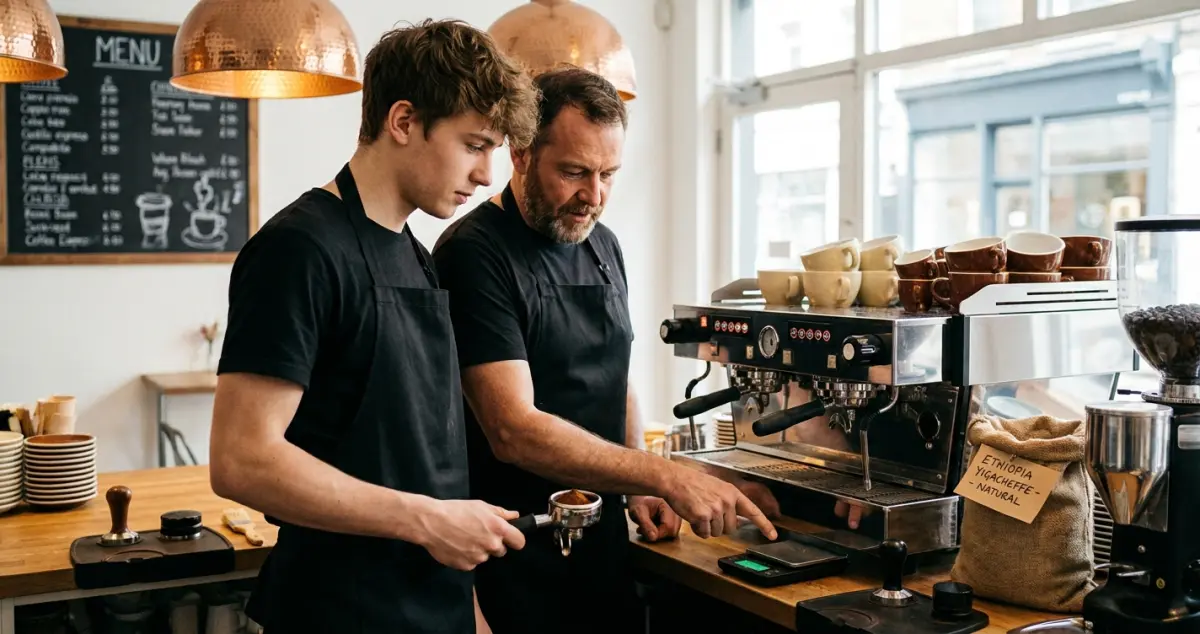
Barista training jobs UK — how to find roles that include paid training, which UK chains fund certifications, and what to ask at interview.
Barista training jobs in the UK are entry-level coffee shop roles that include structured training as part of the package. Funded through chain apprenticeships, roastery schools, or independent cafes, these roles pay course fees on top of wages. The strongest options pay both — a wage plus the certification, often a mid-three-figure value the barista keeps for life.
You want to be a barista. Or you already are one and you're tired of self-funding every course. The honest question isn't "is paid training out there" — it's which UK employers actually fund certifications versus the ones who just claim they "invest in staff" in the job ad.
This guide walks through the UK employers most likely to fund barista training, what to ask in an interview, and how to switch jobs to one that pays for your development. 10 min read.
What You'll Learn
This guide is structured for the barista job-hunting and the working barista deciding whether to switch employers for better training. It's been built around the patterns UK speciality cafes report — who funds training, what apprenticeship vacancies look like, and how to spot training-friendly employers in job ads.
By the end you'll know:
- The UK employer types most likely to fund barista training jobs
- How to spot training-friendly cafes from job ads
- What to ask in an interview about paid training
- How apprenticeship vacancies work and where to find them
- A short checklist for evaluating a barista training job offer
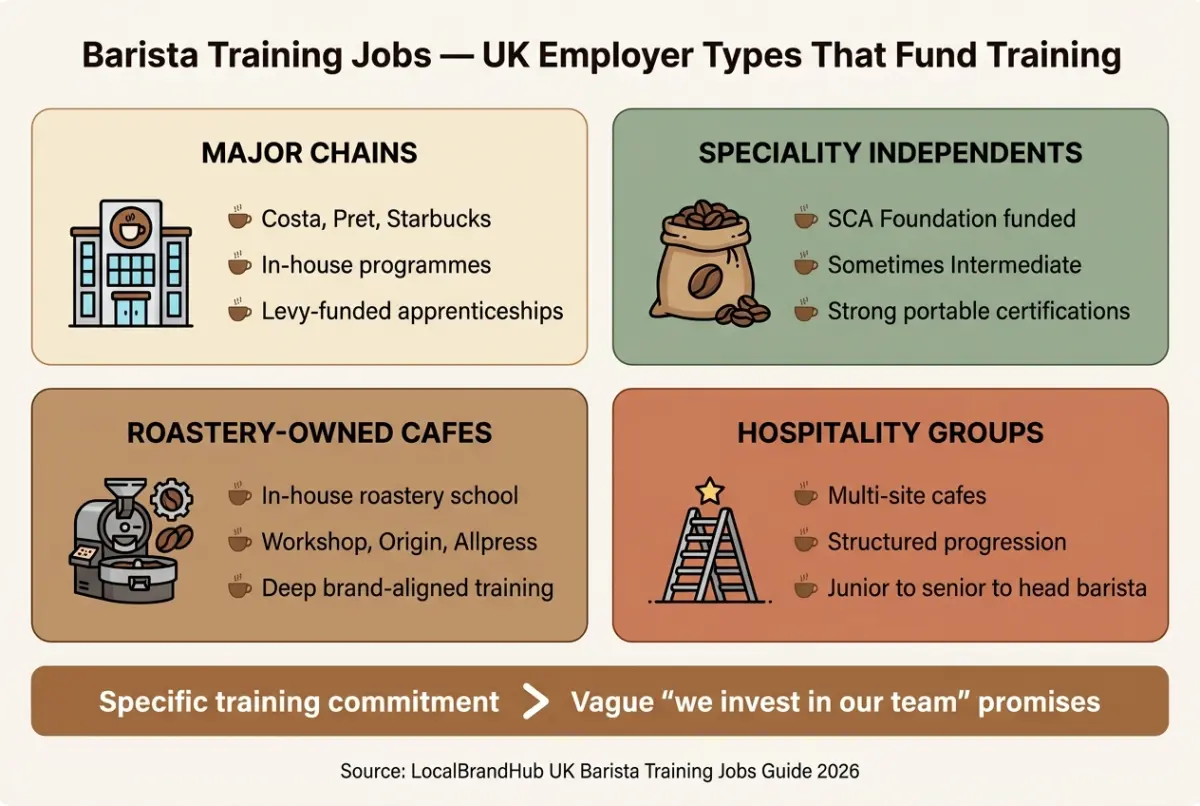
Table of Contents
- What Are Barista Training Jobs?
- Four UK Employer Types That Fund Training
- How to Spot Training-Friendly Cafes
- Interview Questions to Ask About Training
- Apprenticeship Vacancies: Where to Look
- Switching Jobs for Better Training
- FAQs About Barista Training Jobs
- Key Takeaways
What Are Barista Training Jobs?
Barista training jobs are a framework that combines paid coffee shop work with structured skill development, typically including a recognised certification at the employer's expense. The strongest UK options pay a wage, fund a course, and offer a clear progression path from entry-level to senior barista.
Related: Barista Training Overview & Levels
The UK has more than 28,000 coffee outlets (Allegra World Coffee Portal, 2025). Most major chains and many speciality independents now fund some level of barista training as part of staff retention. The catch is that "we invest in our team" appears in nearly every job ad — so the practical skill is reading between the lines.
For example, a 22-year-old career-changer applying to barista jobs in Bristol might shortlist three roles: a chain advertising "ongoing training", a speciality cafe advertising "we fund SCA Foundation in your first 3 months", and a roastery-owned cafe with no training mention at all. The middle one is almost always the strongest option.
Why this matters: A specific training commitment in the job ad is more valuable than a vague one. "We fund SCA Foundation" beats "we invest in development" every time.
Four UK Employer Types That Fund Training
Now that the framework is in place, here are the four UK employer types most likely to fund barista training as part of the job.
| Employer Type | Training Typically Funded | Apprenticeship Common? |
|---|---|---|
| Major chains (Costa, Pret, Starbucks) | In-house programmes + apprenticeships | Yes (Levy-funded) |
| Speciality independents | SCA Foundation/Intermediate | Sometimes |
| Roastery-owned cafes | Roastery in-house school + SCA | Sometimes |
| Hospitality groups | Structured progression programmes | Often |
Funding patterns are typical for UK employers in 2026; check each individual cafe's offer.
Major Chains
Chains like Costa, Pret and Starbucks run substantial in-house training programmes plus formal apprenticeship routes for many staff. The training is genuine and Levy-funded, though the brand-specific style may not transfer cleanly to speciality work later.
Speciality Independents
Speciality cafes (those serving lighter roasts, hosting brew bars, or working with named roasters) often fund SCA Foundation in the first three to six months of employment. The pay tends to be lower than chains, but the certification and reputation transfer better.
Roastery-Owned Cafes
Cafes owned by speciality roasteries (Origin, Workshop Coffee, Square Mile partners) typically include the roastery's in-house training school as a perk. For example, a barista joining a Workshop Coffee partner cafe in Manchester might attend the Workshop training school within their first three months.
Hospitality Groups
Multi-site hospitality groups running multiple cafes often have structured progression programmes — junior to senior to head barista — with funded training between each step.
If you're only looking at chain jobs you'll always lose to speciality-focused baristas with portable certifications. That never works as a long-term plan if you want to stay in the speciality scene.
How to Spot Training-Friendly Cafes
Now that the employer types are mapped, here's how to identify training-friendly cafes from job ads alone.
Strong Signals
- Specific certification mentioned ("we fund SCA Foundation in your first 3 months")
- Apprenticeship route advertised ("Level 2 Hospitality apprentice — barista pathway")
- Roastery affiliation ("Workshop Coffee partner", "Square Mile espresso")
- Senior barista progression named ("clear path to head barista within 18 months")
- Specific roastery school mentioned ("you'll attend the Origin training school in your first 90 days")
Weak Signals to Discount
- "We invest in our team" with no specifics
- "Ongoing training" without naming what or when
- "Career development" with no progression structure
- "Coffee enthusiast wanted" — usually means no training, expects you to bring it
For example, a barista in Liverpool reading two job ads might find one says "junior barista — coffee experience preferred" while the other says "junior barista, SCA Foundation funded in month 3, Intermediate at month 12 if performance review passes". The second is a much stronger barista training job.
From experience: The cafes that fund the best training are usually the cafes most particular about who they hire. If the application includes a coffee-knowledge test or a working trial, that's typically a sign the training will be substantial.
Interview Questions to Ask About Training
Now that you've shortlisted training-friendly cafes, here are the questions to ask in the interview.
- What specific barista training does this role include?
- Is the training funded by the cafe or do I co-pay?
- When in my employment does the training happen?
- What certification do I keep at the end?
- What's the progression path from junior to senior barista here?
- How often does the team get refresher training?
- Does the cafe sponsor apprenticeships?
Worked example: A barista interviewing in Edinburgh for a roastery-owned cafe might ask all seven questions — the answers reveal that the role includes a funded SCA Foundation in month two, ongoing in-shop coaching, and a clear progression to senior at the 12-month review.
Apprenticeship Vacancies: Where to Look
Now that interview questions are sorted, here's the dedicated apprenticeship route. UK barista apprenticeships are paid placements (typically Level 2 hospitality) that combine on-the-job work with structured study, ending in a recognised qualification.
Where to Find UK Barista Apprenticeships
- gov.uk apprenticeship search — the official UK apprenticeship vacancy listing (gov.uk)
- Major chain careers pages — Costa, Pret, Starbucks all post apprenticeship roles
- Local FE colleges — many run hospitality apprenticeships placed with regional cafes
- Roastery group careers pages — Workshop Coffee, Origin, Allpress UK list apprentice roles
- Apprenticeship-specific job boards — RateMyApprenticeship, AmazingApprenticeships
What to Expect
A barista apprentice typically earns the National Minimum Wage for their age band, completes structured study one day per week, and qualifies at Level 2 hospitality after 12 months. The wage isn't generous, but the certification is fully funded.
For example, a 19-year-old apprentice in Manchester might earn the apprentice minimum wage in their first year, gain a Level 2 hospitality qualification at month 12, and step up to a senior junior barista role at adult minimum wage from month 13.
If you can't tell whether a cafe's apprenticeship is structured or just a way to pay below minimum wage that's usually a sign you need to call the apprenticeship provider, not just the cafe, before signing.
Switching Jobs for Better Training
Now that you've seen the routes in, here's the route across. Switching from a chain to a speciality independent — or vice versa — is a common UK career move for baristas seeking better training.
Common Switching Patterns
- Chain → speciality independent: pay typically drops slightly but training and reputation lift sharply
- Speciality independent → roastery cafe: pay similar, training depth lifts substantially
- Apprenticeship → senior barista at speciality cafe: typically a real pay rise plus continued development
For example, a barista who started at a chain in Birmingham, gained two years of fundamental experience there, and switched to a speciality independent might find their second employer funded an SCA Foundation immediately — a course the chain had never offered.
From experience: The right time to switch for training is after 12 — 18 months in your first role, when you have working experience but want structured certification. Earlier and you're churning; later and the chain habits ossify.
Frequently Asked Questions About Barista Training Jobs
Now that the routes are mapped, here are the questions UK baristas ask most often when looking for training-funded roles.
Which UK chain offers the best barista training? For most baristas, Costa and Pret are widely regarded as offering the most structured chain-funded training in the UK, including formal apprenticeship routes. The training is brand-specific but credible. Speciality alternatives often pay less but produce more portable skills.
Are barista training jobs only for total beginners? No — many UK speciality cafes offer Intermediate-level training for working baristas with one to two years of experience. The funded course at this stage is typically SCA Intermediate rather than Foundation.
Can I get an apprenticeship as a career-changer in my 30s or 40s? Yes — apprenticeships have no upper age limit in the UK, and adult apprentices receive at least the National Minimum Wage for their age band. For example, a 34-year-old career-changer in Sheffield might apply for a hospitality apprenticeship at a local roastery cafe and earn full adult minimum wage while training.
How much does a barista training job typically pay? Most UK barista training jobs pay between minimum wage and a small premium above it. The "value" is the certification you keep, not the headline wage. A cafe paying minimum wage plus a funded SCA Foundation effectively pays a mid-three-figure premium to anyone who stays the full term.
Should I take a lower wage for better training? For most early-career baristas, yes — the certifications you accumulate in the first two to three years compound. A barista with two SCA certifications and three years' experience earns more in the long run than one with no certifications and slightly higher pay early on.
What's the most important question to ask in a barista interview? Ask: "What specific course will this role fund, and when?" Vague answers signal the training won't materialise. Specific answers ("SCA Foundation at month 3, Intermediate at month 12 subject to performance review") signal a real commitment.
Where can I see real reviews of UK cafe employers? Glassdoor, Indeed and Reddit's r/Barista have real reviews of chain employers. For independents, ask current and ex-staff directly via LinkedIn or Instagram DMs.
Key Takeaways: Barista Training Jobs
Now that we've covered the employer types, the signals, the interview questions, the apprenticeship route and the switching patterns, here's the pull-together. UK barista training jobs are real and worth searching for — but the strong ones are specific in their training commitment, not vague.
- Four UK employer types fund training: chains, speciality independents, roastery cafes, hospitality groups
- Read job ads for specifics — "SCA Foundation funded in month 3" beats "we invest in our team"
- Apprenticeship routes are paid, fully funded and end in a recognised UK qualification
- Ask seven questions in interview — listed above — to confirm training is real
- Switching after 12 — 18 months is the standard route to better training
Would you walk into your current barista job and feel proud of the certifications you've gained this year? If the answer is "not really", a job switch to a training-funded role is one of the highest-leverage moves you can make this quarter.
If you'd like a hand mapping out your barista career plan with training in mind, LocalBrandHub has free templates for working baristas — useful if you're working solo and want one place to keep the development plan together.
Weekly Action
This week, do two things to find a training-funded barista job:
- Day 1 — 3: Search the gov.uk apprenticeship listings and three local roastery websites for current vacancies that mention specific funded training.
- Day 4 — 7: Email two cafes you'd love to work for and ask if they fund SCA Foundation for new starters.
For restaurants, salons, and local businesses
Need help with your marketing?
We help UK businesses turn social media into real results, not busywork.
Get in TouchKey Takeaway
UK barista jobs that include paid training are out there, but the strong ones are specific — "we fund SCA Foundation in month 3" beats "we invest in our team" every time. Chains, speciality independents, roastery-owned cafes and hospitality groups all run funded routes, and apprenticeships add a fully-paid Level 2 hospitality qualification. Read job ads for specifics, ask the seven interview questions, and treat your first 12 — 18 months as the runway to a training-funded move.
About the Author
Local Brand Hub
Empowering UK Businesses
Local Brand Hub provides comprehensive business management tools designed specifically for UK local businesses to streamline operations, automate marketing, and grow revenue.
More articlesRelated Articles
 Business Growth
Coffee Shop Seating Ideas: A UK Cafe Owner's Guide
Coffee shop seating ideas that add covers and keep customers longer — a UK owner's guide to seating types, layout, comfort and outdoor space.
 Business Growth
Coffee Shop Lighting Ideas: A UK Cafe Owner's Guide
Coffee shop lighting ideas that make a cafe feel warm and photograph beautifully — a UK owner's guide to layers, colour temperature and budget fixtures.
 Business Growth
Coffee Shop Interior Design: A UK Cafe Owner's Guide
Coffee shop interior design that fills quiet afternoons — a UK cafe owner's guide to layout, seating, lighting, ambience and budget ideas.