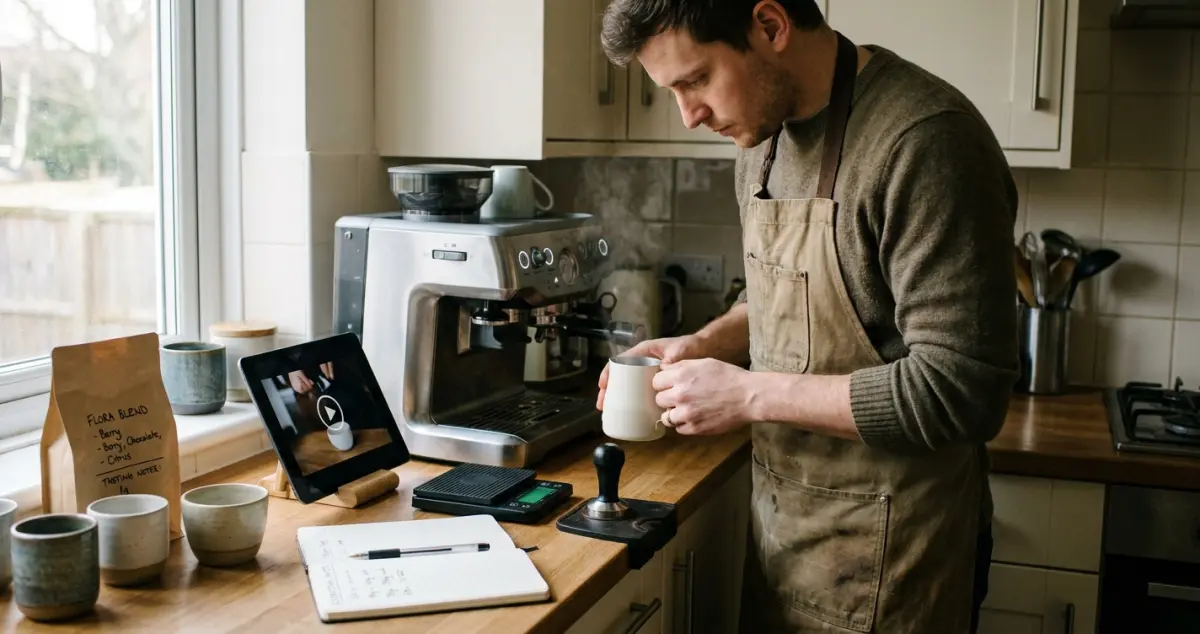
Online barista training in the UK: what online courses can and can't teach, the best UK providers, and how to combine theory with hands-on practice.
Online barista training is self-paced learning that covers the theoretical side of the craft. Extraction science, brewing methods, sensory vocabulary and basic latte art technique are taught through video lessons and written modules. It works well for theory. The hard limit is muscle memory: pulling a real shot under pressure only develops on a real machine.
You've watched a few YouTube videos and read about extraction yields. You can describe what a good flat white looks like. If you're reading this thinking "I've spent £80 on a subscription and I'm not sure my baristas have got better", you're not alone. Most owners face exactly that question. The honest answer isn't whether online barista training is "real" training. It's where the line between online theory and in-person practice actually sits, and how to use both without wasting time or money on either.
This guide walks through what UK online barista training does well, where it falls short, and which providers are worth the subscription. 11 min read.
What You'll Learn
This guide is structured for the cafe owner trying to upskill a small team without sending everyone away, and for the working barista looking to fill theory gaps between shop hours. It's been built around the patterns UK independents report: strong on vocabulary, weak on milk technique, brilliant for the price.
By the end you'll know:
- What online barista training can and can't teach
- The four UK online provider types and how they compare
- Realistic costs and how online compares to in-person on price
- How to combine online theory with hands-on practice in your shop
- The red flags that mark a poor-value online course
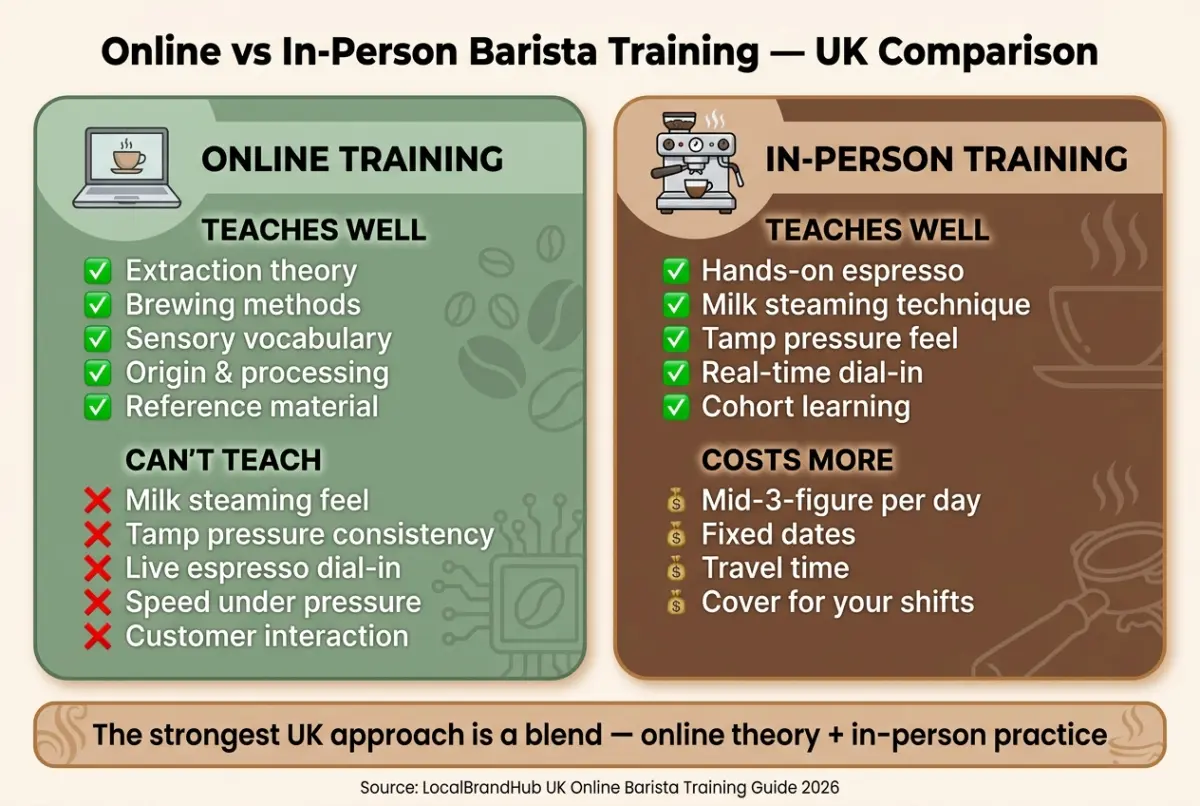
Table of Contents
- What Is Online Barista Training?
- What Online Can and Can't Teach
- UK Online Provider Types
- Online vs In-Person: The Real Comparison
- How to Combine Online with Practice
- Red Flags in Online Courses
- FAQs About Online Barista Training
- Key Takeaways
What Is Online Barista Training?
Online barista training is a framework that develops coffee theory and reference knowledge through video lessons, written modules, and self-paced exercises. It's the lowest-cost entry point into structured barista development: typically a sub-three-figure annual subscription versus a mid-three-figure single in-person day.
Related: Barista Training Overview & Levels
Related: Free Barista Training Options
The UK has more than 28,000 coffee outlets (Allegra World Coffee Portal, 2025) and online learning has become a standard part of how independents train new hires. Most UK speciality cafes now use a blend: online theory before someone steps behind the counter, then in-person practice once they're working shifts.
For example, a Birmingham independent might give every new hire a sub-three-figure online subscription as part of the welcome pack, getting the team aligned on vocabulary and theory before they touch the espresso machine.
Why this matters: Online barista training is most valuable when paired with shop time, not used as a substitute. A barista who's watched 20 hours of online courses but never pulled a shot in a busy 9am rush is still a beginner.
What Online Can and Can't Teach
Now that we've framed online training as a theory layer, here's what it actually does well and where it falls down.
What Online Does Well
- Extraction theory: TDS, yield ratios, dose, time, water flow. All of it can be taught online with diagrams and worked examples.
- Brewing methods: V60, AeroPress, Chemex, French press. The dry steps are easy to demonstrate on video.
- Sensory vocabulary: flavour wheels, descriptive language, common defects. Free resources here rival paid courses.
- History and origin: green-bean knowledge, processing methods, country profiles. Pure information; no practical needed.
- Reference material: recipe cards, tamping charts, troubleshooting guides. Better as a download than a memorised lecture.
What Online Can't Teach
- Milk steaming feel: the texture of properly-steamed milk only registers in your hands, not your ears
- Tamp pressure consistency: the muscle memory of an even 30-pound tamp needs real practice
- Espresso dial-in: adjusting grind in response to a real shot in front of you, on real beans, in a real cafe
- Speed under pressure: the morning rush is the only place to learn morning rush
- Customer interaction: the rhythm of taking orders, making drinks, and chatting at speed
For example, a self-taught barista in Leeds might know more about extraction theory than a junior at a chain, but produce inconsistent shots in a busy 8am rush because the muscle memory was never built.
If you can't tell whether your online training is producing real skill or just confident vocabulary that's usually a sign you need to spend a fortnight on a real bar.
UK Online Provider Types
Now that the limits are clear, here are the four UK online barista training provider types worth knowing.
| Provider Type | Format | Typical Cost |
|---|---|---|
| SCA Coffee Skills Online | Modules + theory assessment | Sub-three-figure per module |
| Roastery YouTube channels | Free video tutorials | Free |
| Subscription platforms (e.g. Coffee Compass) | All-you-can-eat library | Sub-three-figure annual |
| Home barista communities | Peer-led, forums + livestreams | Free or low-three-figure |
Cost ranges are typical for UK access in 2026; check each provider for current pricing.
For example, a Sheffield owner might combine a free SCA YouTube series for the team's first week with a sub-three-figure subscription for the head barista's ongoing development: total spend a small fraction of what a single in-person Foundation course would cost.
From experience: Free options can match paid ones for theory. The Square Mile and Workshop Coffee YouTube channels cover extraction, milk and brewing methods to a level that rivals subscription content.
Online vs In-Person: The Real Comparison
Now that we've covered what online does and the providers offering it, here's the honest comparison versus in-person training.
| Aspect | Online | In-Person |
|---|---|---|
| Cost | Sub-three-figure to mid-three-figure annual | Mid-three-figure per day |
| Time flexibility | Self-paced anytime | Fixed dates |
| Theory depth | Excellent | Variable |
| Hands-on practice | None | Several hours per day |
| Assessment | Often online-only | Typically in-person |
| Network/community | Limited to forums | Full cohort + trainer |
Comparison reflects typical UK speciality coffee training in 2026; specific courses vary in detail.
If you pick just one route for someone brand new to coffee, in-person Foundation training is often the strongest start. The muscle memory only builds with real machine time. Online theory becomes powerful as a supplement once the hands know what they're doing.
For example, a Norwich cafe might run a hybrid model: online subscription for the whole team year-round, plus one in-person Foundation day per new hire in their first month. The combined cost is similar to two in-person days alone but delivers far more learning per pound.
If you're only doing online training and never the practical you'll always lose to baristas who built muscle memory at a real machine. That never works as a long-term plan. Online theory needs hands-on follow-through to stick.
How to Combine Online with Practice
Now that you've seen how online and in-person compare, here's how to combine them effectively.
The Three-Stage Blend
- Stage 1 (week 1): Online theory before any shop time: extraction, milk basics, drink construction vocabulary
- Stage 2 (weeks 2 to 6): Daily shop practice with online modules in parallel, focused on whatever's drifting (often milk)
- Stage 3 (month 3+): In-person Foundation course as benchmark and skills audit
A Quick In-Shop Routine
- Morning: 15-minute review of one online module (theory or technique)
- Mid-shift: Practise the technique covered during a quiet moment
- End of shift: Discuss with a senior barista what worked and what didn't
This routine costs nothing beyond an annual online subscription and 15 minutes of shop time daily. Most UK independents who use it report new hires reach a competent service standard 30 to 40% faster than self-taught equivalents.
Worked example: A Bristol cafe owner might run this three-stage blend across two new hires, sending both to an in-person Foundation course after eight weeks. Both pass on the day because the online prep eliminated the theory gap.
Red Flags in Online Courses
Now that the blend strategy is clear, here are the warning signs that an online barista training course isn't worth the subscription.
- No reference to real working baristas: if no shop owners or working baristas appear, the content is likely outdated theory
- Outdated equipment in videos: if the espresso machine on screen is from many years ago, the dial-in advice may not match modern kit
- No assessment option: no way to verify your skill at the end
- Marketing-heavy modules: courses that sell you the next course rather than teaching you the current one
- No milk-steaming module: milk is half the work; missing it suggests a thin syllabus
- No update history: coffee science evolves; a course unchanged for several years is showing its age
If you can't tell whether an online course is teaching you or just selling you that's usually a sign to test the free tier first.
Frequently Asked Questions About Online Barista Training
Now that the framework is in place, here are the questions UK independents and individual baristas ask most often.
Is online barista training worth it for a complete beginner? For most beginners, online barista training is a strong first step but not enough on its own. Pair it with at least a few hours of in-person practice before working a real shift. For example, a London beginner might watch an online series on extraction theory before attending an in-person Foundation day. The day then makes much more sense.
Can I get an SCA certification entirely online? Some SCA Coffee Skills Programme modules can be taken online for theory, but practical assessments at Intermediate and Professional levels typically require in-person attendance. Check the SCA website for the current online module list.
How long does an online barista training subscription typically last? Most UK subscription platforms run on annual cycles at sub-three-figure cost, with some offering monthly options. Free YouTube content has no time limit but lacks structured progression.
Is free YouTube barista training as good as paid online courses? For many topics, yes. Free content from Square Mile, Workshop Coffee, James Hoffmann and roastery channels covers extraction, milk, brewing, and origin to a high standard. Paid platforms add structure, assessment, and certification, useful but not essential.
Can my employer claim back the cost of an online barista training subscription? Yes, staff training is typically a deductible business expense for UK cafes registered with HMRC. Keep the subscription receipts for your accounts.
How does online barista training compare to apprenticeships? Apprenticeships combine paid work with structured learning over 12+ months and end in a recognised qualification. Online training is faster and cheaper but produces no formal credential. Most independents use both: apprenticeships for entry-level hires and online platforms for ongoing development.
Should I use multiple online platforms or pick one? For most UK independents, picking one paid platform plus free YouTube channels works well. Multiple paid subscriptions get expensive quickly without proportional learning gains.
Key Takeaways: Online Barista Training
Now that we've covered what online does, what it doesn't, the providers, the comparison, the blend, and the red flags, here's the pull-together.
- Online barista training excels at theory: extraction, brewing methods, vocabulary, sensory
- It can't teach milk steaming or tamp consistency: those need real machine time
- Free YouTube content rivals paid platforms for many topics
- The strongest UK approach is a blend: online theory plus shop practice plus one in-person Foundation
- Red flags include outdated equipment, no working-barista voices, and missing milk modules
Would you walk into your own cafe right now and trust a self-taught barista to handle the morning rush? If the answer is "not yet", online barista training plus a few weeks of supervised shop time is often the cheapest way to build that trust.
If you'd like a hand mapping out your team's blended training plan in one place, LocalBrandHub has free templates for independent cafes, useful if you're working solo and want one place to keep the development plan together. The same one-place approach helps with the marketing side too. You can see the plans built for independent cafes if you want your posts, promotions and local listings organised alongside your training notes.
Weekly Action
This week, do two things to start an online-plus-practice training programme:
- Day 1 to 3: Pick one free YouTube channel (Square Mile, Workshop Coffee, James Hoffmann) and watch one extraction theory video alongside the team during a quiet afternoon.
- Day 4 to 7: Sign up to one annual online subscription and assign each team member one module to complete in their first week.
If you run a coffee shop and want to see how Local Brand Hub can support your marketing, explore our coffee shop marketing tools.
For restaurants, salons, and local businesses
Need help with your marketing?
We help UK businesses turn social media into real results, not busywork.
Start freeKey Takeaway
Online barista training in the UK is the strongest, lowest-cost route for theory: extraction, brewing, vocabulary and sensory work all transfer well to video and self-paced modules. Where it stops short is muscle memory: milk steaming, tamp consistency and dial-in only build on a real machine. The right approach for most independents is a blend: online subscription for the whole team plus an in-person Foundation day per new hire to lock in the practical.
Get More Marketing Tips
Practical marketing tips for UK business owners, straight to your inbox. No spam, unsubscribe anytime.
About the Author
Local Brand Hub
Empowering UK Businesses
Local Brand Hub provides comprehensive business management tools designed specifically for UK local businesses to streamline operations, automate marketing, and grow revenue.
More articlesRelated Articles
 Tutorials
Barista Training Free: UK Routes for Zero-Cost Learning
Barista training free options in the UK: apprenticeships, employer-funded courses, free YouTube channels and college routes that work.
 Tutorials
Barista Training Courses: UK Course Evaluation Guide
Barista training courses UK: how to choose a paid course by accreditation, hands-on hours, equipment, and trainer credentials, with real costs.
 Tutorials
Barista Training: UK Levels, Costs & Provider Guide
Barista training in the UK: Foundation to Professional levels explained, what good courses cost, where to find them, and how to train cafe staff.