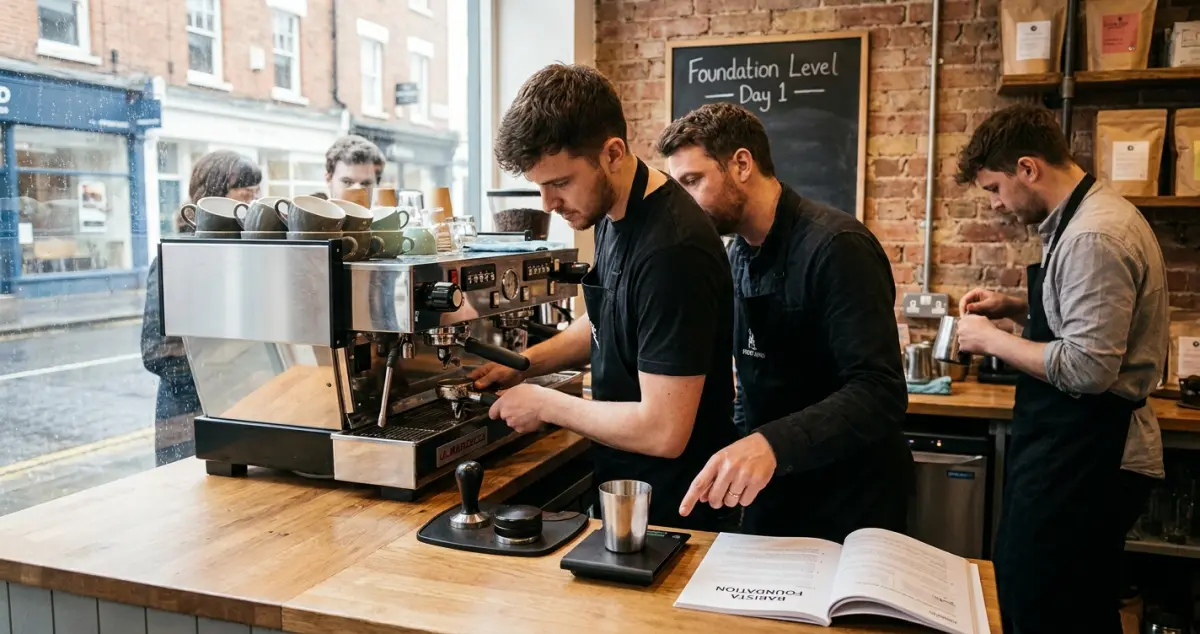
Barista training courses UK: how to choose a paid course by accreditation, hands-on hours, equipment, and trainer credentials, with real costs.
Barista training courses are paid, structured programmes that develop espresso, milk-steaming and brewing skills under a qualified trainer. The strongest courses, typically SCA-authorised or roastery-led, combine theory with hands-on machine time and end with an assessment. Picking the right one comes down to four factors: accreditation, hands-on hours, equipment quality, and trainer credentials.
You've read the listicles. Every course claims to make you a better barista. If you're reading this thinking "I've already booked something; am I about to waste £350 on a glorified slideshow?", you're not alone: most first-time owners face exactly that question. The honest answer isn't which course "is best": it's which course actually puts you on a real espresso machine for enough hours, taught by someone who works in the industry, with beans that match what your shop serves.
This guide walks through how to evaluate a paid barista training course before you book, and how to spot the courses that look legit but aren't. 12 min read.
What You'll Learn
This guide is structured for the cafe owner choosing where to send a new hire, and for the barista picking their next development course. It's been built around the actual evaluation process UK independents use: checking accreditation, calling past attendees, and trialing one trainer before committing the whole team.
By the end you'll know:
- The four factors that decide whether a barista training course is worth the money
- How UK courses compare on accreditation, hands-on hours, and trainer credentials
- Realistic price ranges and what each price tier actually buys
- The red flags that signal a course is closer to marketing than training
- A checklist to evaluate any course before you book
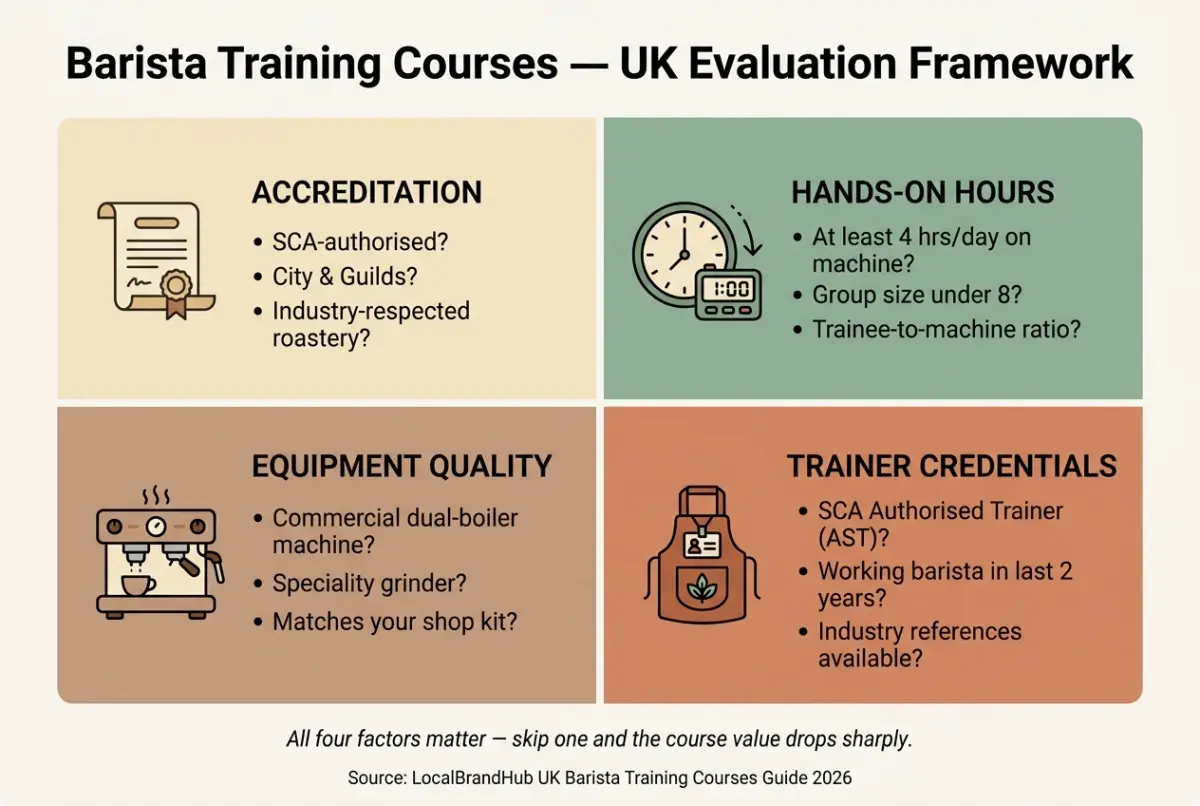
Table of Contents
- What Makes a Good Barista Training Course?
- The Four Factors
- UK Course Types Compared
- How Much Do Barista Training Courses Cost?
- Red Flags to Avoid
- The Pre-Booking Checklist
- FAQs About Barista Training Courses
- Key Takeaways
What Makes a Good Barista Training Course?
A good barista training course is a framework that combines theory, hands-on machine time, and assessment under a working barista trainer. It produces measurable skill gains rather than just a certificate. The strongest UK courses are SCA-authorised, taught by Authorised SCA Trainers (ASTs), and use commercial-grade equipment that reflects what most independents actually run.
Related: Barista Training Overview & Levels
Related: Free Barista Training Options
Related: Online Barista Training Guide
The UK has more than 28,000 coffee outlets (Allegra World Coffee Portal, 2025) and the speciality side of the market keeps expanding. Most owners report that a barista who's been through a structured course pulls more consistent shots within their first week than a self-taught hire does in their first month.
For example, a Manchester independent might compare two new hires: one who watched YouTube tutorials at home, one who completed an SCA Foundation day. Within a fortnight, the SCA-trained barista is producing reliable flat whites in the morning rush; the self-taught hire is still inconsistent.
Why this matters: A barista training course isn't a certificate. It's the muscle memory and vocabulary that lets a new hire keep up at 8am. The course is the floor, not the ceiling: practice in your shop is what turns the floor into a finished kitchen.
The Four Factors
Now that we've framed what good looks like, here's the evaluation framework UK independents actually use. Every paid barista training course breaks down into four factors.
Factor 1: Accreditation
Accreditation tells you whether the course is recognised beyond the trainer's own brand. The strongest UK options are Speciality Coffee Association (SCA) certifications, which are globally portable. City & Guilds qualifications carry weight domestically. Roastery-specific courses (Workshop Coffee, Square Mile, Origin) carry industry weight even without SCA certification.
For example, a barista in Edinburgh who plans to travel and work abroad benefits more from SCA Foundation than a roastery-specific course; a barista staying in their UK hometown might prefer the roastery course because the trainer is someone they'll see regularly.
Factor 2: Hands-On Hours
Now that accreditation is checked, hands-on hours matter most. The single biggest predictor of how much a trainee actually learns is time on a commercial machine, not the slides on screen. Look for courses that schedule at least 4 hours of espresso practice per day, not 90 minutes of demo and 30 minutes of "have a go".
Factor 3: Equipment Quality
Next, the equipment matters as much as the trainer. A course taught on an old home machine doesn't transfer to a 2026 commercial dual-boiler. Ask which espresso machine, grinder and water filter the course uses, and whether it matches the kit your shop runs.
Factor 4: Trainer Credentials
Finally, the trainer's working background matters. SCA Authorised Trainers (ASTs) work in the industry and bring real shop context. Avoid courses where the trainer hasn't worked behind a counter in the last two years.
UK Course Types Compared
Now that the four factors are clear, here's how the main UK barista training course types compare.
Related: Online Barista Training Guide
| Course Type | Accreditation | Hands-On Hours | Trainer Background |
|---|---|---|---|
| SCA Foundation (1 day) | Globally recognised | ~4-5 hours | SCA Authorised Trainer |
| SCA Intermediate (2-3 days) | Globally recognised | ~10-12 hours | SCA Authorised Trainer |
| Roastery-led course | Industry-recognised | ~5-6 hours | Working head barista |
| City & Guilds hospitality | UK-recognised | Variable | College tutor |
| Online theory + practical | Mixed | ~2-3 hours practical | Variable |
Course lengths and hands-on hours are typical for UK courses in 2026; check each provider's syllabus for exact figures.
For example, a small Bristol cafe owner deciding between two single-day Foundation courses might pick the one taught by a local roastery's head barista over the generic SCA day, because the local trainer's bean and machine match the shop's, and the relationship continues after the course ends.
If you're only choosing a course on price you'll always lose to operators who picked one their team trusts. That never works as a development decision: barista training only sticks when the trainer is someone the trainee respects.
How Much Do Barista Training Courses Cost?
Now that course types are mapped, here's what each one costs.
Per-Course Price Ranges
- SCA Foundation (1 day): mid-three-figure sum per person
- SCA Intermediate (2-3 days): mid-to-high-three-figure sum
- SCA Professional (5+ days): four-figure sum, often including assessment fees
- Roastery in-house day: low-to-mid-three-figure sum, sometimes subsidised by the roastery's bean account
- City & Guilds programme: variable; often heavily subsidised through colleges or apprenticeship funding (gov.uk apprenticeships)
- Online + practical bundle: sub-three-figure annual subscription plus a single in-person assessment day
For example, a UK independent budgeting for two new hires might land around a low four-figure total: Foundation course for both plus one Intermediate for the head barista. Apprenticeship-funded routes can bring this to near-zero employer cost. The same value-for-money scrutiny is worth applying to every recurring bill, including marketing, comparing the plans before you commit stops you paying for tools you will not use.
From experience: Cheaper courses aren't always worse. A small roastery's head trainer running a focused day for £180 a head can outclass a generic SCA Foundation at £350, if the roastery aligns with your bean choice.
Red Flags to Avoid
Now that you've seen the good signals, here are the warning signs that a barista training course isn't what it claims to be.
- No mention of hands-on hours in the course description: usually means there are very few
- Trainer has no working barista history: slides-only teaching produces slides-only baristas
- Generic equipment that doesn't match working cafes: home machines, single-boiler setups
- No follow-up support: good trainers offer a question email for the first month after
- Group sizes over 8: too many trainees per machine means almost no individual practice time
- No bean information published: strong courses tell you what they're roasting because the bean affects every dial-in
If you can't tell whether a course is going to develop your barista or just hand them a certificate that's usually a sign you need to call a past attendee before booking.
Worked example: A cafe owner in Brighton might trial one trainer with a single new hire before committing the whole team to that provider's three-day course: paying £180 to test the relationship before investing £1,200.
The Pre-Booking Checklist
Now that the framework, providers, costs and red flags are covered, here's a practical checklist before you book any barista training course.
For example, a Glasgow cafe owner running through the checklist might call two past attendees from one shortlisted SCA course, hear that group sizes were over 10 last cohort, and switch to a smaller roastery-led day even though it cost slightly more.
- Have you confirmed the accreditation (SCA, City & Guilds or industry-respected roastery)?
- Have you checked the trainer's working barista history in the last two years?
- Have you asked about hands-on hours per day on a commercial machine?
- Have you confirmed the espresso machine and grinder match (or are similar to) your shop kit?
- Have you asked about group size and trainee-to-machine ratio?
- Have you spoken to one past attendee about the course quality?
- Have you locked in shop cover for the day(s) the trainee is away?
Why this matters: A barista training course is an investment in muscle memory, not a piece of paper. The pre-booking work (checking accreditation, calling past attendees) is where you avoid wasting £350 on a slide deck.
Frequently Asked Questions About Barista Training Courses
Now that the framework is in place, here are the questions UK independents ask most often when picking a barista training course.
How long are most UK barista training courses? Most foundational UK barista training courses run as a single intensive day (around 6 to 7 hours) or two half-days. Intermediate courses extend to 2 to 3 days. Professional courses run a week or more, often spread across multiple weekends.
Are online barista training courses worth it? Online courses work well for theory (extraction science, brewing methods, sensory vocabulary) but can't substitute for hands-on machine practice. For example, a Liverpool owner might use an online subscription to teach the team theory, then book a single in-person day for the practical assessment.
Do I need a barista training course to work in a UK cafe? No formal qualification is required. However, many UK independents prefer hires with at least an SCA Foundation, because it speeds up onboarding by two to three weeks. For working baristas, courses are often the difference between a junior shift and a senior one.
Can my employer pay for my barista training course? Yes, and many UK independents do. The Apprenticeship Levy can fund training for staff via apprenticeship-route programmes. Smaller employers can claim co-funding from the government for hospitality skills training.
How do I find SCA-authorised trainers near me? The SCA maintains a public directory of Authorised Trainers (ASTs) at sca.coffee. Filter by country, then by city. Most UK cities have at least one AST within an hour's travel.
What's the difference between a course and an apprenticeship? A course is typically a fixed-length programme leading to a certificate; an apprenticeship is a longer paid placement (12+ months) combining on-the-job training with structured learning, ending in a recognised qualification.
Should I book a course before or after I start working as a barista? Most UK owners recommend booking after a couple of weeks of shop time. The course makes more sense once the trainee has felt a real espresso machine in their hands during a morning rush.
Key Takeaways: Barista Training Courses
If you run a coffee shop and want to see how Local Brand Hub can support your marketing, explore our coffee shop marketing tools.
For restaurants, salons, and local businesses
Need help with your marketing?
We help UK businesses turn social media into real results, not busywork.
Start freeKey Takeaway
Choose a UK barista training course using four factors: accreditation (SCA, City & Guilds, or a respected roastery), hands-on hours on a commercial machine, equipment that matches your shop kit, and a trainer who still works behind a counter. SCA Foundation is the safest entry point, but a roastery-led day with the right trainer can outclass it: trial one trainer with a single hire before booking the whole team.
Get More Marketing Tips
Practical marketing tips for UK business owners, straight to your inbox. No spam, unsubscribe anytime.
About the Author
Local Brand Hub
Empowering UK Businesses
Local Brand Hub provides comprehensive business management tools designed specifically for UK local businesses to streamline operations, automate marketing, and grow revenue.
More articlesRelated Articles
 Tutorials
Barista Training: UK Levels, Costs & Provider Guide
Barista training in the UK: Foundation to Professional levels explained, what good courses cost, where to find them, and how to train cafe staff.
 Tutorials
Barista Training Free: UK Routes for Zero-Cost Learning
Barista training free options in the UK: apprenticeships, employer-funded courses, free YouTube channels and college routes that work.
 Tutorials
Online Barista Training: UK Self-Paced Learning Guide
Online barista training in the UK: what online courses can and can't teach, the best UK providers, and how to combine theory with hands-on practice.