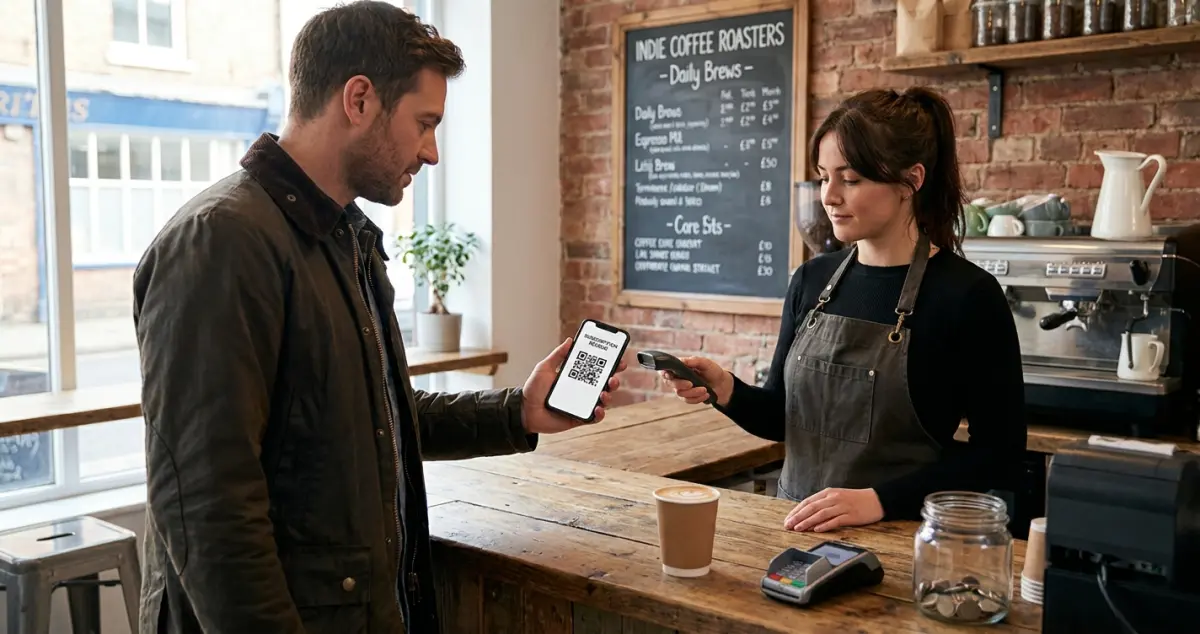
Coffee shop subscription UK 2026: monthly pass models, unit economics, churn, infrastructure needed and whether the maths actually works for an indie cafe.
A coffee shop subscription is a monthly pass that gives customers a capped number of drinks per day for a flat fee. For UK independents in 2026, a coffee shop subscription only works when the unit economics on milk, labour, and cup costs leave you whole at the subscription price.
If you're reading this thinking Pret made it look easy, look harder. Chains can run subscriptions because their unit cost per drink is squeezed by scale: wholesale milk, machine financing, and labour split across hundreds of sites. An indie cafe paying retail-ish on inputs has to do the maths carefully before launching, not after. Reading time: 12 minutes.
Related: Coffee Shop Loyalty Programs UK 2026
What You'll Learn
About this guide: Based on the UK independent coffee shop market and our editorial work with LocalBrandHub, with unit-economics reasoning informed by UK indie operator experience and platform-level notes verified against vendor documentation as of 2026.
This guide is for owner-operators of UK independent coffee shops considering a coffee shop subscription model. We focus on the unit economics first because a coffee shop subscription pricing model with the wrong inputs is the fastest route to subsidising your competitors' customers.
- How the Pret-style subscription model actually works
- The three unit-economics inputs that decide whether subscription is viable for an indie
- Churn, abuse, and the operational realities most operators underestimate
- Infrastructure needed: POS integration, payment processing, daily caps
- When subscription is the wrong answer
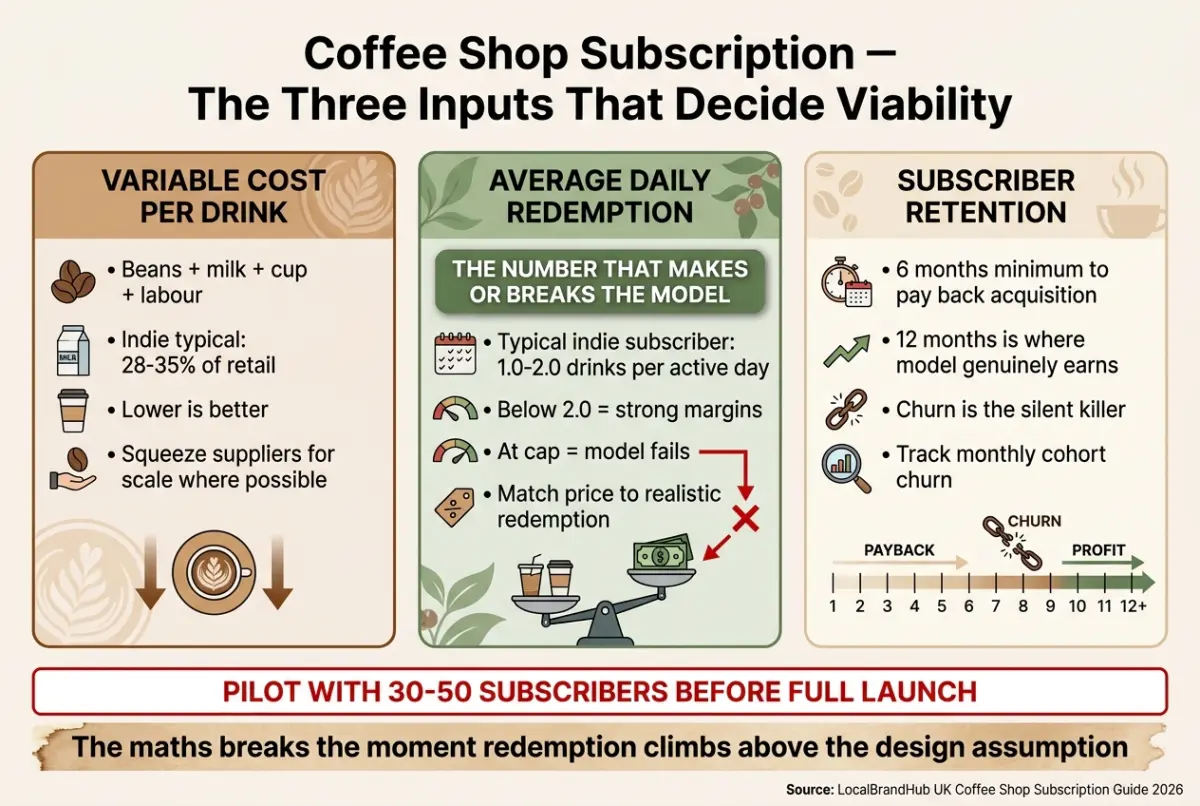
Table of Contents
- What is a coffee shop subscription?
- The Pret-style model explained
- Unit economics: when subscription is viable
- Churn, abuse, and operational reality
- Infrastructure you actually need
- When subscription is the wrong answer
- Frequently asked questions
- Weekly Action
What is a coffee shop subscription? {#what-is}
A coffee shop subscription is a framework that swaps per-transaction pricing for a flat monthly fee giving the customer a capped number of drinks per day. Unlike a loyalty card (which rewards behaviour after the fact) or a referral programme (which acquires new customers), a subscription is a predictable monthly revenue stream that ties a customer to your cafe through pricing structure.
For example, a single-site cafe in Brighton might offer a subscription at a mid-two-figure monthly fee for up to five drinks per day. A daily flat-white drinker who would otherwise spend the retail price per drink over twenty working days pays the flat fee instead. The cafe trades revenue per transaction for revenue predictability and visit frequency.
The Pret-style model explained {#pret-model}
Now that the framework is clear, here's the specific shape the UK market has standardised on. Pret a Manger popularised the monthly-cap subscription with their Club Pret offering: typically a flat monthly fee for a daily cap of barista-prepared drinks. The model has three key features.
Feature 1: daily cap, not unlimited
Subscriptions almost always cap drinks per day (typically five) and add a minimum gap between drinks (typically thirty minutes). Without these caps, a single subscriber could redeem dozens per day or hand the QR code around to family and friends.
For example, a single-site cafe owner in Liverpool initially launched a coffee shop subscription with no daily cap. Within two weeks, three subscribers were redeeming twelve drinks per day each by sharing codes. They restructured to a five-drink cap with thirty-minute gap and the problem disappeared overnight.
Feature 2: redemption via QR code or phone
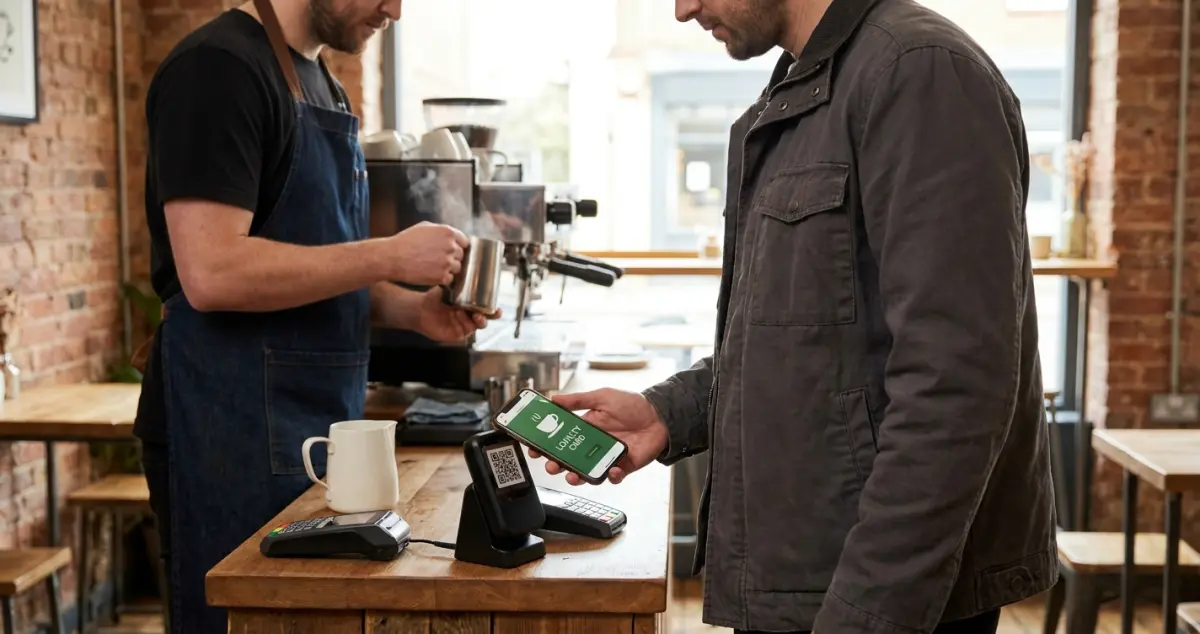
The customer shows a code at the till. Staff scan, the system confirms eligibility, the drink is rung through as a comp (or as part of the subscription revenue split). No cash, no card transaction at the till.
For example, a two-site indie in Glasgow uses phone-number lookup at the till rather than QR codes: saves the customer fishing out their phone and trims roughly five seconds per redemption during morning rush. Five seconds matters when the queue is twelve deep.
Feature 3: monthly recurring billing
Payment is processed at the start of each month, usually via Stripe, GoCardless, or the platform's own billing rails. Customers can cancel for the following month but don't get pro-rated refunds within the month.
For example, a roastery-cafe in Bristol uses GoCardless direct debit rather than card-on-file because the transaction fees are meaningfully lower at scale: saves roughly a low single-pound figure per subscriber per year once you cross a hundred subscribers.
Furthermore, the model relies on most customers redeeming meaningfully less than the daily cap allows; that's where the maths works. If every subscriber redeemed five drinks every day, the model wouldn't survive even at chain scale.
Unit economics: when subscription is viable {#unit-economics}
First, the maths. A subscription is a margin trade: you swap higher per-drink margin for lower-but-more-predictable monthly margin. It only makes sense when three numbers line up.
Input 1: variable cost per drink
Beans, milk, cup, lid, sleeve, labour for the pour. A UK indie's variable cost per flat white commonly sits at a high-twenties-to-mid-thirties percentage of retail price. Lower-cost drinks (filter, americano) sit lower; specialty drinks (mochas with cream, syrups) sit higher.
Input 2: average daily redemption rate
How many drinks a subscriber redeems per active day. If the cap is five but the average is 1.5, you're well within the maths. If the average is 3, you're closer to break-even. If the average is at the cap, the maths fails.
Input 3: subscriber retention
How many months the average subscriber stays. Three months barely pays for acquisition. Twelve months is where the recurring revenue model genuinely earns. Churn is the silent killer.
| Metric | Indie-typical | Implication |
|---|---|---|
| Variable cost per drink | High twenties to mid thirties % of retail | Lower is better; squeeze suppliers |
| Average daily redemption | 1.0-2.0 drinks per active day | Below 2 means strong margins |
| Subscription price | Mid two-figure £ per month | Must cover ~30 redemptions at variable cost |
| Subscriber retention | Six months minimum to pay back acquisition | Below 4 months and the model bleeds |
Unit economics figures are typical for UK independent operators in 2026; your numbers will vary by location, supplier costs, and customer mix.
Worked example
Take a flat monthly subscription at a mid-two-figure pound price. Variable cost per drink at a third of retail. A subscriber who redeems an average of 1.5 drinks per day over twenty active days redeems 30 drinks at COGS of approximately mid one-figure pounds per drink: total monthly COGS in the upper teens. Gross contribution per subscriber per month sits in the low to mid two-figure pound range. Over six months that's a meaningful contribution, provided retention holds.
Why this matters: The maths breaks the moment redemption averages climb above the design assumption. A subscriber redeeming four drinks daily costs you twice as much in COGS as one redeeming two. If your subscription price was set on a two-drink assumption, the four-drink customer is a slow loss.
Churn, abuse, and operational reality {#churn}
Next, the part most operators underestimate. Subscription revenue feels reliable until churn arrives, and abuse arrives faster than you expect.
Churn patterns
The single biggest churn driver in cafe subscriptions is the customer who tries the model for a month, doesn't hit the daily cap often enough to feel value, and cancels. The countermeasure is matching subscription price to realistic redemption, not optimistic redemption.
For example, a cafe owner in Reading initially priced their subscription assuming subscribers would redeem three drinks daily, set the monthly price high accordingly, and saw 60% cancel after month one because daily redemption averaged 1.4. Repricing to a lower monthly fee aligned with realistic redemption recovered the model.
Abuse vectors
Three patterns recur. Subscriber lets a friend use the QR code: defeats the per-subscriber maths. Subscriber redeems multiple drinks back-to-back to avoid the gap timer: drains the daily cap with workarounds. Subscriber redeems at peak rush every day, fine in theory, but operationally creates queue pressure during the moments when full-paying customers are already waiting.
Defences
- Per-account QR codes with a name and photo on staff-facing display
- Time-gap enforcement in the platform (typically thirty minutes between redemptions)
- Off-peak incentives: bonus retail item or food discount during 11am-2pm window for subscribers
For example, a single-site indie in Sheffield offers subscribers a free pastry during the 2-4pm quiet afternoon slot: shifted roughly 30% of their subscriber redemptions out of the morning rush in the first quarter. The pastry cost a fraction of the rush-hour operational pressure it relieved.
If you're only optimising for subscriber count you'll always lose to competitors who optimise for subscriber profitability. That never works as a sustainable strategy.
Infrastructure you actually need {#infrastructure}
Building on the above, the operational layer. A subscription isn't a marketing campaign: it's a recurring billing system tied to a POS-integrated redemption mechanic. The infrastructure has to be in place before you launch.
POS integration
Square, Loyverse, Lightspeed and other modern POS systems either include subscription mechanics natively or integrate with third-party platforms. Without POS integration, every redemption is a manual workflow at the till: operational tax that compounds during the morning rush.
Recurring payment processing
Stripe, GoCardless, or the platform's own rails. Watch transaction fees: a low single-digit percentage on a mid-two-figure monthly fee is a recurring chunk of margin.
Cancellation and customer service
Cancellation must be one-click in the customer-facing app or via email. Friction-heavy cancellation processes are now flagged by the Competition and Markets Authority and the UK Digital Markets, Competition and Consumers framework. Make it easy to leave.
Data and reporting
Track active subscribers, monthly churn rate, average redemptions per subscriber, and COGS per subscriber. Without these four numbers monthly, you can't tell whether the model is paying off.
Worked example: A two-site indie in Edinburgh ran a subscription pilot for three months. Subscribers averaged 1.7 daily redemptions. Churn was 8% per month. Average tenure landed at twelve months. Gross contribution per subscriber per month sat comfortably in the mid two-figure pound range. The pilot turned into a permanent offering. The pilot's success depended entirely on the three unit-economics inputs landing favourably from launch.
When subscription is the wrong answer {#wrong-answer}
If you can't tell whether your customers want predictability or variety that's usually a sign you haven't asked them. Subscription only works when a meaningful share of your daily traffic wants the same thing every day.
Three situations where subscription doesn't fit
- Mixed-purpose cafes where customers come for different drinks on different visits: predictability isn't the value proposition
- Low daily-regular base where most traffic is occasional rather than daily: the model has nobody to sell to
- Tight margins on inputs: if your COGS per drink already exceeds 40% of retail, the maths is fragile from sentence one
If you pick subscription as your loyalty mechanic, only commit after you've run a 90-day pilot with capped sign-ups (typically 30-50 subscribers) and measured the three numbers: daily redemption, churn, COGS per subscriber. A full launch without a pilot is the most expensive way to learn whether the model fits.
Pre-launch checklist
- Calculate variable cost per drink across your top three drinks
- Set realistic daily redemption assumption (start with 1.5)
- Price the subscription at 2-2.5x that assumed COGS for headroom
- Confirm POS integration and recurring billing rails are in place
- Cap pilot at 30-50 subscribers for first 90 days
- Set monthly review of churn and average redemption
Would you actually subscribe to your own cafe at the price you've just set? If yes, you're ready to pilot. If you'd hesitate, lower the price or rethink the cap.
Frequently asked questions {#faq}
Q: What is a coffee shop subscription?
A coffee shop subscription is a monthly pass where a customer pays a flat fee in exchange for a capped number of drinks per day. The cap is typically five drinks per day with a minimum gap between redemptions (often thirty minutes). Customers redeem via QR code or phone at the till. The model swaps higher per-transaction margin for lower-but-predictable monthly revenue.
Q: How much should a coffee shop subscription cost?
For UK indies, a mid-two-figure monthly fee is the standard reference point set by Pret's Club Pret pricing. The right price for your cafe depends on your variable cost per drink and realistic daily redemption assumption: typically 2-2.5x your expected monthly COGS per subscriber to leave headroom for above-average redeemers.
Q: Is a coffee shop subscription profitable for independents?
It can be, but the maths is fragile. The model only works when variable cost per drink is moderate (under a third of retail), daily redemption averages under two drinks, and subscriber retention exceeds six months. Indies with tight margins on inputs or low daily-regular bases typically find a loyalty card or paired-reward referral programme generates more contribution.
Q: How does Pret's coffee subscription work?
Pret's Club Pret offers a daily cap of barista-prepared drinks for a flat monthly fee with a minimum gap (typically thirty minutes) between redemptions. Customers redeem via the Pret app with a QR code. The chain's economics work because their variable cost per drink is lower than an indie's (wholesale milk, scale-discount beans) and their customer base is heavily skewed to daily commuters who redeem consistently.
Q: What stops people abusing a coffee shop subscription?
Three defences: time gaps between redemptions (typically thirty minutes), per-account QR codes that staff can verify, and off-peak incentives to spread redemption away from rush hours. Most abuse is a rounding error in the model: over-engineering anti-abuse measures often costs more in operational complexity than the abuse itself.
Q: How do I handle subscription cancellations?
One-click cancellation in the customer-facing app or via email is the standard. Friction-heavy cancellation processes can attract attention from the Competition and Markets Authority and damage trust. Customers who cancel cleanly often resubscribe; customers who feel trapped never come back.
Related: Coffee Shop Loyalty App UK 2026
Why this matters: LocalBrandHub sees indies launch coffee shop subscription models without piloting first, and reverse out within six months. Pilot small, measure, then commit.
If you only have 30 minutes a week {#minimum-viable}
A coffee shop subscription doesn't need a launch event: it needs the numbers to add up first, the same discipline you'd bring to working out the return on any marketing investment. If you only have 30 minutes a week, do this:
This week, test coffee shop subscription viability in 30 minutes:
- Day 1-2: Calculate variable cost per drink across top three drinks, ten minutes
- Day 3-4: Set the subscription price at 2-2.5x expected monthly COGS, five minutes
- Day 5-7: Ask ten regulars if they'd subscribe at that price, fifteen minutes
If you run a coffee shop and want to see how Local Brand Hub can support your marketing, explore our coffee shop marketing tools.
For restaurants, salons, and local businesses
Need help with your marketing?
We help UK businesses turn social media into real results, not busywork.
Start freeKey Takeaway
Key Takeaway
A subscription isn't a marketing line: it's a recurring billing system tied to operational maths. This week, here's how to test viability before committing.
Day 1-3: Calculate the maths. Variable cost per flat white. Estimated daily redemption per subscriber. Multiply by 30 active days. Subscription price should sit at 2-2.5x that COGS. If the maths doesn't work on paper, it won't work in the wild.
Day 4-7: Ask ten regulars. Show them a single-page pilot offer at your proposed price and cap. Ten "I'd subscribe today" answers means pilot. Anything less means redesign: usually price or cap is wrong.
A subscription is a promise: recurring, predictable, and quietly demanding. Don't make the promise until the maths is honest enough to keep it.
Get More Marketing Tips
Practical marketing tips for UK business owners, straight to your inbox. No spam, unsubscribe anytime.
About the Author
Local Brand Hub
Empowering UK Businesses
Local Brand Hub provides comprehensive business management tools designed specifically for UK local businesses to streamline operations, automate marketing, and grow revenue.
More articlesRelated Articles
 Business Growth
Coffee Shop Customer Retention: Who Knows Your Regulars
Coffee shop customer retention for UK indies: count your regulars with a pencil, and why the recognition that brings them back can leave with a barista.
 Business Growth
Coffee Shop Loyalty Programs: Discount or Customer List?
Coffee shop loyalty programs UK: what the free tenth cup really costs under HMRC rules, plus the data duties and possible ICO fee an app brings with it.
 Tutorials
Coffee Shop Loyalty App UK 2026: Platform Comparison Guide
Coffee shop loyalty app UK 2026: compare Square, Loyverse, Stamp Me and custom-built options. When an app earns its monthly fee and when it does not.