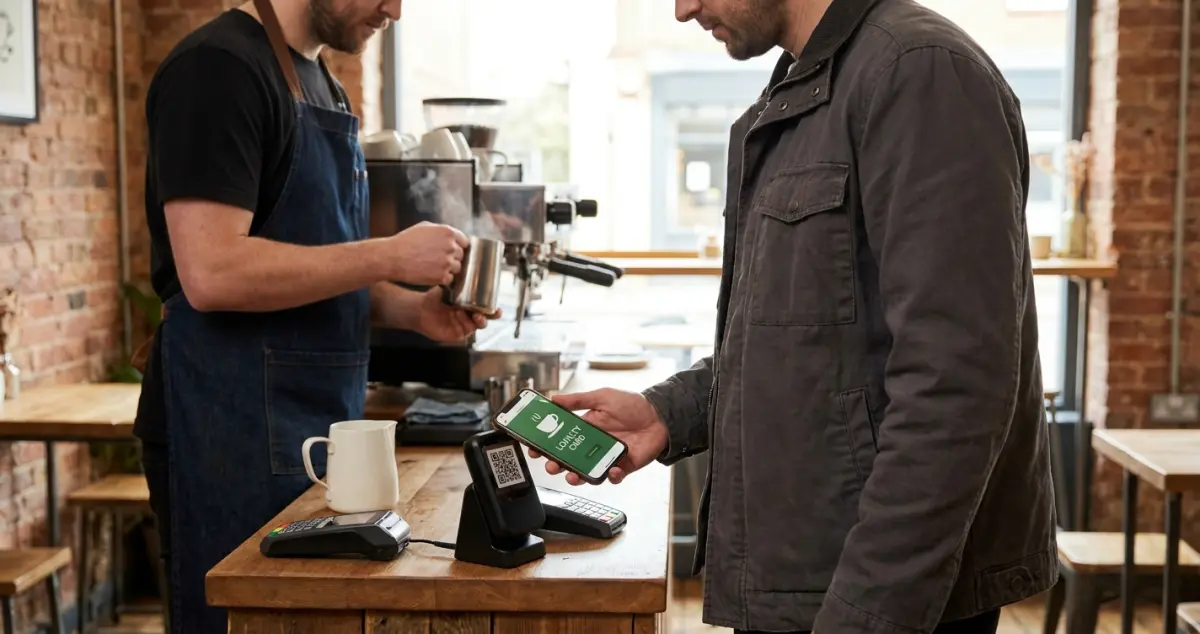
Coffee shop loyalty app UK 2026: compare Square, Loyverse, Stamp Me and custom-built options. When an app earns its monthly fee and when it does not.
A coffee shop loyalty app is a digital platform that tracks customer purchases and triggers rewards through a smartphone. For UK independents in 2026, a coffee shop loyalty app earns its monthly fee when it shifts frequency, spend per visit, and recency. When it doesn't, it's a subscription draining margin.
If you're reading this thinking you should "just get an app" because every chain has one, slow down. The cafes that switch from paper to digital and then back again all share one trait: they bought the platform before they trained the staff. The app didn't fail; the rollout did. Reading time: 12 minutes.
Related: Coffee Shop Loyalty Programs UK 2026
What You'll Learn
About this guide: Based on the UK independent coffee shop market and our editorial work with LocalBrandHub, with platform feature notes verified against vendor documentation as of 2026 and ICO/gov.uk guidance on GDPR-PECR specifics.
This guide is for owner-operators evaluating digital loyalty platforms for a UK independent coffee shop. We compare the coffee shop loyalty app platforms most cafes actually consider and show how to calculate whether the monthly fee is earning its place on your P&L.
- The four UK platform categories worth comparing (hosted, POS-integrated, white-label, custom)
- Realistic monthly costs and what the price includes
- How to calculate whether an app is worth its fee
- The five-step rollout that decides sign-up rates
- GDPR and PECR obligations the moment you go digital
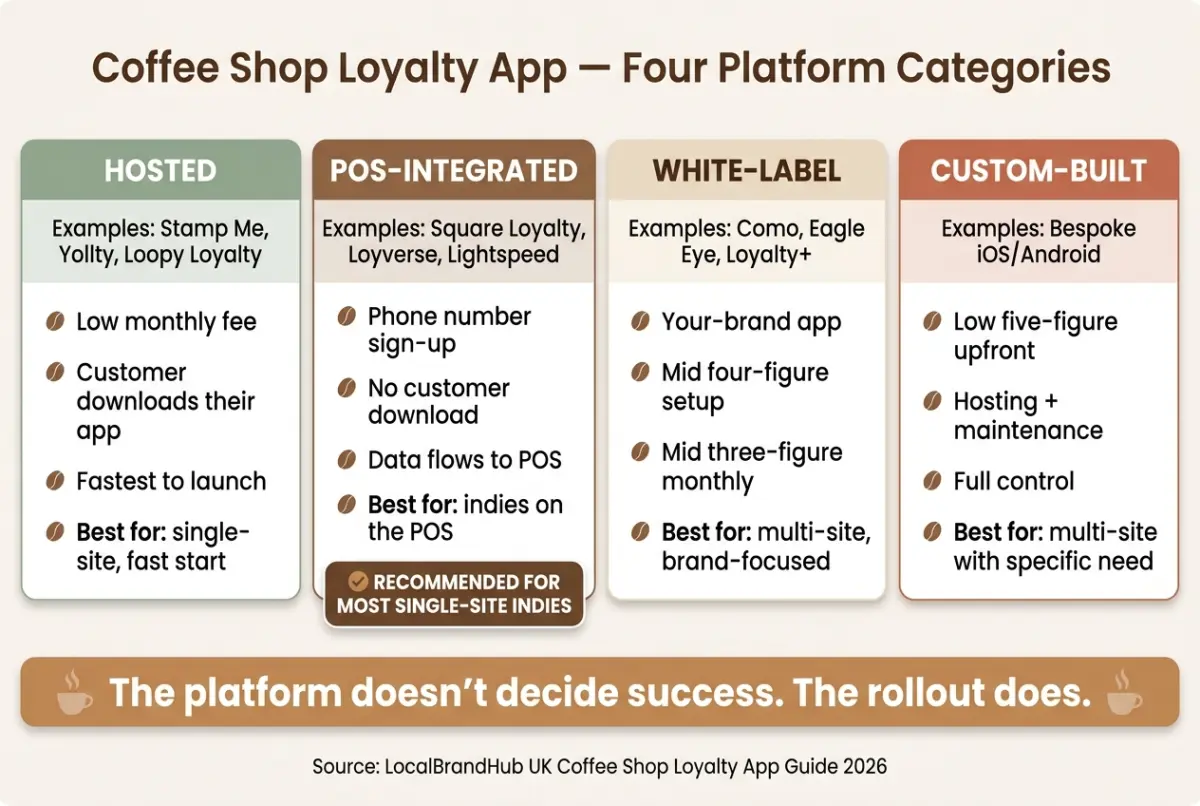
Table of Contents
- What is a coffee shop loyalty app?
- The four platform categories
- Cost breakdown: what an app actually costs
- When an app earns its fee
- Rollout: the five steps that decide adoption
- GDPR, PECR, and the legal layer
- Frequently asked questions
- Key Takeaway
What is a coffee shop loyalty app? {#what-is}
A coffee shop loyalty app is a framework that replaces the paper stamp card with a smartphone-based mechanic: QR code scan, phone number lookup, or app-tap at the till. The system records the transaction, awards points or stamps, and triggers a reward when thresholds are met. Unlike paper, it captures who the customer is and how often they visit.
For example, a single-site cafe in Brighton using a hosted platform might capture 400 sign-ups in the first quarter, track average spend, and push a "we miss you" email after 30 days of no visits. That data is the operational difference between a paper card (which knows nothing about who carries it) and a digital one (which knows almost everything).
The four platform categories {#categories}
Now that the basics are clear, here are the four shapes a UK indie loyalty app typically takes. Pick the wrong category and you'll either overpay for features you don't need or undershoot for what you actually want to measure.
1. Hosted loyalty platforms
Stamp Me, Yollty, FiveStars, Loopy Loyalty. These are SaaS products with their own customer app or branded mini-app inside their ecosystem. Setup is fast (often same-day). Customers download a separate app or scan a QR code that opens a hosted card.
For example, a cafe in Newcastle running Stamp Me hands customers a card that lives inside the Stamp Me app. It works, but the customer experience is "another app on my phone", which is friction for casual visitors.
2. POS-integrated loyalty (Square, Loyverse, Lightspeed)
Square Loyalty sits inside Square POS. Loyverse Loyalty sits inside Loyverse POS. The customer "joins" by giving a phone number at the till; the till looks them up automatically on subsequent visits. No customer-facing app required.
This is the sweet spot for many UK indies because the friction at sign-up drops dramatically. Furthermore, the data flows directly into your POS reporting so you can see programme members vs non-members in the same dashboard.
3. White-label platforms
Como, Eagle Eye, LoyaltyLion (more retail-focused). These let you launch a "your-brand-name" app with your colours and logo. Setup runs into weeks rather than hours; monthly fees are meaningfully higher than hosted options.
White-label fits multi-site indies and small chains where a branded experience matters. A single-site cafe rarely justifies the cost difference.
4. Custom-built apps
A bespoke iOS/Android build from a freelancer or agency. Costs typically run into the low five figures upfront plus ongoing hosting and maintenance. Custom only makes sense for multi-site indies with brand budget and a specific operational need no off-the-shelf platform handles.
From experience: Most single-site indies are best served by POS-integrated loyalty. Hosted platforms add an app the customer has to download. White-label and custom only earn their cost when you've got three or more sites or a brand position that genuinely benefits from a bespoke app.
Cost breakdown: what an app actually costs {#cost}
First, the headline number isn't the only number. The honest cost of an app includes platform fees, transaction fees if any, staff training time, and the opportunity cost of slower till throughput during rollout.
| Platform type | Setup | Monthly per site | Customer download required | Best fit |
|---|---|---|---|---|
| Hosted (Stamp Me, Yollty) | Low to none | Low two-figure | Yes (their app) | Single-site indies, fast launch |
| POS-integrated (Square, Loyverse) | None if POS in place | Low to mid two-figure | No (phone number) | Indies already on the POS |
| White-label (Como, Eagle Eye) | Mid four-figure | Mid three-figure | Yes (your-brand app) | Multi-site, brand-conscious |
| Custom-built | High four-figure to low five-figure | Hosting + maintenance | Yes (your-brand app) | Multi-site with specific need |
Cost ranges are typical for UK independent coffee shops in 2026; your numbers will vary by features, integrations, and supplier.
If you can't tell whether an extra mid-three-figure monthly fee is worth it that's usually a sign you haven't calculated your baseline, and running the numbers on what the extra visits are worth is the quickest way to settle it. Without a frequency-and-spend baseline, every loyalty platform looks like a good deal.
If you pick just one platform for a single-site UK indie, POS-integrated loyalty is often the strongest choice: there's no extra customer download, the till team already uses the POS daily, and the data flows into one dashboard. That's the configuration with the highest adoption odds and the lowest training overhead.
When an app earns its fee {#earns-fee}
Next, the question that should decide everything. The app earns its monthly fee when it produces enough incremental margin to cover the fee plus the cost of redeemed rewards. The maths is simple but rarely run.
The break-even calculation
Take your monthly platform fee. Add the cost of redeemed rewards (typically your variable cost on those drinks). That's your monthly outlay. To break even, the app needs to shift either frequency or spend by enough to generate equivalent gross contribution.
For example, a cafe owner in Liverpool paying a low two-figure monthly platform fee needs the programme to generate roughly 15-25 additional drinks per month from the same regulars (or equivalent margin from new regulars the app attracted) to be flat on the deal. Anything above that is genuine return. Anything below is a slow subscription leak.
The three numbers that prove it's working
Here's the trio. Track these and the answer is obvious within ninety days.
- Member frequency vs non-member frequency: programme members should visit at least 20% more often
- Member spend per visit vs non-member spend: sometimes higher, sometimes flat, rarely lower
- Cost per redeemed reward: total reward COGS divided by redemption count
Why this matters: If members visit at the same rate as non-members but redeem rewards regularly, you're subsidising behaviour that would have happened anyway. The app isn't shifting anything: it's a recurring discount.
Rollout: the five steps that decide adoption {#rollout}
Building on the cost analysis, here's the operational layer that decides whether you'll have 50 sign-ups or 500 after the first quarter.
Step 1: train every barista on the sign-up sentence
The single biggest determinant of digital loyalty sign-up rate is whether your barista mentions the app at the till during the morning rush. Train one sentence: "We've got a loyalty card: first drink's free if you sign up while I'm making this." Without that line, sign-ups collapse to single digits.
Step 2: print physical prompts at the till
A small A6 sign at the till and on the counter explaining the programme in one line. Most customers don't read; they look at the sign once, then the next time they're ready. Visible reminders matter.
Step 3: include the first-drink-free signup incentive
A free first drink at sign-up converts roughly 3-5x better than a "10% off" offer. The free first drink also gets the customer through the friction of downloading or signing up.
Step 4: keep the friction down
Phone-number-only sign-up beats download-and-register every time. If your platform supports phone-only enrolment at the till, use it. Email capture and full profile can come later via an in-app prompt.
Step 5: review weekly for the first three months
For example, a cafe owner in Cardiff sets aside fifteen minutes every Sunday morning to check sign-ups, redemptions, and any flagged accounts during the launch quarter. After ninety days the data is stable enough to drop to monthly review.
Worked example: A two-site indie in Edinburgh trialled the same Loyverse loyalty programme at both sites for the same launch quarter. Site A (baristas trained, sign-up incentive visible, manager checked weekly) hit 312 sign-ups. Site B (same software, no till training, no signage) hit 41 sign-ups. Same platform. Same customers. Rollout decided everything.
If you're only optimising for platform features you'll always lose to competitors who optimise for staff adoption. That never works as a launch strategy.
GDPR, PECR, and the legal layer {#gdpr-pecr}
The moment you collect a phone number, email, or any personal data through a loyalty app, the Information Commissioner's Office rules engage in full. This is the part most app vendors quietly skip past in their onboarding.
The five obligations every app-using cafe must meet
- Lawful basis: typically consent for marketing communications, contract for the loyalty mechanic itself
- Privacy notice: accessible at sign-up, written in plain English
- Separate marketing consent: under PECR, no marketing SMS or email without explicit opt-in
- Right to erasure: customers can request deletion; you have a month to action it
- ICO data protection fee: most coffee shops collecting customer data need to pay the annual fee (see ico.org.uk fees)
For example, a cafe in Oxford running Square Loyalty must rely on Square's privacy framework for the data Square holds but is still responsible for any data exported, used in mail-merges, or shared with third parties. The platform doesn't absolve the cafe.
Pre-launch checklist
- Choose platform and confirm fee, integration, and customer experience
- Write a one-paragraph privacy notice for the till and the sign-up screen
- Train every barista on the sign-up sentence and the free-first-drink incentive
- Set a 90-day review cadence with the three key metrics
- Confirm ICO data protection fee is paid if applicable
Would you sign up for the programme you've just designed, in your own queue, during a morning rush? If the answer is "not really", fix it before you launch.
Frequently asked questions {#faq}
Q: What's the best loyalty app for a UK coffee shop?
For most UK single-site indies, POS-integrated loyalty (Square Loyalty if you're on Square; Loyverse Loyalty if you're on Loyverse) is the strongest fit because there's no extra customer download and the data flows into one dashboard. Hosted platforms like Stamp Me suit cafes not already on those POS systems. White-label and custom builds rarely pay for themselves at single-site scale.
Q: How much does a coffee shop loyalty app cost in the UK?
Hosted platforms commonly run a low two-figure monthly fee per site. POS-integrated loyalty (Square, Loyverse) is typically low to mid two-figure monthly when added to the underlying POS subscription. White-label platforms run into mid three-figure monthly territory plus a mid four-figure setup. Custom-built apps run high four-figure to low five-figure upfront plus ongoing hosting and maintenance.
Q: Do customers actually use coffee shop loyalty apps?
Adoption depends almost entirely on rollout, not on platform. With staff trained on the sign-up sentence and a free-first-drink incentive, UK indies typically see sign-up rates of 8-15% of unique transactions during the launch quarter. Without staff training, sign-ups collapse to under 2% and the platform looks like a failure when the rollout was the issue.
Q: How do I know if my loyalty app is working?
Compare member frequency to non-member frequency. Members should visit at least 20% more often within the same period. If they don't, you're either rewarding existing habit or the programme hasn't reached enough of your regular base. Member spend per visit and total reward cost are the other two numbers to track.
Q: Are coffee shop loyalty apps GDPR-compliant by default?
No, compliance is your obligation, not the platform's. The platform processes data on your behalf as a data processor, but you remain the data controller. You need a lawful basis, a privacy notice, marketing consent under PECR for any promotional comms, and likely a paid ICO data protection fee. Most platforms supply template privacy notices: adapt them to your cafe.
Q: Can I switch from a paper card to an app without losing my regulars?
Yes, with a transition plan. Run both systems in parallel for 60-90 days. Honour existing paper cards (give the free drink when filled) and offer paper-card holders a bonus stamp or free drink for joining the app. Communicate the date paper stops being issued. Cold-cutting a paper programme typically loses 10-15% of regulars to confusion. Don't do that.
Related: Coffee Shop Birthday Rewards UK 2026
Why this matters: LocalBrandHub consistently sees UK indies that combine a POS-integrated coffee shop loyalty app with strong staff training outperform standalone-paper schemes, but the staff training is the bigger lever, not the platform itself.
If you only have 30 minutes a week {#minimum-viable}
A coffee shop loyalty app doesn't need a launch project. If you only have 30 minutes a week, do this:
This week, audit your coffee shop loyalty app rollout in 30 minutes:
- Day 1-2: Confirm POS supports loyalty natively (ten minutes)
- Day 3-4: Draft the till sign-up sentence and test on one barista (ten minutes)
- Day 5-7: Print a small A6 sign and put it at the till (ten minutes)
If you run a coffee shop and want to see how Local Brand Hub can support your marketing, explore our coffee shop marketing tools.
For restaurants, salons, and local businesses
Need help with your marketing?
We help UK businesses turn social media into real results, not busywork.
Start freeKey Takeaway
Key Takeaway
A loyalty app earns its monthly fee through the rollout, not the software. This week, here's how to set yourself up so the answer in ninety days is "yes, it paid off" rather than "we should never have started."
Day 1-3: Pick one platform. Read the pricing page, watch a demo, and write down, in one sentence, why this platform fits your cafe better than paper. If you can't, pause and revisit paper.
Day 4-7: Write the sign-up sentence. Test it on three baristas. Refine it until they can say it in under five seconds during a morning rush. The platform is the easy bit. The sentence is the hard bit.
An app is software. A loyalty programme is a habit. Software without the habit is just a subscription line on your bank statement.
Get More Marketing Tips
Practical marketing tips for UK business owners, straight to your inbox. No spam, unsubscribe anytime.
About the Author
Local Brand Hub
Empowering UK Businesses
Local Brand Hub provides comprehensive business management tools designed specifically for UK local businesses to streamline operations, automate marketing, and grow revenue.
More articlesRelated Articles
 Tutorials
Loyalty Card for Coffee Shop UK 2026: Paper That Pays Off
Loyalty card for coffee shop UK 2026 guide: paper stamp card design, suppliers, mechanics that work, and when paper still beats every app on the UK market.
 Business Growth
Coffee Shop Subscription UK 2026: The Indie Operator's Guide
Coffee shop subscription UK 2026: monthly pass models, unit economics, churn, infrastructure needed and whether the maths actually works for an indie cafe.
 Business Growth
Coffee Shop Customer Retention: Who Knows Your Regulars
Coffee shop customer retention for UK indies: count your regulars with a pencil, and why the recognition that brings them back can leave with a barista.