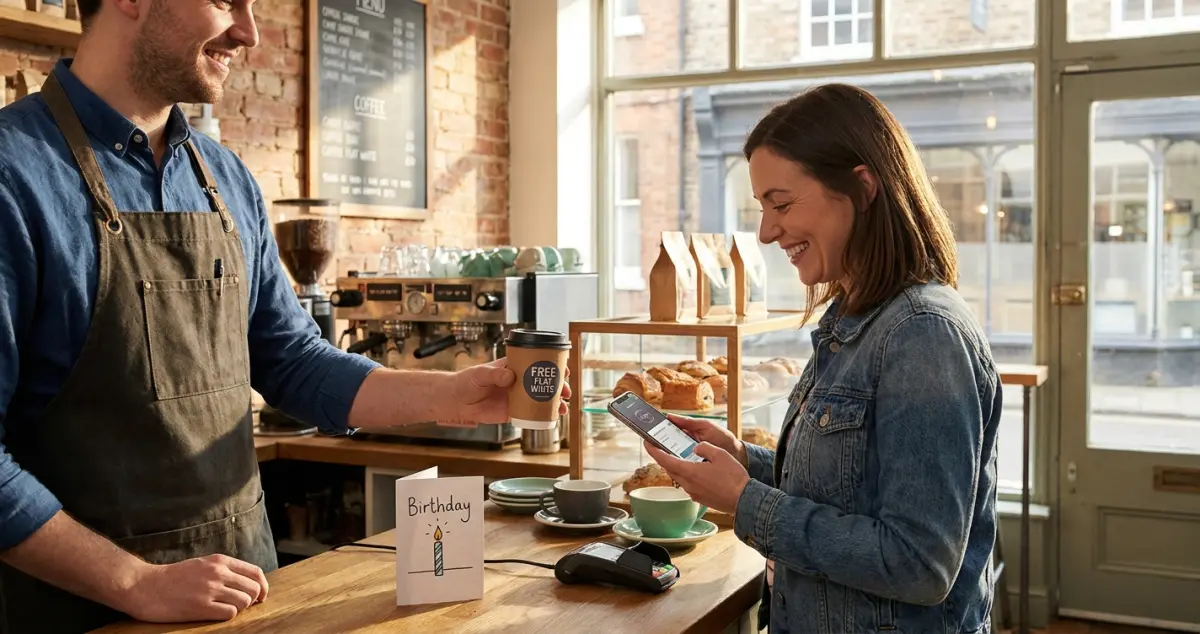
Coffee shop birthday rewards UK 2026: how to capture date of birth legally, the free-drink-on-birthday play, redemption rates and full GDPR rules.
A coffee shop birthday reward is a free drink sent to a customer in the week of their birthday, designed to trigger a visit. For UK independents in 2026, coffee shop birthday rewards are the cheapest trigger-marketing play available: capture date of birth at sign-up, send one well-timed email, watch redemption beat any other automated marketing.
If you're reading this thinking birthday rewards are "nice but not essential": they're more important than that. Birthday-week visits often produce paired transactions (customer brings someone) and the free drink rarely costs more than the variable cost of a single drink while generating a meaningful share of marketing-attributable visits. Reading time: 10 minutes.
Related: Coffee Shop Loyalty Programs UK 2026
What You'll Learn
About this guide: Based on the UK independent coffee shop market and our editorial work with LocalBrandHub, with ICO/gov.uk citations on GDPR-PECR consent and redemption-rate ranges reflecting typical UK indie operator experience.
This guide is for owner-operators of UK independent coffee shops planning to layer coffee shop birthday rewards onto an existing loyalty programme, or running coffee shop birthday rewards as a standalone retention trigger.
- The two ways to capture date of birth without breaking GDPR
- Realistic redemption rates and what they really cost
- The wording that works for the birthday email or SMS
- How to spot and avoid common birthday-reward abuse
- When birthday rewards are the wrong investment
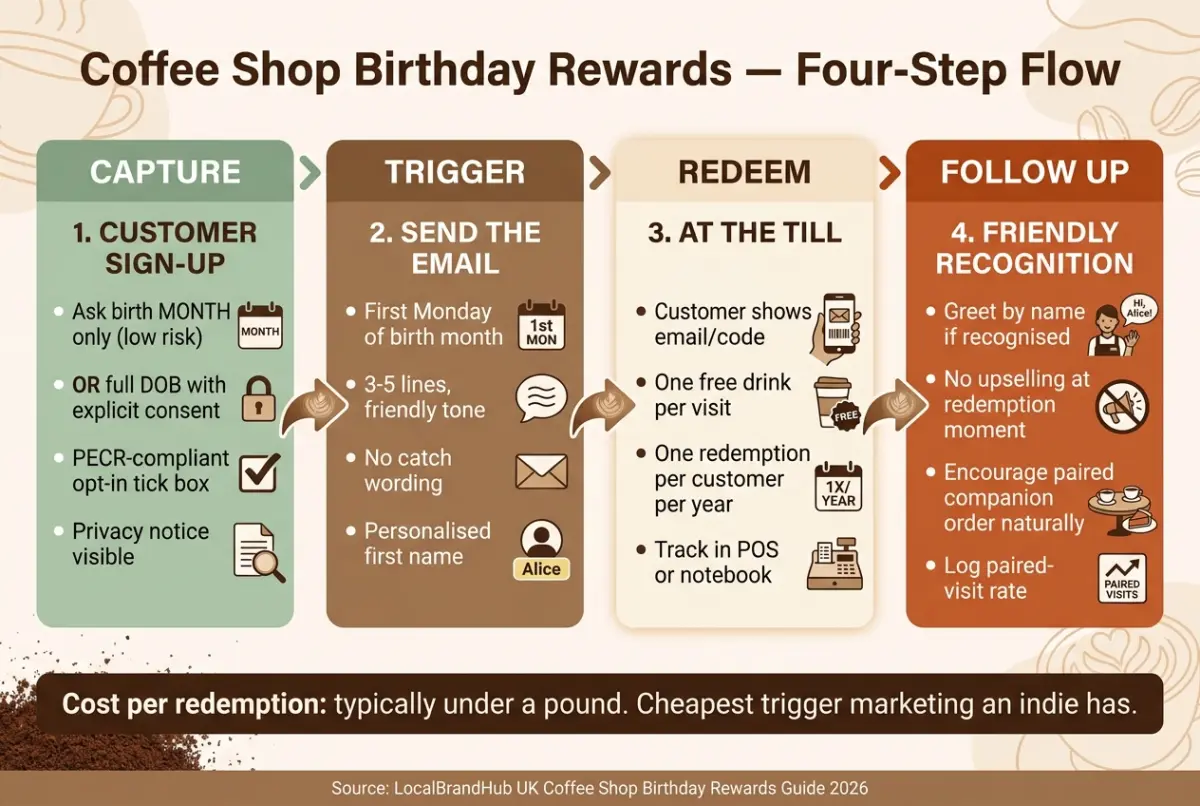
Table of Contents
- What is a coffee shop birthday reward?
- Capturing date of birth legally
- The reward itself: what to offer
- Wording the birthday message
- Redemption rates and real cost
- Frequently asked questions
- Weekly Action
What is a coffee shop birthday reward? {#what-is}
A coffee shop birthday reward is a framework for triggering a customer visit on or around their birthday through a free drink, paired offer, or bonus reward. The mechanic relies on date-of-birth data captured under UK GDPR rules. Unlike a loyalty card (which rewards repeat behaviour) or a referral programme (which acquires new customers), birthday rewards target a specific date, and date-driven marketing has dramatically higher open and redemption rates than generic promotional sends.
For example, a single-site cafe in Bristol that captures DOB at loyalty sign-up and sends a birthday-week free-drink email might see open rates well above their normal promotional average and redemption rates measurably above standard offers. The trigger date is the differentiator.
Capturing date of birth legally {#dob-capture}
First, the legal layer. The moment you collect a date of birth, you're processing personal data under UK GDPR and the Information Commissioner's Office framework. The two compliant ways to do it are simple but worth doing properly.
Method 1: month-only capture (lowest risk)
Ask only for birth month, not full date of birth. "Which month is your birthday?" gives you everything you need for birthday-week marketing without collecting full DOB. Lower legal exposure, fewer data-minimisation concerns, and still triggers the right campaign.
For example, a cafe in Cardiff captures only month at sign-up, sends a birthday email in the first week of each month to all customers whose birthday falls in that month, and offers a free drink valid any time during the month. Same campaign effectiveness, less data, simpler compliance.
Method 2: full DOB with explicit purpose
Capture full date of birth at sign-up with a clear statement of why ("we'll send you a free drink on your birthday"), an explicit opt-in tick box for marketing under PECR, and a privacy notice. This gives you a more precise trigger but requires more careful handling of the data and a defensible retention policy.
From experience: Most UK indies are best served by month-only capture. The marginal benefit of exact DOB is small; the GDPR exposure is meaningful. Don't capture data you don't need.
Lawful basis and PECR
Under PECR (Privacy and Electronic Communications Regulations), you need explicit opt-in for marketing emails and SMS. The free-drink birthday offer falls under marketing communications. A pre-ticked box is not consent. Customers must actively opt in. See the gov.uk PECR guidance for the authoritative reference.
The reward itself: what to offer {#reward}
Now that the data layer is sorted, the next question is what to actually send. Three options dominate UK indie practice.
Option 1: free drink (cleanest)
A single free drink redeemable in the birthday week. Easy to communicate, easy to redeem at the till (one stamp on a printed code or one app-flagged redemption), and the cost is the variable cost of one drink, typically well under a pound.
Option 2: paired free drink (brings a guest)
A "free drink for you plus 50% off a second" or "bring a friend, both get a free drink" offer. Higher cost per redemption but pairs naturally with the social moment of a birthday visit. Often generates the biggest single-redemption revenue lift because the friend who comes along usually buys food.
Option 3: free food item alongside paid drink
A free pastry or slice of cake when paying for a drink. Lower margin impact for cafes with healthy food margins; particularly strong for brunch-positioned indies.
| Reward type | Cost per redemption | Typical redemption rate | Best fit |
|---|---|---|---|
| Free drink | Variable cost of one drink | Higher than other channels | Single-site indies |
| Paired free drink | Variable cost of two drinks | Lower than single | Brunch positioning, social cafes |
| Free food alongside paid drink | Variable cost of one food item | Moderate to high | Cafes with food-led mix |
Cost ranges and redemption rate factors are typical for UK independent operators in 2026; your numbers will vary by reward design, send timing, and customer mix.
If you pick just one reward type for launch, the free-drink option is often the strongest choice: simplest to communicate, lowest cost per redemption, and easiest for staff to operationalise at the till.
Wording the birthday message {#wording}
Building on the reward, here's the wording layer. The message is short. The tone is the thing.
What works
"Happy birthday from [Cafe Name]. Your coffee's on us this week: pop in any time before [date], show us this message, and we'll sort the rest. No catch."
That's the entire message. Personalisation (the customer's first name in the subject line and opening) lifts open rates meaningfully. The phrase "no catch" handles the suspicion that there might be small print.
What doesn't work
Long, paragraph-heavy emails about how much the cafe values customers. Birthday messages should feel like a friendly nod, not a marketing campaign. Furthermore, anything that requires the customer to forward the message, share on social, or sign up for additional things kills redemption.
Timing
Send on the customer's birthday or the morning of the first weekday of birthday week. Sunday evening sends underperform; Monday-morning sends typically perform well. For example, a cafe owner in Edinburgh testing Saturday vs Monday sends found the Monday-morning version meaningfully outperformed despite the offer being identical.
Worked example: A two-site indie in Manchester captured month-only DOB at loyalty sign-up, sent a single first-Monday-of-the-month "happy birthday: free coffee this week" email to all customers with that month's birthday, and saw redemption rates of around 35% across the trial quarter. Of redeemers, roughly 40% brought a companion who also bought a drink and food. Cost per acquired birthday visit landed in pence terms. Best-performing single email campaign on their P&L.
Redemption rates and real cost {#redemption}
Next, the maths. Birthday redemption rates routinely outperform standard promotional sends because the trigger is personally meaningful. Realistic ranges sit well above general newsletter promotional benchmarks.
What the cost actually looks like
Take 200 customers with captured birthday months. Send 200 birthday emails over the year (roughly 17 per month). Assume 30-40% redemption. That's 60-80 free drinks per year per 200 birthday customers: at variable cost of well under a pound per drink, total programme cost is in the mid two-figure pound range per year for a customer cohort generating meaningful annual revenue. The ratio is favourable in almost every reasonable scenario.
If you can't tell whether your birthday emails are actually getting opened that's usually a sign you haven't set up basic email tracking. Even a free Mailchimp account shows opens and clicks. Without those numbers, you're guessing.
Abuse and edge cases
The most common abuse is customers giving fake birth months to game the system. The practical defence is one redemption per customer per twelve-month period: even if a customer says their birthday is in March and again in October, the redemption flag prevents a second free drink within the year. Most platforms handle this automatically.
If you're only optimising for redemption rate you'll always lose to competitors who optimise for the conversation that happens around the redemption. That never works as a long-term retention strategy.
Pre-launch checklist
- Decide DOB capture method (month-only is recommended)
- Update sign-up form with explicit consent line for birthday marketing
- Choose reward type (free drink is the standard)
- Draft a short birthday email (3-5 lines, friendly tone, no catch)
- Set send cadence (first Monday of each month for month-only capture)
- Configure one-redemption-per-customer-per-year flag
Would you redeem the offer you've just designed if your friend's cafe sent it to you? If yes, you're ready to launch. If not, simplify it.
Frequently asked questions {#faq}
Q: How do coffee shops collect customer birthdays legally in the UK?
Two compliant methods: month-only capture (lowest risk, "which month is your birthday?") or full date of birth with explicit purpose statement and PECR-compliant marketing opt-in. Month-only capture is recommended for most UK indies because it provides the same campaign effectiveness with less data, fewer compliance considerations, and a simpler retention policy.
Q: What's a typical redemption rate for coffee shop birthday rewards?
Birthday redemption rates routinely outperform standard promotional sends because the trigger is personally meaningful. UK indies typically see redemption rates well above their general promotional benchmarks. The exact rate depends on send timing (Monday morning beats weekend), wording (short and friendly beats long and corporate), and reward type (single free drink beats complex paired offers for simplicity).
Q: Should I send birthday rewards by email or SMS?
Email is the lowest-friction send for most UK indie cafes. SMS has higher open rates but feels more intrusive for a low-stakes birthday offer and has higher per-message costs. If your loyalty platform supports both, send email by default and reserve SMS for higher-value triggers like win-back reminders.
Q: How much does a coffee shop birthday rewards programme cost to run?
The marginal cost is the variable cost of one drink per redemption (typically well under a pound) plus any platform-specific email sending fees. For a typical UK indie with 200 customers captured, annual programme cost lands in the mid two-figure pound range. Per-redemption cost is the lowest of any standard retention play.
Q: Can I send a birthday offer without explicit consent?
No: under PECR, marketing emails and SMS to consumers require explicit opt-in. The birthday offer is a marketing communication regardless of how friendly it feels. A pre-ticked box is not consent under the Information Commissioner's Office framework; the customer must actively opt in to marketing at sign-up.
Q: Should I include a birthday reward in my paper loyalty card scheme?
Yes, if the card includes a sign-up step that captures month (and consent for marketing). Without a sign-up step capturing month-of-birth, paper cards alone can't trigger birthday rewards: they have no way to know when the customer's birthday is. A hybrid model (paper card with optional email sign-up for birthday offers) is the cleanest fit.
Related: Coffee Shop Loyalty App UK 2026
Why this matters: LocalBrandHub consistently sees coffee shop birthday rewards as the highest-ROI trigger marketing UK indies can run, provided the data capture stays minimal and the message stays short.
If you only have 30 minutes a week {#minimum-viable}
Coffee shop birthday rewards don't need an automation platform to start. When you're ready to layer on other timed offers, ready-made campaign templates save you building each one from scratch. If you only have 30 minutes a week, do this:
This week, set up coffee shop birthday rewards in 30 minutes:
- Day 1-2: Add one line to sign-up form: "Which month is your birthday?" (five minutes)
- Day 3-4: Draft a three-line birthday email (ten minutes)
- Day 5-7: Schedule the first send for the first Monday of next month (fifteen minutes)
If you run a coffee shop and want to see how Local Brand Hub can support your marketing, explore our coffee shop marketing tools.
For restaurants, salons, and local businesses
Need help with your marketing?
We help UK businesses turn social media into real results, not busywork.
Start freeKey Takeaway
Key Takeaway
Birthday rewards are the cheapest trigger-marketing play an indie cafe has. This week, here's how to get it ready to run.
Day 1-3: Update your sign-up form. Add a single line: "Which month is your birthday? Tick here if you'd like a free coffee in your birthday week." That's the entire data-capture rewrite.
Day 4-7: Draft and schedule the email. Three to five lines, friendly tone, no catch. Schedule the first send for the first Monday of next month and review the open rate the day after.
A birthday reward is a small thing. But small things, sent at the right moment, are how a cafe stops being a transaction and starts being remembered.
Get More Marketing Tips
Practical marketing tips for UK business owners, straight to your inbox. No spam, unsubscribe anytime.
About the Author
Local Brand Hub
Empowering UK Businesses
Local Brand Hub provides comprehensive business management tools designed specifically for UK local businesses to streamline operations, automate marketing, and grow revenue.
More articlesRelated Articles
 Marketing Tips
Coffee Shop Rebooking Reminders Done Right
Coffee shop rebooking reminders UK 2026: SMS vs email win-back nudges, wording that works, ICO PECR rules and the offer structure that revives regulars.
 Tutorials
Coffee Shop Referral Programme: Bring-a-Friend Done Right
Coffee shop referral programme UK 2026: bring-a-friend mechanics that actually work for indies, the £5/£5 model vs free-drink swap, and GDPR-safe tracking.
 Business Growth
Coffee Shop Subscription UK 2026: The Indie Operator's Guide
Coffee shop subscription UK 2026: monthly pass models, unit economics, churn, infrastructure needed and whether the maths actually works for an indie cafe.