Coffee shop rebooking reminders UK 2026: SMS vs email win-back nudges, wording that works, ICO PECR rules and the offer structure that revives regulars.
A coffee shop rebooking reminder is an automated nudge, email or SMS, sent to a customer who hasn't visited within a set period, designed to trigger a return visit. For UK independents in 2026, coffee shop rebooking reminders are the difference between losing a regular permanently and recovering them with one well-timed message.
If you're reading this thinking your lapsed customers are just busy and will come back when they're ready, some will. Many won't. The cafes that win them back are the ones that notice they've stopped coming and send a small message at the right moment, before the new café around the corner becomes the new habit. Reading time: 10 minutes.
Related: Coffee Shop Loyalty Programs UK 2026
What You'll Learn
About this guide: Based on the UK independent coffee shop market and our editorial work with LocalBrandHub, with ICO/gov.uk citations on PECR-compliant automated marketing and the win-back rate ranges reflecting typical UK indie operator experience.
This guide is for owner-operators of UK independent coffee shops layering automated coffee shop rebooking reminders onto an existing loyalty programme or running coffee shop rebooking reminders as a standalone retention play.
- The 14/30/60-day win-back windows and which one to trigger first
- Email vs SMS: when each wins
- The wording that recovers a lapsed regular without sounding desperate
- ICO and PECR compliance for automated marketing nudges
- The win-back offer structure that earns its keep
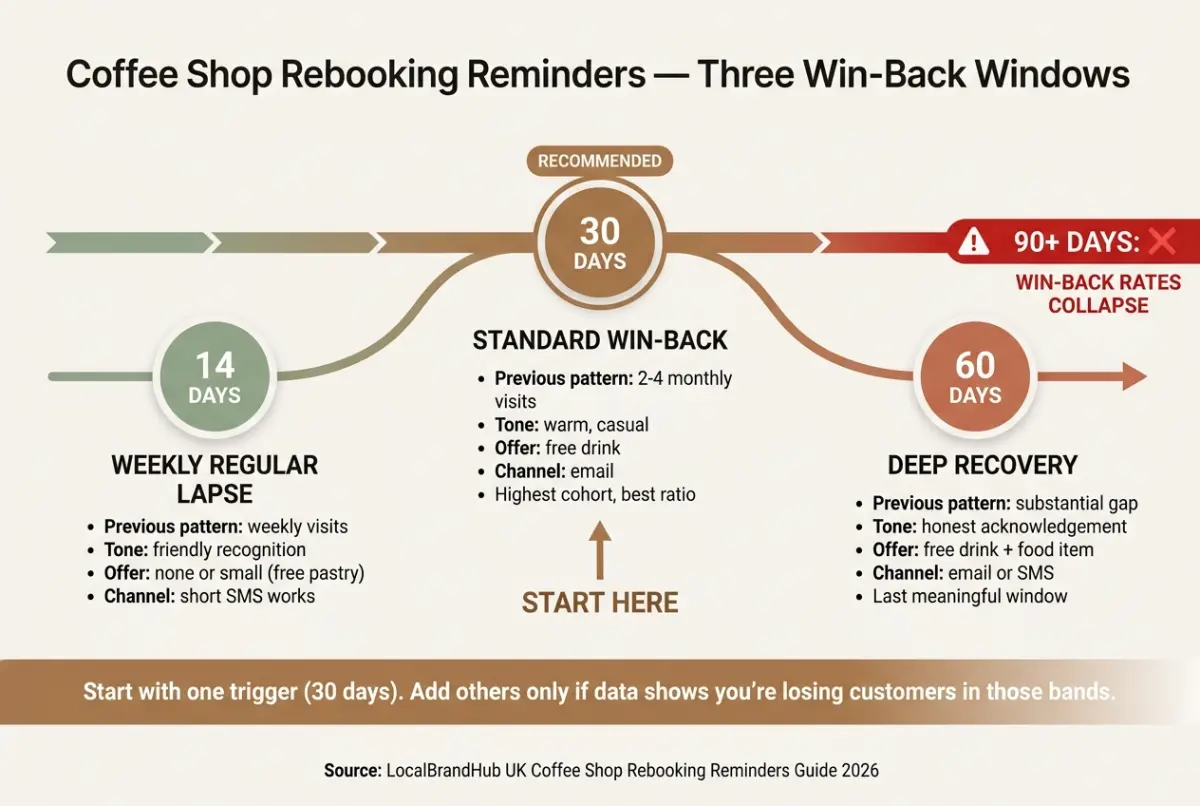
Table of Contents
- What is a rebooking reminder?
- The three win-back windows: 14, 30, 60 days
- Email vs SMS: when each wins
- Wording that recovers without sounding desperate
- ICO and PECR compliance
- The win-back offer structure
- Frequently asked questions
- Weekly Action
What is a rebooking reminder? {#what-is}
A coffee shop rebooking reminder is a framework that automatically detects when a former regular has lapsed (typically defined as no visit within a set time window) and sends a one-off message designed to trigger a return visit. The trigger is automated; the message is personalised; the offer is meaningful but not extravagant.
For example, a single-site cafe in Brighton running automated rebooking reminders detects that a customer who previously visited weekly hasn't been in for thirty days, sends a single email with a "we miss you, free drink on us this week" offer, and recovers a meaningful share of those lapsed regulars in the following ten days. Without that trigger, most of those customers would never return. Running that trigger by hand every week is the part that tends to slip, so many owners fold it into a wider marketing setup. It's worth seeing what a marketing plan costs against the lifetime value of one recovered regular.
The three win-back windows: 14, 30, 60 days {#windows}
Now that the concept is clear, the next question is when to trigger. Three windows dominate UK indie practice, and the choice of when to send matters as much as what you send.
14-day window: the gentle nudge
For a customer whose previous pattern was weekly, fourteen days without a visit is a meaningful gap. The message is light: no big offer, just a friendly "haven't seen you in a fortnight, your usual is ready when you are." Often a recognition rather than a discount.
30-day window: the standard win-back
For a customer whose previous pattern was 2-4 visits per month, thirty days is the natural prompt. This is the standard win-back window most platforms default to. Furthermore, this is where the free-drink offer typically works best: meaningful enough to break a new habit, low cost to deliver.
60-day window: the recovery attempt
For customers who've drifted significantly, sixty days is the last meaningful window before they're effectively gone. The message acknowledges the gap honestly ("it's been a while") and the offer is more substantial (free drink plus paired food item or a discount on first visit back). After ninety days, win-back rates drop sharply.
| Window | Previous pattern | Tone | Typical offer |
|---|---|---|---|
| 14 days | Weekly regular | Friendly recognition | None or small (free pastry) |
| 30 days | 2-4 monthly visits | Standard win-back | Free drink |
| 60 days | Lapsed substantial gap | Honest acknowledgement | Free drink + food, or paired offer |
Window definitions, win-back rates and offer structures are typical for UK independent operators in 2026; your numbers will vary by previous visit pattern, season and customer mix.
If you pick just one window to start with, 30 days is often the strongest choice. It catches the largest cohort of lapsing customers and the offer-cost-to-win-back-rate ratio is the most favourable.
If you can't tell whether a customer is "lapsed" or "just on holiday" that's usually a sign you need a clear rule. Pick a window, document it, and trust the system to send the message regardless. The message is small enough that wrong-time sends rarely cause harm.
From experience: Most UK indies overcomplicate win-back by running too many windows simultaneously. Start with the 30-day trigger only. Add 14-day or 60-day later if data shows you're losing customers in those bands. One trigger executed well beats three triggers half-baked.
Email vs SMS: when each wins {#email-vs-sms}
First, the channel choice. Email and SMS both work for win-back but they suit different scenarios.
Lower cost per send, higher tolerance for slightly longer messages (still keep it short), and easier to template for personalisation. Works well for 30-day and 60-day win-back where the offer is meaningful. Furthermore, email gives you the click-tracking visibility that SMS doesn't. You'll know who opened, who clicked through, and who ignored.
For example, a cafe in Cardiff using Mailchimp's automation triggers a single 30-day win-back email with the customer's first name and a "free drink on us this week" line and sees open rates well above their normal promotional benchmark.
SMS
Much higher open rates than email but higher per-message cost and lower tolerance for length. Works best for 14-day "we miss you" nudges where the message is short and the urgency is gentle, or for very-high-value customers where the cost-per-send is justified.
The trap with SMS is over-use. Send too often and you'll trigger unsubscribes and complaints to the Information Commissioner's Office. One win-back SMS per lapsed customer per year is the sensible ceiling.
Wording that recovers without sounding desperate {#wording}
Next, the message itself. Win-back messaging fails when it sounds either too corporate or too needy. The sweet spot is friendly and confident: the message of someone who's noticed you've been missing and would like to see you back, no pressure.
What works (30-day window)
"Hi [Name], we noticed it's been about a month since you popped in. We miss you. Drinks on us this week if you fancy a coffee. No catch, just nice to see you back."
That's the entire message. Brief, warm, personalised, and the "no catch" line handles suspicion.
What works (60-day window)
"Hi [Name], it's been a while. Life gets busy. We get it. Here's a free flat white and a slice of cake whenever you're next near us. We'd love to see you again."
Slightly more substantial offer because the recovery is harder; the tone acknowledges the gap honestly rather than pretending it hasn't happened.
What doesn't work
- Long marketing-speak emails about how much you value customer loyalty
- Guilt-tripping language ("we miss you so much it hurts")
- Vague offers ("treat yourself to something special")
- Anything that requires the customer to take more than one step to redeem
Worked example: A two-site indie in Edinburgh A/B tested two 30-day win-back emails for a quarter. Version A: long, corporate, with multiple links and a paragraph about cafe values. Version B: three lines, free drink offer, no catch. Version B's win-back rate was meaningfully higher. Same audience, same offer, different tone.
ICO and PECR compliance {#compliance}
Building on the wording layer, the legal layer. Automated marketing nudges are marketing communications under PECR. They need an explicit opt-in from the customer at the original sign-up, not at the moment of send.
The five rules that apply
- PECR opt-in at sign-up: explicit consent for marketing emails or SMS; pre-ticked boxes don't count
- Unsubscribe in every message: a one-click way to opt out
- Consent records: keep a record of when each customer opted in
- No re-marketing after unsubscribe: once they've opted out, the trigger should not fire for them again
- ICO data protection fee: most coffee shops processing customer data need to pay the annual fee (see ico.org.uk fees)
For example, a cafe owner in Newcastle using Square Loyalty exports its lapsed-customer list to Mailchimp for a win-back send must ensure the export only includes customers who opted in to marketing at original sign-up. The gov.uk PECR guidance is the authoritative reference if the cafe is unsure about specific scenarios.
If you're only optimising for win-back rate without compliance you'll always lose to competitors who treat the legal layer as foundational. That never works as a sustainable retention strategy.
The win-back offer structure {#offer}
Now that the message and compliance layers are in place, the offer itself. The offer needs to be meaningful enough to break the lapse but lean enough to protect margin.
Standard offer (30-day window)
A single free drink valid for seven days from the message send. No minimum spend, no specific drink restriction, no "valid Tuesday-Thursday only" small print. Total cost per redemption is the variable cost of one drink, typically well under a pound.
Recovery offer (60-day window)
A free drink plus paired food item (slice of cake, pastry, or breakfast item) valid for ten days. Higher cost per redemption but the recovery rate is meaningfully better than a drink-only offer at the 60-day mark.
Avoid
- Percentage-off offers ("20% off your next order"): feel transactional and rarely convert
- "Tell us why you stopped coming" surveys: feel desperate and low conversion
- Multi-tier offers ("£5 off, or 10% off, or free drink"): choice paralysis kills redemption
- Time-restricted "valid this Sunday only": adds friction without lifting urgency
Pre-launch checklist
- Confirm marketing opt-in is captured at sign-up and stored
- Pick one trigger window (30 days is recommended)
- Draft a three-line message in friendly tone
- Set offer (free drink for 30-day, free drink + food for 60-day)
- Configure unsubscribe link in every send
- Set a 90-day review of win-back rate vs lapse cohort size
Would you redeem the offer you've just designed if a cafe you'd drifted from sent it to you? If yes, you're ready to launch. If you'd ignore it, redesign before scheduling.
Frequently asked questions {#faq}
Q: What is a coffee shop rebooking reminder?
A coffee shop rebooking reminder is an automated message, typically email or SMS, sent to a customer who hasn't visited within a defined period (commonly 30 days). The reminder includes a brief friendly message and a small offer (typically a free drink) designed to trigger a return visit before the customer's habit shifts to a competitor.
Q: How often should I send win-back reminders to lapsed customers?
One reminder per lapse cycle is the sensible default. If a customer was a 30-day-trigger lapse and didn't redeem within ten days of the message, send a single 60-day-trigger follow-up if they remain lapsed. Beyond that, don't send further win-back messages. Repeated attempts trigger unsubscribes and complaints to the ICO.
Q: Are coffee shop rebooking reminders allowed under UK GDPR?
Yes, provided the customer opted in to marketing communications at original sign-up under PECR rules. The win-back message is a marketing communication regardless of how friendly the tone is. Pre-ticked boxes don't count as opt-in. The customer must have actively consented to receive marketing from your cafe.
Q: What's the best window for a coffee shop win-back reminder?
Thirty days is the standard recommendation for most UK indies because it catches the largest cohort of lapsing customers and the offer-cost-to-win-back-rate ratio is most favourable. Fourteen-day windows suit weekly regulars; 60-day windows suit deeper recoveries. Most indies are best starting with 30 days only and adding other windows after measuring results.
Q: Should I use email or SMS for rebooking reminders?
Email is the default for most win-back scenarios: lower cost per send, easier to personalise, and email open rates for friendly, low-pressure win-back messages typically beat their normal promotional benchmarks. SMS works for short 14-day "we miss you" nudges or for very-high-value customers where the cost-per-send is justified. One SMS per lapsed customer per year is a reasonable ceiling.
Q: What should the win-back offer be?
A single free drink (no minimum spend, no time restrictions beyond the 7-day redemption window) is the standard 30-day offer. For 60-day recoveries, a free drink plus paired food item improves recovery rates meaningfully. Avoid percentage-off offers, multi-tier choices, and survey requests. They reduce conversion and feel transactional.
Related: Coffee Shop Birthday Rewards UK 2026
Why this matters: LocalBrandHub consistently sees indies discover that coffee shop rebooking reminders sent at 30 days are their single highest-converting automated send, often outperforming launch campaigns and promotional sends.
If you only have 30 minutes a week {#minimum-viable}
Coffee shop rebooking reminders don't need a full marketing stack to start. If you only have 30 minutes a week, do this:
This week, set up coffee shop rebooking reminders in 30 minutes:
- Day 1-2: Confirm marketing opt-in is captured for existing customers, ten minutes
- Day 3-4: Draft a three-line 30-day win-back email, ten minutes
- Day 5-7: Schedule the first automated batch and review responses in ten days, ten minutes
If you run a coffee shop and want to see how Local Brand Hub can support your marketing, explore our coffee shop marketing tools.
For restaurants, salons, and local businesses
Need help with your marketing?
We help UK businesses turn social media into real results, not busywork.
Start freeKey Takeaway
Key Takeaway
A rebooking reminder is the cheapest recovery channel an indie cafe has, and the most commonly skipped. This week, here's how to set up the first trigger.
Day 1-3: Define your lapse window and confirm consent. Pick 30 days as the trigger threshold. Check your loyalty platform export filter to only include customers who opted in to marketing at sign-up.
Day 4-7: Draft the message and schedule the automation. Three lines, friendly tone, free drink offer, unsubscribe link, send the first automated batch and review responses ten days later.
A rebooking reminder isn't a marketing campaign. It's the quiet equivalent of a regular friend noticing you've been missing, and saying so without making it a thing.
Get More Marketing Tips
Practical marketing tips for UK business owners, straight to your inbox. No spam, unsubscribe anytime.
About the Author
Local Brand Hub
Empowering UK Businesses
Local Brand Hub provides comprehensive business management tools designed specifically for UK local businesses to streamline operations, automate marketing, and grow revenue.
More articlesRelated Articles
 Marketing Tips
Coffee Shop Birthday Rewards UK 2026: Trigger That Pays
Coffee shop birthday rewards UK 2026: how to capture date of birth legally, the free-drink-on-birthday play, redemption rates and full GDPR rules.
 Tutorials
Coffee Shop Referral Programme: Bring-a-Friend Done Right
Coffee shop referral programme UK 2026: bring-a-friend mechanics that actually work for indies, the £5/£5 model vs free-drink swap, and GDPR-safe tracking.
 Business Growth
Coffee Shop Subscription UK 2026: The Indie Operator's Guide
Coffee shop subscription UK 2026: monthly pass models, unit economics, churn, infrastructure needed and whether the maths actually works for an indie cafe.