Coffee shop customer retention for UK indies: count your regulars with a pencil, and why the recognition that brings them back can leave with a barista.
Coffee shop customer retention is the share of your customers who come back often enough to plan around, and the habits that produce them. For a UK independent it is measured at your own till, against a definition you choose, because the retention percentages quoted across the first page of results rarely say what they measured.
Search this topic and three numbers arrive within two scrolls: a share of revenue your regulars supposedly account for, a profit lift a small retention gain supposedly buys, an average visit frequency for a customer nobody has met. Ask of any of them which businesses were measured, in which country, in which decade, and the page usually goes quiet. A number nobody will source is not a benchmark you can steer by.
If you have run your shop for years and could not say how many regulars you have, that is the ordinary starting position, not a failure. You need two numbers of your own, kept in pencil, and an honest look at where your shop keeps the thing that brings people back. In a shop with nothing written down, that is a person, and people hand in their notice.
Related: Coffee Shop Loyalty Programs
Note
About this guide: for owner-operators of UK independent coffee shops who want to measure retention before buying anything to improve it. Where a figure was measured across all of hospitality or all of Great Britain, this guide says so.
What are you actually counting?
Retention is a ratio, and a ratio needs a line drawn somewhere. Draw yours first: a regular comes in at least three times a calendar month, or four, or twice a week if your trade is commuter-heavy. Which number you pick matters far less than holding it still.
Then count two things a shift, not twelve:
- New face. Nobody on the shift recognises them. One mark.
- Known face. One of you does. One mark.
- Sunday totals. Two numbers, dated, in the same notebook every week. Sunday is arbitrary; the fixed day is the point.
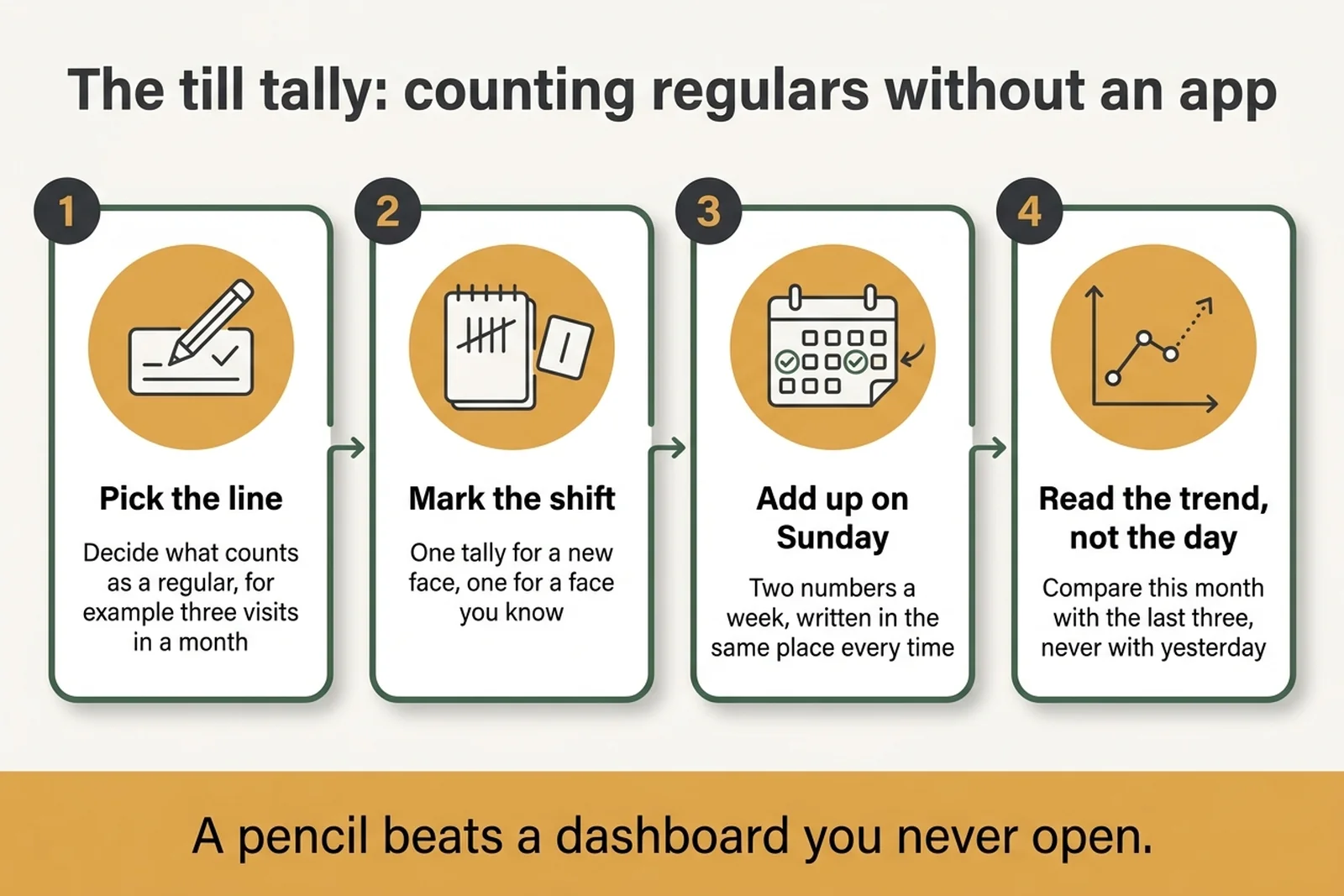
Two marks a shift, two numbers a week. The instrument is cheap on purpose: the one you never use measures nothing.
Read it monthly against the previous three months, never against yesterday: a wet Wednesday tells you about weather. And read the share beside the raw counts, because the share climbs just as neatly when new faces dry up, which is a different problem wearing the same number. What you want is known faces rising while new faces hold.
A pencil beats a dashboard you never open. This tally is not a lesser version of proper analytics. It is the version that survives a Saturday rush.
What are the 8 C's of customer retention?
The 8 C's are a checklist out of customer relationship writing, usually some arrangement of consistency, customisation, convenience, communication, contact, commitment, community and culture. Which eight you get changes from author to author, which is a fair clue to how load bearing the list is.
Two survive contact with a counter at half past eight in the morning. Consistency, because the flat white has to be the one they came back for. Recognition, which the lists tend to fold into contact or community and then never mention again. The rest is good language for a strategy day and useless language during a queue.
Your best retention system keeps handing in its notice
Recognition in a small independent lives in a barista's memory: a name, a usual, an oat flat white on weekdays and a toddler on Saturdays. Nothing is written down. It works beautifully until the shift pattern changes, which is the part most retention guides skip.
A benchmark report from workforce software supplier Sona and Pineapple, covering the first half of 2025 and published on the UKHospitality site in February 2026, put hospitality staff turnover at 67%, down from 75% across the previous 12 months (UKHospitality). That figure covers hotels, pubs and chains rather than independent coffee shops, it comes from a supplier with an interest in the subject, and your own team may be far steadier. What it establishes is that people moving between jobs is ordinary here, not an unlucky year, and a practice held in one person's head is exposed to exactly that.
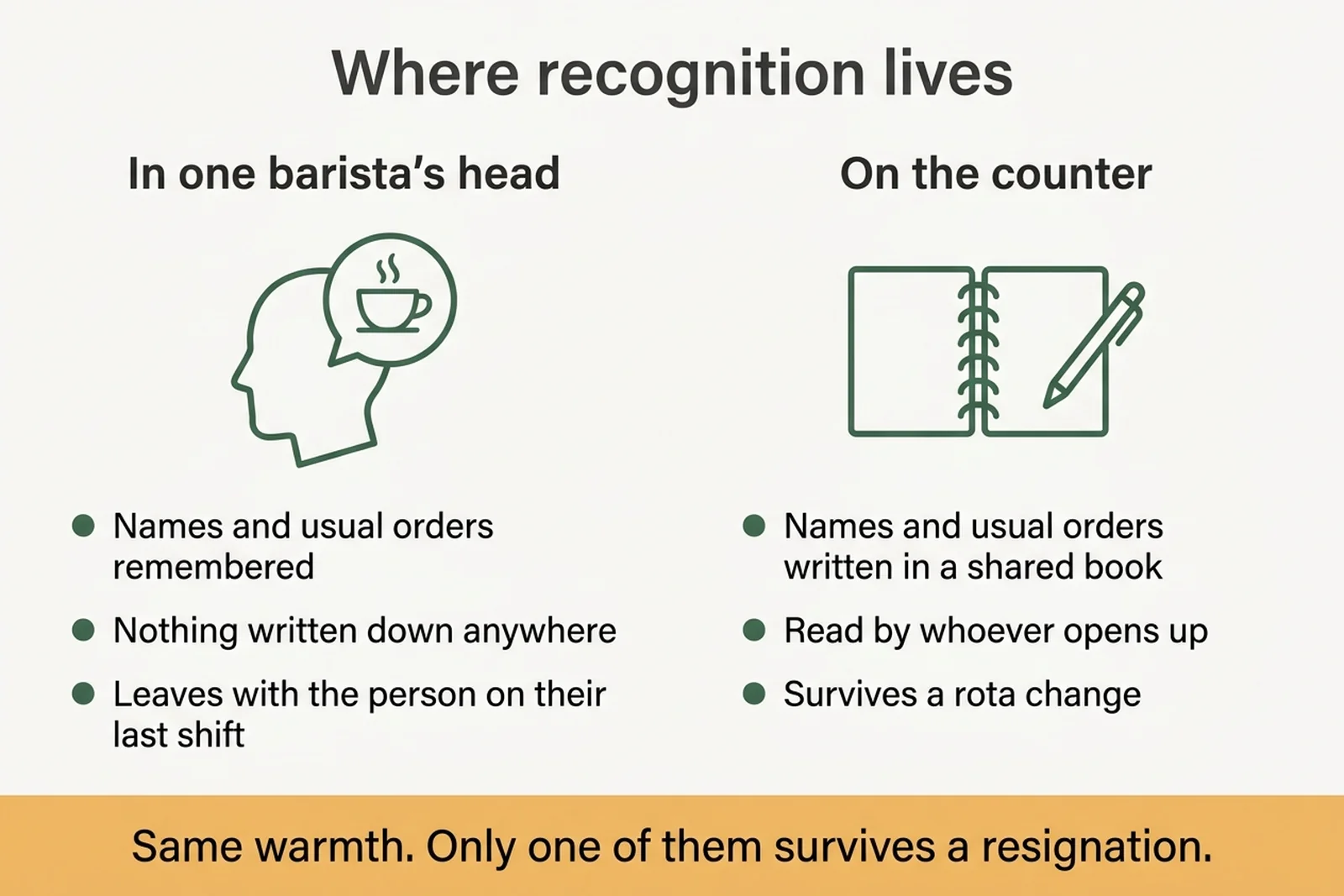
Same warmth either way. Only one version is still there after a rota change.
A notebook fixes it. Keep a regulars page under the till and add three lines on somebody's third visit:
- First name, spelled the way they say it rather than the way you would guess.
- Usual order, milk included, because the milk is the part people notice you remembering.
- One detail worth having, such as the Saturday toddler or the fortnight in April they are always away.
Whoever opens up reads the last page, and new starters get it on day one. The room takes months to learn by accident. It takes a morning to read.
Why this matters: recognition that lives in one head is not a system, it is a favour. Written down, it belongs to the shop rather than to whoever happens to be on shift, and it survives the person who collected it.
Keep the book modest: a page of customer details is still a page of customer details. A first name and an order is plenty, and collecting contact details puts you in different territory.
Related: Loyalty Card for a Coffee Shop
The fourth visit competes with your customer's own budget
Your competition for that fourth visit is rarely the cafe across the road. It is the cafetiere at home and the decision to skip. That is the harder rival, because it is always open and nobody ever queues for it.
The Office for National Statistics found that in the period 7 January to 29 March 2026, the most common action adults in Great Britain reported taking because of increases in the cost of living was spending less on non-essentials, at 61% (ONS). A takeaway coffee is a discretionary purchase by definition, so it sits in the category people say they are trimming. The survey records what people say about all their spending, not what they did at your counter, so treat it as weather rather than proof.
A second figure from the same survey is more useful. In that period, 42% reported shopping around more. Shopping around is not the same as buying cheaper, and somebody comparing options is somebody briefly paying attention. Nothing in the survey says they are comparing cafes, but it describes a market in the mood to look, and looking happens from the pavement. Three things need to be readable out there, at walking pace, by somebody who has not come in yet:
- what a flat white costs, without anyone having to ask
- what is on this week that was not on last week
- whether the offer taped to the window expired in spring
That is a marketing job rather than a counter job. LocalBrandHub sends a weekly report on what your marketing is doing, which is a different question from what your counter is doing. The tally of regulars stays yours, in your notebook.
Related: Coffee Shop Subscriptions
How do I turn a first-timer into a regular?
The moves below all happen at the counter, and the counter never sees the customer who did not come back. So the work belongs on the first visit, the one you know you have.
Three moves fit inside a normal service:
- Ask one real question and hold the answer for the length of the pour. "First time in?" counts.
- Hand the first drink over deliberately, rather than sliding it down the counter with the rest.
- Say what is on tomorrow, so a second visit is something they can picture rather than invent.
Imagine a shop where the barista writes first names on the cup for anyone she has served twice, then copies them into the book at close. Six weeks later a new starter greets a Thursday regular by name on his first shift. The customer thinks the shop knows him. The mechanism is a notebook.
None of it needs an app, and none of it stops you buying one later; it just means you would be automating a habit that already works instead of hoping software invents one. The rebooking reminders guide covers prompting that return visit rather than waiting for it.
Frequently Asked Questions
How do I measure customer retention in my coffee shop?
Pick a definition of regular, count new faces and known faces each shift, and total them weekly. Compare this month's two totals against the last three months, and read them together, because a share rises when new faces fall away. Two numbers, one pencil, no integration. The trend is the finding; any single day is weather.
What is a good customer retention rate for a coffee shop?
The rates quoted for this topic rarely say which businesses they measured, and a rate from another sector's customers cannot tell you whether yours are coming back. Your own trend is the benchmark: known faces rising across a quarter while new faces hold steady is working, whatever the absolute number turns out to be.
What are examples of customer retention in a coffee shop?
Five that work in a small shop: a regulars book behind the till with names and usual orders; opening hours that never surprise anyone; a replacement drink handed over before the complaint finishes; a stamp card for a habit somebody already has; and a Monday sign naming this week's guest bean for the people who come in for that.
What are the 4 P's of marketing for a coffee shop?
Product, price, place and promotion: the drinks and food you sell, what you charge, the site and its passing trade, and how anyone hears about any of it. Retention sits mostly in product and place, which is why promotion alone rarely fixes a leaking base.
Do loyalty schemes actually improve customer retention?
They reward repeat purchase, which is not the same as creating it. On top of consistent coffee and staff who recognise people, a scheme has a habit worth rewarding. On top of neither, it is mostly a discount for customers who were coming anyway. Fix the counter first, then decide what the card is for.
Should I collect email addresses to keep customers coming back?
Only if you can picture the message you would send on a wet Tuesday in February. A contact list is a responsibility as well as an asset, so build one when you have a use for it. A birthday offer is the usual first use, covered in the birthday rewards guide.
Weekly Action
Key Takeaway
- Write your definition of a regular above the till
- Put a notebook beside it and take two marks a shift
- Total the two numbers on Sunday, dated, same page every week
- Start the regulars page and add one name a day you are open
- Read both numbers against the last three months, not against yesterday
A month of that gives you a list. A year of it gives you the one asset here a competitor cannot copy, because it was built a name at a time and never went on sale.
For restaurants, salons, and local businesses
Need help with your marketing?
We help UK businesses turn social media into real results, not busywork.
Start freeSources
Get More Marketing Tips
Practical marketing tips for UK business owners, straight to your inbox. No spam, unsubscribe anytime.
About the Author
Local Brand Hub
Empowering UK Businesses
Local Brand Hub provides comprehensive business management tools designed specifically for UK local businesses to streamline operations, automate marketing, and grow revenue.
More articlesRelated Articles
 Business Growth
Coffee Shop Subscription UK 2026: The Indie Operator's Guide
Coffee shop subscription UK 2026: monthly pass models, unit economics, churn, infrastructure needed and whether the maths actually works for an indie cafe.
 Business Growth
Coffee Shop Loyalty Programs: Discount or Customer List?
Coffee shop loyalty programs UK: what the free tenth cup really costs under HMRC rules, plus the data duties and possible ICO fee an app brings with it.
 Tutorials
Coffee Shop Loyalty App UK 2026: Platform Comparison Guide
Coffee shop loyalty app UK 2026: compare Square, Loyverse, Stamp Me and custom-built options. When an app earns its monthly fee and when it does not.