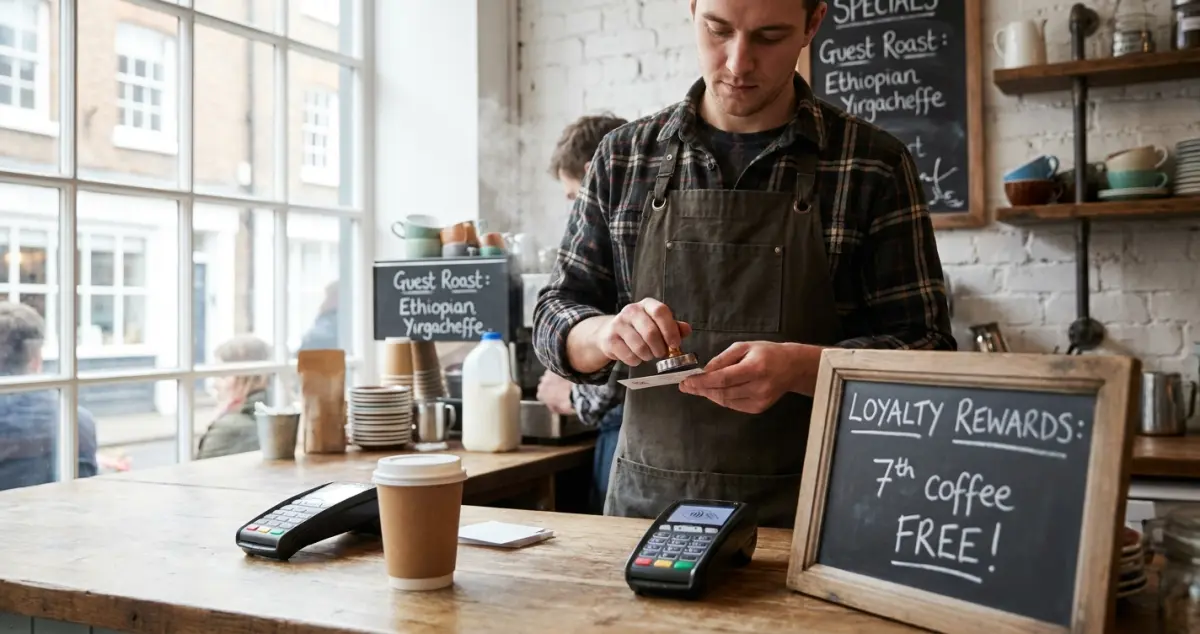
Coffee shop loyalty programs UK 2026 guide: paper vs digital vs hybrid, the unit economics that decide which works, and indie retention mistakes.
Coffee shop loyalty programs are reward schemes that give returning customers a stamp, point, or perk for repeat visits. For UK independents in 2026, the choice of coffee shop loyalty programs is paper card, digital app, or hybrid. The right coffee shop loyalty program depends on your customer mix, your margin per drink, and till speed.
If you're reading this thinking your stamp cards live in coat pockets and never come back, you're not alone. If you're thinking apps look complicated and expensive, that's fair too. Most independent cafe owners run coffee shop loyalty programs without ever working out whether they pay for themselves. That's why the chain down the road keeps stealing your regulars — not because their coffee is better, but because their app remembers customers when yours doesn't. Reading time: 17 minutes.
What You'll Learn
About this guide: Based on the UK independent coffee shop market and our editorial work with LocalBrandHub, with citations to UK government and Information Commissioner's Office (ICO) guidance for regulatory specifics. Worked examples reflect typical UK indie operator experience, not specific client case studies.
This guide is for owner-operators of UK independent coffee shops who want coffee shop loyalty programs that earn their keep, not ones that give away free drinks to people who would have come back anyway. We focus on the unit economics first because retention without margin is just slow bankruptcy.
- The four loyalty programme mechanics that work for UK independents, with cost ranges
- How to decide between paper, digital, and hybrid programmes
- The unit economics: what a "regular" is worth and what you can afford to give away
- The five UK GDPR and ICO rules you must follow before collecting customer data
- Specific mistakes that quietly kill loyalty programmes — and how to spot them early

Table of Contents
- What is a coffee shop loyalty program?
- The four mechanics that work for UK independents
- Paper, digital, or hybrid: a decision framework
- The unit economics of a regular
- UK GDPR, ICO rules, and the legal small print
- Mistakes that quietly kill loyalty programmes
- Frequently asked questions
- Weekly Action
What is a coffee shop loyalty program? {#what-is-a-coffee-shop-loyalty-program}
A coffee shop loyalty program is a framework that rewards customers for repeat purchases, typically through a stamp card, app-based points scheme, or subscription. The aim of coffee shop loyalty programs is to shift behaviour — moving a one-time buyer to a weekly regular, and a weekly regular to a daily one — by making the next visit feel cheaper, easier, or more rewarding than walking past.
Three quick UK indie examples
Take three quick examples from the UK indie scene. A small independent in Brighton might run a buy-nine-get-one-free paper card. A city-centre cafe in Manchester might use a digital app that tracks every transaction and pushes a free drink at the eleventh. A roastery-cafe in Edinburgh might offer a monthly subscription giving subscribers two drinks per day for a flat fee. All three are coffee shop loyalty programs. None of them work the same way or suit the same customer.
Why coffee shop loyalty programs matter for indies
Related: How to Start a Coffee Shop in the UK
The UK Coffee Shop Market Report (Allegra Strategies) consistently shows that independents win on relationship, not price. Coffee shop loyalty programs are the operational shape of that relationship — they're the thing that says "we know you, we remember you, you're worth us tracking." If you're only competing on bean quality you'll always lose to competitors who turn first-visit customers into named regulars within two weeks. That never works as a long-term retention strategy.
Why this matters: LocalBrandHub sees this same pattern across UK indies — the cafes that grow steadily are almost always the ones running a coffee shop loyalty program that's tied to a clear measurement habit, not a marketing whim.
The four mechanics that work for UK independents {#the-four-mechanics}
Now that you know what coffee shop loyalty programs are meant to do, here's the honest list of mechanics that actually move the dial for UK indies. There are dozens of variations of coffee shop loyalty programs, but they all collapse into four shapes.
1. Stamp card (buy X, get one free)
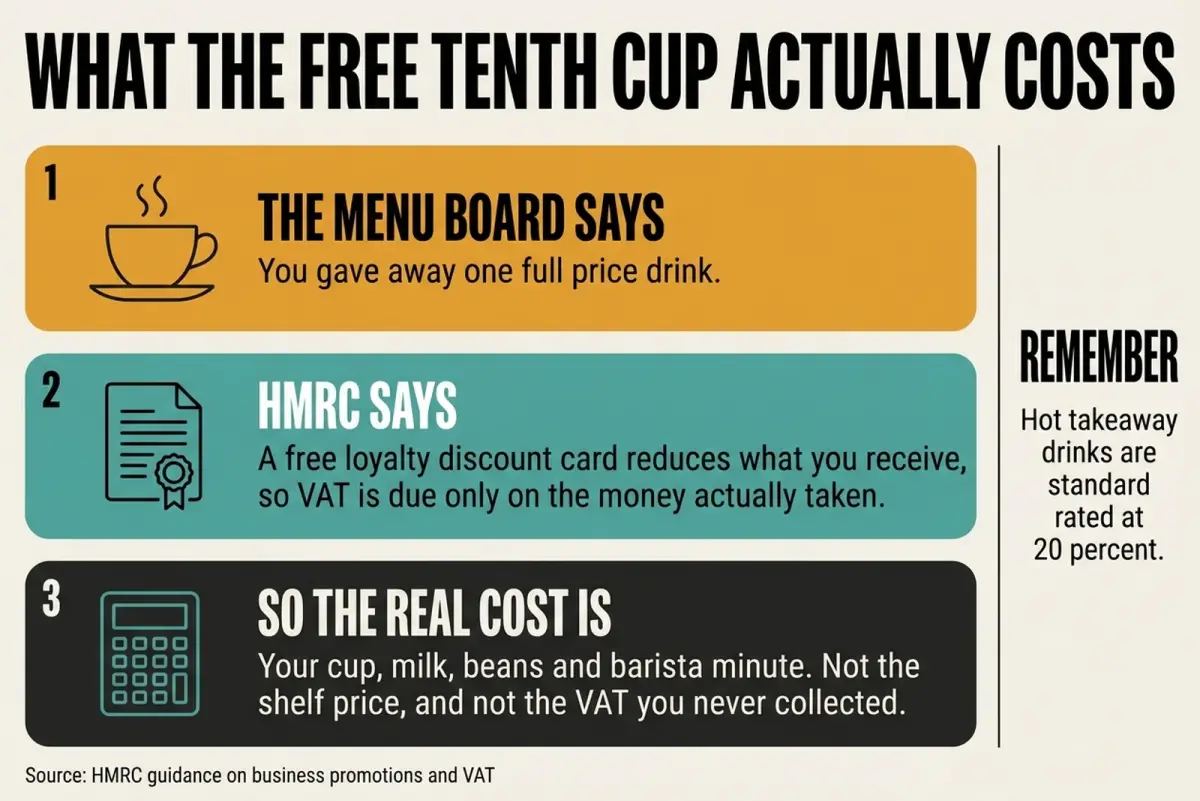
The classic paper card with stamps. Customers buy nine drinks, get the tenth free. Cost to print: typically pennies per card. Cost per redeemed reward: roughly your variable cost on one drink — milk, beans, cup, and a few seconds of barista time, usually well under £1.
For example, a single-site cafe in Bristol with a steady commuter crowd might give one free drink per twelve sold, which works out at roughly 8% off when redeemed. Simple, no infrastructure, no GDPR exposure if you collect no personal data.
2. Digital points (app-based)
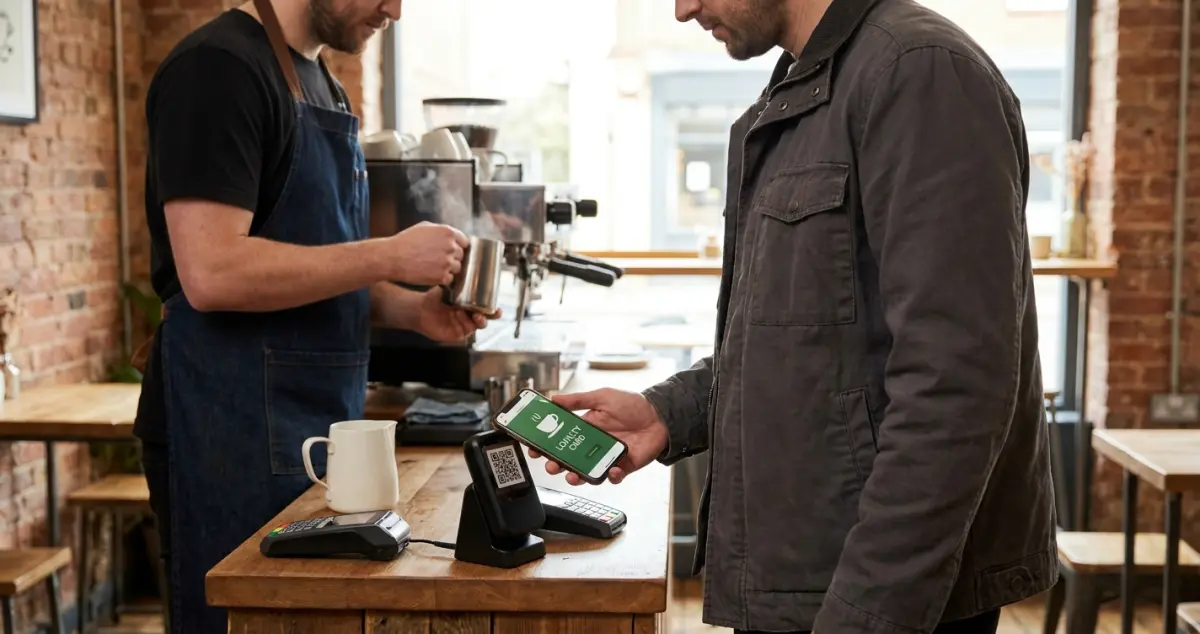
Customers download an app like Stamp Me, Loyverse Loyalty, or Square Loyalty and earn points at the till via QR code, phone number, or card. The app handles reward triggers, retention nudges, and birthday rewards. Monthly cost: a low two-figure subscription per site is typical for hosted platforms; custom apps run into thousands upfront.
Here's where digital earns its fee: you actually know who's coming back. Paper cards are anonymous. Apps capture spend, frequency, and recency — the three numbers retention actually runs on.
3. Tiered or VIP programme
First-time customer gets a discount; ten visits earns "regular" status with priority queueing or named cups; fifty visits earns a free drink on birthdays plus event invitations. Tiered programmes are how chains like Starbucks operate, and they work for indies with strong community identity. Furthermore, they double as a way to mark out your best customers without making them feel uncomfortable.
4. Subscription / monthly pass
The customer pays a fixed monthly fee (typically a mid-two-figure amount) and gets a capped number of drinks per day. Pret's Club Pret popularised this for UK chains. For an independent, subscription only works if your unit economics on milk, labour, and cup costs leave you whole at the subscription price — and that calculation needs doing before you launch, not after.
From experience: Most owners pick mechanic number one because it's familiar, then quietly abandon mechanic number four because the maths frightened them. The middle two are where most operators get stuck — they buy an app, never train staff to push it, and wonder why nobody signs up.
Paper, digital, or hybrid: a decision framework {#paper-digital-hybrid}
Honest comparison of the options
First, the honest comparison of coffee shop loyalty programs. None is universally better. The right pick depends on your customer base, your operational tolerance for technology, and what you actually want to measure from your coffee shop loyalty program.
| Mechanic | Setup cost | Monthly cost | Customer data captured | Best fit |
|---|---|---|---|---|
| Paper stamp card | Print run only | Card reprints | None unless you ask | Single-site, cash-heavy, older crowd |
| Digital app (hosted) | Low | Low monthly per site | Phone, email, visit history | Single or multi-site with regular tech |
| Custom-built app | High upfront | Hosting + maintenance | Full control | Multi-site indies with brand budget |
| Subscription pass | Variable | Payment processing | Email, billing data | Strong daily-regular base, predictable margins |
| Hybrid (paper + email capture) | Print + form | Email tool | Email only | Indies wanting some data without an app |
Cost ranges, capture types, and operational tolerance figures are typical for UK independent operators in 2026; your numbers will vary by location, mix, and supplier.
If you can't tell whether your customers prefer paper or app-based programmes that's usually a sign you've never asked them. A two-week till-side conversation costs nothing and tells you more than three years of guessing.
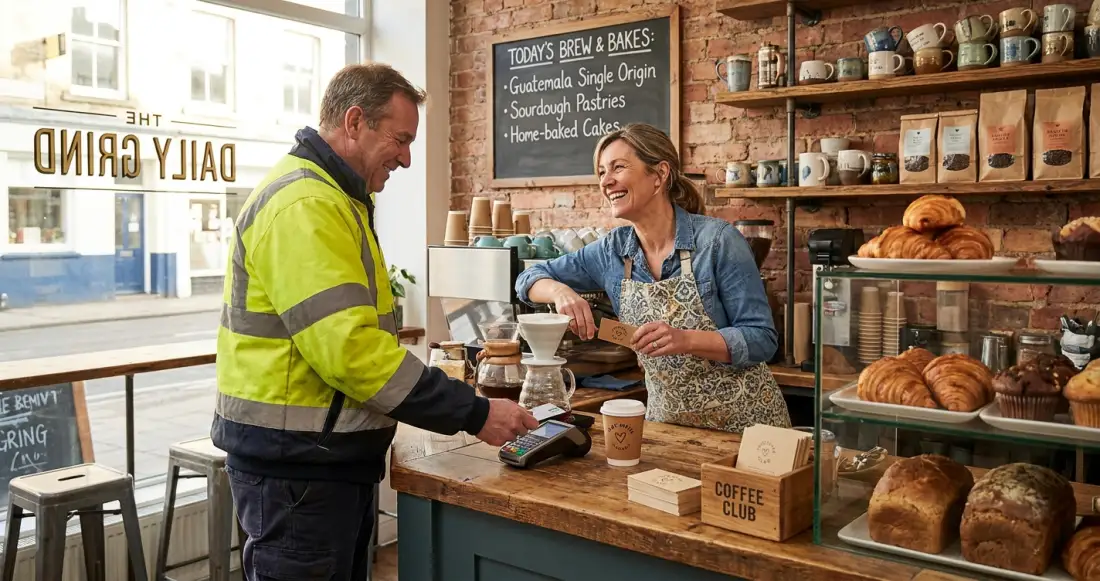
If you pick just one, hybrid is often the strongest choice — a printed card with a "join our email list for a free drink on signup" QR code captures the data without forcing customers to download anything. It gives you a way to message regulars when you have something to say, without the friction of app adoption.
Worked example: which model fits whom
Consider a coffee cart at a station in Reading. It sees 80% of customers in a five-minute window between 7am and 9am. Paper stamps win there — no friction, no app load time, no till queue. A roastery-cafe in Hackney with weekend brunch and longer dwell times can run a digital app because customers are happy to fish out a phone while waiting for an oat flat white.
Worked example: A two-site independent in Cardiff trialled a free hosted app for ninety days. Sign-ups hit 400. Repeat-visit rate among app users was 38% higher than the till average. They kept the app. A single-site in rural Devon ran the same trial — got 22 sign-ups, no measurable lift — and went back to paper. Same software, different fit.
The unit economics of a regular {#unit-economics}
Building on the framework above, the next step is the maths. You can't decide what to give away in a coffee shop loyalty program until you know what a regular is worth.
The headroom calculation
Take a typical UK independent flat white at a mid-four-pound retail price. Variable cost — beans, milk, cup, lid, labour for the pour — is commonly around the high-twenties to mid-thirties of a percent of retail. That leaves a gross contribution per drink in the low single pounds. A regular who comes in three times a week, fifty weeks of the year, buys 150 drinks. Gross contribution per regular per year sits in the low three figures — small per drink, meaningful per customer.
Why the maths almost always works
That's your headroom. A free drink every ten visits costs you roughly your variable cost on one drink, while pulling in nine paid drinks at full margin. The maths typically works — provided redemption rates are sensible and you're not giving rewards to people who would have visited anyway.
The three numbers you actually need to track
Here's the trio. Everything else is decoration. For example, a cafe owner in Birmingham running a paper card who tracks only frequency saw their coffee shop loyalty program shift visits-per-regular from 2.4 to 3.1 in the first quarter — proof the programme was working without needing any digital tooling.
- Frequency — visits per regular per month
- Average spend per visit — drinks plus food attach
- Redemption rate — percentage of cards that actually get redeemed (industry-typical: paper cards 15-25%, digital 35-50%)
Why this matters: A 50% redemption rate means half of all stamped/pointed cards are turning into free drinks. If your gross contribution per drink is in the low single pounds and your free drink costs you under a pound, you're still in the black — but only if the programme is genuinely shifting frequency, not subsidising existing behaviour.
UK GDPR, ICO rules, and the legal small print {#uk-gdpr-ico-rules}
Next, the part most operators skip. Coffee shop loyalty programs that capture an email, phone number, or birthday are processing personal data under the UK GDPR — and the Information Commissioner's Office takes a dim view of cafes that bolt on an app without thinking about consent.
What triggers GDPR for coffee shop loyalty programs
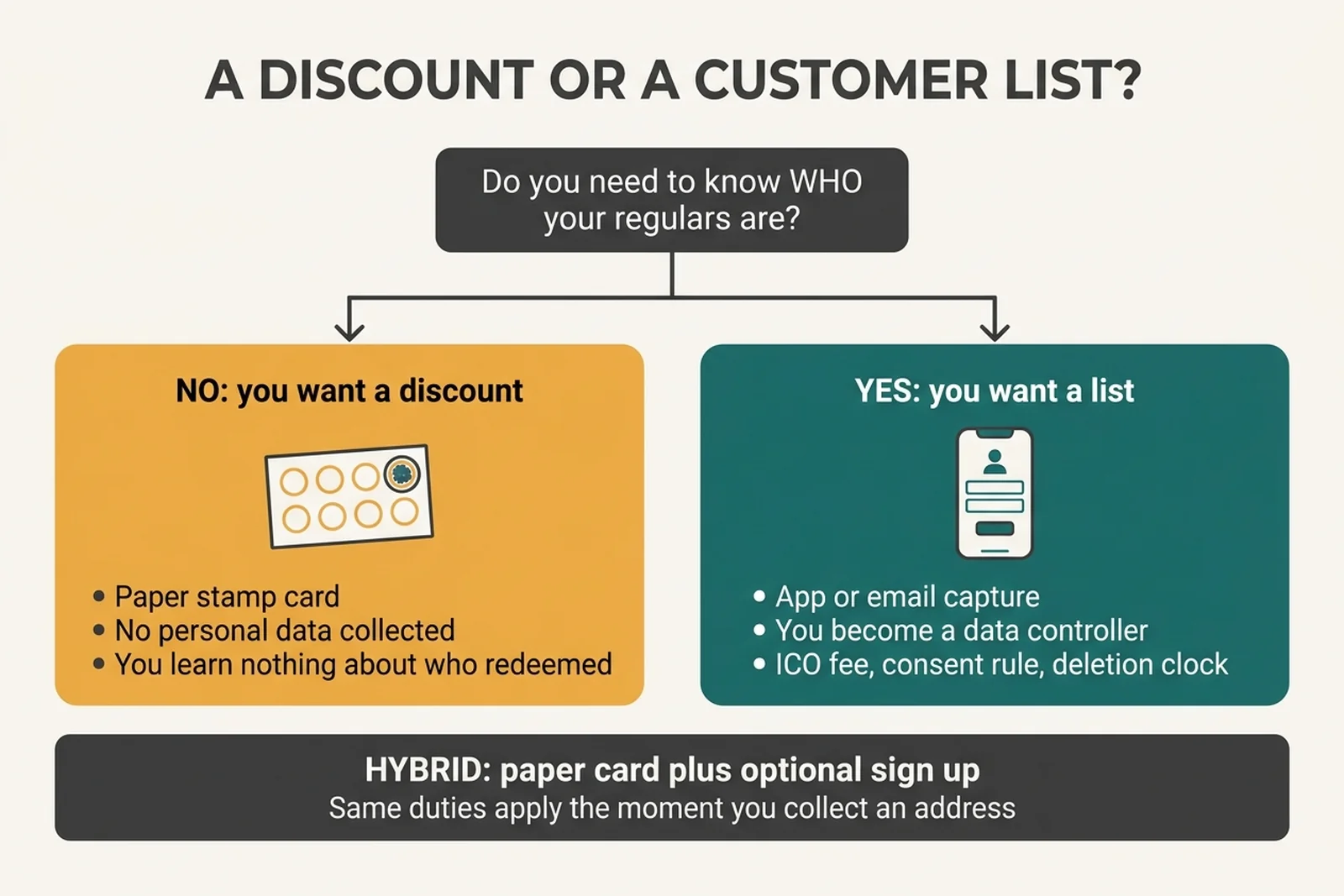
The trigger is personal data, not the platform. A paper stamp card with no name or email collected is GDPR-light. The moment you collect identity data — at sign-up, on a form, or via an app — the framework engages in full and you become the data controller.
The five rules that apply to almost every coffee shop loyalty programme
- Lawful basis — typically consent for marketing, contract for the loyalty mechanic itself
- Clear privacy notice — accessible at point of sign-up, plain English, no dark patterns
- Separate consent for marketing — under PECR (Privacy and Electronic Communications Regulations), you need explicit opt-in before sending promotional emails or SMS
- Right to erasure — customers can ask you to delete their data and you have a month to do it
- Data minimisation — only collect what you actually use; birthday-only collection is fine, full date-of-birth-plus-address is not
Take a cafe owner in Leeds capturing emails on paper sign-up forms. They must keep a record of the consent (the form), have a clear way for customers to unsubscribe, and never resell or share the list. The gov.uk PECR guidance is the authoritative source if you're unsure.
If you're only running a paper stamp card with no name, email, or phone capture, GDPR exposure is minimal — the card has no personal data. The moment you add a digital sign-up, the rules engage in full. Plan for that before you commit.
Mistakes that quietly kill loyalty programmes {#mistakes-to-avoid}
Now that the framework, economics, and legal basics are covered, let's look at the failure modes. These are the recurring traps that turn promising coffee shop loyalty programs into marketing lines on chalkboards nobody pays attention to.
Mistake 1: rewarding behaviour that would have happened anyway
The 8am Monday-to-Friday commuter buying their flat white before the train isn't loyal because of your card. They're loyal because of geography and habit. Stamping their card costs you a free drink every ten visits without changing their behaviour by a single visit. The honest move is to design the programme around shifting marginal customers — the weekly who could become daily, the monthly who could become weekly — not subsidising existing daily traffic.
Mistake 2: launching an app and never training staff to push it
Apps don't market themselves. The single biggest determinant of digital loyalty sign-up rate is whether your barista mentions it at the till during the morning rush. Train the line: "We've got an app — get your first drink free if you sign up while I'm making this." Without that one sentence, sign-up rates collapse to single digits and you've bought a monthly subscription for nothing.
Mistake 3: rewards too generous or too stingy
A "buy 5 get 1 free" card is a 17% discount and probably eats your margin alive. A "buy 20 get 1 free" card is a 5% discount that customers stop chasing because the finish line feels too far away. The standard buy-nine-get-one-free (10% effective discount) sits in the sweet spot for most UK indies — generous enough to feel earned, lean enough to protect margin.
Mistake 4: no measurement
If you can't tell whether your coffee shop loyalty program has lifted frequency, average spend, or redemption rate over baseline, it isn't a programme — it's a giveaway. Set a baseline before you launch and measure quarterly. Even a paper card can be tracked: count cards completed per month and you'll know if mechanic strength is increasing.
For example, a cafe owner in Nottingham counts completed paper cards on the first Monday of each month, jotting the number on a noticeboard in the back office. After two quarters, the trend line was enough to tell them their coffee shop loyalty program was driving meaningful repeat behaviour — without any app or platform.
Pre-launch checklist
Before you launch any loyalty scheme, walk through this:
- Pick one of the four mechanics and write down why it suits your customer mix
- Calculate your variable cost per drink and your effective discount under the chosen mechanic
- Set a baseline for current frequency and average spend (one week of till counts is enough)
- If digital, decide on the platform and have a staff training plan ready
- If you capture any personal data, draft a one-paragraph privacy notice and a consent line
Would you walk into your own shop tomorrow morning and sign up for the programme you've just designed? If the answer is "not really" — redesign it before you launch, not after.
Frequently asked questions about coffee shop loyalty programs {#faq}
The questions below cover the three areas UK indie owners most often ask about: costs and ROI on coffee shop loyalty programs, paper-versus-digital decisions, and the legal layer.
Q: How much do coffee shop loyalty programs cost to run?
The cost depends on the mechanic. A paper stamp card costs essentially print pennies plus the variable cost of redeemed drinks (commonly well under £1 each). A hosted digital app typically runs a low two-figure monthly subscription per site. A custom-built app can run into thousands upfront plus ongoing hosting. The hidden cost in all cases is staff time at the till — train your team or sign-up rates stall.
Q: Paper card or app coffee shop loyalty programs — what's better for an independent UK coffee shop?
Paper-based coffee shop loyalty programs win for cash-heavy, single-site indies with older demographics and tight morning-rush till times. Digital wins when you want to know who your regulars actually are — paper cards are anonymous, apps capture frequency and spend. Hybrid coffee shop loyalty programs (paper card with optional email capture via QR) are often the strongest compromise for indies that want some data without the app friction.
Q: What's a good redemption rate for coffee shop loyalty programs?
Industry-typical ranges are 15-25% for paper cards (many never come back) and 35-50% for digital programmes. A higher redemption rate isn't automatically better — it can mean you're rewarding existing habit rather than shifting marginal behaviour. The metric that matters more is whether visit frequency among programme members exceeds the till average.
Q: Do I need to register with the ICO for coffee shop loyalty programs?
Most independent coffee shops running coffee shop loyalty programs that process customer data for marketing purposes need to pay the ICO data protection fee — fees are tiered by organisation size and turnover (see ico.org.uk fees). Paper-based coffee shop loyalty programs with no personal data captured generally don't trigger this. Adding a digital sign-up changes that calculation, so check the current fee structure before launching an app or email capture.
Q: How do I stop people gaming coffee shop loyalty programs?
Common fraud patterns include passing cards between strangers, double-stamping after a single transaction, and creating duplicate digital accounts. Practical defences: one stamp per transaction not per drink, no group transactions on one card, and for digital programmes use phone-number-based sign-ups with verification. Most fraud is a rounding error compared to programme value — don't over-engineer.
Q: Should coffee shop loyalty programs include food, or drinks only?
If your food gross margin is healthier than your drink margin (which is often the case in indies that bake their own pastries or run a brunch menu), pulling food into the programme can lift average spend per visit. Many UK indies start drinks-only because it's simpler, then add a "double stamp on weekends" or "stamp on any £5+ transaction" rule once the baseline programme is bedded in.
If you only have 30 minutes a week {#minimum-viable}
Loyalty doesn't need a project plan. Coffee shop loyalty programs run on small habits done consistently. If you only have 30 minutes a week to invest, do this:
This week, audit your coffee shop loyalty program in 30 minutes:
- Day 1-2: Count how many regulars you have right now (definition: three or more visits per month) — fifteen minutes
- Day 3-4: Pick one mechanic and write the till sign — ten minutes
- Day 5-7: Brief your team on the trigger sentence and put the sign up — five minutes total
That's the entire programme. Everything else is decoration.
For restaurants, salons, and local businesses
Need help with your marketing?
We help UK businesses turn social media into real results, not busywork.
Get in TouchKey Takeaway
Key Takeaway
Coffee shop loyalty programs are tested at the till, not on spreadsheets. This week, here's how to move from theory to a working baseline.
Day 1-3: Pick your mechanic. Walk through the four options against your customer mix and pick one — paper, digital, hybrid, or subscription. Write a single paragraph explaining why it suits your shop. If you can't write the paragraph, the mechanic isn't right.
Day 4-7: Set your baseline. Spend a week counting transactions, average spend, and frequency of regulars (a regular is anyone who came in three or more times in the previous month). Write the three numbers on a sticky note on the espresso machine. Without these, you'll never know if the coffee shop loyalty program worked.
Coffee shop loyalty programs aren't a marketing accessory. They're an operational system that decides how much of your future revenue you can predict — and how much of it walks past your door on a Tuesday afternoon. Build the framework first. The free drinks come later.
About the Author
Local Brand Hub
Empowering UK Businesses
Local Brand Hub provides comprehensive business management tools designed specifically for UK local businesses to streamline operations, automate marketing, and grow revenue.
More articlesRelated Articles
Marketing TipsCoffee Shop Rebooking Reminders UK 2026: Win-Back Done Right
Coffee shop rebooking reminders UK 2026: SMS vs email win-back nudges, wording that works, ICO PECR rules and the offer structure that revives regulars.
Marketing TipsCoffee Shop Birthday Rewards UK 2026: Trigger That Pays
Coffee shop birthday rewards UK 2026: how to capture date of birth legally, the free-drink-on-birthday play, redemption rates and full GDPR rules.
TutorialsCoffee Shop Referral Programme UK 2026: Bring-a-Friend Right
Coffee shop referral programme UK 2026: bring-a-friend mechanics that actually work for indies, the £5/£5 model vs free-drink swap, and GDPR-safe tracking.