
Coffee shop referral programme UK 2026: bring-a-friend mechanics that actually work for indies, the £5/£5 model vs free-drink swap, and GDPR-safe tracking.
A coffee shop referral programme is a "bring a friend" mechanic that rewards a customer for introducing a new one: typically through a free drink or paired reward. For UK independents in 2026, a coffee shop referral programme is the cheapest customer acquisition channel available when designed properly.
If you're reading this thinking "my regulars already tell their friends": they do, but informally. The cafes that systemise that word of mouth get measurable lift. The ones that don't keep wondering why their best customers seem so generous with praise but their door count barely moves. Reading time: 10 minutes.
Related: Coffee Shop Loyalty Programs UK 2026
What You'll Learn
About this guide: Based on the UK independent coffee shop market and our editorial work with LocalBrandHub, with citations to ICO/gov.uk guidance on GDPR-safe referral tracking and worked examples reflecting typical UK indie experience.
This guide is for owner-operators of UK independent coffee shops who want a coffee shop referral programme delivering new customers, not just compliments.
- The three referral mechanics that work for UK indies
- How to set the right reward without giving away margin
- GDPR-safe ways to track who referred whom
- Why most coffee shops skip referrals, and what they miss
- The launch plan that gets real referrals in the first month
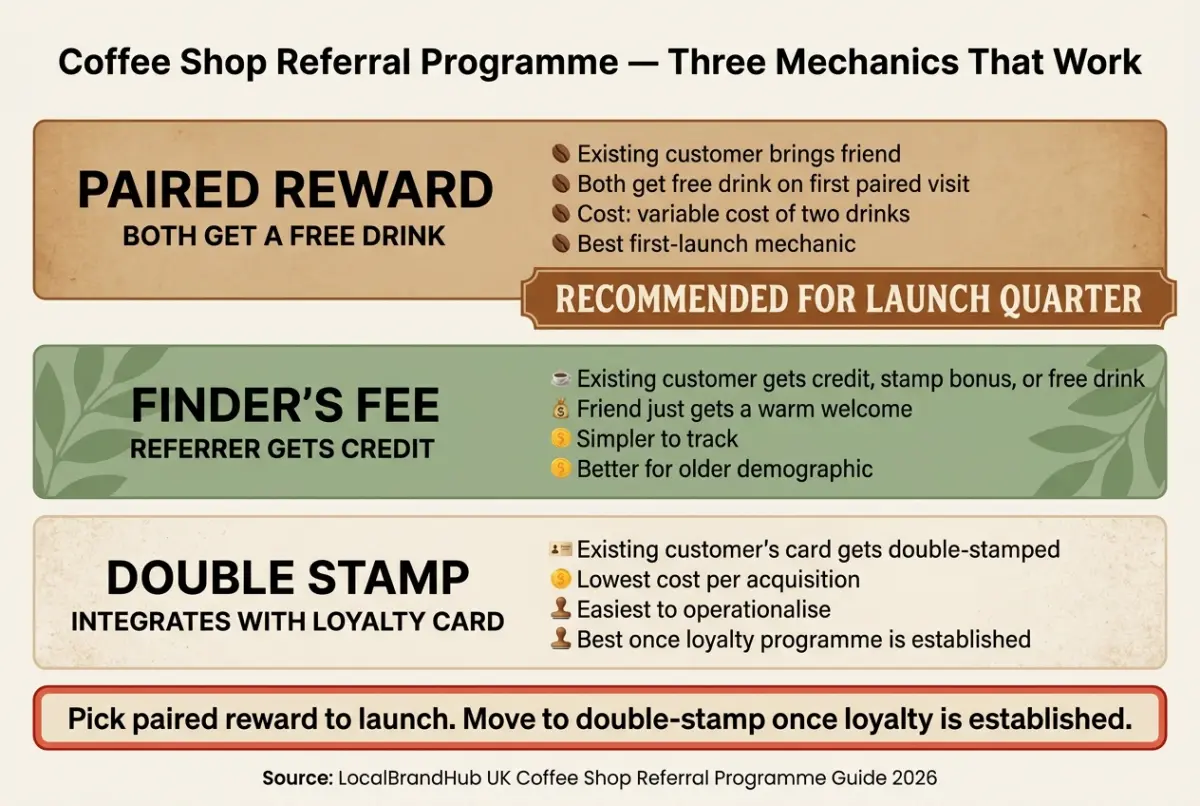
Table of Contents
- What is a coffee shop referral programme?
- Three mechanics that work
- Setting the reward without leaking margin
- GDPR-safe referral tracking
- Why most coffee shops skip referrals
- Frequently asked questions
- Weekly Action
What is a coffee shop referral programme? {#what-is}
A coffee shop referral programme is a framework that rewards a current customer for bringing in a new one. The reward can be a free drink, paired drinks for both customer and friend, a stamp bonus, or a credit on the next visit. Unlike a general loyalty programme (which rewards repeat purchase), a referral programme specifically incentivises customer acquisition.
For example, a single-site cafe in Bristol running a paired reward might give both the existing customer and the new arrival a free drink on the first joint visit. That's a higher cost per acquisition than a paper card stamp, but it pulls a brand-new customer through the door, and new customers are almost always more valuable than discounting existing traffic.
Three mechanics that work {#mechanics}
Now that the concept is clear, here are the three shapes a referral programme typically takes in a UK indie context.
1. Paired reward (free drink for both)
The cleanest mechanic. Existing customer brings a friend; both get a free drink (or a meaningful discount) on that first paired visit. Easy to communicate ("bring a friend, both get a free drink"), easy to enforce at the till, and the new customer's first cafe experience is positive from the start.
Cost per acquisition: roughly the variable cost of two drinks, typically a low single-pound sum. Worth it almost every time, because customer lifetime value across multiple return visits dwarfs that cost.
2. Finder's fee (referrer gets a credit)
The existing customer gets a credit (a free drink, a stamp bonus, or a small monetary credit) when their named friend visits and mentions them. The friend doesn't get anything beyond a warm welcome.
This mechanic suits cafes where the existing customer base is heavily skewed older or where pairing the rewards feels awkward. Furthermore, it's simpler to track because only one customer needs to be identified.
3. Double-stamp referral
The existing customer's loyalty card gets a double stamp when they bring a new face. Cheaper than a paired reward, integrates with an existing paper or digital programme, and easy for staff to apply without a separate workflow.
From experience: Most UK indies that launch a referral programme pick mechanic one for the launch quarter (because it's the most generous and the most likely to actually trigger word of mouth), then move to mechanic three once the loyalty programme is established. Don't pick the finder's fee first: it asks too much trust of the new customer.
Setting the reward without leaking margin {#reward}
First, the maths. Customer acquisition cost (CAC) in any service business is the metric that matters; the referral programme is competing with paid social, Google Ads, and printed flyers as a channel.
| Channel | Typical CAC | Conversion to regular | Best for |
|---|---|---|---|
| Paid Instagram ads | Mid one-figure to low two-figure £ per click; conversion typically low | Variable | Awareness |
| Google Ads (local) | Mid one-figure to low two-figure £ per click | Higher than social | Search-intent |
| Printed flyers | Pennies per flyer; very low conversion | Low | Hyperlocal launch |
| Referral programme | Cost of two drinks per acquisition | Highest of all channels | Existing-customer-led growth |
CAC ranges, conversion factors, and channel comparisons are typical for UK independent operators in 2026; your numbers will vary by location, mix, and timing.
Here's the punchline: a referred customer arrives pre-qualified. Someone they trust already vouched for the cafe. Their conversion-to-regular rate is meaningfully higher than any other channel. That's why even a generous-feeling reward (two free drinks per acquisition) is often the lowest-CAC channel an indie has. If you want to put a figure on it, work out your cost per new customer and set it against what you're spending on ads.
If you pick just one mechanic, the paired reward is often the strongest choice: it removes any awkwardness about who gets what and gives the new customer a positive first experience from sentence one. That first experience is the entire point.
If you can't tell whether a referral has happened because nobody's actually counting that's usually a sign the launch was undercooked. A referral programme without measurement is a generosity policy.
Worked example: A cafe owner in Leeds launched a paired-reward referral programme alongside their paper loyalty card. In ninety days, 47 paired-reward visits were logged. Of the 47 new customers, 19 returned at least three times in the following quarter (40% conversion-to-regular). Each acquisition cost approximately the variable cost of two drinks. Cheapest channel on their P&L by a long way.
GDPR-safe referral tracking {#tracking}
Next, the legal and operational layer. Tracking referrals can edge into GDPR territory the moment you record who referred whom, but the simple paper-based systems most indies use are typically low-risk.
Low-risk tracking methods
- Counted on the loyalty card: the existing customer's card gets a double stamp, no separate referral record. No personal data of the new customer captured.
- Till count of paired-reward redemptions: staff log paired-reward visits in a simple count, no names.
- Verbal acknowledgement: "Bring a friend, both get a free drink, just tell us at the till." No data captured beyond the transaction.
Higher-risk tracking methods
- Referral codes tied to email: captures personal data of both referrer and referred; PECR rules apply for any marketing follow-up
- App-based referral codes: same; needs explicit consent under the Information Commissioner's Office framework
- Refer-a-friend forms: if you capture the friend's email before they've visited, you need a lawful basis (usually consent) and a privacy notice
For example, a cafe owner in Sheffield using a verbal "bring-a-friend" mechanic captures no personal data beyond the till transaction, which keeps GDPR exposure minimal. If they later layered a digital referral programme through an app, the gov.uk PECR guidance would apply in full.
Why most coffee shops skip referrals {#why-skipped}
Building on the maths above, the question worth asking is: why do so few UK indies actually run a referral programme? Three reasons keep coming up.
Reason 1: it feels like discounting
Owners worry that a "two free drinks" reward devalues the offering. The maths says the opposite (the cost per acquired customer is lower than any paid channel), but the emotional weight of "giving away coffee" feels heavier than the cost on a P&L.
Reason 2: tracking feels complicated
Owners imagine the referral programme needs an app, a code, a system. It doesn't. A till count and a double-stamp policy is all most indies need. Complexity is invented after the fact.
Reason 3: the launch never happens
A "we mean to do it" referral programme stays on a planning sticky note for months. The cafes that do launch usually time it with a season change, a refit, or a launch of a new menu: anything that gives them a reason to put a sign up and brief the team.
If you're only competing on bean quality you'll always lose to competitors who turn one regular into two regulars in a single visit. That never works as a long-term growth strategy.
Pre-launch checklist
- Pick one mechanic (paired reward, finder's fee, or double-stamp)
- Set the reward: write down the exact wording for the till sign and the staff brief
- Decide tracking method: till count for low-risk, app code only if you're already digital
- Print a small A6 sign for the till and the counter
- Brief every barista on the trigger phrase and the reward
- Set a 90-day review date with one number: how many paired-reward visits
Would you ask one of your regulars to bring a friend in tomorrow? If yes, you're ready to launch. If no, fix the awkwardness first.
Frequently asked questions {#faq}
Q: What is a coffee shop referral programme?
A coffee shop referral programme is a structured "bring a friend" mechanic that rewards an existing customer for introducing a new one to the cafe. Rewards typically include a free drink for both customer and friend, a stamp bonus on a loyalty card, or a small credit on the next visit. It's the cheapest customer acquisition channel available to most UK indies.
Q: How much should a coffee shop referral reward be worth?
For most UK indies, the paired-reward model (one free drink each for referrer and friend) sits in the sweet spot. The cost per acquisition is the variable cost of two drinks, typically a low single-pound sum, and a new customer's lifetime value across return visits dwarfs that cost. A "buy one get one free" offer on a single visit can work but feels less generous than a free pair.
Q: How do I track coffee shop referrals without breaking GDPR?
The lowest-risk method is a till count of paired-reward redemptions plus a double-stamp on the referrer's loyalty card: no names captured beyond the transaction itself. The moment you collect email addresses, app-based referral codes, or refer-a-friend forms, you trigger UK GDPR and PECR obligations under the ICO framework.
Q: Do referral programmes actually work for independent coffee shops?
Yes: referred customers convert to regulars at a meaningfully higher rate than customers from paid social or printed flyers, because they arrive with social proof from someone they trust. The challenge isn't whether they work; it's whether you've actually launched the programme rather than left it on a planning sticky note.
Q: Should a referral programme be paper or digital?
For most single-site UK indies, paper or verbal tracking is plenty: a till count of paired-reward visits and a sign on the counter is the whole system. Digital referral codes earn their complexity only when you're already running a digital loyalty programme and the app supports it natively. Don't build a digital referral programme as your first move.
Q: When is the best time to launch a coffee shop referral programme?
Tie it to a seasonal moment: September back-to-work, January reset, a refit, or a menu launch. The reason isn't marketing; it's that you need a hook to put a fresh sign up and brief the team. A standalone referral launch on a quiet Tuesday rarely catches.
Related: Coffee Shop Loyalty App UK 2026
Why this matters: LocalBrandHub sees the same pattern across UK indies: a working coffee shop referral programme launched alongside a loyalty card multiplies acquisition without any extra marketing spend.
If you only have 30 minutes a week {#minimum-viable}
A coffee shop referral programme doesn't need a marketing plan. If you only have 30 minutes a week, do this:
This week, launch your coffee shop referral programme in 30 minutes:
- Day 1-2: Pick the mechanic (paired reward recommended) and write the till sign, ten minutes
- Day 3-4: Print the A6 sign at home or local print shop, ten minutes
- Day 5-7: Brief the team on the trigger sentence and place the sign at the till, ten minutes
For example, a cafe owner in Liverpool ran the entire 30-minute setup on a quiet Sunday afternoon and saw the first paired-reward visit within five days. No app, no platform, no setup cost beyond a printed sign.
If you run a coffee shop and want to see how Local Brand Hub can support your marketing, explore our coffee shop marketing tools.
For restaurants, salons, and local businesses
Need help with your marketing?
We help UK businesses turn social media into real results, not busywork.
Start freeKey Takeaway
Key Takeaway
A referral programme is the cheapest acquisition channel an indie has, and the most commonly skipped. This week, here's how to actually launch one.
Day 1-3: Pick one mechanic and write the till sign. One sentence, no caveats. "Bring a friend, both get a free drink on us." That's the entire programme.
Day 4-7: Brief the team and put the sign up. Train every barista on the trigger phrase and the reward. Set a notebook by the till to log paired-reward redemptions. The first paired-reward visit usually happens within the first week.
A referral programme isn't a marketing channel. It's a permission slip: telling your regulars they're allowed to bring a friend without feeling like they're imposing.
Get More Marketing Tips
Practical marketing tips for UK business owners, straight to your inbox. No spam, unsubscribe anytime.
About the Author
Local Brand Hub
Empowering UK Businesses
Local Brand Hub provides comprehensive business management tools designed specifically for UK local businesses to streamline operations, automate marketing, and grow revenue.
More articlesRelated Articles
 Tutorials
Coffee Shop Loyalty App UK 2026: Platform Comparison Guide
Coffee shop loyalty app UK 2026: compare Square, Loyverse, Stamp Me and custom-built options. When an app earns its monthly fee and when it does not.
 Tutorials
Loyalty Card for Coffee Shop UK 2026: Paper That Pays Off
Loyalty card for coffee shop UK 2026 guide: paper stamp card design, suppliers, mechanics that work, and when paper still beats every app on the UK market.
 Marketing Tips
Coffee Shop Rebooking Reminders Done Right
Coffee shop rebooking reminders UK 2026: SMS vs email win-back nudges, wording that works, ICO PECR rules and the offer structure that revives regulars.