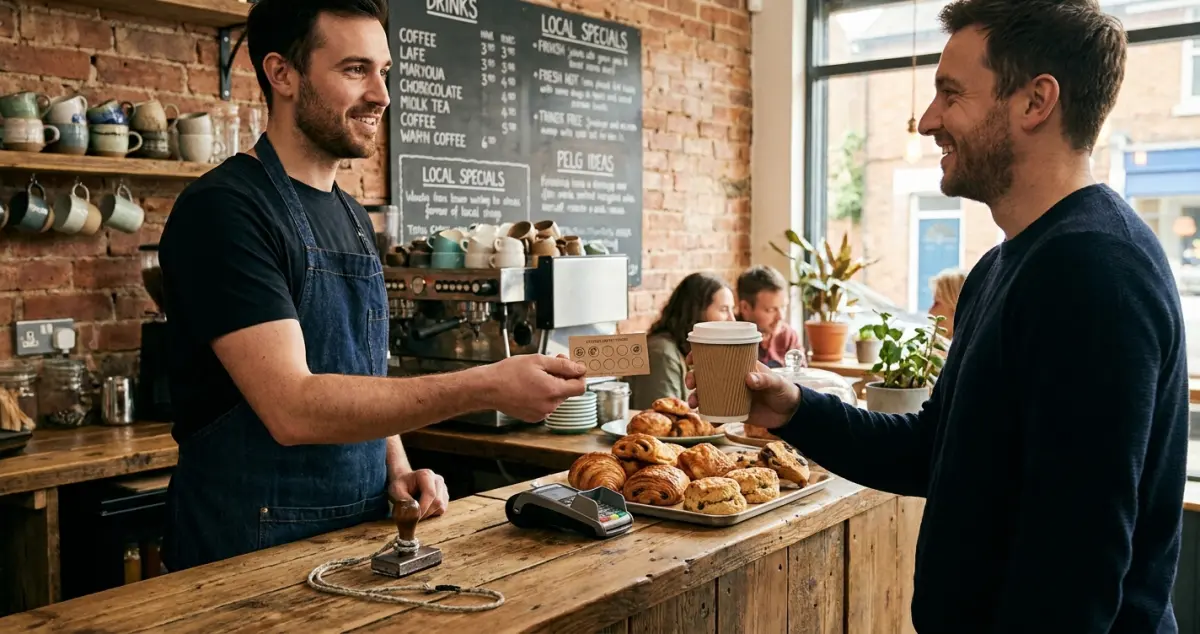
Loyalty card for coffee shop UK 2026 guide: paper stamp card design, suppliers, mechanics that work, and when paper still beats every app on the UK market.
A loyalty card for a coffee shop is a printed stamp card that customers carry. They get a stamp per qualifying purchase and a free drink once filled. For UK independents in 2026, a loyalty card for a coffee shop is the cheapest, fastest, and most GDPR-light loyalty mechanic available.
If you're reading this thinking apps are the future and paper is dead, hold on. Most UK independent cafes that switch from a working paper scheme to a digital app see sign-up rates collapse for the first three months because their morning rush won't slow down for a QR scan. Paper isn't behind the times. It's behind the till for a reason. Reading time: 11 minutes.
Related: Coffee Shop Loyalty Programs UK 2026
What You'll Learn
About this guide: Based on the UK independent coffee shop market and our editorial work with LocalBrandHub, with citations to UK ICO and gov.uk guidance for regulatory specifics. Cost ranges and supplier notes reflect typical UK indie experience in 2026.
This guide is for owner-operators of UK independent coffee shops deciding whether a loyalty card for coffee shop programme still earns its keep, and if so, how to design one that actually shifts customer frequency rather than just decorating coat pockets.
- Why paper still beats apps for many UK indies in 2026
- The design choices that decide whether your card gets carried or binned
- UK printers and card suppliers worth comparing
- Stamp mechanics, redemption rules, and lost-card policy
- The single mistake that kills paper-card programmes, and how to spot it
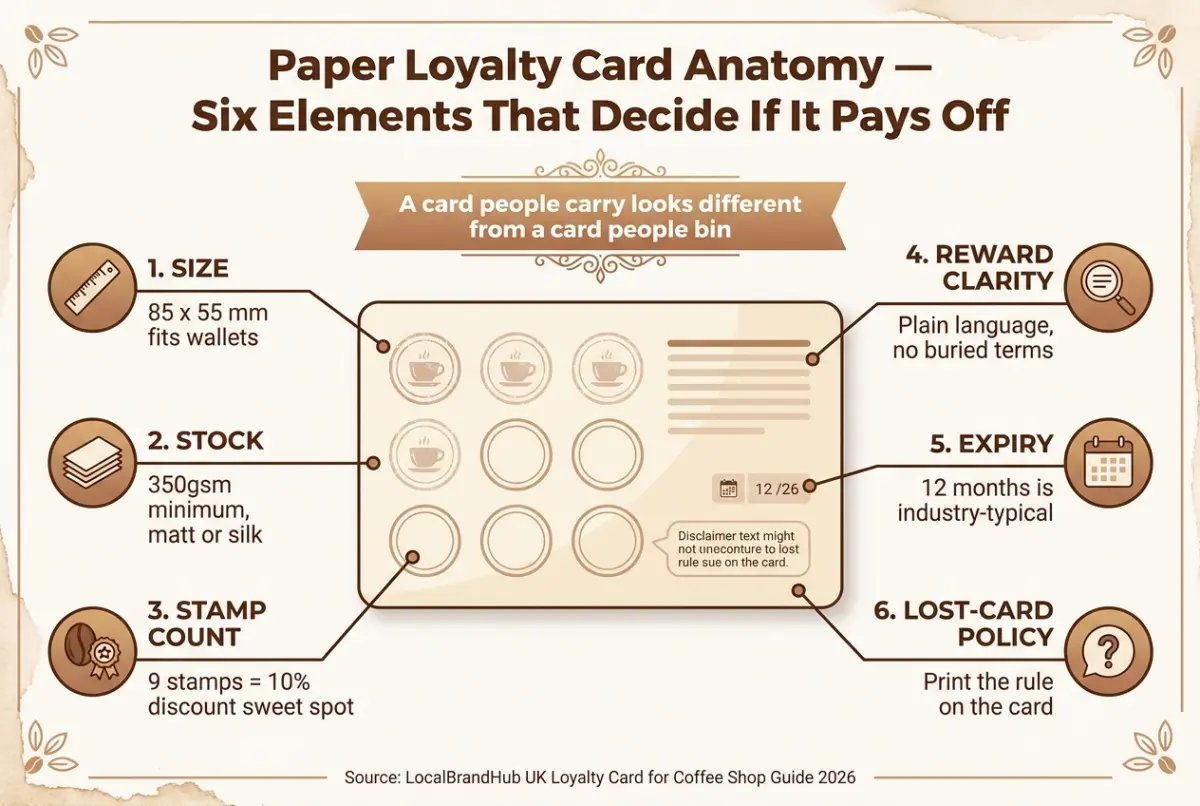
Table of Contents
- What is a coffee shop loyalty card?
- Paper vs digital: when paper still wins
- Designing a card people actually carry
- Stamp mechanics, redemption, and rules
- UK suppliers and print costs
- Frequently asked questions
- Weekly Action
What is a coffee shop loyalty card? {#what-is}
A loyalty card for coffee shop is a framework for recording repeat purchases on a small printed card, typically business-card or bookmark sized, through stamps, hole-punches, or initials. The reward, most commonly a free drink, triggers when the card is filled. It's a framework that turns one-time buyers into named regulars without any app, software subscription, or staff retraining.
For example, an independent cafe in Sheffield might print 500 cards per quarter at a low one-figure pence-per-card cost, give one stamp per drink purchased, and hand a free drink at the tenth stamp. No software. No GDPR. No login screen. The card lives in a wallet, gets stamped at the till in three seconds, and the only operational requirement is a stamp on a string.
Paper vs digital: when paper still wins {#paper-vs-digital}
First, the honest comparison. Paper isn't a retreat from technology: for many UK indie operators it's the right tool for the job.
| Factor | Paper card | Digital app |
|---|---|---|
| Setup cost | Low (print run only) | Variable (monthly fee or higher upfront) |
| Time at till | Two to three seconds | Five to fifteen seconds during rush |
| Sign-up friction | None | Download, signup, verify |
| Customer data captured | None unless you ask | Phone, email, history |
| GDPR exposure | Minimal | Full UK GDPR + PECR |
| Best fit | Cash-heavy, single-site, older crowd | Multi-site, daily-regulars, tech-comfortable |
Operational figures are typical for UK independent coffee shops in 2026; your numbers will vary by location, mix, and equipment.
Here's the bit most operators miss: the morning rush is where loyalty programmes are won or lost. If you can't tell whether your queue moves faster with paper or app-based sign-ups that's usually a sign you've never timed it. A two-week trial at the till tells you more than any vendor demo.
If you pick just one mechanic, the paper card is often the strongest choice for a single-site UK indie: it costs almost nothing, requires zero staff training, and customers understand it on sight. That's not nostalgia talking. That's till throughput maths.
From experience: A cafe owner in Norwich tried a hosted loyalty app for ninety days, saw 38 sign-ups against 6,000 transactions, and quietly went back to paper. Same customers. Different friction.
When paper stops being the answer
For example, a multi-site indie in Manchester with daily commuter regulars across three sites needs digital to track which sites a regular visits. Paper can't do that. Furthermore, if you want birthday triggers, rebooking nudges, or quarterly retention reports, paper is decorative.
Related: Coffee Shop Loyalty App UK 2026
Designing a card people actually carry {#designing}
Now that the case for paper is clear, the next step is design. The card people carry looks different from the card people throw away. Six elements decide which side of that line your card lands on.
1. Size and stock
Business-card dimensions (85 × 55 mm) fit standard wallet slots and slot into card holders. Bookmark sizes look distinctive but get bent. Cardstock should be 350gsm minimum: anything thinner curls in pockets. Matt or silk finish takes a stamp clearly; glossy finishes can smudge if your ink isn't fast-drying.
2. Stamp count
The standard "buy 9 get 1 free" (effectively 10% off when redeemed) sits in the sweet spot for most UK indies. Five-stamp cards are too generous (17% effective discount). Twenty-stamp cards are too far away: customers stop chasing the reward. For example, a cafe in Edinburgh testing both 8-stamp and 12-stamp variants found completion rates of 28% on the 8-stamp and 11% on the 12-stamp version after three months.
3. Reward clarity
State the reward in plain language: "Buy 9 drinks, get the 10th free." Don't bury terms. Don't add "any drink up to £3.50" without thinking through whether that excludes your bestsellers. A free hot drink with no restrictions is the cleanest reward.
4. Branding
Your name, logo, and one-line positioning ("Independent coffee, [city]") on the front. Stamp boxes on the back. No QR codes unless you actually have a digital companion programme: they add visual clutter and customers ignore them.
5. Expiry policy
The hardest call. No-expiry cards are customer-friendly but can hang around for years. Twelve-month expiry from issue date is industry-typical. Six-month expiry feels stingy. Whatever you pick, print it on the card.
6. Lost-card policy
Print the rule: "Lost cards cannot be replaced unless registered." Most cafes don't register cards, which means losing a card means losing the stamps. That's defensible, but say it upfront.
Worked example: A two-site cafe in Bath redesigned its paper card after the original (gloss stock, 20 stamps, no expiry) saw a 6% completion rate. The redesign (matt stock, 9 stamps, 12-month expiry) pushed completion to 31% in the next quarter. Same coffee, same customers, different card.
Stamp mechanics, redemption, and rules {#mechanics}
Building on design, here's the operational layer that decides whether the card pays off or quietly bleeds margin.
One stamp per transaction, not per drink
This is the single most important rule. If a customer buys four drinks for their colleagues, they get one stamp, not four. Otherwise group orders quietly become 4× discounts on every coffee run. Print "One stamp per visit" on the card and brief staff on it.
Redemption at point of sale, not after
When a card is filled, the customer hands it in at the till on the next visit. The free drink is rung through as a discount line on the till (not as a comp), the card is binned, and a new card is offered. This keeps your daily sales totals honest and your COGS reporting accurate.
What counts toward a stamp
The cleanest rule: any hot drink over a minimum spend (typically a low single-pound figure) earns a stamp. Cold drinks, retail bags, and food are usually excluded to protect margin, though some indies count any £5+ transaction. For example, a cafe owner in Cardiff using the £5-minimum-any-category rule lifted average transaction value by approximately 8% in the first quarter.
Fraud and abuse
Common issues: customers asking for "today's stamps" without buying anything, card-sharing between strangers, double-stamping on a single purchase. The defences are simple: only stamp at the moment of payment, one stamp per transaction, and no group transactions on one card. If you're only optimising for fraud prevention you'll always lose to competitors who optimise for customer experience. That never works as a retention strategy.
UK suppliers and print costs {#suppliers}
Next, the practical question every owner asks. Where do you actually get them printed?
Online print services
UK options worth comparing include MOO, Vistaprint, Solopress, and Instantprint. For 500 standard business-card-size stamp cards on 350gsm stock, expect a low two-figure to low three-figure pound range depending on finish and turnaround. Order quantities of 500-1,000 give the best per-card economics for a single-site cafe.
Local printers
A local print shop often beats online for short runs (250 or fewer), faster turnaround, and being able to inspect a proof in person. For example, a cafe owner in Glasgow using a local print shop for monthly 250-card runs paid roughly 15% more per card than ordering 1,000 online but saved on storage and got design tweaks turned around in a day.
DIY design
Canva, Figma, and even Word templates work fine for stamp card design. Pay a freelancer for an initial brand-aligned template if your visual identity matters and you don't have design confidence. After that, you reorder the same file every quarter.
Pre-launch checklist
- Choose card size (business-card 85 × 55 mm is standard)
- Choose stock (350gsm minimum, matt or silk)
- Set stamp count (9 stamps for "buy 9, get 1 free" is industry-typical)
- Print expiry and lost-card policy on the card
- Order a sample run of 250 before committing to 1,000
- Brief all baristas on the one-stamp-per-transaction rule
Would you carry the card you've just designed in your own wallet? If the honest answer is no, redesign before you print. Once you're happy with it, a handful of social posts announcing the scheme gets your first cards into circulation.
Frequently asked questions {#faq}
Q: How many stamps should a coffee shop loyalty card have?
Nine stamps with a tenth-drink reward is the UK industry-typical setup. That's a 10% effective discount when fully redeemed, which protects margin while feeling generous enough that customers chase the finish line. Five-stamp cards eat margin (17% discount); twenty-stamp cards see customers give up before redemption.
Q: How much does it cost to print coffee shop loyalty cards in the UK?
For 500 standard business-card-size cards on 350gsm stock, expect a low two-figure to low three-figure pound range from online printers like MOO, Vistaprint, or Solopress. Local print shops are competitive for runs under 250 and often faster on turnaround. Per-card economics improve significantly at 1,000+ orders.
Q: Should a coffee shop loyalty card have an expiry date?
A twelve-month expiry from the issue date is the most common UK practice. It limits liability (an unredeemed pile of cards from three years ago can't suddenly land all at once) while feeling fair to regulars. Whatever expiry you choose, print it on the card so the rule isn't a surprise.
Q: Are paper loyalty cards subject to GDPR in the UK?
If your card collects no personal data (no name, email, phone, or signature), UK GDPR exposure is minimal because there's no personal data being processed. The moment you add a sign-up form (e.g., "give us your email for a free drink"), the Information Commissioner's Office rules engage in full and you need a lawful basis, privacy notice, and PECR-compliant marketing consent.
Q: Can paper loyalty cards compete with apps in 2026?
For single-site UK independents with morning-rush till pressure and a mixed-age customer base, paper often outperforms apps because there's zero sign-up friction and zero time at the till. Apps win where data capture, multi-site tracking, or automated triggers (birthday rewards, rebooking nudges) become operationally important.
Q: What's the biggest mistake with paper loyalty cards?
Stamping cards for behaviour that would have happened anyway. The 8am Monday commuter buying their flat white before the train isn't loyal because of your card: they're loyal because of geography. Stamping their card costs you a free drink every ten visits without changing their behaviour. Design the programme around shifting marginal customers, not subsidising existing daily traffic.
Why this matters: LocalBrandHub consistently sees UK indies underestimate paper: a well-designed loyalty card for coffee shop programme outperforms half the digital platforms on offer, at a fraction of the operational overhead.
If you only have 30 minutes a week {#minimum-viable}
A loyalty card for a coffee shop doesn't need a project plan. If you only have 30 minutes a week to invest, do this:
This week, audit your loyalty card for coffee shop programme in 30 minutes:
- Day 1-2: Sketch the card and check existing supplier prices online, fifteen minutes
- Day 3-4: Order a 250-card sample print run, five minutes
- Day 5-7: Brief the team on the one-stamp-per-transaction rule, ten minutes
If you run a coffee shop and want to see how Local Brand Hub can support your marketing, explore our coffee shop marketing tools.
For restaurants, salons, and local businesses
Need help with your marketing?
We help UK businesses turn social media into real results, not busywork.
Start freeKey Takeaway
Key Takeaway
A paper loyalty card isn't a marketing accessory. It's the cheapest retention tool an indie cafe owns. This week, here's how to build one that pays off.
Day 1-3: Sketch your card. Choose size, stamp count, expiry, and lost-card policy. Write the rules in plain language on a sticky note before opening Canva. If you can't explain the rules to a barista in thirty seconds, simplify them.
Day 4-7: Order a sample run. Get 250 cards printed (local print shop or online) and run them for a fortnight before committing to a larger order. Time the stamp at the till during morning rush: anything over four seconds and you've designed the wrong card.
A loyalty card isn't paper. It's a contract: one stamp at a time, between you and a customer deciding whether next Tuesday's coffee comes from you or the chain on the corner.
Get More Marketing Tips
Practical marketing tips for UK business owners, straight to your inbox. No spam, unsubscribe anytime.
About the Author
Local Brand Hub
Empowering UK Businesses
Local Brand Hub provides comprehensive business management tools designed specifically for UK local businesses to streamline operations, automate marketing, and grow revenue.
More articlesRelated Articles
 Tutorials
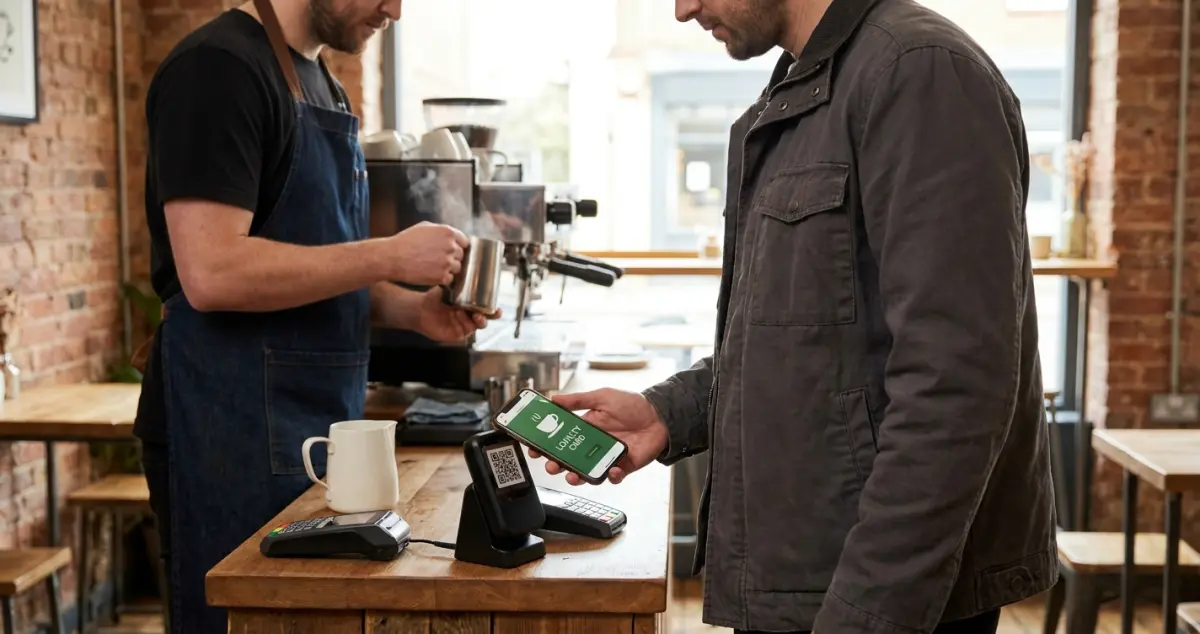
Coffee Shop Loyalty App UK 2026: Platform Comparison Guide
Coffee shop loyalty app UK 2026: compare Square, Loyverse, Stamp Me and custom-built options. When an app earns its monthly fee and when it does not.
 Business Growth
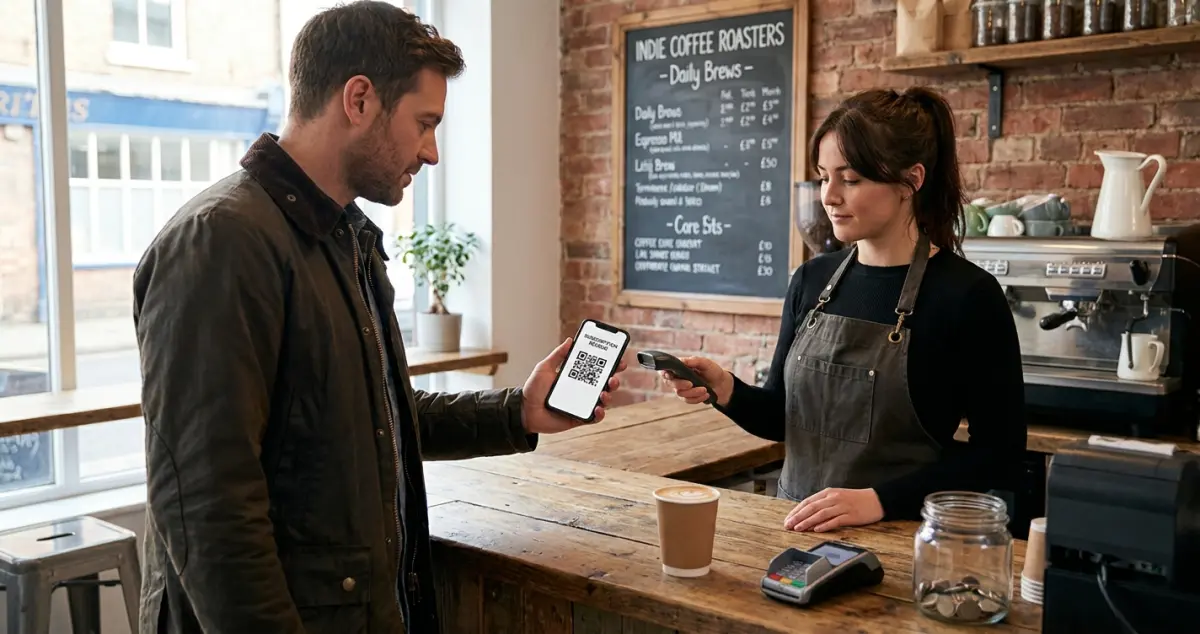
Coffee Shop Subscription UK 2026: The Indie Operator's Guide
Coffee shop subscription UK 2026: monthly pass models, unit economics, churn, infrastructure needed and whether the maths actually works for an indie cafe.
 Business Growth
Coffee Shop Customer Retention: Who Knows Your Regulars
Coffee shop customer retention for UK indies: count your regulars with a pencil, and why the recognition that brings them back can leave with a barista.