
Medical aesthetics marketing for UK doctor and nurse-led clinics. GMC/NMC rules, before-and-after photo limits, CQC signals and patient trust strategies.
You're a GMC- or NMC-registered practitioner running an aesthetics clinic. You want more patients. You open Instagram, start drafting a post with a treatment result, and then stop. Because somewhere in the back of your mind is the question: can I actually post this? 11 min read.
Medical aesthetics marketing operates under rules that don't apply to beauty salons or non-medical aesthetics studios. The GMC, NMC, ASA, and CQC all have a stake in how you promote your services. Get it wrong and you're not just risking a complaint. You're risking your registration.
Info
Related: Aesthetics Clinic Marketing: the complete pillar guide for UK aesthetics clinics
This guide is for medically qualified practitioners (doctors, nurses, and prescribers) running clinics that offer injectables, advanced skin treatments, or prescription-only interventions.
What you'll learn:
- Why medical aesthetics marketing is stricter than general aesthetics
- The GMC and NMC advertising requirements that apply to you
- The exact rules on before-and-after photos
- How to build authority that converts patients compliantly
- How patients move from first search to first booking
- A compliance checklist to review your marketing this week
What Makes Medical Aesthetics Marketing Different
Medical aesthetics marketing isn't aesthetics marketing with a white coat. The rules are different. The risks are different. So is the strategy.
Info
Medical aesthetics marketing sits at the intersection of professional regulation, medicines law, and advertising standards. Three sets of rules, all applying at once.
A non-medical therapist offering facials operates mainly under consumer advertising rules. As a GMC- or NMC-registered practitioner, your marketing is also governed by your professional body. Your regulator can act on advertising that breaches their guidance, separately from any ASA complaint. Two processes. Two sets of consequences.
The prescription-only medicines (POM) restriction
Most injectable treatments (Botox, certain dermal fillers) are prescription-only medicines (POMs). Advertising POMs to the general public is prohibited under medicines regulations. You can advertise your clinic and your expertise. You cannot run an ad promoting Botox by name, promising specific outcomes, or showing injectable before-and-after photos. Our aesthetics regulations UK guide covers the full framework.
For example, a nurse prescriber cannot post "see our amazing Botox results" with a before-and-after photo on Instagram. A non-medical therapist offering non-injectable skin treatments faces no such restriction. That's the practical difference in medical aesthetics marketing.
The UK aesthetics industry is projected to be worth more than £3.6 billion by the end of 2025 (Policy Bee, 2025). Around 7.7 million people had an aesthetic treatment in the UK by 2025, with 13.9 million considering one, nearly 1 in 5 adults (Policy Bee, 2025).
Pro Tip
A compliance-first approach to medical aesthetics marketing positions your clinic as the credible choice. In a sector where patients are becoming more cautious about who they trust, that matters.
Medical aesthetics marketing isn't about finding clever workarounds. It's about being the practitioner who doesn't need them.
GMC and NMC Guidelines on Advertising
So you understand why the rules differ. Now let's look at what they actually require.
Both the GMC and NMC have published specific guidance for registered practitioners offering cosmetic interventions. The core expectations are consistent.
GMC advertising requirements (gmc-uk.org, Guidance for doctors who offer cosmetic interventions):
- Marketing must be factual and verifiable: you cannot publish claims that cannot be checked
- You must not trivialise or minimise risks: describing a procedure as "quick and simple" without acknowledging risks is a breach
- You must not exploit patient vulnerability: this includes targeting people distressed about their appearance
- You must not claim procedures are risk-free
- If a medical assessment is required before treatment, your marketing must say so
NMC Code application: Nurses must "uphold the reputation of your profession at all times." The NMC has confirmed this extends to advertising and social media. From 2025, remote prescribing of botulinum toxin by nurses is no longer permitted. A face-to-face assessment is required before prescribing (London Road Clinic, 2025). Any marketing that implies remote prescribing is available would breach NMC standards and medicines regulations.
ASA/CAP rules layer on top:
- Ads for cosmetic procedures must not target under-18s
- No misleading claims about outcomes
- Testimonials must be genuine, not cherry-picked
- POMs cannot be advertised to the public
| Regulatory body | Applies to | Key marketing requirement |
|---|---|---|
| GMC | Doctors | Factual, verifiable, no risk minimisation |
| NMC | Nurses/midwives | Uphold professional reputation; face-to-face prescribing only |
| ASA/CAP | All advertisers | No POM ads to public; no misleading efficacy claims |
| CQC | Clinics using POMs | Registration required; display rating prominently |
Your credentials as a marketing differentiator
One advantage for medical practitioners: credentials carry genuine marketing weight. With 58% of injectable practitioners in the UK not medically qualified (Policy Bee, 2025), your GMC or NMC registration number is a differentiator. Most aesthetics marketing guides tell you to be creative. Medical aesthetics marketing tells you to be verifiable.
If you're uncertain about a specific campaign, the CAP Copy Advice service (cap.org.uk) allows pre-publication guidance, a sensible step before spending budget.
For specialist agency support, our guide to choosing an aesthetics marketing agency covers what to look for when agencies understand the compliance layer.
Before-and-After Photos: The Strict Rules
Now for the section most practitioners ask about first.
Before-and-after photos feel like the most natural aesthetics marketing tool. For medical practitioners doing injectable treatments, they're largely off-limits in public-facing advertising.
The ASA treats before-and-after photographs as efficacy claims. The same evidence requirements apply as any performance claim: controlled clinical evidence, not just a happy patient. More critically: any before-and-after image linked to a POM is likely to count as advertising that POM to the public. That is prohibited (ASA, asa.org.uk, Before and after photos).
A photo showing botulinum toxin results, even without naming the product, implies the ad promotes that POM. This applies regardless of image accuracy.
| Permitted? | Image type |
|---|---|
| Not permitted | Before-and-after photos of injectable (POM) treatments in public-facing ads |
| Not permitted | Filtered or retouched images that could mislead about outcomes |
| Permitted (with conditions) | Before-and-after of non-prescription treatments: must have evidence + signed dated consent |
| Permitted | Clinic photography, team profiles, educational skin condition content (without implying outcomes) |
The compliance risk in plain terms
If you're thinking "other clinics post before-and-afters and nothing is done about it," that's sometimes the case. But if you're only staying compliant because you haven't been caught yet, you'll always be one complaint away from an ASA ruling that's permanently searchable by your name. Compliant content protects your register entry, not just your social feed.
Many clinics build strong presences without before-and-afters
Many medical aesthetics clinics build strong Instagram presences entirely on educational content and clinical expertise. That's not a workaround. That's usually a sign of a practice with strong long-term patient relationships.
Free pre-publication guidance
The ASA's Cap.org.uk Copy Advice service provides free pre-publication guidance. Ten minutes of review versus an upheld ruling later.
Building Authority as a Medical Practitioner
So what do you do instead of before-and-after photos? You build authority. For medically trained practitioners, that's genuinely easier than for non-medical competitors.
Credentials visible and verifiable: Your GMC or NMC registration number should be on your website homepage, not an About page. Your full name and title. Your specialist training. Patients researching medical aesthetics will check these details, sometimes on the GMC or NMC register directly. Making this easy signals confidence.
Info
A CQC-registered medical aesthetics clinic might display its registration number, current inspection rating, and a brief sentence on why CQC registration matters, on the homepage, above the fold. Non-medical studios cannot do this. That single element typically differentiates you from many competitors in a patient's first 30 seconds.
CQC registration as a marketing asset: Clinics using prescription-only medicines are generally required to register with the CQC. Your registration number should be visible on your site. A positive inspection outcome is public information; you can reference it. In a sector where many providers are unregistered, CQC status is a real trust signal.
Educational content competitors can't match: A GP-turned-aesthetics practitioner can write about contraindications for dermal fillers or the anatomy of danger zones. Non-medical injectors cannot do this convincingly. That kind of content builds trust with the patients most likely to book.
Why transparent risk discussion matters
Patients doing serious research notice when a practitioner openly discusses side effects before they ask. So does Google. A blog post titled "What are the risks of lip filler?" that gives a genuinely clinical answer builds more trust than any promotional content.
Patient Journey: From Discovery to Booking
With authority built, the question becomes: where does medical aesthetics marketing actually reach prospective patients?
Patients researching clinics spend more time before booking than those booking beauty treatments. They're often making a health decision as much as a beauty one.
Discovery: Most patients start with a search: "Botox near me", "aesthetics clinic [city]", "non-surgical skin treatment." Your Google Business Profile is often the first impression. List your services without crossing into POM advertising. "Advanced anti-wrinkle consultations" is acceptable. "Botox injections from £X" likely is not. A local SEO checklist helps you complete that profile and gather genuine reviews without straying into POM claims. If you're building your aesthetics business, understanding this distinction is essential from day one.
Research: Patients check registration numbers on the GMC and NMC registers. They read bios, reviews, and blog posts. They compare several clinics before deciding. A practitioner with detailed articles on treatment safety, candidacy, and aftercare looks more credible than one with just a services page. That's where authority content pays off.
Pro Tip
The research phase is where most medical aesthetics patients decide. Not at the point of booking. Not at the consultation. Before they ever contact you.
Decision and consultation: Patient reviews focused on experience and care, not POM treatment outcomes, are permitted and valuable. Request them actively after positive consultations. The consultation itself is a marketing event: a thorough clinical conversation builds word-of-mouth no paid ad can replicate.
The reality for most practitioners
If you're reading this thinking "I barely have time for all this," you're not alone. Most practitioners run a clinic with limited admin support. That's why your website needs to do the heavy lifting: credentialling, trust signals, patient education. So the patient arrives at consultation already confident they've chosen the right practitioner.
For more aesthetics marketing ideas that work within compliance boundaries, see our dedicated guide. Planning your clinic from scratch? Our aesthetics business plan guide covers the foundations, and if you're exploring the full journey, start with how to start an aesthetics business.
Audit Your Marketing Compliance This Week
So you've built the authority. You understand the patient journey. Now let's make sure your existing medical aesthetics marketing isn't quietly creating compliance risk.
Before investing in more activity, a review is worth a few hours. Non-compliant content creates regulatory risk. And if a complaint is upheld, it erodes the trust you've spent months building.
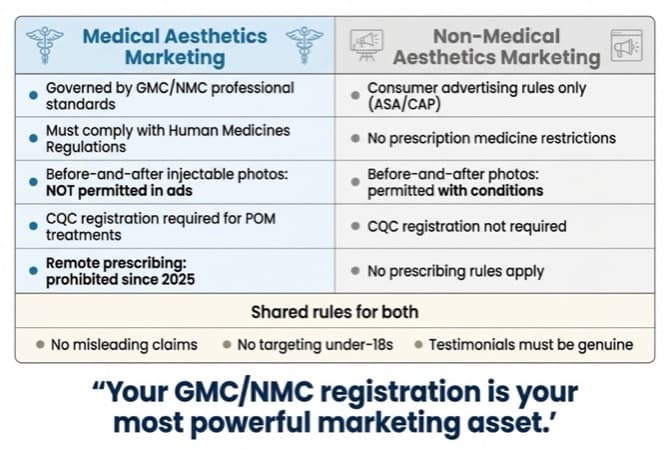
Medical vs non-medical aesthetics marketing rules at a glance
If you only have 30 minutes a week, do this:
This week, audit your medical aesthetics marketing
- Day 1-2: Check your website homepage: GMC/NMC registration visible? CQC details displayed? Remove before-and-after imagery of injectable treatments.
- Day 3-4: Social media audit: review the last three months. Flag before-and-after images of injectables, risk-minimising language, or any implication that remote prescribing is available.
- Day 5-7: Review consultation communications: confirm all pre-booking materials state that prescribing requires a face-to-face assessment. Frame it as a clinical standard. It is one.
Full compliance checklist:
- GMC or NMC registration number visible on website homepage
- CQC registration number and rating displayed (if applicable)
- No POM product names used as marketing claims
- No before-and-after photos of injectable treatment results in public-facing ads
- Patient testimonials focus on experience, not POM treatment outcomes
- No suggestion that remote prescribing is available
- CAP Copy Advice sought for any campaigns you're uncertain about
Reflective question: Ask yourself honestly: if you searched for a medical aesthetics clinic in your area, would your own website make you want to book? How would you rate your credential visibility compared to the top result? If the answer is "not as strong", that's the gap to close first.
Weekly action
Pick one section of your website or one month of social content to review each week:
- Check for any POM product names used in marketing claims
- Verify your GMC/NMC registration is prominently displayed
- Flag any before-and-after imagery that needs removing
Medical aesthetics marketing compliance isn't a one-time audit; it's an ongoing standard that protects your registration and your reputation. Stay up to date with new regulations for aesthetics 2025 as the landscape continues to evolve.
Explore beauty salon marketing tools that help clinics manage their online presence compliantly.
For restaurants, salons, and local businesses
Need help with your marketing?
We help UK businesses turn social media into real results, not busywork.
Start freeKey Takeaway
Key Takeaways: Medical Aesthetics Marketing
Medical aesthetics marketing operates within tighter constraints than general aesthetics. Those constraints, understood correctly, become competitive advantages.
- GMC and NMC guidance requires marketing to be factual, non-exploitative, and non-trivialising of risk, with strict limits on POM advertising
- Before-and-after photos for injectable treatments are not permitted in public-facing advertising under ASA/CAP rules
- CQC registration, visible GMC/NMC credentials, and transparent risk communication are your most powerful compliant marketing tools
- The patient journey in medical aesthetics is longer; authority content converts better than promotional content at the decision stage
- Remote prescribing of botulinum toxin is no longer permitted: ensure no marketing implies otherwise
The UK Government is consulting on restrictions for the highest-risk cosmetic procedures in spring 2026 (gov.uk). Medical aesthetics practices building compliance-first marketing in 2026 will be well positioned as regulation closes the gap between medical and non-medical providers.
Get More Marketing Tips
Practical marketing tips for UK business owners, straight to your inbox. No spam, unsubscribe anytime.
About the Author
Local Brand Hub
Empowering UK Businesses
Local Brand Hub provides comprehensive business management tools designed specifically for UK local businesses to streamline operations, automate marketing, and grow revenue.
More articlesRelated Articles
 Marketing Tips
Aesthetics Marketing Agency: A UK Clinic Buyer's Guide
How to find the right aesthetics marketing agency for your UK clinic: what to look for, red flags, costs, and when DIY is smarter.
 Marketing Tips
Aesthetics Clinic Marketing: Market Your Compliance
Aesthetics clinic marketing in the UK is being reshaped by licensing. What the proposed England scheme covers, what the ASA bans, and what to publish now.
 Marketing Tips
Aesthetics Marketing: DIY Playbook for UK Clinics
Practical aesthetics marketing strategies you can run yourself. Social media, before-and-after content, local SEO, email, and referrals for UK clinics.