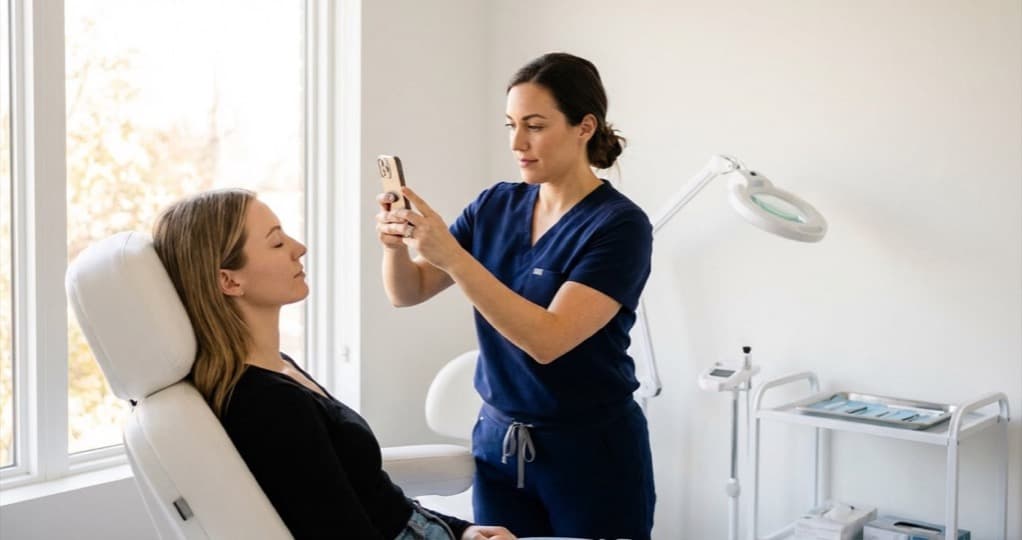
Practical aesthetics marketing strategies you can run yourself. Social media, before-and-after content, local SEO, email, and referrals for UK clinics.
You're doing the treatments. You're getting good results. But your booking calendar has gaps you can't explain, and a clinic that opened six months ago (less qualified, worse location) seems to have a constant flow of new enquiries.
Over 50% of new aesthetic patients cite social media and online reviews as the primary factor when choosing a clinic. The gap between you and that competitor almost certainly isn't clinical skill. It's consistent aesthetics marketing.
Not budget. Not agency spend. Just intentional activity across the right channels.
This guide is the hands-on playbook for UK aesthetics clinics doing their own marketing. Not the strategic overview, that's covered in Aesthetics Clinic Marketing, but the practical channel-by-channel approach: what to post, how to optimise your listing, what to send, and how to build a referral programme that doesn't require you to ask awkwardly every time.
Would you book a treatment at your own clinic based on your current online presence? If there's any hesitation, this is for you.
If you're thinking "I'm fully booked already, so marketing isn't urgent", the reality for most aesthetics clinics is that it stays that way until one slow month reminds you the pipeline was always just a few loyal regulars and one good referral week.
Already working with a specialist? See: Aesthetics Marketing Agency: how to evaluate and brief an agency.
What You'll Learn
- Which social platforms are worth your time as an aesthetics clinic
- The ASA/CAP rules around before-and-after content, and how to stay compliant
- How to optimise your Google Business Profile for "near me" searches
- What to send via email to drive rebookings, not unsubscribes
- How to structure a referral programme without it feeling awkward
- A minimum viable plan if you only have 30 minutes this week
Social Media Marketing for Aesthetics Clinics
Here's where most independent clinics start, and where the clearest wins are. Instagram remains the primary acquisition channel for UK aesthetic clinicians. The platform's visual format suits treatment showcasing, and its 35.5 million UK users include the core audience for aesthetic treatments.
TikTok is the growth channel. With an engagement rate of 3.70%, up 49% year-on-year (Digital Information World, March 2026), TikTok pushes content to new audiences regardless of follower count. For a clinic starting from scratch, that algorithm advantage is significant.
For most UK aesthetics clinics, Instagram first, TikTok second, but don't neglect the latter if you're building from zero.
Why this matters: 80% of aesthetic clinicians use Instagram as their primary channel. If you're only on Instagram, you're competing with the entire industry on the same platform. TikTok's lower competition and higher engagement rate make it a meaningful differentiator.
A practical weekly content mix:
| Content Type | Platform | Frequency |
|---|---|---|
| Treatment results (compliant before/after) | Instagram, TikTok | 2-3x/week |
| Behind-the-scenes, day-in-the-life | Instagram Stories, TikTok | 3-4x/week |
| Educational: how treatments work | TikTok, Reels | 1x/week |
| Client testimonials (video preferred) | Instagram, Google | Weekly |
For example, a solo aesthetics practitioner might post a compliant results reel Tuesday, a "day in the treatment room" TikTok Thursday, and a 60-second educational video on skin boosters Friday. A smartphone, ring light, and 20 minutes. That's a full week of aesthetics marketing content.
Clinics that post only when they remember, and call that a social media strategy, will always lose to those that treat content as part of operations, not an afterthought.
Related: Aesthetics Marketing Ideas: specific content ideas by treatment type and season.
Before-and-After Content: Rules and Best Practices
Now that you've picked your platforms, here's the content question everyone asks: before-and-after photography is the most powerful aesthetics marketing tool available. It's also the most regulated.
The ASA and CAP rules are clear, and the NHBF has published guidance on how the incoming 2025 regulatory changes affect marketing obligations for salon and clinic owners:
- No image manipulation: signed, dated proof of genuine, unaltered images required; filters that exaggerate results make content non-compliant
- Results must be representative: typical outcomes, not your best-case result on your most photogenic client
- POM treatments: you cannot promote botulinum toxin results through standard social media promotional posts
- No targeting under-18s: CAP Code rule 12.25 (November 2021) prohibits cosmetic intervention ads targeting under-18s; applies to paid social audience settings
What this means practically: build a photo protocol into every treatment. A designated spot with consistent lighting, a standard camera distance, and a consent form covering marketing use. That's a 10-minute setup that removes compliance risk from every before-and-after image you produce.
For non-POM treatments (chemical peels, microneedling, facials, LED therapy) you have considerably more freedom. Consistent lighting, same angle, no filters. That standard is both legally sound and more trust-building than images that look too good to be real.
Why this matters: The ASA doesn't just act on formal complaints: it actively monitors social media. Clinics using face-smoothing filters on before-and-after posts have been found non-compliant even when no client complained. The risk isn't theoretical.
See also: Medical Aesthetics Marketing: POM treatment advertising, influencer partnerships, and responsible marketing frameworks.
Local SEO for Aesthetics Clinics
Building on your social presence, here's the channel that captures clients who are already searching.
Social media builds awareness. Local SEO captures demand that already exists. Someone searching "lip filler near me" has already decided: they're choosing who, not whether.
Clinics in Google's local pack see up to 156% more booking enquiries, and those with complete profiles are 70% more likely to attract location-based search traffic (Consentz, 2025).
If you're thinking "I've been meaning to sort this for months", you're not alone. Most clinic owners have an incomplete profile eating into their local visibility right now.
Priority GBP actions:
- Claim and verify at Google Business Profile (business.google.com)
- Complete every field: name, category, address, phone, website, hours
- Add treatment-specific photos: rooms, compliant results, practitioner headshots
- Request reviews actively: 50% of new patients cite reviews as the primary decision factor (Consentz, 2025)
- Use Google Posts for seasonal promotions and consultation availability
- Respond to every review, publicly and promptly
Beyond GBP, your website needs location signals. A page titled "Aesthetics Clinic in [Your Town]" with your address and treatment menu consistently outperforms a generic homepage.
For example, a clinic that writes "Beauty & Aesthetics" on its website but "Beauty and Aesthetics" on its Fresha listing has a citation mismatch Google treats as two different businesses. That's usually a sign local SEO isn't working, and it's a 20-minute fix. Our local SEO tools flag mismatches like this so you can ensure your NAP (name, address, phone) is identical everywhere: GBP, website footer, Treatwell, Fresha, and any directories.
Pro Tip
Add your top 3 treatments as services in your GBP listing. "Botox", "Lip Filler", "Skin Booster" as named services improve visibility for those specific treatment searches.
For the deeper framework on treatment page structure, local schema, and content strategy, see our beauty salons industry page.
Email Marketing and Client Retention
Now that you're findable and attracting clients, here's how to keep them. Acquiring a new aesthetics client costs 5 to 25 times more than retaining an existing one (Pabau, 2025). A 5% improvement in retention can increase profits by 25 to 95%.
Email does one thing well: keeping clients who already trust you from drifting to a competitor when it's time to rebook.
The sequences that work:
- Post-treatment follow-up (Day 2-3): Aftercare reminder, ask how they're feeling, invite to share results. Natural opening for next booking.
- Rebook prompt (3-4 months post-treatment): For Botox clients: "Your results will start to fade: here's how to secure your next appointment."
- Seasonal campaigns (4x/year): Spring refresh, summer glow, pre-Christmas, January reset. Align with demand peaks.
- Birthday offer (annual): Outperforms generic promotional emails.
Most clinic software (Pabau, Cliniko, Fresha) includes automation. Set the post-treatment and rebook sequences once; they run indefinitely. Clinics that only email when they have a promotion will always lose to those that stay in touch consistently between bookings.
If you can't tell whether your current email activity brings clients back or just gets ignored, that's usually a sign you're sending one-off campaigns instead of triggered, behaviour-based sequences.
If you're only emailing during promotions you'll always lose to clinics that stay in touch consistently, because loyalty is built between appointments, not at them.
Referral Programmes That Work
Now that you've covered retention: email keeps existing clients coming back. Referrals bring in new ones at the lowest cost of any channel. Word-of-mouth has always been the strongest channel in aesthetics: clients who look great are walking adverts. A structured programme turns that passive recommendation into a trackable system.
What tends to work:
- Treatment credit (not cash): £20 to £30 off their next appointment when the referred client completes their first treatment. Credit drives rebooking: cash gets forgotten.
- Double-sided incentive: New client gets £25 off; referrer gets £25 credit when that booking completes. Both parties have a reason to act.
- Named programme: "The Friends Club" or "Introduce a Friend" feels intentional. Branding matters for participation rates.
For example, an aesthetics clinic running a double-sided programme at £25/£25 on a typical first-treatment value of £150 to £200 is spending 25 to 33% of one treatment on an acquisition that could be worth thousands over a client lifetime. Compare that to paid social cost-per-acquisition, and referrals usually win.
Promote it actively: mention it at the end of every appointment, include it in your post-treatment email, and add a line to your email signature. Aesthetics marketing that relies on clients to remember never scales.
Ask yourself: would you know if your referral programme was working? If you can't point to a number (referrals per month, conversion rate from referred friend) that's usually a sign it's running on hope rather than system.
Pick One Channel and Start This Week
So now you've got five channels mapped out. Here's the honest part: don't start all five. The biggest mistake aesthetics clinics make is deciding to "do everything" and then doing nothing because it's overwhelming.
Pick your primary channel based on where you are right now:
| Your Situation | Best Channel to Start |
|---|---|
| No online presence | Google Business Profile |
| New clinic, zero following | TikTok (algorithm advantage) |
| Established clients, poor retention | Email marketing |
| Bookings good, no new enquiries | Local SEO + GBP |
| Solid bookings, no referrals | Referral programme |
If you pick just one this week, pick GBP optimisation. It's free, it's permanent, and it captures clients who are already searching for what you offer. Every other channel sends people to Google first anyway.
If you only have 30 minutes this week, do this:
- Day 1-2: Complete your Google Business Profile: add 5 photos, check your category, send 5 review requests to recent clients
- Day 3-4: Write and activate your post-treatment follow-up email in your clinic software
- Day 5-7: Post one piece of compliant content: a treatment result with a caption explaining what it treats and how to book
The clinic that does one of these consistently for 90 days will outperform the one that starts all five and maintains none.
Weekly Action
This week:
- Audit your GBP: is every field complete? Are your photos up to date?
- Check your email setup: is there any automation active, or are you sending manually?
- Review your last 5 Instagram posts: are they compliant? Would a new client book from them?
- Ask your next 3 satisfied clients for a Google review
Aesthetics marketing isn't about advertising treatments: it's about making people feel safe trusting someone with their face.
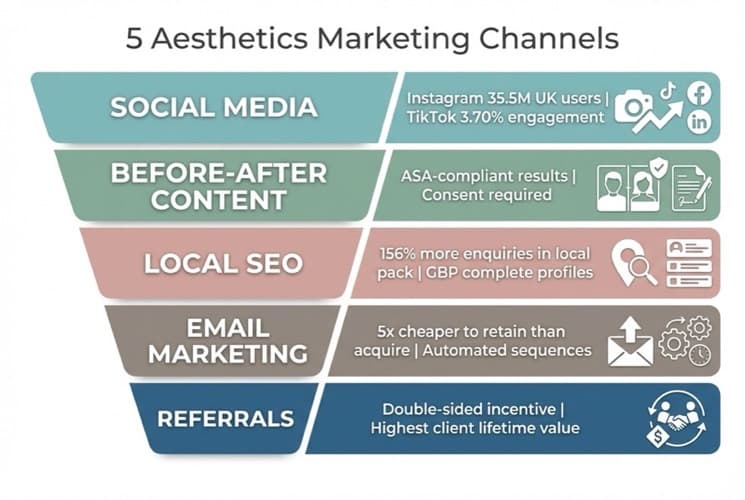
The five core aesthetics marketing channels every UK clinic should consider
Frequently Asked Questions
Here's what practitioners most commonly ask when starting their aesthetics marketing.
Starting Out
What is aesthetics marketing? Aesthetics marketing is the set of strategies used by cosmetic clinics and practitioners to attract new clients and retain existing ones. In the UK, this covers social media, local SEO, email campaigns, referral programmes, and content marketing, all within ASA/CAP advertising guidelines.
What does aesthetics marketing cost for a small clinic? The DIY approach costs time, not budget. Google Business Profile, organic social, and email automation through your existing clinic software are all free or near-free. Paid social advertising starts from £5 to £10/day and is optional. Most independent aesthetics clinics build their initial client base entirely through organic channels before introducing paid spend.
How do I promote my aesthetics business to get more clients? Start with your Google Business Profile: it captures clients who are already searching for treatments near you. Add consistent social media content, set up a post-treatment email sequence, and ask every satisfied client for a review. These four actions, done consistently, build a steady pipeline without paid advertising.
Compliance and Regulations
Can I use before-and-after photos in aesthetics advertising? Yes, with restrictions. The ASA requires images to be genuine, unmanipulated, and representative of typical results. For POM treatments (such as botulinum toxin), before-and-after results cannot be used in promotional social media posts. Always obtain signed client consent covering marketing use. See asa.org.uk for full guidance.
What are the main regulations covering aesthetics marketing in the UK? The ASA and CAP codes govern cosmetic clinic advertising. Among the primary rules: before-and-after images must be genuine and unmanipulated; POM treatment results (e.g. botulinum toxin) cannot typically be promoted on social media; cosmetic intervention advertising cannot target under-18s. The ASA guidance on cosmetic interventions is the authoritative reference.
For more on UK aesthetics compliance, see Aesthetics Regulations UK and New Regulations for Aesthetics 2025.
Social Media
How often should an aesthetics clinic post on social media? Consistency matters more than frequency. Two to three times per week on Instagram and TikTok is sustainable for solo practitioners. One post per week, published every week without gaps, beats five posts this week followed by silence.
Related Reading
Looking for more on building and growing an aesthetics business? These guides cover the broader picture:
- Aesthetics Business: running and scaling an aesthetics practice
- Aesthetics Business Plan: financial planning and growth strategy
- How to Start an Aesthetics Business: getting started from scratch
For UK aesthetics clinics
Ready to Simplify Your Clinic Marketing?
Local Brand Hub helps aesthetics clinics schedule compliant content, automate rebooking reminders, and stay visible on Google, without hiring an agency.
Try It FreeKey Takeaways
- Instagram is the dominant acquisition platform; TikTok's algorithm advantage makes it worth prioritising for newer clinics
- Before-and-after content is powerful but tightly regulated: no filters, signed consent, and no promotional use for POM treatment results on social media
- Google Business Profile optimisation is the highest-ROI action for capturing local search; clinics in the local pack see up to 156% more booking enquiries
- Email automation (post-treatment follow-up + rebook prompt) sets up once and runs indefinitely
- Referral programmes work best with double-sided incentives and active promotion, not a verbal mention at checkout
- Pick one channel and run it consistently for 90 days before adding another
- For the strategic overview, see Aesthetics Clinic Marketing
Get More Marketing Tips
Practical marketing tips for UK business owners, straight to your inbox. No spam, unsubscribe anytime.
About the Author
Local Brand Hub
Empowering UK Businesses
Local Brand Hub provides comprehensive business management tools designed specifically for UK local businesses to streamline operations, automate marketing, and grow revenue.
More articlesRelated Articles
 Marketing Tips
20 Aesthetics Marketing Ideas to Fill Your Diary
20 actionable aesthetics marketing ideas for UK clinics: social media, trust-building content, local marketing, retention, and seasonal strategies.
 Marketing Tips
Marketing a Beauty Salon: Week-by-Week Action Plan
A week-by-week plan for marketing your beauty salon. Google, social media, email, and referrals with templates you can use today.
 Marketing Tips
Marketing Hair Salon: 7 Strategies That Fill Your Chair
Seven practical strategies for marketing hair salon businesses in the UK. Google, Instagram, referrals and retention tactics for hairdressers and barbers.