
Aesthetics regulations UK explained. Governing bodies, training standards, ASA advertising rules, insurance needs, and a quarterly compliance checklist.
You're running a full treatment room, but could you show a client your qualifications right now? Or explain your insurance cover? Aesthetics regulations UK are shifting faster than most practitioners expect. Being on the wrong side costs you your insurance, your reputation, or your right to practise.
This is your practical guide to aesthetics regulations UK: who governs the sector, what qualifications actually matter, which ASA rules apply to your marketing, what insurance you genuinely need, and a quarterly checklist so compliance doesn't become a crisis.
This article provides general guidance for informational purposes only and does not constitute legal or professional advice. Always consult the relevant regulatory bodies and a qualified solicitor for advice specific to your practice.
15 min read
What you'll learn:
- Which bodies oversee aesthetics regulations UK and what they require
- Training standards and why they matter under the new licensing scheme
- ASA and CAP advertising rules that apply directly to your marketing
- Insurance requirements and what adequate cover looks like
- Premises and hygiene standards for treatment rooms
- A quarterly checklist for staying compliant as rules evolve
1. Who Regulates Aesthetics in the UK?
Aesthetics regulations UK are split across several bodies. There's no single regulator, and the framework is still being built. Understanding who does what is the first step toward compliance.
The UK does not yet have one mandatory licensing system for all non-surgical cosmetic procedures. The Health and Care Act, Section 180, gives the government power to set that up in England. A consultation response in August 2025 confirmed the scheme is moving forward. Rollout is ongoing as of early 2026.
Regulatory snapshot: Multiple bodies share oversight. No single licence covers everything. Knowing which body covers which treatment is the starting point for compliance.
Here are the bodies that shape aesthetics regulations UK as of early 2026:
The JCCP (Joint Council for Cosmetic Practitioners) is the main professional standards body. It keeps a public register of practitioners who meet agreed training, practice, and insurance standards. Registration isn't yet legally required for most procedures, but insurers and clinics expect it. For instance, a nurse aesthetics practitioner setting up a new clinic would typically get JCCP-registered before approaching specialist insurers, because many insurers ask for it at the application stage.
The CPSA (Cosmetic Practice Standards Authority) works with the JCCP to define what good training and safe practice looks like across the sector.
CPSA + JCCP working together: The CPSA sets standards; the JCCP maintains the practitioner register. Both are voluntary, but widely expected by insurers and employers.
The CQC (Care Quality Commission) oversees aesthetics services that use POMs under the care of a registered healthcare professional.
The MHRA governs the supply of POMs, including botulinum toxin. Under rules in force since April 2022, botulinum toxin in England can only be given by, or under the watch of, a registered healthcare professional. If you're not registered and you're doing these treatments, you're breaking the law.
Key dates in aesthetics regulations UK: April 2022: botulinum toxin restricted to healthcare professionals. August 2025: government confirms licensing scheme is progressing. March 2026: rollout ongoing.
Local authorities license laser and IPL. Requirements vary significantly by council. Scotland, Wales, and Northern Ireland operate separate frameworks: check the rules in your devolved nation.
Related: New Regulations for Aesthetics 2025
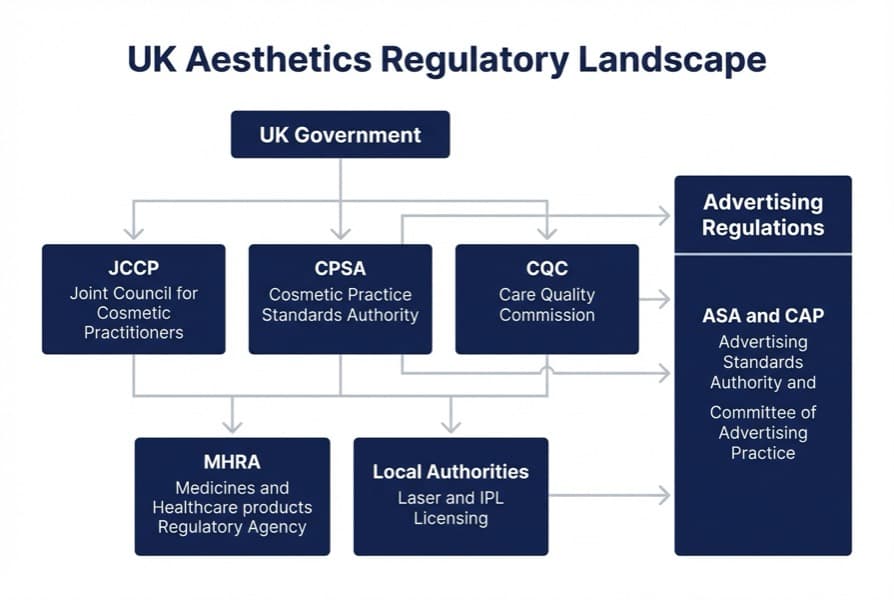
UK aesthetics regulatory landscape: key bodies and their roles
2. Training Standards and Qualifications
Now that you know who the regulators are, here's what you need in terms of qualifications. Training is one of the most actively changing areas of aesthetics regulations UK. The gap between "I've done a course" and "I'm properly qualified" is larger than many practitioners realise, and the stakes are rising.
For botulinum toxin and dermal fillers: These treatments must be done by a registered healthcare professional, or under their watch. That means a doctor, dentist, nurse, or prescribing pharmacist. No registration with the GMC, NMC, GDC, or GPhC means you cannot legally do these treatments in England.
For non-prescription treatments: There's no statutory minimum qualification for many skin procedures or superficial chemical peels, yet. The forthcoming licensing scheme under the Health and Care Act is expected to change this.
What the sector recognises now:
- Level 3 in a relevant area (beauty therapy, nursing, healthcare)
- Ofqual-regulated Level 4 or Level 5 diploma in aesthetic practice for those without a healthcare background
- For prescription treatments: active healthcare professional registration
Quick reference, aesthetics regulations UK training: Non-prescription treatments: Level 3-4 diploma recommended by JCCP. Prescription treatments (botox, fillers): healthcare professional registration legally required.
Why this matters for your practice: Many specialist insurers require recognised qualifications before issuing cover. Hamilton Fraser Cosmetic and PolicyBee are both examples. For example, a solo aesthetics practitioner offering skin rejuvenation might need at minimum a Level 4 qualification to get insured, even where no statutory requirement exists yet.
If you're only relying on a weekend training certificate you'll always be vulnerable when insurers or regulators look closely. That's a risk getting harder to manage as aesthetics regulations UK move forward.
Related: Aesthetics Business
3. Advertising Regulations: ASA and CAP Rules
Additionally, your marketing sits within its own regulatory framework. Advertising rules are a distinct but equally important strand of aesthetics regulations UK. The ASA (Advertising Standards Authority) and CAP (Committee of Advertising Practice) govern all your marketing. That includes Instagram posts, website copy, before-and-after photos, and email promotions.
Getting it wrong has real costs. The ASA can make you remove ads. It can publish rulings against your clinic. It can refer you to Trading Standards. These aren't rare outcomes for aesthetics businesses.
The rules that apply directly to your aesthetics business:
1. You cannot advertise POMs to the public. CAP rule 12.12 is clear: POMs must not be promoted to consumers. No "Botox treatments" in your Instagram bio or on your website. Say "anti-wrinkle injections", not the medicine name.
2. Before-and-after photos must not mislead. Images must show typical results, not best-case outcomes. Filtered images or implied guarantees risk upheld ASA complaints.
3. Claims must be backed up. Outcome claims, timeframe promises, and superlatives need evidence. The ASA's free CAP Copy Advice service can check your content before you publish.
4. Urgency tactics must be real. Fake countdown timers and false scarcity claims break CAP Code misleading advertising rules.
For example, a clinic running a "limited time" offer with a timer that resets daily would face ASA action if someone complained. That pattern has been logged in ASA rulings.
If you're only reviewing your marketing when a complaint arrives you'll always be playing catch-up. Planning your posts ahead with a social media calendar gives you the chance to check every piece against the CAP Code before it goes live, rather than reacting after publication. Aesthetics regulations UK cover advertising: it's not separate from the clinical side of compliance.
Related: Aesthetics Clinic Marketing
4. Insurance Requirements for Practitioners
Now that you know who sets aesthetics regulations UK and what training you need, consider this: having insurance is not the same as having the right insurance.
Public Liability Insurance covers injury or property damage claims. These are incidents not caused by your professional treatment: someone slipping in your treatment room, for example.
Professional Indemnity Insurance covers claims arising from the advice or treatment you provide. Skin damage from a chemical peel. Adverse reactions from an injectable. This is the critical cover. Specialist providers including Hamilton Fraser Cosmetic and PolicyBee offer policies tailored to aesthetics practitioners.
What adequate aesthetics cover looks like:
- Public Liability: minimum £1 million for independent practitioners; £5 million increasingly standard for clinics
- Professional Indemnity: explicitly lists the treatments you perform: injectables, laser, energy-based devices named, not assumed
- Product Liability: required if you retail treatment products
- Mobile/home-visit coverage: check if your policy covers off-premises work
Insurance compliance check: Does your policy schedule explicitly list every treatment you offer? Treatments added after the last renewal are the most common coverage gap practitioners miss.
The link between qualifications and insurance: Insurers require appropriate training for the treatments they cover. If a claim arises from a treatment you're not qualified for, your insurer may refuse to pay. Qualification and insurance are two sides of the same decision: you can't separate them.
If you're thinking "I'll sort the qualifications side later", that's usually a sign the policy you're relying on has gaps you haven't checked yet.
Related: How to Start an Aesthetics Business
5. Premises and Hygiene Standards
Furthermore, the physical environment where you practise is part of your compliance picture. Aesthetics regulations UK also govern where and how you work. This section covers the key premises and hygiene standards.
CQC-regulated clinics are those providing POMs under a prescribing healthcare professional. These clinics must meet CQC fundamental standards on safety and care quality. Check whether CQC registration applies to your setup if you work with a prescribing practitioner.
All aesthetics premises must also meet:
- Local authority licensing for laser, IPL, and skin-piercing treatments (varies significantly by council)
- Health and Safety at Work obligations if you employ staff
- COSHH Regulations when handling chemical peels and sterilisation chemicals
Core hygiene standards, these apply everywhere:
| Area | What's required |
|---|---|
| Needles and consumables | Single-use only, never reused |
| Equipment sterilisation | Follow manufacturer protocols; document every cycle |
| Surface and couch disinfection | Between every client; logged cleaning schedule |
| Hand hygiene | WHO protocol before and after each procedure |
| Clinical waste | Licensed contractor only, not general waste |
| Client records | Retained securely, GDPR-compliant, minimum 7 years |
Home-based practice: permitted in most areas. But you must meet the same hygiene, insurance, and local authority licensing standards as a commercial clinic. Some councils require a premises licence regardless of setting. Check yours before advertising home-based treatments.
If you run a beauty salon alongside aesthetics services, your premises compliance needs cover both sets of requirements.
6. Staying Compliant: Your Quarterly Checklist
Finally, here's how to turn what you've just read into a repeatable habit. Keeping on top of aesthetics regulations UK isn't a one-time task. The rules keep changing. Practitioners who review compliance each quarter are far less likely to get caught out when new rules kick in.
If you're reading this thinking "I don't have time for compliance reviews", you're not alone. Most solo practitioners feel the same. But one insurance gap or upheld ASA complaint costs more time than a 30-minute review ever would.
If you only have 30 minutes a week to spare on compliance, start here:
- Week 1: Pull out your insurance schedule. Check every treatment you perform is explicitly listed.
- Week 2: Log in to the JCCP register. Confirm your entry is current.
- Week 3: Audit your website and Instagram bio for POM references by medicine name.
- Week 4: Check your local authority licence status and renewal date.
That's enough to address the most common compliance gaps. The full checklist builds on it.
Full quarterly compliance checklist:
Qualifications and Registration
- JCCP register entry is current
- CPD requirements on track per your professional body
- All treatments you perform covered by your current qualifications
- JCCP/CPSA standards updates reviewed for the past quarter
Insurance
- Policy renewal date noted; review scheduled 60 days ahead
- Every treatment you perform is explicitly listed on your policy
- Indemnity limit appropriate for current client volume and treatment types
- No exclusions changed at renewal
Advertising and Marketing
- Website contains no direct POM references by medicine name
- Before-and-after images unedited and reflect typical results
- All marketing claims substantiated and evidenced
- Paid advertising reviewed against CAP Code
Premises and Hygiene
- Local authority licence status checked; renewal date noted
- Cleaning and sterilisation logs up to date
- Clinical waste collection scheduled
- Equipment servicing records current
Would you pass an unannounced inspection today? If that question makes you uncomfortable, your review is overdue. Start with insurance and qualifications, and work outwards from there.
Frequently Asked Questions
Do I need a licence to do aesthetics in the UK?
Aesthetics regulations UK require a licence for some treatments but not all. Botulinum toxin must be administered by or supervised by a registered healthcare professional. For laser and IPL, most local authorities require a licence. For example, a beauty therapist wanting to offer laser hair removal in Manchester would need to apply for a premises licence from Manchester City Council before treating clients. The licensing scheme being phased in under the Health and Care Act is extending requirements to more procedures: check with your local authority and the JCCP for current requirements.
Can I do aesthetics from home in the UK?
Yes, in most areas, but home-based practitioners must meet the same hygiene, insurance, and local authority licensing standards as a clinic. Some councils require a premises licence regardless of setting. Check before starting home practice.
What are the new aesthetics regulations UK for 2025?
The most significant change is the ongoing rollout of the licensing scheme under the Health and Care Act. Additionally, nurse and midwife prescribers must conduct in-person consultations before prescribing cosmetic POMs: remote prescribing for cosmetic purposes ended in 2025. Check gov.uk for the licensing scheme timeline.
What aesthetics regulations UK apply to advertising?
The ASA and CAP govern all aesthetics marketing. Advertising POMs to consumers is banned under CAP Code rule 12.12. Marketing claims must have evidence behind them: outcomes, timeframe promises, and superlatives all require proof. Before-and-after photos must show typical results. The ASA Copy Advice service can check your content before you publish, at no charge.
What aesthetics regulations UK changes are coming in 2026?
The phased rollout of the licensing scheme under the Health and Care Act continues throughout 2026. More procedures will be brought within the scheme as implementation progresses. Monitor JCCP.org.uk and gov.uk for announcements on specific procedure types and timelines as aesthetics regulations UK continue to evolve.
For restaurants, salons, and local businesses
Need help with your marketing?
We help UK businesses turn social media into real results, not busywork.
Start freeKey Takeaway
Key Takeaways: Aesthetics Regulations UK
Aesthetics regulations UK are moving faster than most practitioners expect. Ask yourself: if a client or inspector asked you today to show your qualifications, your insurance schedule, and your last compliance review, could you do it in five minutes?
Here's what to hold onto:
- Botulinum toxin must be administered by or under supervision of a registered healthcare professional: non-healthcare practitioners cannot legally offer these treatments
- JCCP registration is the primary professional quality marker for aesthetics practitioners in the UK
- In-person consultations are required before prescribing cosmetic POMs: remote cosmetic prescribing ended in 2025
- ASA/CAP rules prohibit advertising POMs to consumers and require marketing claims to be substantiated
- Insurance must explicitly cover every treatment you perform: general beauty therapy cover is rarely sufficient for aesthetics
- Local authority licensing applies to laser, IPL, and certain procedures: requirements vary significantly by council
Getting compliant with aesthetics regulations UK, before the full licensing scheme rollout, protects your practice and your clients.
For the specific 2025 changes in detail, see New Regulations for Aesthetics 2025. To build a compliant and profitable aesthetics business from the ground up, see Aesthetics Clinic Marketing. For a broader look at medical aesthetics marketing, practical aesthetics marketing ideas, or working with an aesthetics marketing agency, explore the rest of our aesthetics hub.
Aesthetics regulations UK: sources used in this guide, gov.uk (August 2025 consultation response), the Health and Care Act, JCCP (jccp.org.uk), MHRA, ASA/CAP Code, Hamilton Fraser Cosmetic (hamiltonfraser.co.uk). Last reviewed March 2026. Always verify current requirements directly with the relevant regulatory body.
Get More Marketing Tips
Practical marketing tips for UK business owners, straight to your inbox. No spam, unsubscribe anytime.
About the Author
Local Brand Hub
Empowering UK Businesses
Local Brand Hub provides comprehensive business management tools designed specifically for UK local businesses to streamline operations, automate marketing, and grow revenue.
More articlesRelated Articles
 Business Growth
Aesthetics Business Plan: What UK Clinic Owners Need
Write a business plan for your aesthetics clinic with realistic financial projections, treatment menu planning, and compliance costs for UK practitioners.
 Tutorials
How to Start an Aesthetics Business UK (Step-by-Step)
Step-by-step guide to starting an aesthetics business in the UK: qualifications, insurance, licensing, premises, equipment, and launch marketing explained.
 Industry Insights
New Regulations for Aesthetics 2025: UK Compliance Guide
New regulations for aesthetics 2025: licensing, training, premises and UK compliance timeline. What aesthetics clinics must do before licensing opens.