
Write a business plan for your aesthetics clinic with realistic financial projections, treatment menu planning, and compliance costs for UK practitioners.
You've just finished your training. You know the treatments, you've scoped out premises, but you still have not written the business plan. What's stopping you? For most new aesthetics clinic owners, it isn't lack of skill. It's lack of a clear structure for putting the numbers on paper.
Related: Aesthetics Clinic Marketing: once your plan is written, this guide covers how to fill your treatment diary.
If you are reading this thinking "I know what I want to do, I just do not know how to write it down", that is a sign you need a clear structure, not more research. This guide gives you exactly that: the six sections an aesthetics business plan needs, realistic UK numbers, and the compliance costs most new clinics underestimate.
What You'll Learn
- Why an aesthetics business plan matters beyond just securing a loan
- The six sections every aesthetics business plan must include
- How to build honest financial projections for a UK clinic
- How to structure your treatment menu to maximise early revenue
- What compliance and insurance costs to budget from day one
- How to write your executive summary this week
Why Aesthetics Clinics Need a Business Plan
First, let's be clear about what an aesthetics business plan is for. It is not a document you write once and file in a drawer. It is the clearest proof that you have thought seriously about whether your clinic will actually make money, and how long that will take.
For an aesthetics business specifically, the stakes are higher than most small businesses. You are entering a regulated, reputation-sensitive field. One compliance gap or under-budgeted launch can create problems that are genuinely hard to recover from. The reality for most new clinic owners is that the planning stage is where the expensive lessons happen cheapest.
Here are the three situations where it becomes non-negotiable:
- Securing finance. Banks will not consider a business loan without your plan. They want projected revenue, your cost structure, and a repayment timeline. Without those numbers, the conversation ends early.
- Renting premises. Many commercial landlords, especially in medical or high-footfall locations, ask to see a business plan before offering a lease. They want assurance your clinic will remain solvent.
- Keeping yourself honest. If you cannot write down realistic numbers for your aesthetics business, that is a sign those numbers have not been properly worked through yet.
If you're only launching on confidence and qualifications alone you'll always lose to the clinic down the road that opened with a plan, realistic cashflow, and a clear client acquisition strategy. The good news is the plan itself is not complicated. The next section breaks it into six specific sections.
Essential Sections for an Aesthetics Business Plan
Now that you understand why the plan matters, here is what it needs to contain.
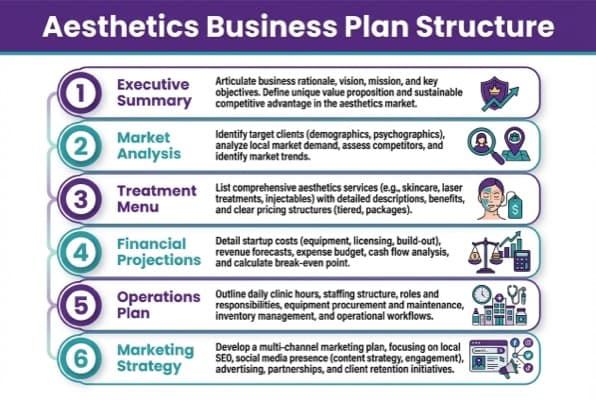
The six essential sections of an aesthetics business plan
| Section | What It Contains |
|---|---|
| Executive Summary | Business rationale, market opportunity, competitive advantage (2 pages max) |
| Market Analysis | Target clients, local demand, competitor gaps |
| Treatment Menu | Services offered, pricing, qualifications at launch |
| Marketing Strategy | Local SEO, social media, referral plan |
| Operations Plan | Clinic hours, equipment, appointment system, staffing |
| Financial Projections | Startup costs, monthly overheads, revenue forecast, break-even |
1. Executive Summary
Two pages maximum. Written last, placed first. It explains your business rationale, identifies your market opportunity, and states your competitive advantage clearly.
For example, a sole practitioner opening in a town where the nearest competitor has a six-week waiting list for Botox appointments has a specific, observable market opportunity. That belongs in the executive summary, not a vague line about "growing demand for aesthetics treatments."
2. Market Analysis and Competitor Overview
Who are your target clients? What treatments are in demand locally? What are existing clinics not offering?
Do not write generic statements about market growth. Give observed detail: the nearest aesthetics clinic is 5 miles away; they do not offer skin boosters; their reviews consistently mention long waiting times. That is useful market analysis.
3. Services and Treatment Menu
List your initial treatment menu with pricing. Be honest about what you are qualified to offer at launch versus what you plan to add as your practice develops. Lenders read this carefully: it tells them how your aesthetics business will generate revenue from day one.
4. Marketing Strategy
How will clients find you? Where will you appear online? What does your launch look like in the first 90 days? This section should cover your local SEO plan, social channels, and any referral partnerships: working through a local SEO checklist is a practical way to turn vague intentions into concrete, costed tasks. See our aesthetics clinic marketing guide for what actually drives bookings.
5. Operations Plan
Clinic hours, appointment system, equipment, consumables sourcing, and staffing. Starting as a solo practitioner? Say so: many profitable aesthetics clinics begin that way.
6. Financial Projections
Revenue forecasts, startup costs, monthly overheads, and a break-even calculation. Covered in detail in the next section.
On format: A 12 to 15 page plan with a clear financial spreadsheet is more useful than a 40-page document padded with industry statistics. Credibility comes from specific, honest numbers, not volume.
If you're only writing it for the bank you'll always lose to the clinic owner who uses their plan as an actual management tool, one they return to, update, and measure against. The plan is most valuable when it forces you to question your own assumptions before they become expensive mistakes.
Financial Projections: Realistic Numbers
Next comes the part most practitioners find hardest. Financial projections are the section most new aesthetics clinic owners get wrong. Usually by being too optimistic on revenue, too vague on costs, or both.
- If you are reading this after already having a number in your head for month-one revenue, that number is worth questioning before it goes into your plan.
- If you are not sure where to start, the startup cost breakdown below gives you a practical starting point.
Startup Costs
For a basic UK aesthetics clinic setup, startup costs typically range from £15,000 to £30,000 (industry estimates, 2025). The range is wide because location matters considerably: a central London clinic faces very different costs than one in a smaller UK city or a home-based setup.
| Cost Category | What It Includes |
|---|---|
| Equipment | Treatment bed, injectable equipment, skincare stock, sharps disposal |
| Premises setup | Fitting out your clinical space for hygiene and infection control |
| Insurance | First-year professional indemnity and public liability |
| Marketing | Website, photography, social media setup, launch promotion |
| Software | Booking system, clinic management tools, from around £25/month |
| Registration | Limited company setup, legal review of premises lease |
Budget a contingency
Build a contingency of 15 to 20% on top of your estimated startup costs. Every clinic launch uncovers something unplanned.
Monthly Running Costs and Break-Even
Build a monthly overhead figure before you project any revenue. Then ask the question that should appear explicitly in your aesthetics business plan: how many treatments do I need to perform each month to cover this overhead?
For example: if monthly overheads total £2,500 and your average treatment revenue is £200, you need around 13 clients per month to break even, roughly 3 per week. Most practitioners find that number considerably more achievable once they have actually written it out.
Revenue Projections
A newly launched solo aesthetics practitioner working 3 to 4 treatment days per week might realistically generate between £2,000 and £5,000 per month in early months. A full-time established clinic can generate considerably more, but month one rarely looks like month twelve.
The three-scenario approach: Model conservative, realistic, and optimistic scenarios (slow start, expected ramp-up, strong launch). Show all three. Lenders appreciate honesty and range far more than a single confident number with no basis. In practice, most new clinics land closer to their conservative scenario in months one through three.
Once your financial projections are drafted, your treatment menu needs to match them, which is where the next section comes in.
Treatment Menu and Pricing Strategy
Building on the financial projections, your treatment menu needs to directly support the revenue numbers you have set. Your treatment menu is not just a price list: it is a set of business decisions. Here is a framework that works for most new UK aesthetics clinics:
- Start with 3 to 5 high-demand anchor treatments that generate repeatable revenue
- Add new treatments with a clear revenue justification, not just because they are popular
- Build in course pricing from day one to improve cash flow and retention
Every treatment you offer requires consumable stock, practitioner time, insurance coverage, and equipment. The wrong menu at launch can spread you too thin before your systems are ready.
Start with Your Anchor Treatments
For most new aesthetics clinics, the launch menu focuses on 3 to 5 high-demand treatments that generate consistent, repeatable revenue. Injectable treatments, botulinum toxin and dermal fillers, are typically the revenue anchor for clinics qualified to offer them.
Typical UK market pricing (2025/2026: varies considerably by location, positioning, and practitioner experience):
- Botulinum toxin: typically £200 to £500 per area
- Dermal fillers: typically £300 to £900 per syringe
- Skin treatments (peels, microneedling, boosters): typically £80 to £1,200 depending on treatment type and whether sold as a single session or course
For guidance on positioning your clinic's pricing strategy competitively, see our guide to aesthetics marketing ideas.
Depth Before Breadth
A common mistake in business plans for aesthetics clinics is listing 20 different treatments at launch. This sounds impressive to the planner and alarming to the lender: it raises questions about training, stock management, and operational complexity.
A stronger approach: launch with your 4 to 5 core treatments, refine your protocols, and add treatments with a clear revenue justification. For example, adding skin boosters because existing filler clients are asking for them is a justified expansion. Adding 6 new treatments because they seem popular is not.
Think in Courses
Treatments sold as courses (typically 3 to 6 sessions) create more predictable cash flow and significantly better client retention. A client who books a course of microneedling sessions is worth considerably more than a single-session booking, and far more likely to become a long-term client. Factor course pricing explicitly into your financial projections.
With your treatment menu shaped, compliance is the section that tends to produce the most surprises, particularly for aesthetics clinics.
Compliance and Insurance Costs to Budget
When it comes to budgeting for your aesthetics clinic, compliance is the section most new business plans underestimate, sometimes significantly. For an aesthetics business, compliance is not a box-ticking exercise.
It is a genuine cost centre that will only grow as UK regulations develop. Budget for it properly now, or discover it painfully later.
Insurance
Professional indemnity and public liability insurance is essential before you treat a single client. Cosmetic insurance for UK aesthetics practitioners typically costs around £500 per year (Hamilton Fraser, Cosmetic Insure, Insync, industry estimates, 2025).
A few practical points:
- Inform your insurer each time you train in a new procedure to ensure coverage applies. New procedures typically do not increase premiums significantly.
- Your policy must explicitly cover the treatments you offer. A policy that includes facials but excludes injectables is not adequate for an injectable-focused aesthetics business.
- Valid indemnity insurance is expected to become a formal legal requirement under the forthcoming licensing regime.
For example, an aesthetics clinic offering Botox, dermal fillers, and chemical peels needs three specific treatment categories covered, not a generic beauty therapy policy. Checking this before you launch is considerably easier than discovering the gap after an incident.
Regulatory Compliance: What Is Coming
The UK's Health and Care Act 2022 gives powers to regulate non-surgical cosmetic procedures in England. As of early 2026, final regulations have not yet been enacted, but the direction is clear (Source: UK Department of Health and Social Care, 2025).
Under the proposed framework:
| Requirement | What It Means for Your Clinic |
|---|---|
| Local authority licensing | Both practitioner and premises will need a licence |
| Training standards | Nationally determined qualifications for injectable treatments |
| Premises standards | Health protection and infection control requirements |
| Indemnity insurance | Will be compulsory, not optional |
If you plan to offer injectable treatments, budget for compliance costs that will become mandatory, even though the exact figures are not yet confirmed. A compliance contingency line in your financial plan is not overcautious; it is prudent.
For a detailed view of current and forthcoming UK rules, see our guide to aesthetics regulations UK and new regulations for aesthetics 2025.
Other Compliance Costs
Key compliance costs to include in your aesthetics business plan:
- Clinical waste disposal: Injectable treatments generate clinical waste: sharps, contaminated materials. Budget for a licensed contractor; costs vary by collection frequency.
- CPD: At least one CPD course per year, plus qualification upgrades under forthcoming licensing standards.
- VAT registration: Required when turnover exceeds £85,000 in any rolling 12-month period (gov.uk). Until then, you pay VAT on purchases but do not charge it to clients.
- Company administration: Annual confirmation statement fees, accountancy support.
If you are thinking "I didn't realise compliance would cost this much", that's usually a sign your original budget was built without looking at this section closely enough. Better to know now than to discover it three months after opening. The reality is that the compliance budget is the section that most often needs revising upward after the first draft of your aesthetics business plan.
With compliance costs mapped, you are ready for the most important two pages of the whole document.
Write Your Executive Summary This Week
Now let's put it all together. Your executive summary is the part lenders read first and remember most.
Info
Start now: even a rough draft is more useful than nothing. It is also the section most aesthetics clinic owners leave until they feel "ready," which usually means never.
A five-paragraph structure for aesthetics clinic owners:
- Para 1: The business: What clinic, where, when, what treatments, and to whom?
- Para 2: The market opportunity: What specific local demand or gap does your clinic fill?
- Para 3: Your competitive advantage: Qualifications, location, treatment specialisms, patient experience.
- Para 4: The numbers: Startup costs, projected monthly revenue at full operation, break-even point.
- Para 5: What you need: If seeking finance or a specific lease, state it clearly.
Read it back and ask: would I lend money to this business based on this summary? If the answer is uncertain, that is usually a sign a section needs more specific detail, particularly the numbers.
Would you book a treatment at your own clinic based on the impression your business plan gives of it? If the answer is hesitant, that is where you start editing.
If you only have 30 minutes a week, do this:
- Day 1-2: Write paragraphs 1 and 2 of your executive summary: what your aesthetics business is and what market gap it fills
- Day 3-4: Build your startup cost list using the categories in the financial section above
- Day 5-7: Calculate your break-even: monthly overhead / average treatment revenue = clients needed per month
That is not a finished aesthetics business plan. But it is the foundation. And foundation-building is the hardest part to start.
Tools like LocalBrandHub can help with the marketing section of your plan: local SEO, social media presence, and client acquisition built specifically for independent clinics. For the beauty salon industry and beyond, having the right marketing tools matters. See our full guide to how to start an aesthetics business for the broader picture, or explore aesthetics marketing and medical aesthetics marketing for strategies to grow once you are up and running. You might also benefit from working with an aesthetics marketing agency as your clinic scales.
Frequently Asked Questions
Do I need a business plan to start an aesthetics clinic?
You are not legally required to have one. But if you need finance, want to rent commercial premises, or simply want to test whether your clinic is financially viable before investing £15,000 to £30,000, a business plan is essential. The process of writing it is often as valuable as the document itself.
How much does it cost to start an aesthetics business in the UK?
A basic UK aesthetics clinic setup typically costs between £15,000 and £30,000 (industry estimates, 2025). This covers equipment, premises fit-out, initial stock, insurance, software, marketing, and registration. Costs vary significantly by location, clinic size, and treatment offering.
What insurance does an aesthetics practitioner need?
Professional indemnity and public liability insurance are essential before treating any client. Cosmetic insurance typically costs around £500 per year in the UK. Major providers include Hamilton Fraser, Insync, and Cosmetic Insure. Ensure your policy explicitly covers every treatment you offer.
Do I need a licence to offer Botox or dermal fillers in the UK?
As of early 2026, a mandatory licensing regime has not yet been enacted in England. However, the Health and Care Act 2022 sets the framework for local authority licensing for both practitioners and premises offering injectable treatments. Your aesthetics business plan should treat this as a near-term compliance requirement and budget accordingly.
What is realistic revenue for a new aesthetics clinic?
Realistic revenue is a framework that starts with your occupancy rate and treatment pricing, then models three scenarios (conservative, expected, and optimistic) across your first 12 months. For a part-time solo practitioner, early months might generate £2,000 to £5,000 per month. A full-time established clinic can generate considerably more. Build these projections into your aesthetics business plan before you open.
What are the key sections of a business plan for aesthetics?
An aesthetics business plan should include: executive summary, market analysis, services and treatment menu, marketing strategy, operations plan, and financial projections. Each section needs clinic-specific content, particularly around compliance costs, treatment qualifications, and UK-specific regulatory requirements.
For restaurants, salons, and local businesses
Need help with your marketing?
We help UK businesses turn social media into real results, not busywork.
Start freeKey Takeaway
Key Takeaways
- An aesthetics business plan covers six core sections: executive summary, market analysis, treatment menu, marketing, operations, financial projections
- UK startup costs typically range from £15,000 to £30,000: build in a 15 to 20% contingency
- Calculate your break-even: monthly overheads / average treatment revenue = minimum clients per month
- Launch with 4 to 5 anchor treatments rather than a broad menu
- Budget for insurance (around £500/year), clinical waste disposal, CPD, and forthcoming licensing requirements
- Write your executive summary now: two pages, five paragraphs, honest numbers
Get More Marketing Tips
Practical marketing tips for UK business owners, straight to your inbox. No spam, unsubscribe anytime.
About the Author
Local Brand Hub
Empowering UK Businesses
Local Brand Hub provides comprehensive business management tools designed specifically for UK local businesses to streamline operations, automate marketing, and grow revenue.
More articlesRelated Articles
 Industry Insights
Aesthetics Regulations UK: Your Compliance Guide
Aesthetics regulations UK explained. Governing bodies, training standards, ASA advertising rules, insurance needs, and a quarterly compliance checklist.
 Tutorials
How to Start an Aesthetics Business UK (Step-by-Step)
Step-by-step guide to starting an aesthetics business in the UK: qualifications, insurance, licensing, premises, equipment, and launch marketing explained.
 Marketing Tips
Aesthetics Clinic Marketing: Market Your Compliance
Aesthetics clinic marketing in the UK is being reshaped by licensing. What the proposed England scheme covers, what the ASA bans, and what to publish now.