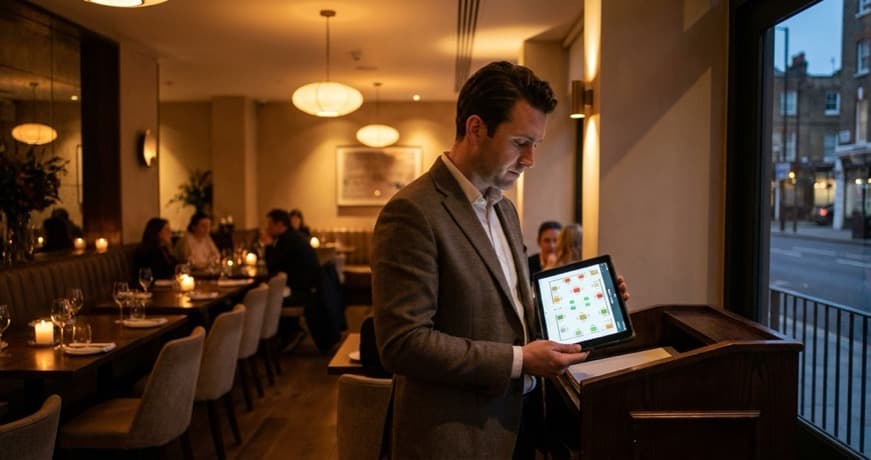
Compare restaurant table management software for UK venues. See features, pricing, and top options in a segment growing at 19.19% CAGR.
How much did last Friday's chaos cost you? You've just survived another busy night. Your reservation book said 40 covers but walk-ins pushed it to 55. Your host juggled a paper diary and a phone that won't stop ringing. Someone got seated twice at the same table. You comped a bottle of wine to apologise.
Table management software replaces paper diaries with real-time floor plans, bookings, and waitlists. 76% of restaurant operators say technology gives them a competitive edge (Apicbase, 2025). For busy venues, the right software turns your Friday night chaos into a smooth system.
Info
Related: Restaurant Management Software - our complete hub guide to restaurant tech
What You'll Learn
- What table management software does and why it matters for UK restaurants
- Feature comparison of leading platforms available in the UK market
- Real costs from free options to premium restaurant booking systems
- Decision framework to match software to your restaurant type
- Implementation tips for a smooth transition from paper diaries
What Is Restaurant Table Management Software?
Restaurant table management software is a framework that handles reservations, seating plans, waitlists, and guest communication from one digital dashboard. It replaces the handwritten diary with a live floor plan that updates as guests arrive, sit, eat, and leave.
The table and delivery management market reached $739.9 million globally in 2025. It is projected to hit $2.1 billion by 2030, growing at 19.19% per year (Grand View Research, 2025). That growth tells you something clear: restaurants are moving away from paper bookings because the costs of getting it wrong are too high.
For example, a 60-cover bistro in Edinburgh running two sittings on Saturday needs to turn tables fast. A table empty for 20 minutes between bookings is lost revenue every week. Software tracks average dining times and fills the gaps for you.
The Core Problem It Solves
Double-bookings. No-shows. Walk-ins you cannot accommodate because you cannot see which tables are about to free up. These are not minor inconveniences. They are revenue leaks.
A restaurant booking system gives your host a real-time view of:
- Which tables are occupied, reserved, or available
- How long each party has been seated
- Upcoming reservations and their table requirements
- Waitlist position and estimated wait times
Ask yourself: how many covers did you lose last month because of booking confusion or no-shows? If you don't know the number, that's usually a sign your current system isn't tracking what matters.
Features That Actually Drive Revenue
Now that you understand the basics, here is what moves the needle for UK restaurants.
Real-Time Floor Management
This is the centrepiece. A digital floor plan that mirrors your actual layout and updates in real time as:
- Guests are seated and their timer begins
- Tables are cleared and turned
- Walk-ins are added to the waitlist
- Reservations are confirmed or cancelled
For instance, a seafood restaurant in Brighton with a mix of two-tops, four-tops, and a communal table can set rules about which configurations work for different party sizes. The software handles the puzzle. Your host focuses on welcoming guests.
Online Booking Integration
62% of full-service customers favour mobile payment methods (SNS Insider, 2025). The same digital-first habit applies to booking. Your guests want to reserve online at 11pm on a Tuesday. They will not call during service hours.
A good restaurant booking system should:
- Accept bookings directly from your website
- Sync with Google Reserve and social media
- Send automated confirmation and reminder messages
- Reduce no-shows through pre-booking deposits or card captures
Waitlist Management
Walk-ins are revenue. Turning them away because "we're full" when three tables are about to finish is a missed opportunity. Smart waitlist features include:
- Accurate wait time estimates based on current table turnover data
- SMS notifications when tables become available
- Guest preferences stored for repeat visitors
Guest Data and CRM
Every booking is data. Over time, table management software builds profiles showing:
- Visit frequency and spending patterns
- Dietary requirements and preferences
- Special occasion dates
- Feedback history
This data turns a booking into a relationship. Staff can greet regulars by name. They remember the usual table. If you think this sounds like something only fancy places do, it is not. It is just using data you already collect.
Top UK Table Management Options
Next, let's compare the platforms available to UK restaurants. No single option suits everyone.
| Platform | Ideal For | Key Strength | UK Pricing |
|---|---|---|---|
| ResDiary | Independent UK restaurants | UK-based, strong local support | From £79/month |
| OpenTable | High footfall, diner network | Large consumer booking network | Commission-based |
| Tableo | Small-medium restaurants | Affordable, easy setup | From £49/month |
| Square | Multi-function needs | Free POS integration | Free basic tier |
| TheFork Manager | European market reach | Broad diner audience | Commission-based |
Note: Pricing is indicative and varies by features, covers, and contract length. Always request a tailored quote.
Our Recommendation
For most independent UK restaurants, ResDiary or Tableo typically offer the strongest combination of UK-focused features, local support, and reasonable pricing. Commission-based models like OpenTable work well if your priority is reaching new diners, but the per-cover fees add up quickly for high-volume venues.
Commission vs Subscription: What Works Better?
This decision matters more than most features.
- Subscription (fixed monthly fee): Predictable costs. Better for restaurants with strong existing booking channels.
- Commission (per cover): Lower upfront cost. Better for new restaurants building their customer base.
If you can't tell whether lost covers cost you more than a subscription would, that's usually a sign your tracking is the real problem. And if you're only choosing based on the monthly price you'll always lose to competitors who calculate total cost per cover including commissions, no-shows, and fees.
Free vs Paid: The Honest Comparison
Now that you have seen the top options, here is what you are actually getting with free versus paid platforms.
| Feature | Free Options | Paid Platforms (£49-£150+/month) |
|---|---|---|
| Basic reservations | Yes | Yes |
| Real-time floor plan | Limited | Full customisation |
| Online booking widget | Basic | Branded, multi-channel |
| Automated reminders | Rarely | SMS + email |
| Guest CRM | No | Standard |
| No-show protection | No | Deposit/card capture |
| Reporting and analytics | Basic | Detailed revenue data |
| Support | Community/email | Phone + dedicated |
When to Upgrade
Cloud-based solutions dominate the market, accounting for 60.87% of revenue in 2025 (Mordor Intelligence, 2025). Both free and paid options are typically cloud-based, so the difference is feature depth, not technology.
For a small place taking fewer than 30 covers per night, a free booking widget works fine. Once you pass that number, paid software pays for itself through fewer no-shows and better table turns.
Pro Tip
Calculate your monthly no-show cost before comparing platforms. If no-shows cost you £500+ per month, even a £100/month platform delivers positive ROI from deposit features alone.
Choosing the Right System for Your Restaurant
Here's the key insight: the right choice depends on your restaurant type, not a feature list.
By Restaurant Type
| Restaurant Style | What You Need Most | Consider |
|---|---|---|
| Fine dining (40-60 covers) | Guest CRM, preferences, occasion tracking | ResDiary, SevenRooms |
| Casual dining (80-120 covers) | Fast table turnover, waitlist management | Tableo, Square |
| Pub/gastropub | Flexible walk-in + booking mix | ResDiary, Square |
| Multi-site group | Centralised dashboard, reporting | OpenTable, ResDiary |
For example, a 40-cover fine dining restaurant in Bath prioritises guest CRM and occasion tracking, while a 100-cover casual chain values fast table turnover and waitlist features above all else.
Integration Matters
Your table management software needs to work with what you already have. Check compatibility with:
- Your existing POS system
- Your website platform
- Cloud restaurant management tools you already use
- Payment processing for deposits
If you cannot tell whether your booking system saves time or just creates a different kind of admin, that's usually a sign it is time to switch. 47% of operators plan to invest in management software in 2025, while 65% plan to devote resources to digital or location-based solutions (National Restaurant Association, 2025) (US data). Whatever you choose now should connect to whatever you add next.
Info
If you're thinking 'I can barely keep up with the tech I already have' - that is a completely valid concern. The reality for most restaurant owners is that the best system is the one your team will actually use consistently. Pick simplicity over features every time.
Integration With Your Existing Setup
However, no table management software works in isolation. It works best when it connects to your broader restaurant management software stack.
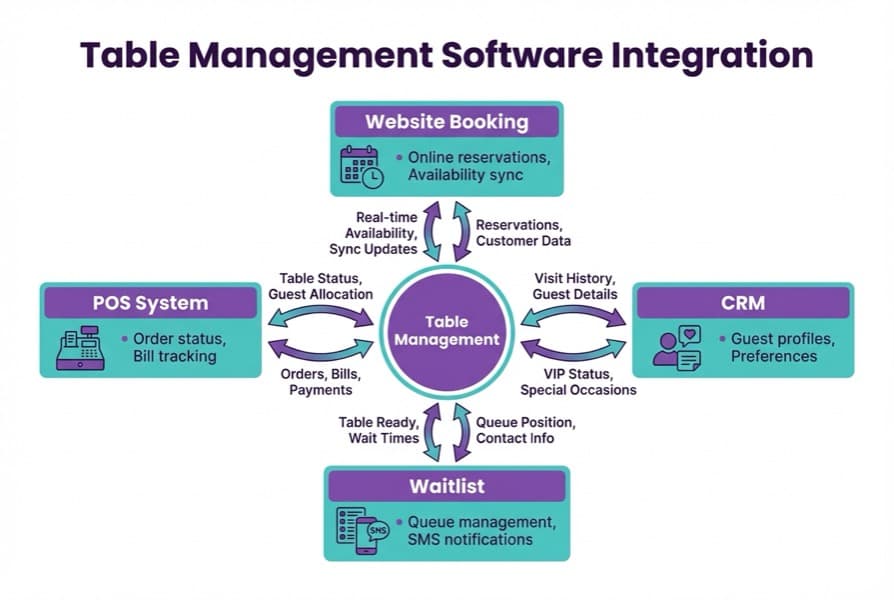
How table management software connects to your existing restaurant tech stack
POS Integration
When your table management syncs with your POS, you get:
- Revenue data per table, per sitting, per server
- Average spend tracking by time slot
- Kitchen prep alerts when large parties are seated
Website Booking Widget
A booking widget on your restaurant website means guests book directly without third-party commissions. Most platforms offer embeddable widgets that match your branding.
Marketing and Loyalty
Guest data from table management feeds into your marketing. For example, knowing that a couple visits monthly and always orders the tasting menu lets you send targeted offers that feel personal, not spammy. An AI social post generator can turn those guest insights into ready-to-post promotions in minutes.
Your Table Management Checklist
Here's your implementation checklist to guide the transition.
- Count last month's no-shows and double-bookings
- Calculate revenue lost to empty tables between sittings
- List your must-have features (online booking, waitlist, CRM, deposits)
- Request demos from three platforms that serve UK restaurants
- Ask about POS integration with your current system
- Compare true cost per cover (including commissions and fees)
- Trial one system during a quieter week before peak season
- Train your host and front-of-house team on the new workflow
For example, a Thai restaurant in Liverpool completed this checklist in two weeks, switching from a paper diary to ResDiary and noticeably reducing no-shows within the first month.
If You Only Have 30 Minutes This Week
Finally, if you only have 30 minutes a week to spend on this, here is your realistic starting point:
This Week's Action
Audit your restaurant's table management:
- Day 1-2: Count your no-shows from the last four Fridays. Write down the number and multiply by your average spend per head. That is your monthly no-show cost.
- Day 3-4: Time how long tables sit empty between sittings. Even 10 minutes per table per night across 15 tables is 2.5 hours of lost capacity.
- Day 5-7: Visit the ResDiary and Tableo websites. Both offer free UK demos. Book one for next week.
One audit. One demo booking. That is enough for week one.
Weekly Action
- Count your no-shows from the past month and multiply by average spend per head
- Book one free demo with a UK platform like ResDiary or Tableo
Frequently Asked Questions
What is the best table management software for UK restaurants?
Choosing the right table management software is a strategy that depends on your restaurant's booking volume and service style. ResDiary and Tableo consistently suit independent UK restaurants with their UK-based support and subscription pricing. OpenTable works well for restaurants that want access to a large diner network but charges per cover. For multi-site groups, centralised platforms like ResDiary or SevenRooms offer the reporting depth needed. Your choice should match your restaurant type and booking volume.
How much does restaurant table management software cost?
Subscription-based platforms range from free basic tiers to £150+ per month for full-featured systems. Commission-based models charge per cover, typically £1-£3 per diner. For a 100-cover restaurant doing 200 bookings per month, commission costs can exceed £400 monthly. Compare total cost of ownership, not just the headline price.
Can table management software reduce no-shows?
Yes. Automated booking confirmations, SMS reminders, and pre-booking card captures or deposits significantly reduce no-show rates. Some platforms report significant no-show reductions after implementing automated reminders and deposit requirements.
Is it worth the investment for smaller venues?
If you take fewer than 20 bookings per day, a simple online booking form might suffice. Once you consistently manage 30+ covers with a mix of reservations and walk-ins, dedicated software reduces errors and improves table turnover. The table and delivery management segment is growing at 19.19% annually (Grand View Research, 2025) because even smaller venues see measurable gains.
How long does it take to switch from a paper diary?
Most cloud platforms can be set up in one to two days. The bigger transition is training your front-of-house team. For example, a bistro in Nottingham ran both paper and digital systems for one week before going fully digital. Budget one week of running both systems in parallel. Staff typically become confident with the new system within two weeks of consistent use.
If you run a restaurant and want to see how Local Brand Hub can support your marketing, explore our restaurant marketing tools.
Key Takeaway
Key Takeaway
- The table management software segment is growing at 19.19% CAGR - this is not a passing trend but a fundamental shift in how restaurants operate
- 76% of operators say technology gives them a competitive edge - and table management is one of the most impactful applications
- Choose subscription over commission if you already have strong booking channels and want predictable costs
- Integration with your POS matters more than standalone features - your table data becomes powerful when connected to revenue data
- Start with one problem - whether it is no-shows, double-bookings, or slow table turns, pick your biggest pain point and solve that first
Restaurant table management software is not about replacing your host's judgement. It is about giving them better information in real time so every seat generates revenue. Research shows that venues using digital table tools outperform those on paper systems. Based on our experience reviewing these platforms, the hands-on setup takes less time than most owners expect.
Your paper diary does not tell you that Table 7 averages 95 minutes on a Saturday. Software does. That single insight can add an extra sitting per week. Over a year, that is thousands of pounds.
Ready to compare options? Explore our restaurant management software hub for detailed platform reviews and implementation guides.
For restaurants, salons, and local businesses
Need help with your marketing?
We help UK businesses turn social media into real results, not busywork.
Start freeGet More Marketing Tips
Practical marketing tips for UK business owners, straight to your inbox. No spam, unsubscribe anytime.
About the Author
Local Brand Hub
Empowering UK Businesses
Local Brand Hub provides comprehensive business management tools designed specifically for UK local businesses to streamline operations, automate marketing, and grow revenue.
More articlesRelated Articles
 Industry Insights
All-in-One Restaurant Software: UK Comparison
Compare all-in-one restaurant software for UK venues. See top platforms, UK pricing, and what to look for when choosing an integrated system.
 Industry Insights
Cloud Restaurant Management Software: Complete UK Guide
Cloud restaurant management software accounts for 60% of the market. Cut costs and streamline UK restaurant operations with our complete guide.
 Industry Insights
Restaurant Kitchen Display System: UK Buyer's Guide
72% of venues use POS-to-KDS systems. Compare UK kitchen display system pricing from £300 and cut order errors by 40%. Full buyer's guide.