
Beauty salon marketing for UK owners with 30 minutes a week: the two channels worth repeating, plus the rules on what you may advertise, review and email.
Beauty salon marketing is the small set of habits that keeps a salon visible to the people who live near it: a complete Google listing, one social channel worked properly, reviews answered, clients nudged to rebook. Repeated weekly, that beats a campaign you run once in a panic.
You're wiping the station down between clients while the nail bar three doors along posts twice a day. Is it winning? Maybe. What you cannot see from your side of the window is whether any of it made their phone ring, and there is a fair chance they cannot either.
Marketing a beauty salon is rarely an ideas problem: you could list twenty things you ought to be doing without looking anything up. It is a repetition problem, and the question is which two you would still do the week a therapist calls in sick and the boiler goes.
The ideas lists also leave out the law. Part of what happens in your treatment rooms is governed by advertising and consumer rules that decide what may go in a post before any platform gets a vote.
What you'll learn
- Which two channels are worth your weekly half hour
- What the 3-3-3 rule gives a salon, and what it does not
- Which treatments the advertising rules keep off your grid
Related: Salon Marketing Plan
What Is the Best Marketing Strategy for a Beauty Salon?
The best strategy is the smallest one you will still run in a bad week. In practice: a complete Google Business Profile and one social channel, worked properly, before anything else joins the list.
Those two earn their place for different reasons. Your listing catches the woman who has already decided she wants a facial, so it needs current prices, hours and photographs of the actual room. Social does the other job: it keeps you in front of people who already know you, a smaller task than winning a stranger and one that does not wait for anybody to search.
How much should a beauty salon spend on marketing? Very little at this stage. Both anchors cost time, not money, and a salon that cannot hold thirty unpaid minutes a week is rarely rescued by a paid boost.
Everything else is a candidate, not a commitment. Paid ads, a newsletter, TikTok, flyers in the gym next door: try each once the first two run without you thinking about them, and drop it the moment it eats their half hour. Choosing deliberately is the work, which is why a written salon marketing plan beats a mental one.
What Is the 3-3-3 Rule in Marketing?
The 3-3-3 rule is a content framework: make three pieces of content, put them on three channels, cut them into three formats. It comes off the social media course circuit rather than out of anybody's published research, which is worth knowing when someone quotes it at you as a finding.
What it is not is a growth lever. Cutting one photograph into three posts multiplies the posting, not the audience: if the same eleven people see all three, you have tripled your admin and left your reach where it was.
Why this matters: a habit borrowed as a promise gets abandoned when the promise fails. Borrowed as a habit, it survives.
The salon version is narrower and worth the ten minutes. Imagine one good before and after, shot in daylight: it earns a post, a line in your next email and a photo on your listing. Three posts on one channel reach the same followers three times; those three places reach three different rooms.
The Part of Your Menu You Are Not Allowed to Advertise
Most of your menu you can advertise as loudly as you like. Facials, brows, lashes and nails: prices, packages, photographs of your own work. Injectables sit under a different rulebook, which plenty of owners meet only when a complaint lands.
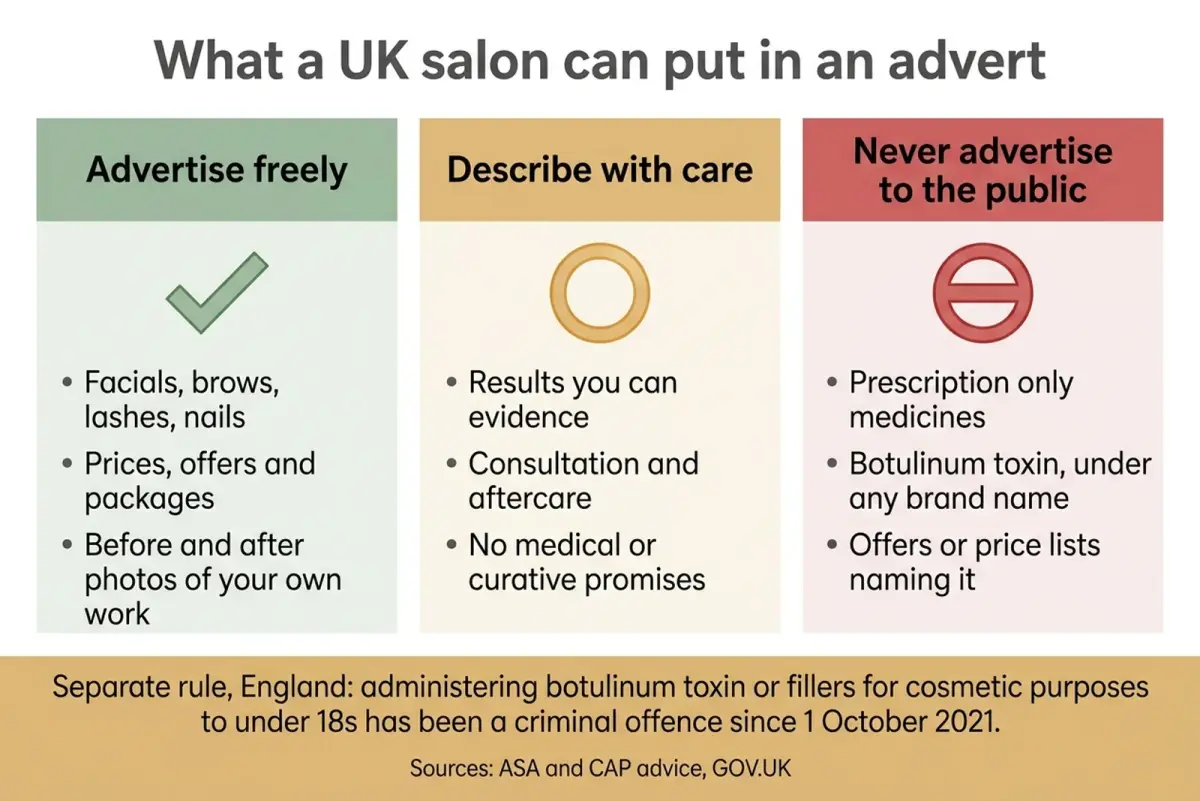
What the advertising rules let a salon promote, and the separate England rule on under 18s.
The advertising regulator's position is plain. Botox is a prescription-only medicine and as such cannot be advertised to the public. That covers more surfaces than owners expect: your grid, your stories, the price list in the window and the offers board are all advertising to the public, whatever you would call them yourself.
A separate rule carries a tighter geography. From 1 October 2021 it is a criminal offence to administer botulinum toxin or a filler by injection for a cosmetic purpose to a person under 18 in England, even with a parent's blessing. So the prom enquiry that arrives every May is a question about a birth date: in England, for a sixteen year old, the answer is no.
Between those two sits everything you can describe but not promise: consultations, aftercare, your training, the awkward questions other salons dodge. Read the current CAP advice before you write the advert, not after somebody complains. Imagine a clinic that answers "is it safe?" in plain words on its own page. It names no medicine and it is still the one people ring.
Promotions That Fill Quiet Slots Instead of Training Discounts
Twenty per cent off everything, every quiet Tuesday, is not an offer. It is a timetable, and a regular who can move her appointment will learn to move it. The mistake is discounting hours that were already going to sell; the promotions worth running aim at a gap in the diary.
- Midweek bundles. Pair a slow treatment with a best seller so the quiet hour carries the offer.
- Referral upgrades, not money off. A conditioning add-on costs you minutes and protects the price you charge everyone else.
- Seasonal work, booked early. Prom, party season and wedding trials are visible from a long way off. Six weeks out is a reasonable first attempt, then move it to fit your enquiries.
Imagine a salon with a dead Wednesday afternoon. It offers a brow and facial hour at a set price for that slot, tells the email list, and leaves the weekend menu alone.
More: salon promotions and marketing ideas for a beauty salon.
Reviews: Ask Loudly, Never Buy
Reviews are the cheapest marketing a salon has, and the one with a legal line through it. The Digital Markets, Competition and Consumers Act 2024 created a banned practice covering fake reviews, reviews that conceal the fact they were incentivised, and publishing reviews in a misleading way. Those provisions apply to commercial practices from 6 April 2025 onwards, so the card in the reception tray offering a free file and polish for five stars is a live problem, not a grey area.
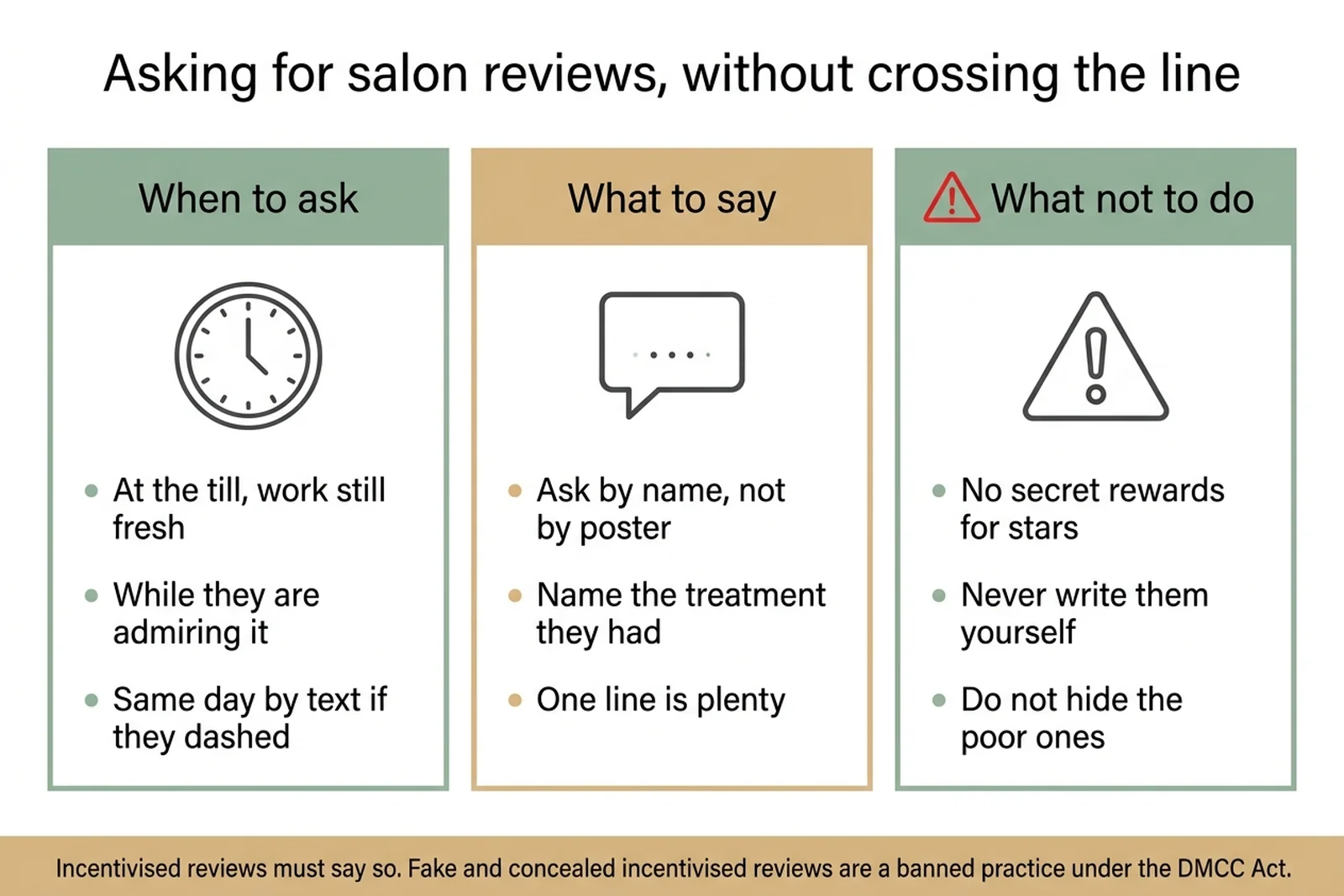
When to ask, what to say, and the concealed incentive that turns a review request unlawful.
Asking is not the problem. Asking is the answer. A review page measures asking at least as much as the work, because a delighted client's next thought is her afternoon, not your listing. So ask at the till, by name, while she is still admiring it: one line naming the treatment she had asks a person, and the poster by the door asks nobody. Then reply to them all, including the three star one, in the voice you would use in the room.
The Emails Clients Do Not Resent
Your booking system quietly holds the most valuable list you own, and most of it has never had a message from you. Rebooking reminders timed to when a treatment wears off, a seasonal prompt and the occasional quiet-slot offer are enough. Three sends a quarter that read like a person will do more than a monthly newsletter nobody opens, and three is a starting number: adjust it to what your list answers.
Know the soft opt-in rule. The Information Commissioner's Office is clear that you may email or text an existing customer who has bought or discussed buying a similar service, but only if you gave them a clear chance to opt out when you took their details, and in every message since. It is also why a bought list is no use to you: nobody on it is your customer.
A lash infill reminder sent in the week your sets tend to fall due, naming the client and offering a Thursday slot, is a rebooking prompt rather than a newsletter.
Templates and timings: beauty salon email marketing.
How Do I Promote My Beauty Salon in 30 Minutes a Week?
Split it into three ten minute jobs and diarise them like clients, because a task with no slot loses to a walk-in.
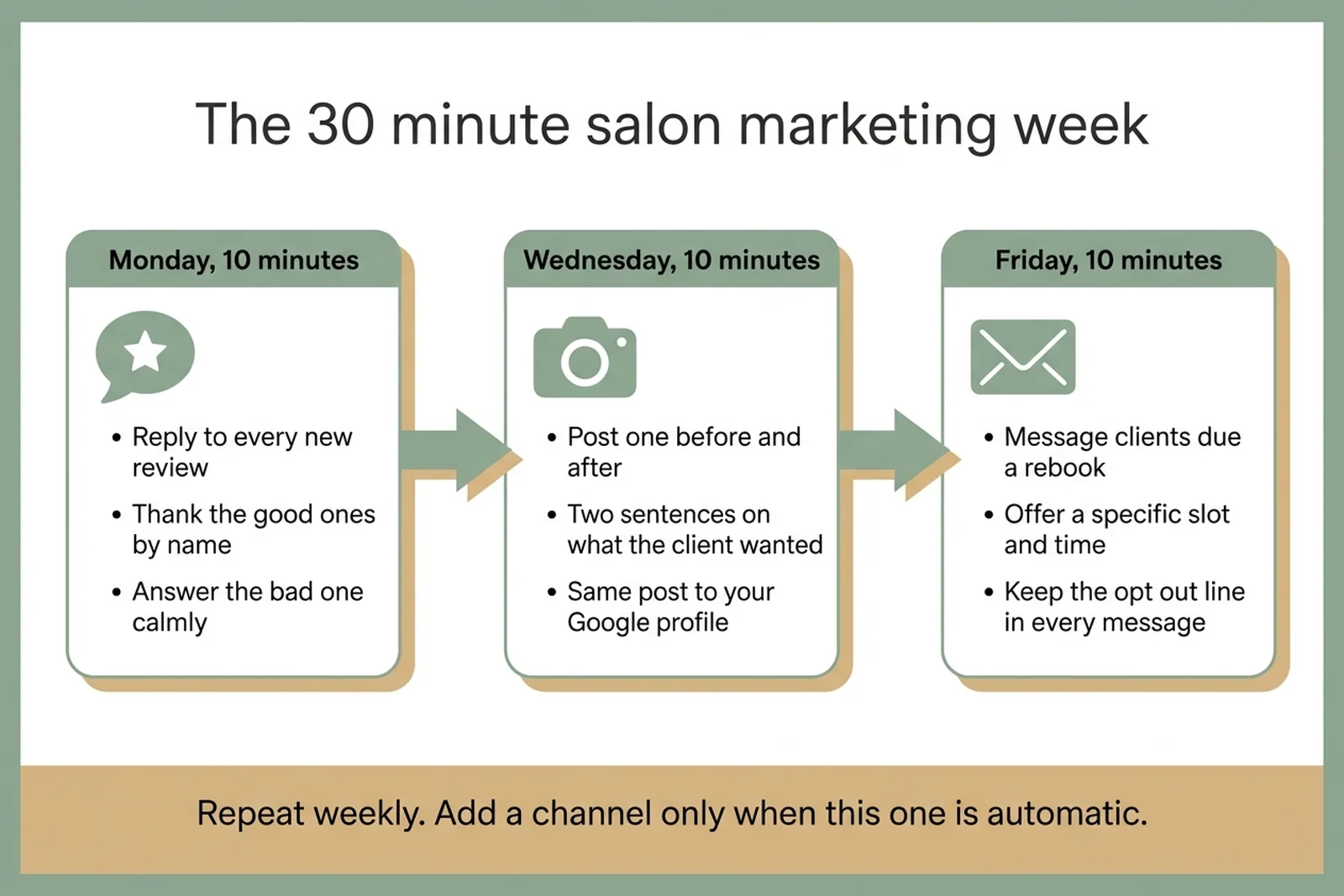
One half hour, split across three days, that holds in a bad week as well as a good one.
- Monday, reviews. Reply to everything that arrived, thank the good ones by name, answer the bad one calmly and in public.
- Wednesday, one before and after. Two sentences on what the client wanted and how you got there, posted to your channel and your listing.
- Friday, rebooking. Message the clients due back and offer a specific slot, because "come in soon" asks her to pick a time while "Thursday at half two" only asks her to say yes. Keep the opt-out line in every message you send.
Post only when the salon is quiet and your feed becomes a map of your worst weeks. When nobody can tell you whether the Wednesday post brought anyone in, put the question to your next ten new clients rather than to a bigger budget. If posting is the part that keeps slipping, LocalBrandHub has a free social post generator and social media calendar, plus a seasonal campaign library on its Growth plan: see how it works. Platform tactics: salon marketing ideas for social media.
Beauty Salon Marketing vs Hair Salon Marketing
Both look alike from the outside and reward different messages. Beauty clients book for an outcome with a date attached, so speak to the occasion and the result. Hair clients come back to a person rather than a premises, which is why the stylist is the brand and a hair post with no name on it is half a post.
| Beauty side | Hair side | |
|---|---|---|
| What books them | An occasion or a maintenance cycle | A stylist they trust |
| Best photo | The result, close up | The transformation, full head |
| Wasted effort | Generic "pamper yourself" posts | Posts with no stylist named |
Rule of thumb, not research: read it against your own rebooking data first.
If hair is the bigger half of the business, marketing a hair salon takes it from that side.
Frequently Asked Questions
What is the best marketing strategy for a beauty salon?
A complete Google Business Profile plus one social channel you post to weekly. Both are free, both are where people look for a salon near them, and both reward turning up. Add a third only when those two run themselves.
What is the 3-3-3 rule in marketing?
The 3-3-3 rule is a content framework. Make three pieces of content, put them on three channels, cut them into three formats. It is a habit for reusing work you have already done rather than a proven growth lever.
What are the 5 Ps of marketing for a salon?
Product, price, place, promotion and people. Your treatment menu, what you charge, where clients find you, how you tell them, and the team who make them come back. People usually decides it.
Can I advertise Botox on my salon Instagram?
No. The Advertising Standards Authority is clear that Botox is a prescription-only medicine and as such cannot be advertised to the public. That includes your grid, your stories and your price list. Post about consultations and aftercare instead, and read the current CAP advice before you name anything at all.
Can I offer a discount in exchange for a review?
Not silently. Fake reviews and reviews that hide the fact they were incentivised are a banned practice under the DMCC Act. Asking every happy client is free and works, which makes the shortcut a bad trade as well as an unlawful one.
How do I attract more customers to my beauty salon?
Be findable and be recent. A complete listing with current photos, prices and hours does the finding; replied reviews and this week's before and after do the reassuring. Referrals close the gap, and the salons who get them ask.
Weekly Action
Key Takeaway
Run this for a fortnight, then move the slots to fit your week: if Monday is your day off, the reviews job belongs on Tuesday.
- Open your Google Business Profile tonight and read it as a stranger would. Ask yourself: would I book this salon on that evidence?
- Fix what is out of date, starting with prices and hours
- Put Monday, Wednesday and Friday in the diary as ten minute jobs
- Ask every client this fortnight where they heard of you, and write it down
Few salons win a local market with better ideas. They win it by being the salon that still turned up in a bad week.
For restaurants, salons, and local businesses
Need help with your marketing?
We help UK businesses turn social media into real results, not busywork.
Start freeSources
- Advertising Standards Authority and CAP, Beauty and Cosmetics: Botulinum toxin (Botox) products
- GOV.UK, Botulinum toxin and cosmetic fillers for under 18s
- Competition and Markets Authority, CMA208 Fake reviews guidance
- Competition and Markets Authority, Unfair commercial practices (CMA207)
- Information Commissioner's Office, Electronic mail marketing (Guide to PECR)
Get More Marketing Tips
Practical marketing tips for UK business owners, straight to your inbox. No spam, unsubscribe anytime.
About the Author
Local Brand Hub
Empowering UK Businesses
Local Brand Hub provides comprehensive business management tools designed specifically for UK local businesses to streamline operations, automate marketing, and grow revenue.
More articlesRelated Articles
 Marketing Tips
Marketing a Beauty Salon: Week-by-Week Action Plan
A week-by-week plan for marketing your beauty salon. Google, social media, email, and referrals with templates you can use today.
 Marketing Tips
Marketing Hair Salon: 7 Strategies That Fill Your Chair
Seven practical strategies for marketing hair salon businesses in the UK. Google, Instagram, referrals and retention tactics for hairdressers and barbers.
 Marketing Tips
Aesthetics Marketing: DIY Playbook for UK Clinics
Practical aesthetics marketing strategies you can run yourself. Social media, before-and-after content, local SEO, email, and referrals for UK clinics.