ChatGPT for restaurant marketing without sounding like a robot: copy-paste prompts for captions, menus, emails and review replies, plus a weekly routine.
ChatGPT for restaurant marketing means using OpenAI's chatbot to draft the writing you keep putting off: social captions, menu descriptions, emails and review replies. You give it your restaurant's details and one specific job, it returns a rough draft in seconds, and you edit until it sounds like you. The tool drafts; you decide.
Updated August 2026
Half past ten on a Tuesday, kitchen wiped down, and the caption box is still empty. You type a sentence, delete it, type it again, post nothing. This guide is for that exact half hour. It gives you prompts that turn a blank box into an editable draft, and the guardrails that stop the result reading like it was written by a call centre.
Here is what that half hour buys you:
- The four things every prompt needs before the output is worth your time
- Copy-paste prompts for captions, menus, emails and review replies
- The habits that make AI copy sound like everyone else's, and how to dodge them
- What must never be published without a human check
- A weekly routine that fits between the veg delivery and the lunch run
What can ChatGPT actually do for your restaurant?
Think of it as a fast, tireless drafting assistant with no taste. It will turn "haddock, chips, peas" into a menu line, produce five caption options while your coffee is still hot, and write a calm reply to a review that made your blood boil. What it cannot do is know your food, your regulars, your prices or your street. Every good use of the tool keeps both halves of that sentence in view.
The adoption numbers stopped being a novelty a while ago. Self-reported AI use among UK businesses with 10 or more employees has roughly tripled in under three years, rising from around 12% to around 35% (ONS, 2026).
Where your trade sits in that curve
Hospitality is late to that party. The FSB's Redefining Intelligence research found just 12 per cent of small accommodation and food services businesses using any AI technology (FSB, 2024). Read that number as a gap: either the one you are stuck in, or the one your competitors are.
Your customers, meanwhile, got there first. A third of UK internet users aged 16 and over (33%) had used ChatGPT in the past year, making it the most popular generative AI tool in the country (Ofcom, 2024). A decent share of the people reading your captions have watched the same tool write, which is precisely why the editing step in this guide is not optional.
Related: Restaurant Technology
Marketing is only one corner of what the technology touches; the AI for restaurants guide walks the whole floor, from bookings to stock, if you want the wider tour before committing to the writing desk.
How do you write a prompt that gets usable output?
Context is the whole trick. A prompt that could describe any restaurant returns copy that could advertise any restaurant. Before you ask for anything, give the tool four things:
| Give it | Why it matters | Sounds like |
|---|---|---|
| Who it is writing as | Voice; stops corporate drift | "Socials for a Yorkshire coast chippy" |
| What it knows about you | The detail only you have | "Hand-cut chips, Friday queues" |
| The job | One task, stated exactly | "Three Instagram captions this week" |
| The guardrails | Length, tone, what to avoid | "Under 120 words, no hashtags" |
Compare the two versions in practice. "Write a social media post about my restaurant" gets you a wall of adjectives and a rocket emoji. "You write the socials for a family-run seafood place near the harbour, known for landing-day specials; write one caption announcing today's catch, under 80 words, warm but not gushing, end with a question" gets you something you would only lightly edit. The extra sentence of context is the cheapest marketing hire you will ever make.
There is no secret framework to memorise here, and you should be suspicious of anyone selling you an acronym. These are simply the four questions a decent freelance copywriter would ask before taking your money. Save your first two answers, the voice and the background, in a note on your phone, and paste them at the top of every session so you only ever type the job and the guardrails.
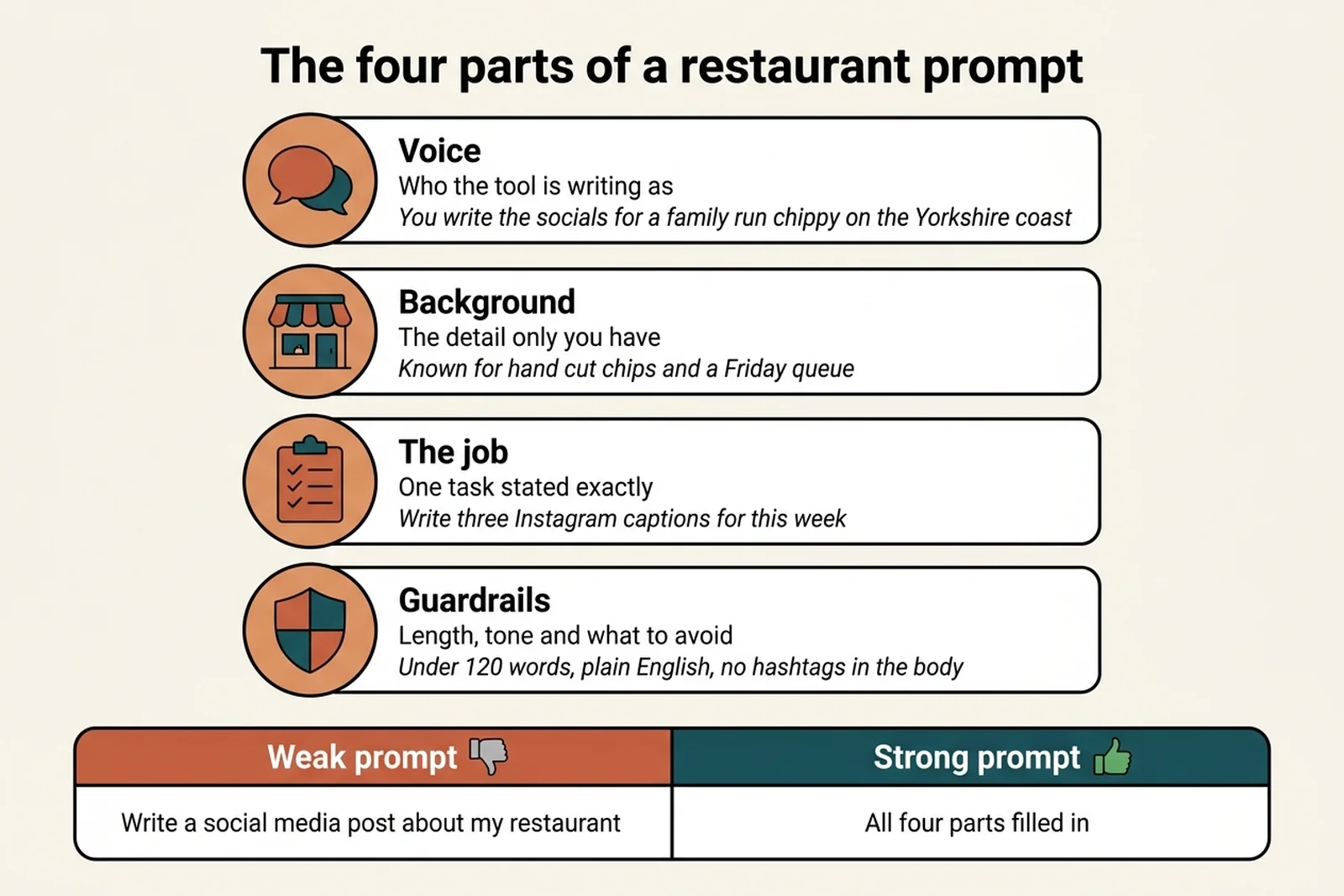
Four questions before every request: the difference between generic filler and a draft worth editing.
Copy-paste prompts for social media captions
The commonest complaint about AI captions is that they read like a press release from nowhere. Both prompts below force the output to be about your place, not "your establishment".
Instagram caption prompt
"You write social media captions for [restaurant name], a [type of place] in [town]. Regulars come for [what you are actually known for]. Write an Instagram caption about [this week's subject]. Under 120 words, warm and plain, like talking to a regular at the bar. End with a question a real person might answer. Put five relevant hashtags on a separate line at the end, none in the body."
Event post prompt
"Write a Facebook post inviting locals to [event] at [restaurant name] on [date]. Cover what is happening, what it costs and how to book. Our crowd is [who actually comes]. Under 150 words, no countdown clichés, no corporate cheerleading."
Batch these. One quiet sitting on a Monday morning, before the deliveries start arriving, can draft the week's posts, and scheduling tools do the rest. If posting has been the job you resent most, batching is how it stops owning your evenings. Captions are only the ammunition, though; the restaurant social media marketing guide covers where to aim them and how often to fire.
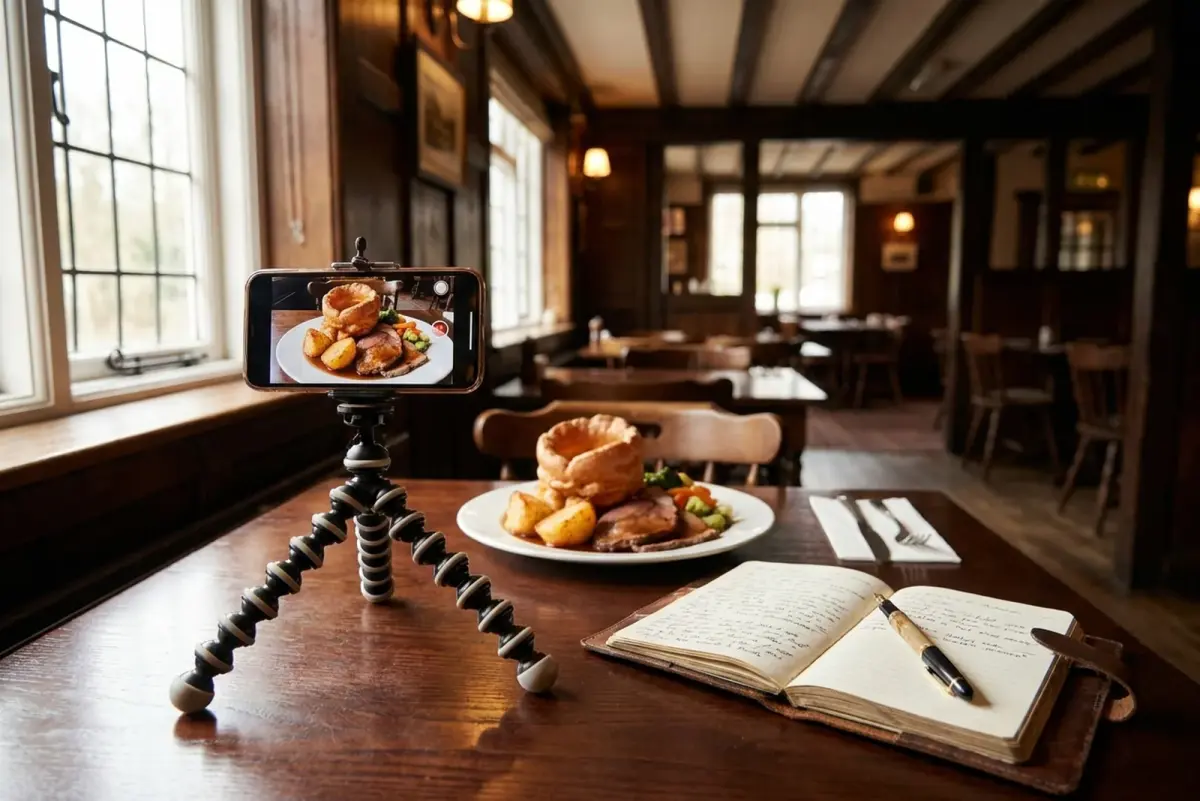
One good photo session plus one prompt session: a week of posts from a single quiet hour.
Can ChatGPT write menu descriptions that sell?
It can write the second draft. Specific, sensory wording reads as more appetising than a list of components. You can test that on your own menu without a research grant: "battered cod, chips, peas" against a line that mentions the crack of the batter. The tool is good at the sensory register; it just needs your true details to hang it on.
Menu description prompt
"Rewrite these menu descriptions in a [casual / elegant / playful] voice. Two sentences each: one for what the dish is, one for why it is worth ordering, using specific sensory detail plus the preparation or sourcing fact I give you. Do not invent ingredients, provenance or history. Dishes: [paste your list, each with one true detail]."
That "do not invent" line is doing real work. Language models pad thin input with plausible fiction, and a menu is the worst possible place for fiction.
Try it on a chippy menu. Feed it "haddock, chips, mushy peas, batter made to a thirty year old recipe" for a harbour-front chippy and ask for a plain voice, and you might get back: "Haddock in a batter that cracks when you tap it, made the same way since before the harbour got its second lifeboat. Chips cut this morning, mushy peas the proper kind." You would trim the lifeboat flourish, keep the rhythm, and let the true detail carry it.
Run the same prompt at each menu change and the seasonal update stops being a writing job; it becomes an editing job, a different size of job entirely.
Prompts for weekly emails and review replies
Email earns its place because it lands in front of people who have already chosen you once. Consistency beats cleverness: a short note that turns up reliably does more than a quarterly masterpiece, and drafting it is exactly the kind of repetitive writing the tool is for.
Weekly email prompt
"Draft a short email from the owner of [restaurant name] to our list. The news this week: [offer, event or change]. Give me a subject line under 45 characters, a two line opening that sounds like a person, one short paragraph, and a single sentence with the booking link. No 'culinary journey', no 'delight your taste buds'."
Review replies are the other quiet time-sink. A reply is read by two audiences, the reviewer and every future customer scrolling past, and it is the second audience that makes the job worth doing well.
Positive review prompt
"Reply to this Google review of [restaurant name]. Thank [first name], mention one specific thing they praised, invite them back. Under 60 words, sounding like a busy human rather than a press office. Review: [paste]."
Negative review prompt
"Draft a reply to this review. Acknowledge the specific complaint without being defensive, apologise once, offer to put it right with a direct way to reach us [email or phone]. Under 80 words. I will edit before posting. Review: [paste]."
The strongest argument for drafting these with AI is temperament: yours, at midnight, after a service that went sideways. The model has no pride to wound. Let it write the first calm draft, then make it true before you post it. For the genuinely awkward cases (the review that names a member of staff, the complaint you suspect is your competitor's cousin) there are worked restaurant review response examples you can lift wholesale.
Where does ChatGPT get restaurant marketing wrong?
The failures are predictable, which is the good news. Watch for these five.
1. Publishing the first draft. The draft is raw ingredient, and nobody serves raw ingredient. Read it aloud; if it does not sound like something you would say across the pass, edit until it does.
2. Letting it invent facts. Language models state guesses with total confidence. Prices, opening hours, allergen and dietary wording get a human check every single time; an invented "gluten free" is a safety incident, not a typo. The same discipline applies to history and sourcing: if the draft says "locally sourced" and your beef actually comes from a farm your regulars know by name, put the real name in, and only claims you can stand behind.
3. Prompting with no context. Bland output nearly always traces back to a bland request. Go back to the four questions and add the detail only you have.
4. Sanding your voice off. If your signs are cheeky, your captions should be cheeky. Describe your tone in the prompt in plain words, "friendly and slightly sarcastic" and "warm and old-fashioned" produce usefully different drafts.
5. Asking for everything at once. "Write my whole month of marketing" produces mush. One task per prompt, run several prompts per sitting.
Before anything is published, a thirty second sweep:
- Read it aloud: does it sound like your restaurant?
- Swap generic phrases for real names, dishes and prices
- Check British spelling and the pound sign
- Verify every factual claim, especially allergens, prices and hours
- Make sure the call to action matches what is actually on
The realistic weekly routine
One sitting, three jobs, and honesty about week one: the first session runs longer because you are writing your saved voice-and-background note and taste-testing the output. From week two the routine shrinks to the size it promises.
Picture a two-room gastropub with one owner-manager and no marketing budget:
- Monday, ten minutes with the coffee: batch three captions for the week and schedule them
- Wednesday, ten minutes: one email to the list about Friday's pie night
- Sunday, ten minutes after the last table has gone: reply to the weekend's reviews before locking up
Thirty minutes on an ordinary week, closer to an hour the first time, and the marketing no longer trails off every time the kitchen gets busy.
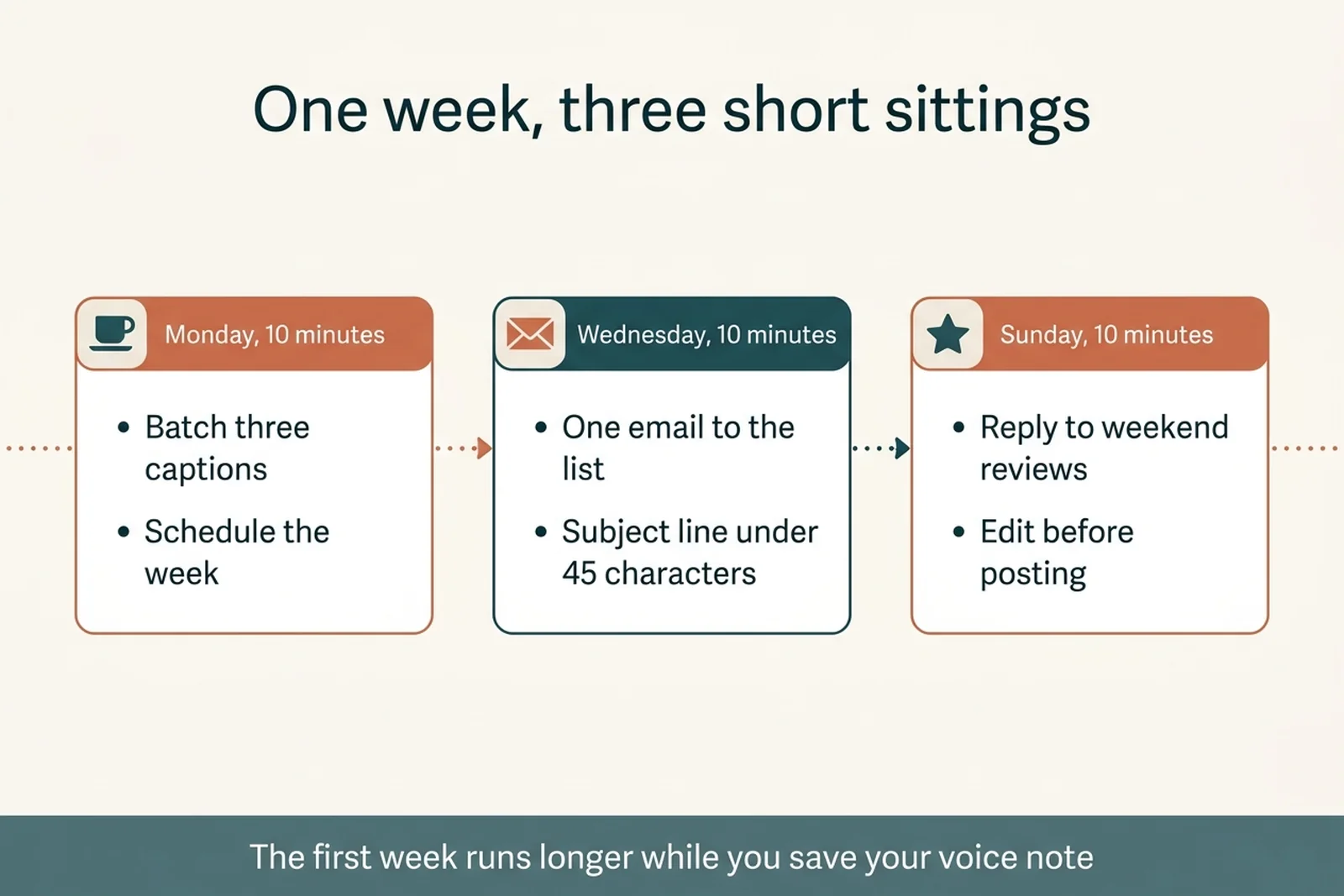
Three short sittings a week: captions, one email, review replies. Small enough to survive a busy fortnight.
Speed is the advert here, and the quieter benefit matters more: marketing stops being the job that falls off the list whenever the kitchen wins, which, in an independent restaurant, is every week.
Key Takeaway
Start with one prompt this evening
ChatGPT has never eaten anywhere. That is the whole deal on offer: it brings the speed, you bring the taste. Copy the Instagram caption prompt, fill in your details from the note you just saved, and you will have three rough drafts before the kettle boils. Editing them into something you would actually post is the real work, and even that fits inside the evening. Then fold the rest in at your own pace, one prompt at a time, until the weekly sitting is a habit.
For where the captions, emails and replies fit in the bigger picture, the restaurant marketing guide covers the whole system your prompts now feed. And if the rest of that system is what keeps slipping, LocalBrandHub helps independent UK restaurants stay visible while the kitchen wins: see how it works.
FAQ
Is ChatGPT free to use for restaurant marketing?
Yes, for most of it. OpenAI's own FAQ states that ChatGPT is free to use, and the free tier handles captions, emails and review replies comfortably. The catch is a cap: OpenAI limits free usage, and ChatGPT tells you when you have hit the current limit and shows when access resets or how to upgrade (OpenAI free tier FAQ).
If you keep hitting that ceiling, OpenAI's help centre lists the paid Plus plan at $20 a month (OpenAI Help Center), and OpenAI localises its subscription pricing by region (multicurrency billing), so take the price at your own checkout as the current UK figure and check it before you commit.
Will customers be able to tell my captions are AI-written?
They can if you publish the first draft untouched. Generic rhythm, over-neat structure and words like "elevate" are the tells. Edit every draft, add one detail only you could know, and read it aloud before it goes out. Machine-flavoured copy is a choice, and the editing step is how you decline it.
Can ChatGPT write in UK English for my restaurant?
Usually, and increasingly it follows the spelling and phrasing of your account and earlier messages without being told. Do not leave it to chance: put "use British English spelling, UK terms and pounds for prices" in your saved instructions. Then scan each draft for stray Americanisms anyway before it reaches your menu or your list.
How often should a restaurant use ChatGPT for marketing?
Once a week is the honest sweet spot for an independent. A single sitting can batch the week's captions, one email and any outstanding review replies. Consistency beats volume: a modest routine you keep through a busy fortnight is worth more than an ambitious one you abandon by week three.
What should never go out without a human check?
Prices, opening hours, allergen and dietary wording, and any factual claim about your suppliers or your history. The model will state a guess as confidently as a fact, and a wrong allergen line is a safety incident. Anything a customer could rely on gets human eyes first, every time.
Do I need a special prompt framework?
No. Every workable prompt answers four plain questions: who the tool is writing as, what it knows about your place, exactly what you want done, and what limits apply. Those are the questions any decent copywriter would ask you. A catchy acronym adds branding to that list, never quality.
For restaurants, salons, and local businesses
Need help with your marketing?
We help UK businesses turn social media into real results, not busywork.
Start freeSources
Get More Marketing Tips
Practical marketing tips for UK business owners, straight to your inbox. No spam, unsubscribe anytime.
About the Author
Local Brand Hub
Empowering UK Businesses
Local Brand Hub provides comprehensive business management tools designed specifically for UK local businesses to streamline operations, automate marketing, and grow revenue.
More articlesRelated Articles
 Marketing Tips
How to Get Press Coverage for Restaurant Owners
Learn how to get press coverage for your restaurant with 10 proven UK tactics. Includes pitch templates, media lists, and timing strategies.
 Marketing Tips
Restaurant Media Kit: 7 Must-Have Elements + Examples
Build a restaurant media kit that gets UK journalists to say yes: the 7 must-have elements, design tips, and real examples you can copy.
 Marketing Tips
Food Blogger Outreach: UK Restaurant Guide
Step-by-step food blogger outreach guide for UK restaurants. Find, pitch, and host bloggers with the 50-15-8 funnel and email templates.