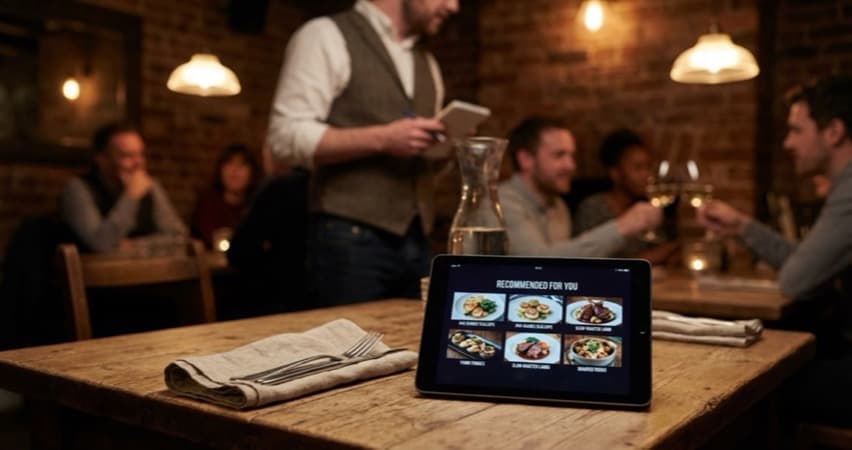
AI menu recommendations are two different jobs wearing one name. Work out which half your UK restaurant can actually run today, and what it costs to start.
AI menu recommendations cover two jobs sharing one name. One suggests dishes to your guest while they order, and needs a digital ordering screen. The other suggests changes to you, the owner, and runs on sales data your till and delivery apps already produce. Only the second is open to a restaurant with no ordering screen of its own.
The pitch rarely makes the distinction, because the demo plays better when the two are blurred. You sit through a slide about a diner being shown the perfect starter, then walk back into a forty cover dining room where the only screen is the card machine. If you have already worked through menu engineering, you have done more of the groundwork than you think.
Related: restaurant technology covers where menus, tills and ordering systems fit together.
What this page gives you:
- A one minute test for which half of the category your restaurant can use
- The item level data an operator-facing recommendation runs on, and where it already lives
- Three questions that separate a working system from a good demo
What are AI menu recommendations?
AI menu recommendations are software that reads order data and produces a suggestion about your menu. What splits the category in two is who the suggestion is aimed at, and each half needs different data and different hardware.
The guest-facing version sits on an ordering screen, reordering or highlighting items using what similar customers ordered, what is selling well tonight, or what that person bought last time. It needs a surface: an app, a self ordering kiosk, a tablet on the table, a marketplace listing. No screen, no guest-facing recommendation, and that is not a budget problem a better vendor can solve.
The operator-facing version aims the same maths at you. It reads item level sales, flags what is quietly dying, notices which two dishes cannibalise each other on Fridays, and proposes what to promote, re-cost or cut. No new hardware, because the data already exists wherever you take orders.
| Guest-facing | Operator-facing | |
|---|---|---|
| Who sees the suggestion | Your diner, mid order | You, before you print |
| What it needs | An ordering screen you own or rent | An item level sales export |
| Runs on | That guest's history, live demand | What sold, when, at what margin |
| Open to a paper menu restaurant | No | Yes |
A rough guide only. Plenty of products do a bit of both, which is why the question is worth asking out loud.
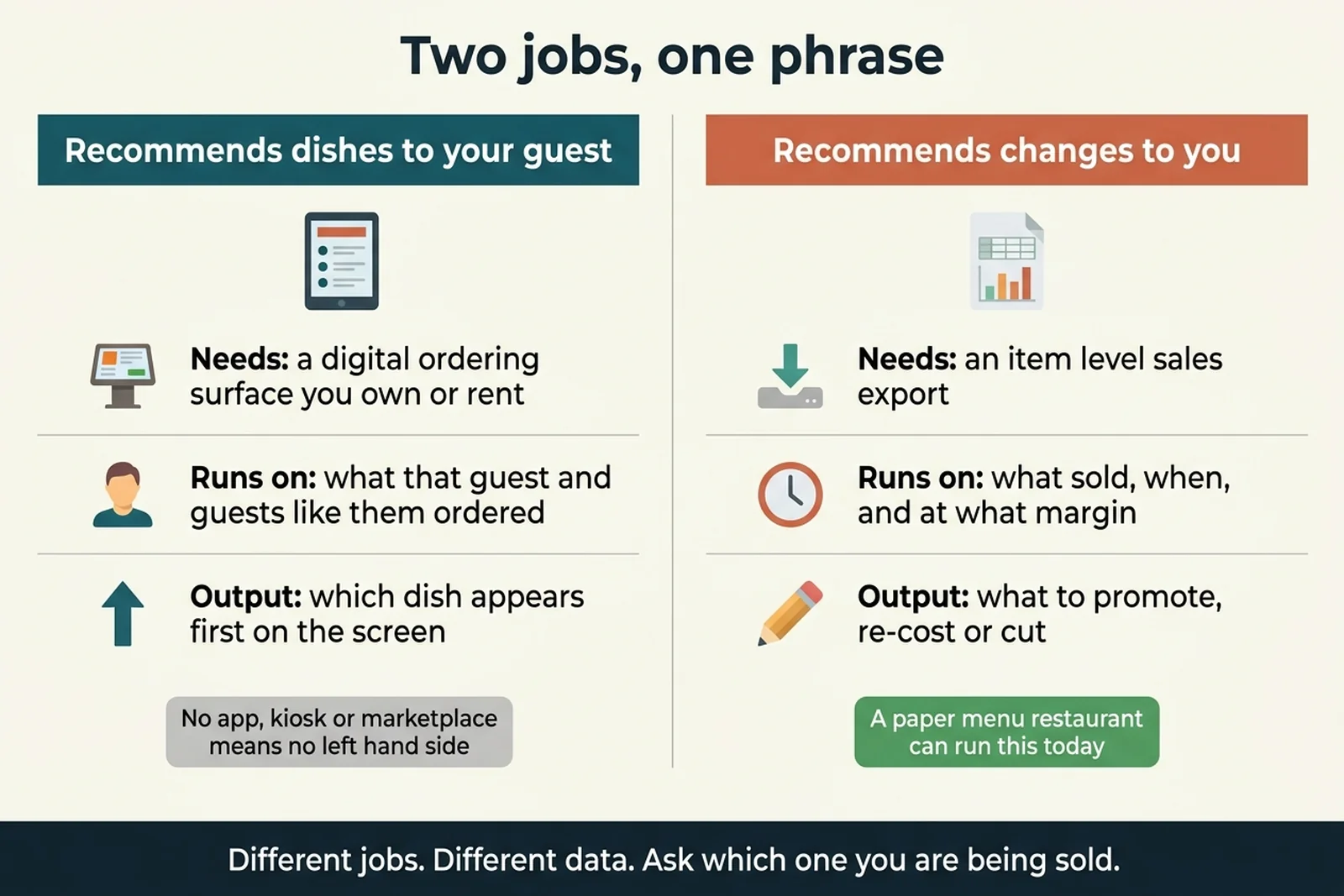
Two jobs, one phrase. The data each one needs is the fastest way to tell which you are being sold.
The line worth keeping: the recommendation you can act on is the one made to you, not the one made to your guest.
Which half can your restaurant actually run?
One question decides it: where does a customer choose a dish? A restaurant whose diners choose from paper cannot run the guest-facing half at all, while any restaurant whose till or delivery dashboard records what sold, dish by dish, can run the operator-facing half this week.
If the answer is a paper menu and a conversation with Chloe, the guest-facing engine has nowhere to live. You would be buying the screen first and the intelligence second, which is a digital menu technology decision with its own payback maths. Make it on its own merits.
If the answer includes a marketplace, a click and collect page or a kiosk, you already have a surface. One thing to know before you spend on it: the ordering screen on somebody else's marketplace is not yours. Whatever governs how dishes get surfaced there was built by the platform and tuned for the platform, and you cannot inspect it. Photographs, descriptions and availability are usually the levers you do hold. Treat a vendor promising to optimise a marketplace listing as making a claim about a black box, and ask how they will measure the result.
Why this matters: the two halves fail differently. A guest-facing tool with no screen is money spent on nothing. An operator-facing tool you cannot feed with clean item data is a monthly bill for a chart you already had.
Nearly three in ten UK businesses across all industries reported using at least one artificial intelligence technology in June 2026, up eight percentage points on the year before (Office for National Statistics). That is an all industry figure rather than a hospitality one, so read it as weather, not a deadline. Adoption being common says nothing about whether a given tool works in your dining room.
Where does the data come from if you have no app?
You already own the data. It sits wherever you take money, and the operator-facing half runs on nothing else. Nobody demos this part, because there is nothing to demo: the answer is an export.
Start with your till. On all but the most basic setups it reports item level sales, and so, in most cases, does whatever dashboard your delivery orders arrive through. Pick a date range, hit export, and you have a list of every dish you sold, when, and for how much. On most systems that costs nothing extra and sits behind a login you already have.

The operator-facing job starts with an export and a pen, not a subscription.
Then ask the questions you stopped asking. Put three months of item sales in front of a general purpose AI assistant and ask what it finds: which dishes sell only when one particular chef is on, which two rise and fall together, what the bottom fifth of the menu costs in prep and stock complexity.
Picture a neighbourhood Italian with a long menu and a tired owner. The export shows the aubergine parmigiana selling steadily every Sunday and almost never midweek, while a similar looking bake drifts along the bottom all week. The suggestion writes itself: run one of them, Sundays only, and free the prep. That needed no platform. It needed somebody to look.
Two cautions before you trust the output:
- A model reading a spreadsheet states a pattern with the same confidence whether it found a real one or a coincidence in ninety days of noise. Treat every finding as a question for your head chef, not an instruction.
- A dish the model ranks first is not a dish that sold. Ranking is a prediction; the till is the scoreboard.
Does AI handle allergens on your menu?
An allergen filter is genuinely useful, and it is not a recommendation feature at all. It sits on a compliance surface, and the responsibility stays where the law puts it.
The duty does not move. Food business operators in the retail and catering sector are required to provide allergen information and follow labelling rules as set out in food law (Food Standards Agency). That sits with the business, and no supplier's feature list shifts it. UK food law requires 14 specified allergens to be declared, although customers may of course be allergic or intolerant to other ingredients too. There is the quiet trap in an automated filter: a system built around the declarable set can present a dish as fine to somebody whose trigger was never on that list.
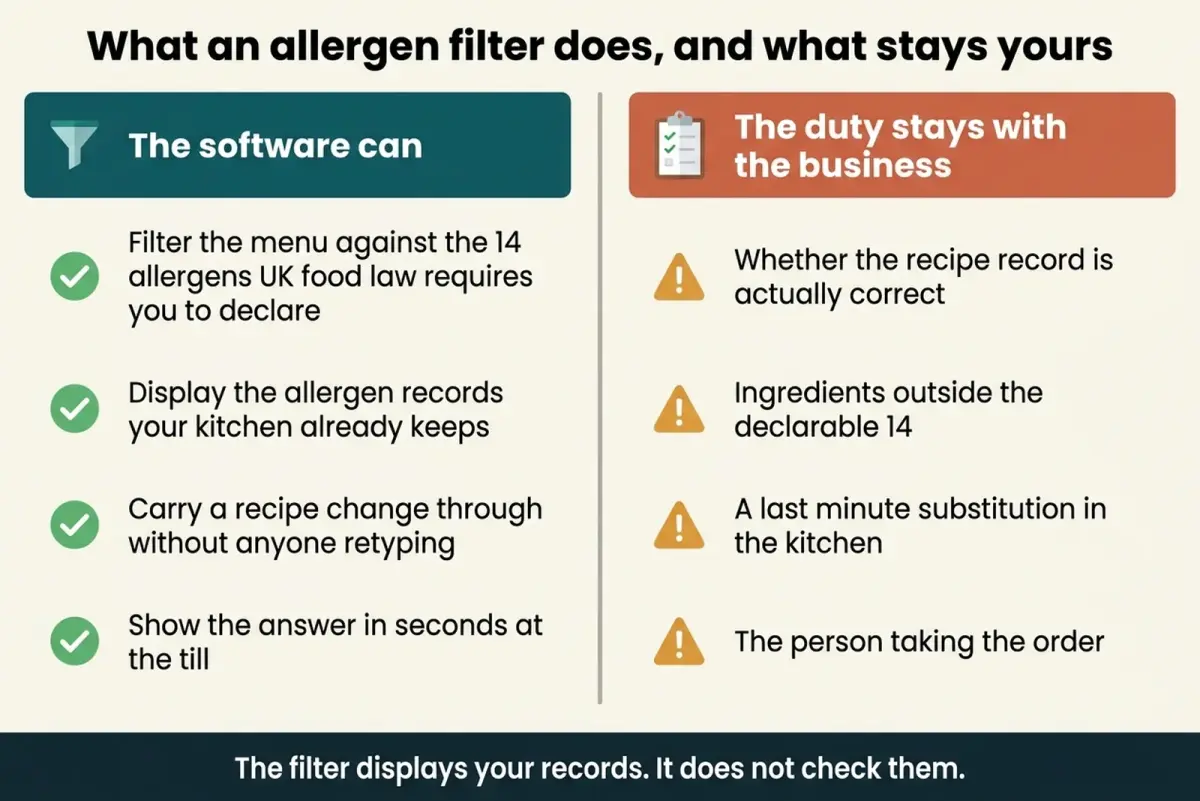
The filter displays your records. Checking them is still a job with a name on it.
The test that matters is not whether the filter works. It is what happens when a recipe changes at four on a Friday. If the answer involves anybody retyping anything, you have bought a display rather than a safety net. The information has to be right before any screen can show it, which puts the work in your recipe records and with the person taking the order. The software's whole job is making the right answer faster to reach.
What should you ask before paying for anything?
Three questions, all aimed at evidence. Ask them in this order and most pitches sort themselves out before the second coffee.
"What data do you need from me, and where does it come from already?" A guest-facing tool that cannot name your ordering surface has not thought about your restaurant. An operator-facing tool should be able to tell you which report it reads, and from which system.
"Show me the uplift figure, and tell me whose site it came from." Case studies are picked, not sampled: the deployment that went best is the one that gets written up. That number can be entirely real and still be no forecast for you. Ask for the median across their UK independents and watch what happens.
"What can I change, and what does the model decide?" You want a system where a suggestion stays a suggestion. If prices move on their own you have handed a stranger the menu pricing decisions your regulars notice fastest, and the menu psychology you spent a weekend on goes with them.
Imagine two quotes for the same forty cover bistro. One vendor asks for a sample export and comes back naming three dishes to test. The other sends a deck with a percentage on the front and a two year commitment. You have seen neither system work, but you have learned which one looked at your restaurant.
FAQ
What are AI menu recommendations?
Software that reads order data and produces a suggestion, either to a diner choosing a dish on a screen or to the owner deciding what belongs on the menu. The halves need different data and different hardware, so establish which one a product does before anything else.
Do I need a digital menu to use AI menu recommendations?
For guest-facing suggestions, yes: something has to render a personalised list, whether a kiosk, a tablet, your ordering page or a marketplace listing. Operator-facing analysis needs no digital menu, only an item level sales export from wherever you take orders.
Can AI replace allergen checks by my staff?
No. The legal duty to provide allergen information sits with the food business, and a filter only displays what your records already say. If the records are wrong, the filter is confidently wrong. Keep staff verification as the final step.
How much do AI menu tools cost in the UK?
Published price lists are rare in this space, so expect a quote built around your site count and the systems you already run. Instead of budgeting from a number you read somewhere, get two quotes for the same defined job and ask each to break out setup, monthly cost per site, and the cost of leaving.
How long before AI menu recommendations show results?
Operator-facing analysis can produce something useful from the first export, because you are reading history you already have. Guest-facing personalisation needs enough repeat orders to learn from, so it is slower to prove and a poor fit where regulars order at the pass.
Is this the same thing as menu engineering?
No, though they answer to each other. Menu engineering sorts dishes by popularity and margin and reshapes the menu around the result. Operator-facing AI is a quicker way to spot what changed since the last time you did that. The judgement about what belongs on your menu stays yours.
Start with one export this week
Key Takeaway
You do not need a decision this month. You need an hour with data you already hold, so the next pitch meets an owner who knows what their numbers say.
- Pull three months of item level sales from your till or your marketplace dashboard
- Ask an AI assistant for the five patterns it finds, then take them to your head chef
- Write down the two questions you keep wanting to ask the data, because that is your real shopping list
Repeat it monthly to begin with and adjust: stretch the gap if a second pass tells you nothing new, tighten it if your menu changes weekly. A shopping list you wrote from your own numbers is a harder thing to upsell against than a blank one.
Wider context sits in our guide to AI for restaurants, and if it is the marketing rather than the menu that keeps slipping, LocalBrandHub sends a weekly report on what is working: see what it covers.
For restaurants, salons, and local businesses
Need help with your marketing?
We help UK businesses turn social media into real results, not busywork.
Start freeSources
Get More Marketing Tips
Practical marketing tips for UK business owners, straight to your inbox. No spam, unsubscribe anytime.
About the Author
Local Brand Hub
Empowering UK Businesses
Local Brand Hub provides comprehensive business management tools designed specifically for UK local businesses to streamline operations, automate marketing, and grow revenue.
More articlesRelated Articles
 Industry Insights
AI for Restaurants: What It Does and How to Start
Learn how AI for restaurants handles bookings, cuts food waste, and automates marketing. UK-focused guide with costs, tools, and a 30-minute plan.
 Tutorials
Restaurant Tech Stack: UK Integration Guide
Build a restaurant tech stack that works together. Covers the five essential systems, integration priorities and realistic costs for UK independents.
 Tutorials
Restaurant Automation Software: Guide for UK Owners
Restaurant automation software handles inventory, scheduling and invoices without you. See which UK tools run on autopilot for independent restaurants.