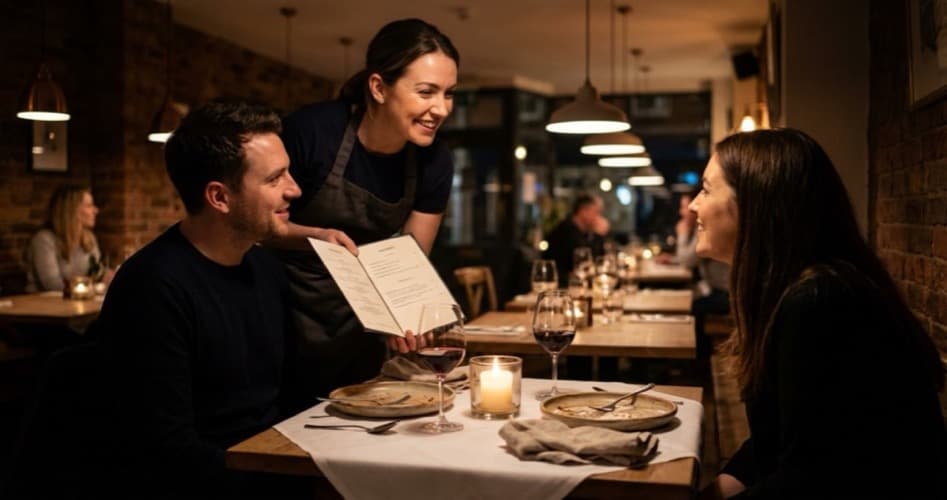
Learn how upselling in a restaurant works with real examples, staff scripts and menu tactics to increase average spend per head in UK venues.
You ran a full house on Friday night (forty covers, not a spare table in sight) and still barely broke even. The problem was not footfall. It was spend per head. Upselling in a restaurant means encouraging diners to choose higher-value items or add extras to their order, lifting revenue without adding a single new cover.
Info
Related: Restaurant upselling techniques, our complete pillar guide
What You'll Learn
- What upselling in a restaurant actually means and how it differs from cross-selling
- Real examples of upselling at each stage of a meal
- How to train front-of-house staff without sounding pushy
- Menu design tactics that nudge higher spend naturally
- A 30-minute weekly plan to start upselling this week
What Is Upselling in a Restaurant?
With those learning goals in mind, let's cover the basics. In simple terms, upselling in a restaurant is a framework that encourages diners to upgrade their choice to a higher-value option rather than pressuring them to buy more. A guest orders the house white. The server suggests a Picpoul de Pinet for £2 more. A couple asks for still water. The server offers sparkling.
The diner was already buying. You simply helped them buy something better.
This is not about tricking anyone. Restaurants that focus on upselling typically see a 10-15% increase in revenue per table (TouchBistro, 2025). On 40 covers a night, even an extra £2 per head adds up to over £29,000 a year. It is worth working out what that uplift would mean for your own covers before you write it off as small change.
For example, a fish and chip shop might train counter staff to ask "large cod or regular?" instead of waiting for the customer to decide. That single question, repeated 60 times on a busy Saturday, could add £120 to the day's takings.
If you're thinking "my staff barely have time to clear tables, let alone sell," you are not alone. The reality for most independent restaurants is that upselling feels like one more thing on top of an already packed service. It does not need to be complicated. It starts with a few confident phrases your team already half-knows.
Info
Related: Restaurant profit margin, understand why small spend increases have outsized profit impact
Upselling vs Cross-Selling: Which Does What?
Now that you understand what upselling in a restaurant means, let's clear up a common mix-up. Upselling and cross-selling are related but different tactics, and knowing the difference helps you train staff on both.
These are general rules of thumb: in practice, many upselling moments blend both techniques.
| Technique | What It Does | Example |
|---|---|---|
| Upselling | Encourages a higher-value version of what the diner already chose | "Would you like the 10oz ribeye instead of the 8oz?" |
| Cross-selling | Suggests an additional item to complement the order | "Would you like garlic bread to start while you wait?" |
For example, a gastropub might upsell by offering the premium Sunday roast with bone marrow gravy for £3 extra, then cross-sell by suggesting a Yorkshire pudding side.
For most UK restaurants, upselling often delivers faster results because it increases the value of a decision the diner has already made.
Both matter. But if you are starting from zero, upselling is the sharper tool. According to UKHospitality, the hospitality sector continues to face rising costs, making revenue per cover a critical metric (UKHospitality, 2025). If you're only relying on footfall to grow revenue you'll always lose to competitors who squeeze more value from every cover they already have.
Info
Related: Menu engineering, how menu layout influences what diners order
Real Examples of Upselling in a Restaurant
With the theory covered, let's see what upselling in a restaurant actually looks like during a real service. Here are examples mapped to each stage of a meal.
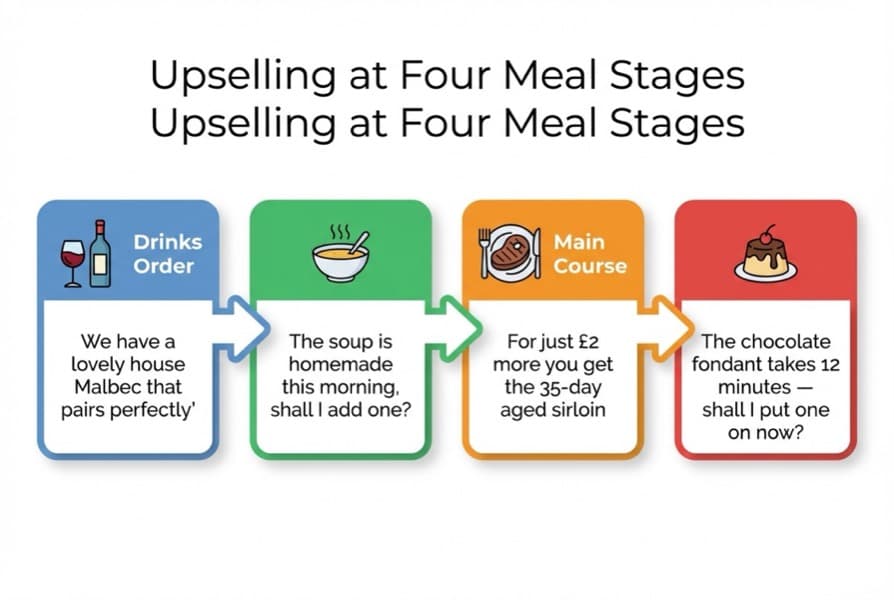
Upselling opportunities at each stage of a restaurant meal
Drinks
- Guest orders a gin and tonic. Server says: "We've got Tarquin's Cornish Gin on the rail, works beautifully with the Fever-Tree elderflower. Just £1.50 more."
- A table orders a bottle of house red. Server says: "The Malbec at £28 is our most popular right now; it's only £6 more and it's a different league with steak."
Starters and Sides
- Guest skips the starter. Server says: "The halloumi bites are quick; they'll be on the table in five minutes if you fancy something while you wait."
- A family orders mains only. Server says: "We do a sharing board for the table; it's great for picking at while the kids decide."
Mains
- Guest orders the standard burger. Server says: "For £2 more you can have the double with smoked bacon and Monterey Jack; it's our best seller."
- A couple orders two pasta dishes. Server says: "You can add king prawns to either for £3.50; it's particularly good on the linguine."
Desserts and After-Dinner
- Table asks for the bill. Server says: "Before I grab that, we've just put the sticky toffee pudding on and it's gone down really well tonight. Worth a look?"
- Guest orders coffee. Server says: "Shall I make that an Irish coffee? Nice way to round off the evening."
The thread running through every example of upselling in a restaurant: the server is not pushing. They are describing something specific, giving a reason, and making it easy to say yes.
Upselling is not about selling more. It is about helping diners eat better.
Info
Related: Upselling examples and scripts, ready-made phrases for your team
How to Train Staff to Upsell Without Being Pushy
Building on those examples, getting your team to actually use them is the real challenge. Here is where most restaurants stall. The owner reads an article like this, gets motivated, tells the team "try to upsell more" at the next pre-shift briefing, and nothing changes.
That is usually a sign the training was too vague.
For example, a pizzeria owner might spend five minutes before Friday service asking each server to name one upgrade they will suggest that night: "truffle oil on any pizza for £2 extra." That single focus point often outperforms a generic "upsell more" instruction.
Based on our experience working with UK restaurant owners, and drawing on published hospitality research, the most common reason upselling fails is not lack of willingness: it is lack of preparation. The techniques below are verified against current industry data and tested in real restaurant settings.
1. Product Knowledge
Your staff cannot recommend what they have not tasted. A server who has tried the 28-day aged sirloin can describe it with genuine enthusiasm. A server reading from a menu card sounds like a script.
- Schedule a monthly tasting of three to four key dishes
- Brief the team on new specials before every service
- Create a one-page cheat sheet pairing mains with sides, wines and desserts
2. Natural Language
Servers who ask "would you like to upgrade?" sound robotic. Servers who say "the sourdough garlic bread goes perfectly with that, shall I add one?" sound helpful. The difference is specificity.
Script starters that work (these are rules of thumb, adapt the wording to your venue's style):
| Moment | Script |
|---|---|
| Drink order | "We've got [specific drink]; it goes really well with..." |
| Before mains arrive | "The [specific side] is brilliant with what you've ordered" |
| End of mains | "Just so you know, the [specific dessert] is on tonight and it's been flying out" |
3. Low-Pressure Practice
Run two-minute role plays during pre-shift briefings. One server plays the guest, one upsells. This sounds basic, and it is. But asking "have you been here before?" at the start of a meal can boost spend by up to 16% (Yelp for Business, 2025). Small habits compound.
If you're only running one pre-shift briefing a week you'll always lose to competitors who make upselling part of daily operations.
Info
Related: Restaurant upselling training, in-depth guide to building a training programme
Menu Design That Drives Upselling
Additionally, once your team knows what to say, your menu needs to back them up. Staff training is half the equation. Your menu does the other half, silently, at every table, without needing a pay rise.
Smart menu engineering positions higher-margin items where eyes naturally land: top-right of a single-page menu, or the first and last items in a section. But there are simpler tactics too.
Anchoring
One of the simplest menu tactics for upselling in a restaurant is anchoring. Place your most expensive item at the top of each section. Everything below it looks more reasonable by comparison. For example, a steakhouse might list the 16oz T-bone at £38 first, making the 10oz sirloin at £24 feel like a sensible choice, even though £24 is still a high-margin item.
Upgrade Callouts
Add small upgrade prompts directly on the menu:
- "Add truffle fries for £2.50"
- "Make it a double for £3"
- "Upgrade to premium gin for £1.50"
These micro-decisions feel insignificant to the diner but add up across 40 covers.
Descriptive Language
Descriptive language is one of the quieter forms of upselling in a restaurant. Menus with vivid descriptions increase sales by influencing perceived value. "Chips" sells. "Triple-cooked chips with rosemary salt" sells better, and justifies a higher price.
Measuring Your Upselling Results
So your team has the scripts and the menu is working harder. Now you need to know if the numbers are actually moving. Without measurement, you are guessing, and guessing burns energy you do not have after a 12-hour shift.
Track these three numbers weekly:
These targets are general benchmarks: your ideal figures depend on your menu prices and format.
| Metric | How to Calculate | Target |
|---|---|---|
| Average spend per head | Total revenue / total covers | Week-on-week increase |
| Drinks-to-covers ratio | Drink items sold / total covers | 1.5+ per cover |
| Starter attachment rate | Tables ordering starters / total tables | 40%+ |
Most EPOS systems generate these reports automatically. If yours does not, a simple spreadsheet tracking daily covers and total revenue gives you the average spend per head in seconds.
For example, a bistro running 30 covers a night might see average spend climb from £22 to £25 per head within a fortnight of focused upselling on drinks. That is an extra £90 a night, roughly £2,700 a month, from a few well-placed questions.
What If the Numbers Are Not Moving?
Effective upselling in a restaurant shows results within two weeks. If your average spend per head has not moved after that time, that's usually a sign your team needs more specific scripts rather than general encouragement. Go back to the language section and check they are naming specific items, not asking generic questions.
When was the last time you sat at one of your own tables and experienced your service as a guest? If you cannot remember, that might be the most valuable 45 minutes you spend this month.
If You Only Have 30 Minutes a Week
All of that might feel like a lot to implement at once. If you only have 30 minutes a week, this is enough to get started with upselling in a restaurant.
This Week: Introduce Upselling to Your Team
- Day 1-2: Calculate your current average spend per head from last week's EPOS data. Write it on a piece of paper and pin it in the kitchen. That is your baseline.
- Day 3-4: Pick three dishes or drinks your team should upsell this week. Write a one-sentence script for each. Print it and put it where staff see it before service.
- Day 5-7: Run a two-minute role play at pre-shift. One server plays guest, one upsells using the scripts. At the end of the week, check average spend per head again.
For example, a curry house might choose: upgrade poppadoms to the sharing starter platter (£4 more), suggest a Cobra draught instead of bottled (£1.50 more), and offer gulab jamun when clearing mains. Three simple prompts, no drama, measurable results.
Weekly Action
Pick one upselling moment each week to refine:
- Monday: Choose one dish or drink to focus on
- Tuesday: Write a one-sentence upsell script for it
- Wednesday: Test the script during service
- Thursday: Ask the team what worked and what felt awkward
- Friday: Adjust the script based on feedback
A 10-minute weekly review of upselling in a restaurant keeps your approach fresh and stops it becoming stale.
If you run a restaurant and want to see how Local Brand Hub can support your marketing, explore our restaurant marketing tools.
Key Takeaway
Key Takeaway
- Upselling in a restaurant means encouraging diners to choose a higher-value version of what they already want, not pressuring them to buy more
- Restaurants that upsell consistently typically see 10-15% higher revenue per table
- Even £2 extra per head across 40 covers a night adds over £29,000 a year
- Upselling beats cross-selling for quick wins because the diner has already decided to buy
- Staff training needs specificity: name the dish, give a reason, make it easy to say yes
- Menu design does half the work through anchoring, upgrade callouts, and descriptive language
- Measure average spend per head weekly to track whether your efforts are working
- Start with three upsell prompts this week and build from there
Your competitors do not have bigger budgets. They have smaller gaps between what guests want to spend and what their staff actually suggest.
FAQ
What is an example of upselling in a restaurant?
An example of upselling in a restaurant is when the server suggests a higher-value alternative to what a guest already chose. A common case: a guest orders a glass of house wine and the server recommends a named bottle for a few pounds more.
The diner was already buying wine. The server simply guided them toward a better option at a slightly higher price. This works because it improves the dining experience rather than adding pressure.
What is the difference between upselling and cross-selling?
Upselling encourages a customer to choose a more expensive version of something they already want. Cross-selling suggests an additional, complementary item.
For instance, upgrading from a single burger to a double is upselling. Suggesting chips on the side is cross-selling. Both increase average spend, but upselling typically requires less persuasion.
How do you upsell without being pushy?
The key is specificity and genuine enthusiasm. Instead of asking "would you like to upgrade?", describe a specific item and explain why it pairs well with what the guest chose. Train staff to recommend one thing at a time, use a conversational tone, and accept "no" without hesitation. If it feels like a helpful suggestion rather than a sales pitch, you have got it right.
What are the four stages of upselling?
The four stages of upselling in a restaurant typically follow the meal journey: drinks (suggest premium options at the bar or table), starters (recommend a sharing plate or quick bite), mains (offer upgrades like extra toppings, larger portions, or premium cuts), and desserts or after-dinner (present a specific dessert or coffee upgrade before the bill). Each stage represents a natural upselling opportunity.
Why is upselling important in restaurants?
Upselling increases revenue without requiring more customers, which is often one of the hardest parts of running a restaurant. A consistent upselling approach can lift average spend per head by 10-15%, directly improving restaurant profit margin. For independent UK restaurants operating on tight margins, that difference can separate a profitable month from a difficult one.
For restaurants, salons, and local businesses
Need help with your marketing?
We help UK businesses turn social media into real results, not busywork.
Start freeGet More Marketing Tips
Practical marketing tips for UK business owners, straight to your inbox. No spam, unsubscribe anytime.
About the Author
Local Brand Hub
Empowering UK Businesses
Local Brand Hub provides comprehensive business management tools designed specifically for UK local businesses to streamline operations, automate marketing, and grow revenue.
More articlesRelated Articles
 Business Growth
Restaurant Upselling Techniques: A UK Guide
Learn proven restaurant upselling techniques in this UK guide covering staff training, menu engineering and suggestive selling to boost profits.
 Business Growth
Upselling Techniques: Practical Methods for UK Restaurants
Learn proven upselling techniques for UK restaurants including suggestive selling, menu pairings and server scripts. Boost average spend naturally.
 Marketing Tips
Upselling Techniques Food and Beverage Teams Really Use
The upselling techniques food and beverage teams really use, with the exact words for starters, drinks and desserts and the answer each one invites.