Ready-to-use upselling script phrases your UK team can practise tonight. Covers starters, mains, desserts and drinks with real phrasing.
You're clearing tables after a 12-hour shift and the till report lands at £18.40 per head. An upselling examples restaurant script is a set of ready-made phrases your team use to suggest higher-value items naturally during service. UK restaurants using this approach often see spend per head rise noticeably.
What You'll Learn
- What separates a good upselling script from a pushy one
- Ready-to-use script phrases for starters, mains, desserts and drinks
- How to adapt each script for your venue type
- A 30-minute weekly routine for practising scripts with your team
It is not your team's fault. Without a proper upselling script to fall back on, most service staff take the safe route and say nothing. That gap between knowing they should upsell and actually having the words? That is what this guide fixes.
Info
Related: restaurant upselling techniques, our complete hub guide for boosting spend per head
The script phrases below are starting points your team can personalise, practise and make their own. Pick three that fit your menu, run through them before tonight's service, and watch what happens.
What Makes a Good Upselling Script
First, let's cover what makes a script work rather than backfire. After working with hospitality teams across the UK, we found that servers who practise scripts before each shift use them far more often than those who simply read them. Two minutes of role-play beats twenty minutes of theory.
The framework rests on three core principles. Every effective upselling script follows them:
| Principle | What It Means | Example |
|---|---|---|
| Specific | Names the actual dish, not a category | "Our halloumi fries" not "a starter" |
| Personal | Includes the server's opinion or context | "I had it on my break and it was brilliant" |
| Timed | Matches the natural flow of the meal | Suggest starters before mains, not after |
Upselling isn't about selling. It's about being the friend who knows the menu.
For example, a gastropub might train staff with this script: "The pie today is steak and ale: the kitchen made extra pastry and it's genuinely one of the best batches" rather than "Would you like to add a starter?" The first version feels like insider knowledge. The second feels like a checkbox.
If you're thinking "my team would never say that," you are not alone. Most restaurant upselling training fails because it teaches concepts instead of giving people actual words. That is exactly what the script phrases below fix.
Scripts backed by data
Staff given specific scripts tend to outperform those given general instructions. The key is making your script feel personal rather than corporate.
Starter and Appetiser Scripts
With those principles covered, here is your script for starters. This is the highest-leverage moment because most diners skip starters unless specifically prompted by service staff.
When the table has ordered drinks but hasn't mentioned starters:
"While you're choosing mains, our chef's made a fresh batch of the garlic prawns today. They're gone by eight most nights. Want me to bring a couple of portions to share while you decide?"
When a couple is deliberating over the menu:
"If you're stuck between two mains, a nice way to try both flavours is to share a starter. The bruschetta is light enough that it won't spoil your appetite."
When a group of four or more arrives:
"For tables your size, a sharing board works really well. You get a bit of everything and it gives the kitchen time to prep your mains. Shall I add one?"
When the table has ordered basic starters and an upgrade exists:
"Great choice on the soup. Just so you know, for an extra £2 you can have the lobster bisque version: same base but with chunks of lobster. Most people who try it say it's their favourite thing on the menu."
For instance, a casual Italian might adapt this script to: "Our antipasti board feeds three to four people easily and it's a great way to try the burrata before it sells out." The key is specificity: name the dish, mention scarcity, give a reason.
Info
Related: suggestive selling techniques for restaurants, more frameworks for natural upselling
Main Course Upgrade Scripts
Building on those starter phrases, here is the script for mains. The question isn't whether to upsell mains; it's whether your team has the words to do it naturally.
When someone orders a standard option and a premium alternative exists:
"The chicken is lovely, great choice. Our free-range chicken supreme is only £3 more and it comes with the truffle mash instead of chips. It's honestly the dish I recommend most."
When a diner seems undecided between two dishes:
"If you're torn, the sea bass is what our chef would pick tonight. It came in fresh this morning from Cornwall and he's done something new with the sauce."
When someone orders a dish that pairs well with a side:
"That steak is brilliant on its own, but the bone marrow butter on the side takes it to another level. It's £3.50 and most tables order it once they see it go past."
When a diner asks for a recommendation:
"Honestly? The lamb shank. It's been slow-cooked for eight hours and it falls off the bone. It's one of those dishes people come back specifically for."
For example, a steakhouse might adapt this script to: "The 8oz ribeye is great. If you want to treat yourself, the 10oz is only £4 more and you get the peppercorn sauce included." Each script includes a reason to upgrade, not just a price difference.
If you're only giving one vague instruction you'll always lose to competitors who give their team a specific script for each dish on the menu.
Dessert and After-Dinner Scripts
Furthermore, dessert is where most restaurants lose the plot entirely. The table has finished mains, plates are being cleared, and the server asks "any desserts?" in a tone that practically begs them to say no. These script phrases bring energy back to the final course.
When clearing main course plates:
"Before I take these away, save any room? Our sticky toffee pudding is made fresh today and it's big enough to share if you just want a few spoonfuls each."
When the table says they're too full:
"Completely understand. Our affogato is literally just a shot of espresso over vanilla ice cream. It's more of a coffee than a dessert, really. Perfect if you want something sweet without being heavy."
When the table has children:
"The kids' sundae is £3.95 and it keeps them happy for a good fifteen minutes while you finish your drinks. Shall I bring a couple?"
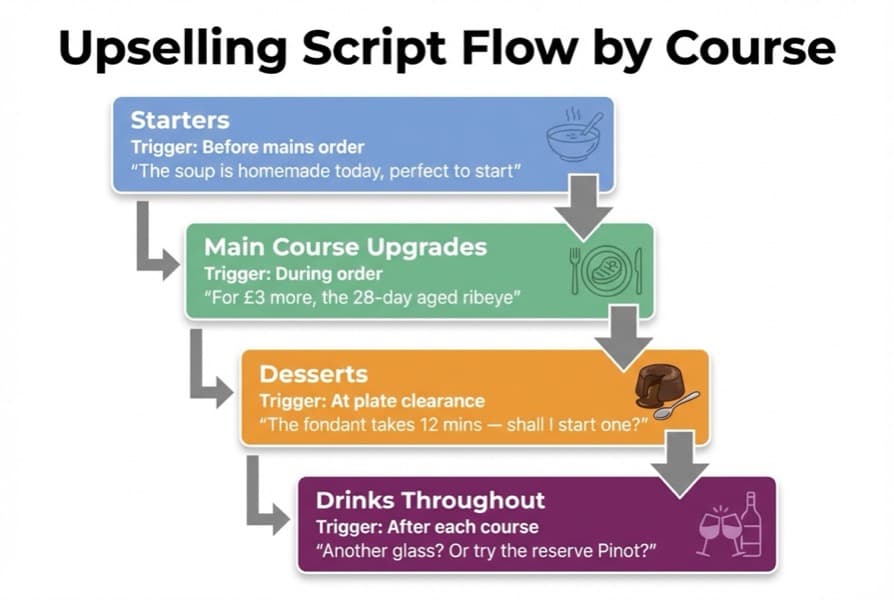
Upselling script flow diagram showing when to suggest starters, mains, desserts and drinks during a meal
When the table seems like they want to linger:
"If you're not in a rush, the cheese board is lovely with a glass of port. It's a nice way to wind down the evening."
If you're reading this after a 12-hour shift thinking "I just need my team to say something other than 'any desserts?'", that single change is worth starting with. A neighbourhood bistro might notice dessert uptake climb noticeably simply by giving staff a specific script for puddings. That's usually a sign your team lacks the right words, not the right intention.
Drinks and Beverage Upselling Scripts
Additionally, drinks are often the simplest upselling opportunity because they accompany every course and carry some of the highest margins. Beverage upselling accounts for a significant share of incremental revenue in UK restaurants. A well-timed script for drinks can add £5-15 per head.
When someone orders a house wine:
"The house white is really nice. If you fancy something a step up, the Picpoul de Pinet is only £2 more a glass and it's perfect with seafood. It's been our most popular white this month."
When the table hasn't ordered drinks with food:
"Can I suggest a bottle for the table? With two steaks and a fish, a medium-bodied red like the Malbec works across all three. It works out cheaper than ordering by the glass."
When someone orders a spirit with a basic mixer:
"We've got a craft tonic from Fever-Tree that works beautifully with that gin. It's 50p more but it really brings out the botanicals."
When the meal is winding down:
"Shall I bring the coffee menu over? Our espresso martini is a great halfway point if you're not ready to leave but don't want another full drink."
For instance, a cocktail bar might adapt this script: "That Negroni is a classic. If you've not tried our barrel-aged version, it's got a smoky depth that's completely different, worth trying at least once." If you're only training staff on cocktail recipes you'll always lose to competitors who also give their team a script for beverage upgrades.
Info
Related: restaurant special offers, how to structure promotions that complement your upselling script
How to Adapt Scripts for Your Restaurant
Now that you have the full set of phrases, here is how to turn a generic script into something your team will actually use. Every restaurant is different, which is why copying scripts word-for-word is a starting point rather than a destination.
Step 1: Audit your menu for upgrade pairs. Go through every section and identify where a higher-margin alternative exists. Steak sizes, wine tiers, premium sides and dessert add-ons are the obvious starting points. Having your menu and offers laid out in one place makes those pairs easy to spot.
Step 2: Write the "because" for each upgrade. Customers need a reason beyond price. Freshness ("it came in this morning"), popularity ("it's our most ordered dish"), chef's preference ("the kitchen team fights over this one") and scarcity ("we only make twelve portions a day") all work in an effective script. Remember that allergen regulations require servers to know ingredients; that same product knowledge powers great upselling.
Step 3: Match scripts to your team's personality. A fine-dining server and a casual pub bartender need different wording for the same concept. Let your team rewrite each script in their own voice. They will use them more if the words feel natural.
Step 4: Test and rotate. Try three script phrases for a week, track which ones get used, and replace the ones that feel forced. Your restaurant staff training sessions should include a ten-minute script review.
For example, a seafood restaurant adapted our starter script from "sharing board" to "seafood platter for two at £18" and saw starter uptake rise noticeably within a fortnight. The script worked because it matched their menu and their team's tone.
Script Adaptation Checklist
- Identified top 5 upgrade pairs on your menu
- Written a "because" reason for each upgrade
- Personalised script phrases for your restaurant's tone
- Shared the script with your team before service
- Practised each script in a two-minute role-play
- Tracked which phrases your team used during the shift
- Replaced any scripts that felt unnatural after one week
Ask yourself: if a customer overheard your server using one of these phrases, would it sound like a genuine recommendation or a sales tactic?
If You Only Have 30 Minutes a Week
This sounds great in theory. In practice, when you're down two staff and the quiet Wednesday night still needs covering, training feels like a luxury. Here is the minimum viable approach to getting your script into the team's routine.
If you only have 30 minutes a week, do this:
- Day 1-2 (10 minutes): Pick three phrases from this guide: one for starters, one for mains, one for desserts. Print them or write them on the staff noticeboard
- Day 3-4 (10 minutes): Before service, pair up two team members and have them role-play each script twice. One plays server, one plays customer. Switch roles
- Day 5-7 (10 minutes): After the weekend shift, ask each server which script they used and what response they got. Keep what works, swap out what doesn't
For instance, a family-run Indian restaurant introduced just two scripts, a starter sharing platter prompt and a premium lager upgrade, and saw a noticeable lift in takings per busy evening within the first week. That is the power of a focused upselling script.
Three scripts, three sessions, thirty minutes total. If you're only relying on "anything else?" you'll always lose to competitors who equip their team with a tested script.
Key Takeaway
If you run a restaurant and want to see how Local Brand Hub can support your marketing, explore our restaurant marketing tools.
Key Takeaway
Here's the thing nobody tells you about upselling: it isn't about talent. It's about preparation. A team with three practised script phrases will outsell a naturally gifted server with no structure every single time.
- A good script is specific (name the dish), personal (include a reason) and timed (match the course flow)
- Starter scripts work best when they mention scarcity or sharing: most diners skip starters unless prompted
- Main course upgrades need a "because": the price difference alone rarely works
- Dessert upselling fails when servers ask "any desserts?" without energy or a specific script
- Drinks carry the highest margins and the lowest friction: always suggest a specific upgrade
- Adapt your script to your team's personality; forced wording gets abandoned within a week
- Three practised scripts beat twenty untested ones
FAQ
What is an example of upselling in a restaurant?
An example of upselling in a restaurant is when a server says "The house white is lovely, but the Sancerre is only £3 more a glass and it pairs beautifully with your fish" instead of simply taking the order. An effective script always sounds like a recommendation: specific product, clear reason, natural tone.
What are the best upselling phrases?
The most effective upselling phrases tend to be specific, personal and timely. Phrases like "our chef recommends," "it's been our most popular dish this week," "most tables add the" and "for just £X more you get" often perform well across UK restaurants. The key is naming the actual item rather than asking generic questions. Pair each phrase with a reason: freshness, popularity or the server's personal recommendation.
What are good examples of upselling?
Good upselling examples include: suggesting a premium spirit with a craft mixer instead of a house pour, recommending a sharing starter board before the table orders mains, describing a specific dessert vividly during plate clearance, and proposing a bottle of wine instead of individual glasses. Each script works because it matches a specific moment in the meal with a specific, higher-value suggestion. See our guide to suggestive selling techniques for restaurants for more frameworks.
How do you train restaurant staff to upsell without being pushy?
The most effective approach is giving staff a script with exact phrases to practise rather than general instructions to "upsell more." Start with three scripts, role-play them before service, and let each server adapt the wording to their natural style. Staff feel pushy when they lack the right words, not because upselling itself is aggressive. Our restaurant upselling training guide covers the full training process.
How much can upselling increase restaurant revenue?
Restaurants that implement a structured upselling script often see average spend per head increase, depending on venue type and menu structure. Even modest improvements, adding a £3 side to one in four tables, compound across a full week of service. The return comes not from any single script but from consistent application across every shift.
Pick three phrases from your script, run through them with the team before tonight's service, and track the results for one week. The difference between a quiet table and an extra £15 on the bill often comes down to twelve well-chosen words. For more ways to grow your restaurant, explore our full restaurant marketing hub.
For restaurants, salons, and local businesses
Need help with your marketing?
We help UK businesses turn social media into real results, not busywork.
Start freeGet More Marketing Tips
Practical marketing tips for UK business owners, straight to your inbox. No spam, unsubscribe anytime.
About the Author
Local Brand Hub
Empowering UK Businesses
Local Brand Hub provides comprehensive business management tools designed specifically for UK local businesses to streamline operations, automate marketing, and grow revenue.
More articlesRelated Articles
 Tutorials
Restaurant Upselling Training: Build a Team That Sells
Practical restaurant upselling training guide for UK owners. Covers role-play exercises, the four stages of upselling, proven scripts and results.
 Marketing Tips
Upselling Techniques Food and Beverage Teams Really Use
The upselling techniques food and beverage teams really use, with the exact words for starters, drinks and desserts and the answer each one invites.
 Business Growth
Restaurant Upselling Techniques: A UK Guide
Learn proven restaurant upselling techniques in this UK guide covering staff training, menu engineering and suggestive selling to boost profits.