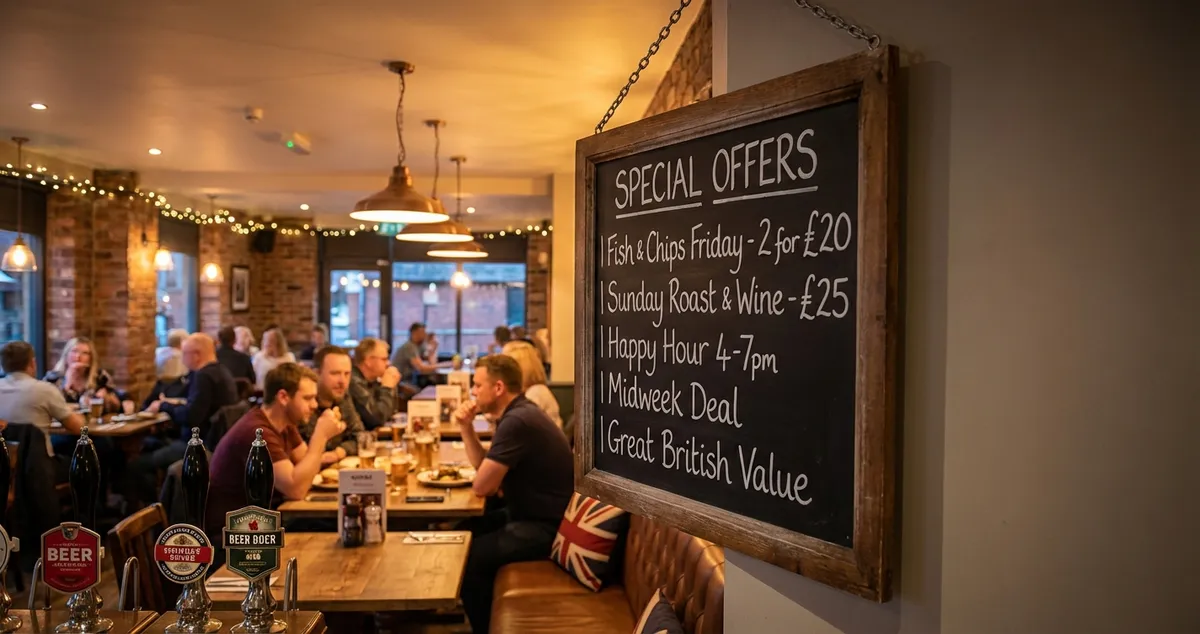
Watch the visual overview· 113 seconds
Restaurant special offers that boost bookings without killing margins. Midweek deals, loyalty schemes, vouchers, and seasonal promotions that work.
Restaurant special offers are promotions, discounts, and deals that UK restaurants use to attract customers during slow periods, build loyalty, and boost revenue without slashing prices. The most effective offers fill empty tables while keeping margins healthy and turning first-time visitors into regulars.
Short on time? Here's the quick version
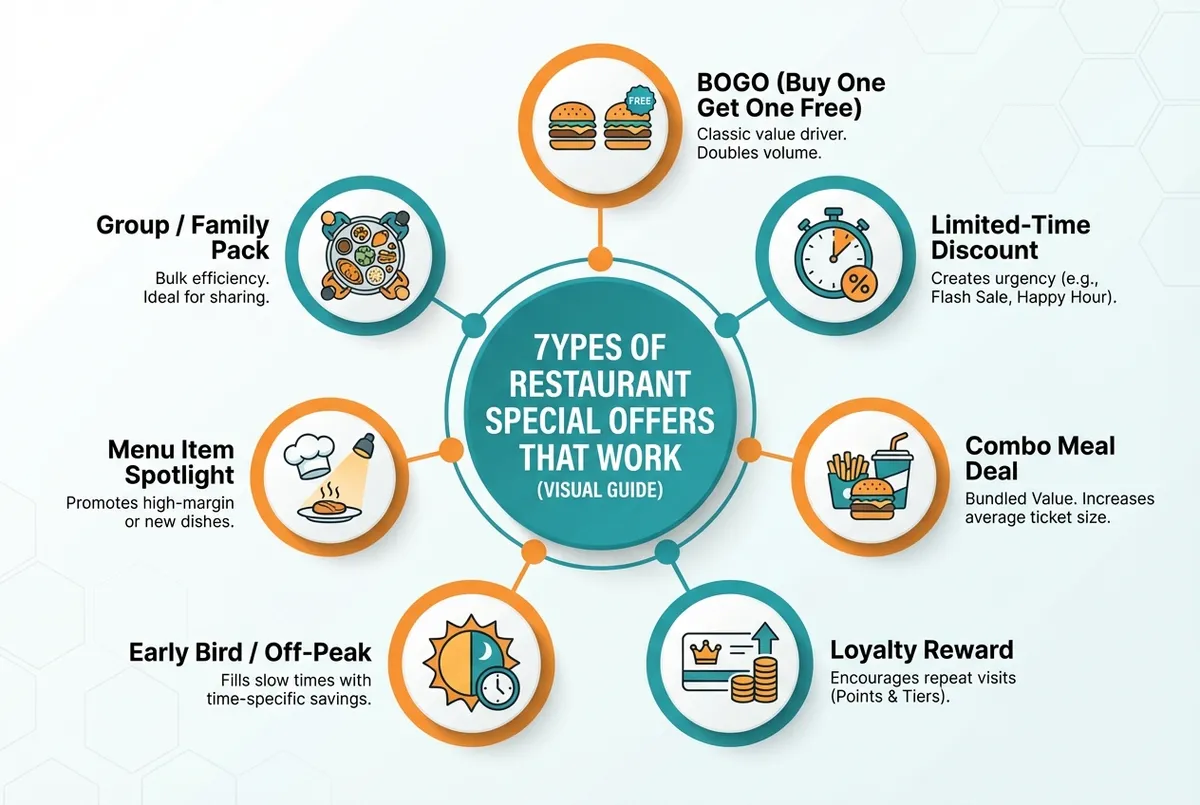
- 7 offer types: Midweek deals, discounts, promotions, happy hour, vouchers, loyalty programmes, seasonal offers
- Break-even formula: Discount % ÷ (Gross margin - Discount %) = Required volume increase
- Best approach: Match offers to quiet periods, not busy times
- Key mistake: Training customers to wait for deals by discounting too often
- Start simple: One well-executed offer beats five confusing promotions
Full guide with calculations and examples below
These include midweek set menus, loyalty programmes, happy hour deals, and seasonal promotions like Valentine's Day packages.
You're staring at empty tables on a Tuesday night. The fixed costs don't care that it's quiet. Meanwhile, the chain down the road has a queue, and their food isn't even better than yours. What are they doing differently with their restaurant special offers?
The difference? They've mastered restaurant special offers. Not desperate discounting that trains customers to never pay full price, but strategic promotions that fill seats during slow periods and turn first-timers into regulars.
This guide covers every type of restaurant offer that actually works in the UK market, from midweek deals to loyalty programmes.
What You'll Learn
- The psychology behind offers that attract customers without devaluing your brand
- Seven types of restaurant promotions and when to use each one
- How to calculate whether a deal actually makes you money
- Real examples from UK restaurants that got it right
- Common mistakes that turn promotions into profit killers
Related: Restaurant Marketing Ideas
Why Restaurant Special Offers Matter More Than Ever
So you've got the basics down: you know offers exist. But here's where it gets interesting.
UK restaurants run on thin margins. Net profit is typically just 3-9% according to UKHospitality. Every empty seat costs you money. Rent, rates, and wages don't stop when tables sit empty.
Strategic special offers solve this by:
- Filling off-peak capacity that would otherwise generate nothing
- Acquiring new customers at a lower cost than advertising
- Increasing average spend through upselling alongside deals
- Building loyalty that translates to full-price visits later
The key word is strategic. A 50% discount that fills your restaurant with bargain hunters who never return isn't a promotion: it's a donation.
Info
If you're thinking "I've tried offers and they just attracted cheapskates," you're not alone. That's usually a sign the offer structure needs work, not that promotions don't work.
Types of Restaurant Special Offers That Work
Now let's look at the specific offer types that UK restaurants use successfully.
Why this matters
Each offer type serves a different goal. Midweek deals fill quiet periods. Loyalty programmes boost visit frequency. Seasonal offers capture planned spending. Using the wrong type wastes money.
For example, a city centre bistro might use midweek set menus to fill Tuesday nights, while a neighbourhood pub focuses on a loyalty card to keep locals coming back weekly.
1. Midweek Restaurant Deals
Tuesday to Thursday are the quiet days. Most UK restaurants struggle to fill tables midweek. Midweek deals target these slots. They offer real value without hurting your weekend trade.
What works:
- Fixed-price menus (e.g., "Two courses for £22, Tuesday-Thursday")
- Kids eat free on specific nights
- Early bird discounts (before 6pm)
What doesn't:
- Generic "20% off everything" that reduces all revenue equally
- Offers so complicated customers need a flowchart
A gastropub using midweek deals might offer "Steak Night Tuesday: 8oz ribeye, chips, and a glass of house wine for £18" rather than discounting their entire menu.
Related: Restaurant Midweek Offers
2. Restaurant Discount Ideas
Not all discounts work the same. The best ones create urgency. They target specific groups. They drive the actions you want.
Effective discount structures:
- Percentage off for specific groups (NHS, students, over-60s)
- Monetary thresholds ("Spend £50, get £10 off your next visit")
- Time-limited flash deals via social media
Warning
The margin reality: A 20% discount requires roughly 25% more covers to maintain the same gross profit. Factor this into every promotion.
Related: Restaurant Discount Ideas
3. Restaurant Promotion Ideas
Promotions go beyond simple discounts. They create experiences, events, or packages that add perceived value without necessarily reducing prices.
High-value promotions:
- Wine pairing evenings with a fixed price
- Chef's table experiences
- Seasonal tasting menus
- Collaboration events with local producers
These work because they offer something customers can't replicate at home, rather than just making existing offerings cheaper.
Related: Restaurant Promotion Ideas
4. Happy Hour and Pre-Theatre Deals
Happy hour still works. When done right, it fills seats before dinner rush. Pre-theatre menus work the same way. They catch people who might skip dining out otherwise.
Structure that works:
- Clear time boundaries (5pm-7pm, not "whenever it's quiet")
- Focused menu rather than everything discounted
- Upsell opportunities (premium spirits at a smaller markup)
Pro tip
If you only have 30 minutes a week for promotions, start here. A well-structured happy hour requires minimal ongoing management once established.
Related: Restaurant Happy Hour Ideas
5. Restaurant Voucher Ideas
Vouchers are clever. You get full price today. The discount comes on a future visit. Gift cards and "come back" vouchers work especially well.
Voucher strategies:
- "Bounce back" vouchers given with bills (£10 off your next visit over £40)
- Gift vouchers sold at face value but redeemed alongside full-price spending
- Birthday vouchers that drive incremental visits
The psychology works because customers view vouchers as "found money" rather than a price reduction.
Related: Restaurant Voucher Ideas
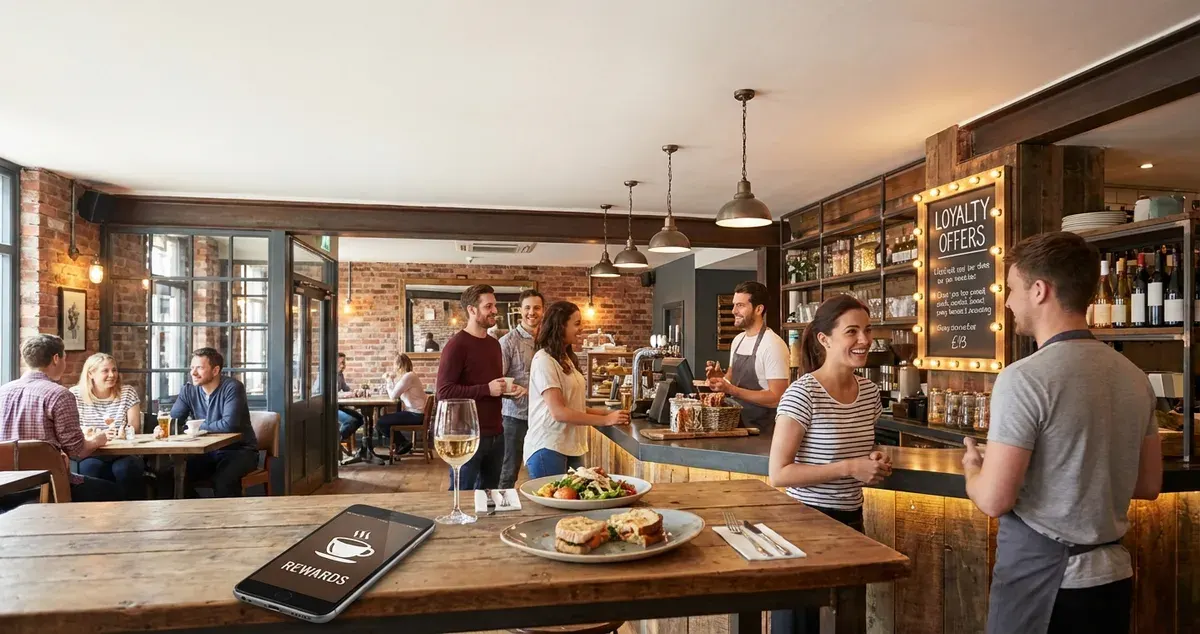
6. Restaurant Loyalty Offers
Loyalty programmes reward regulars. They also give you useful customer data. Keep them simple. Make the rewards feel worth it.
What customers actually want:
- Points they can easily track
- Rewards that feel achievable (not "visit 50 times for a free coffee")
- Recognition beyond just discounts
A neighbourhood bistro might offer "Every 6th main course free" rather than a complex points system nobody understands.
Related: Restaurant Loyalty Offers
7. Seasonal Restaurant Promotions
Valentine's Day, Mother's Day, Christmas: seasonal promotions capture spend that customers have already allocated. The question isn't whether to offer them, but how to stand out.
Seasonal success factors:
- Book early promotions (guarantee tables for regulars)
- Themed menus that create Instagram moments
- Packages that simplify decision-making
Info
The mistake is treating seasonal promotions as discounting opportunities. These are premium occasions: your offer should add value, not reduce price.
Related: Restaurant Seasonal Promotions
How to Calculate If Your Offer Actually Makes Money
If you're reading this after losing money on a promotion that seemed like a good idea, you're not alone. Here's how to avoid that next time.
Warning
Before launching any promotion, ask yourself: would I run this offer if I knew it would cost me money? Then do the maths to find out.
Break-even analysis:
| Metric | Formula |
|---|---|
| Current gross margin | (Revenue - Food cost) ÷ Revenue |
| Required volume increase | Discount % ÷ (Gross margin - Discount %) |
Example: If your gross margin is 65% and you offer 20% off:
- Required volume increase = 20% ÷ (65% - 20%) = 44%
- You need 44% more covers just to break even
This doesn't mean discounts are wrong: it means you need to know the numbers. A 10% discount with a 25% volume increase genuinely adds profit. Once you know an offer works, it pays to build and manage it in one place rather than across scattered spreadsheets: that's exactly what offer management tools are for.
Deal of the Day: Making Daily Specials Work
Restaurant deal of the day promotions drive urgency and reduce food waste when structured around ingredient availability.
Effective daily deal structures:
- Chef's choice menu using surplus ingredients
- Social media-only flash deals
- Lunchtime specials that don't compete with dinner service
The key is variation and genuine scarcity. "Deal of the day" loses power when it's the same deal every day.
Related: Restaurant Deal of the Day
Common Mistakes That Kill Promotion Profitability
That's the theory. Here's where restaurants get it wrong.
Training customers to wait for deals: If you always discount, customers learn to never pay full price. Vary your offers and maintain clear boundaries.
Warning
If you're posting discounts more than twice a week, you'll lose to competitors who treat special offers as special, not standard.
Ignoring operational impact: A busy Monday might sound great until your skeleton crew can't handle it. Ensure promotions align with staffing capacity.
Forgetting the upsell: The best promotions include natural upsell opportunities. "Two courses for £20" should be designed so customers naturally want that £8 dessert.
No measurement: If you can't track redemptions, new vs returning customers, and actual profitability, you're guessing. Most EPOS systems can segment this data.
Competing with yourself: Running a Tuesday deal and a Wednesday deal and a loyalty programme and seasonal offers confuses customers. You end up competing with yourself.
Copying chains blindly: A chain can afford to lose money on a promotion to gain market share. You can't. What works for Nando's probably won't work for your 40-cover bistro.
Real example
A neighbourhood Italian restaurant tried running "50% off pizza" every Monday, plus a Tuesday pasta deal, plus a loyalty card. Customers just waited for whichever deal was best. Full-price bookings dropped 30% within two months.
Quick Promotion Health Check
Before launching your next offer, run through this checklist:
- I've calculated the break-even volume increase needed
- The offer targets a genuinely quiet period (not busy times)
- Staff are briefed and can explain the offer clearly
- There's a clear upsell opportunity built in
- I can track redemptions in my EPOS system
- The offer has a defined end date
- It doesn't conflict with other active promotions
What Works for Different Restaurant Types
| Restaurant Type | Best Offer Types | Avoid |
|---|---|---|
| Fine dining | Wine pairing, chef's table, seasonal tasting | Deep discounts (devalues brand) |
| Casual dining | Midweek deals, loyalty programmes, kids eat free | Complicated multi-buy offers |
| Pubs | Happy hour, Sunday lunch specials, quiz nights | Offers that compete with wet sales |
| Fast casual | Lunch deals, app-based loyalty, meal bundles | Anything requiring table service |
Key Takeaways
If you run a restaurant and want to see how Local Brand Hub can support your marketing, explore our restaurant marketing tools.
Key Takeaways
Restaurant special offers work when they're strategic, measurable, and aligned with your actual business goals, not just a panic response to empty tables.
- Match offers to your quiet periods rather than discounting when you'd fill anyway
- Calculate the break-even before launching any promotion
- Create value through experiences, not just price reductions
- Track everything so you know what actually works
- Start with one offer and execute it well before adding complexity
Weekly Action
This week, launch your first strategic offer
- Identify your quietest 4-hour window this week using till data
- Design one simple offer for that specific slot (e.g., "Set menu Tuesday 5-7pm")
- Calculate the break-even volume using the formula above
- Promote it through one channel (email list, social media, or table talkers)
For UK restaurant owners
Fill More Seats, Protect Your Margins
LocalBrandHub works with UK restaurants to develop promotion strategies that fill seats without destroying margins.
Start freeGet More Marketing Tips
Practical marketing tips for UK business owners, straight to your inbox. No spam, unsubscribe anytime.
About the Author
Local Brand Hub
Empowering UK Businesses
Local Brand Hub provides comprehensive business management tools designed specifically for UK local businesses to streamline operations, automate marketing, and grow revenue.
More articlesRelated Articles
 Marketing Tips
Restaurant Deal of the Day That Drives Covers Daily
Learn how to run restaurant deal of the day promotions that create urgency and reduce waste. Proven daily special strategies for UK restaurants.
 Marketing Tips
Restaurant Happy Hour Ideas That Fill Quiet Afternoon Slots
Fill quiet afternoon slots with profitable happy hour ideas for restaurants. Covers drink deals, food pairings, timing, and UK licensing rules.
 Marketing Tips
Restaurant Loyalty Offers That Keep Customers Coming Back
Create restaurant loyalty offers that reward regulars and capture valuable data. From stamp cards to digital programmes for UK restaurants that work.