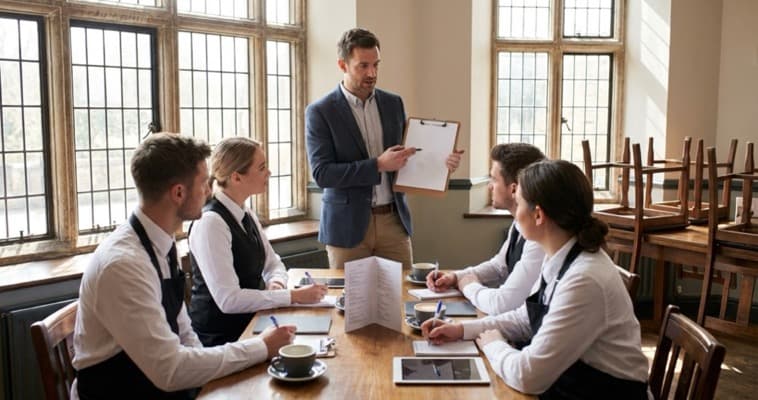
Practical restaurant upselling training guide for UK owners. Covers role-play exercises, the four stages of upselling, proven scripts and results.
You've spent weeks telling your team to suggest starters and desserts. They nod, smile, and carry on exactly as before. Effective restaurant upselling training gives front-of-house staff a structured programme for recommending higher-value items confidently, lifting average spend per cover without pressuring guests.
What You'll Learn
- The four stages of restaurant upselling and how to train each one
- Five suggestive selling techniques that work in UK restaurants
- A role-play framework your team can practise in 15 minutes
- How to measure whether your upselling training is delivering results
- A 30-minute weekly plan for time-pressed owners
What Are the Four Stages of Upselling?
Before teaching specific phrases, your restaurant upselling training needs a framework. The four stages of upselling are a structured approach that moves from understanding the guest to closing the suggestion naturally. The stages are: reading the guest, making a relevant recommendation, handling hesitation, and confirming the choice.
Each stage builds on the last. Skipping any one is where most upselling attempts fall apart.
Stage 1: Read the guest. Train your staff to observe before speaking. A couple celebrating an anniversary responds differently to suggestions than a parent managing two tired children. Body language, ordering pace, and questions all signal receptiveness.
Stage 2: Recommend with relevance. The suggestion must connect to what the guest already chose. If someone orders steak, recommending a red wine pairing feels helpful. Recommending the seafood platter feels pushy.
For example, a gastropub server who notices a guest ordering the pie might say: "That comes with standard chips, but our triple-cooked chips with rosemary salt are brilliant with it, just £1.50 extra."
Stage 3: Handle hesitation. If the guest pauses, your team should not push harder. A simple "no worries at all" preserves the experience. Train staff to read hesitation as a signal to back off, not double down.
Stage 4: Confirm the choice. When a guest accepts, confirm naturally: "Great choice. I'll add those for you." This reinforces that they made a good decision rather than feeling sold to.
Info
Without a framework, servers either avoid suggesting anything (lost revenue) or push too hard (damaged experience). The four stages give your team a structure that feels natural rather than scripted.
Five Suggestive Selling Techniques for Restaurants
Now that your team understands the four stages, they need specific techniques to practise. The five suggestive selling techniques for restaurants are: personal recommendations, descriptive language, strategic timing, bundling, and the premium pivot.
These techniques are general industry best practices. Results vary by restaurant type, price point, and staff experience.
Techniques at a Glance
| Technique | When to Use | Example Script |
|---|---|---|
| Personal recommendation | Guest asks "what's good?" | "I'd go with the lamb; the kitchen's nailing it" |
| Descriptive language | Presenting specials | "Slow-braised eight hours with red wine jus" |
| Strategic timing | After mains, before clearing | "Sticky toffee is made fresh. Can I get the menu?" |
| Bundling | Drinks ordering | "A bottle is £28, cheaper than three glasses" |
| Premium pivot | Guest chooses a base option | "Extra £2 for hand-cut chips with truffle oil" |
Personal Recommendations Work Best
A bistro server using the personal recommendation technique might say: "I had the duck confit for staff lunch and honestly it is the best thing on the menu this week." That is restaurant upselling training in action: genuine enthusiasm, not a sales script.
Based on our experience working with UK restaurant owners, the personal recommendation tends to be the most effective because it feels like real advice. Train servers to pick a genuine favourite each shift and explain why in their own words.
Restaurant Upselling Training Methods Compared
However, techniques are only useful if your team actually practises them. If you're reading this thinking "I barely have time to run service, let alone train staff," you are not alone. The hospitality sector has one of the highest staff turnover rates in the UK, and many restaurant managers blame inadequate training for those numbers. Restaurant upselling training that sticks requires the right method.
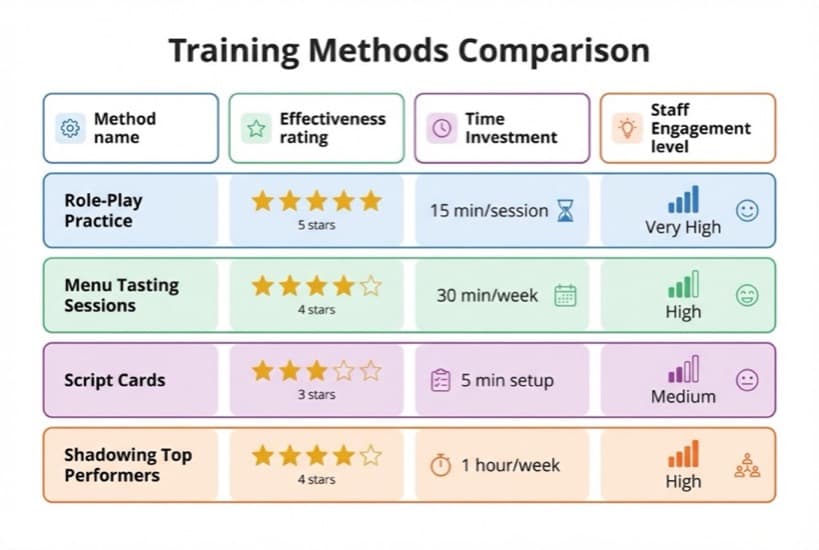
Comparing restaurant upselling training methods by effectiveness and time investment
Effectiveness ratings below are based on general industry observations and may vary by team size and experience.
Methods Compared
| Training Method | Time Needed | Typical Effectiveness | Best For |
|---|---|---|---|
| Pre-shift briefings | 10-15 min daily | High for reinforcement | Keeping skills fresh |
| Role-play sessions | 30-45 min weekly | Strong for building skill | New techniques, new starters |
| Shadowing experienced staff | 2-3 shifts | High for practical learning | Onboarding new members |
| Menu tasting sessions | 1-2 hours monthly | Medium-high for product knowledge | Building genuine recommendations |
Research shows that the most effective approach combines two or three methods. Role-play builds the skill. Pre-shift briefings reinforce it. If you can only do one, prioritise role-play: it builds both confidence and muscle memory.
Many hospitality employers actively invest in staff development as part of their retention strategy. Restaurant upselling training is not just a revenue tool. It is a retention tool too.
Role-Play Exercises Your Team Can Run This Week
With that foundation in place, here's where it gets practical. Role-play sessions that simulate real dining scenarios help staff experiment with phrasing and receive immediate feedback. Here are three exercises you can run in under 15 minutes before service.
Exercise 1: The Reluctant Guest. One person plays a guest who has already decided and seems uninterested. The server practises reading cues and choosing whether to suggest or let it go. This builds the skill of knowing when not to upsell.
Exercise 2: The Curious Guest. One person asks "what do you recommend?" The server gives a genuine personal recommendation using descriptive language, not a memorised script. Rotate menu items each session.
Exercise 3: The Premium Pivot. One person orders a base item. The server offers an upgrade with a specific reason and price. The group discusses which phrasing felt natural and which felt forced.
For example, a curry house might run exercise three with their tikka masala: "Would you like standard naan or our garlic and coriander naan? It's freshly made and goes really well with the tikka, just 80p more."
Film Your Role-Plays
Film one role-play per month on a phone. Watching yourself back is uncomfortable but enormously effective. Your team will self-correct faster than any feedback session.
If you're thinking "my team will laugh at role-play," they probably will the first time. That is fine. The laughter breaks tension. By the third session, they take it seriously because they feel the difference during live service.
The reality for most independent restaurants is that formal training feels like a luxury. But 15 minutes before a quiet Wednesday night service costs you nothing and builds habits that last.
Measuring Your Restaurant Upselling Training Results
Now that your team is practising, how do you know the restaurant upselling training is actually working? Track these four metrics weekly using your EPOS system:
- Average spend per cover: The primary indicator. Compare week-on-week after restaurant upselling training starts
- Dessert attachment rate: What percentage of tables order dessert? A trained team often lifts this noticeably
- Drinks per head: Are guests ordering an extra drink or upgrading to premium options?
- Side order uptake: How often are sides, starters, or add-ons ordered alongside mains?
If average spend per cover increases by even 10%, the programme is paying for itself. For a restaurant doing 80 covers a night at £25 average, a 10% lift means an extra £200 per night, over £6,000 per month. It is worth running the numbers for your own venue to see what a similar lift would add to your bottom line.
Drinks are often the biggest opportunity. Restaurants typically achieve around 70-80% profit margins on alcoholic beverages, making beverage upselling one of the highest-return areas for restaurant upselling training.
If your numbers are not shifting after a fortnight, that's usually a sign the team is not using the techniques during live service. Go back to pre-shift briefings and ask each server what they plan to upsell that evening.
Common Restaurant Upselling Training Mistakes
Additionally, even restaurants that invest in upselling training can get stuck. Here are the mistakes that undermine results, and how to fix them.
Mistake 1: Scripts without context. Handing staff a laminated card of phrases does not work. They need to understand the four stages and choose the right technique for each moment. Scripts without judgement sound robotic.
Mistake 2: Training once and forgetting. A single session fades within a fortnight. If you're only running restaurant upselling training during onboarding you'll always lose to competitors who reinforce it weekly.
Mistake 3: No menu knowledge. Your team cannot recommend what they have not tasted. This sounds great in theory. In practice, when you're down two staff on a Friday night, tastings feel impossible. Start small: one dish per pre-shift briefing.
Mistake 4: Ignoring the data. Without tracking spend per cover, you are guessing. Pull EPOS data weekly and share results with the team. When they see numbers improving, motivation follows.
Upselling Training Checklist
- Run a 10-minute pre-shift briefing with one upsell focus per service
- Schedule a 30-minute role-play session once a week
- Ensure every server has tasted key dishes and can describe them naturally
- Track average spend per cover weekly using your EPOS system
- Set a team target (e.g., 20% dessert attachment rate) and share progress
- Pair new starters with your strongest upseller for their first three shifts
- Refresh upselling scripts monthly so they stay natural
Would you follow your own team's upselling advice? Sit at a table in your own restaurant this week and experience the service as a guest. If nobody suggests a thing, you have your next priority.
If You Only Have 30 Minutes a Week
Finally, here is how to start restaurant upselling training without carving out a full day.
Info
This week, launch your upselling training programme:
- Day 1-2: Pull your EPOS data and note your current average spend per cover. This is your baseline. Write it on the staff noticeboard.
- Day 3-4: Choose one dish or drink to focus on. Brief your team for 5 minutes before service: "Tonight, if someone orders X, suggest Y and here's why."
- Day 5-7: Run a 15-minute role-play before a quieter service. Use the Reluctant Guest exercise. Note what felt natural and what felt forced.
For example, a seafood restaurant might pick their house white as the focus item and train servers to recommend it alongside any fish dish: "This Picpoul goes perfectly with the sea bass: it cuts through the butter sauce."
Weekly Action
Each week, add one new element to your restaurant upselling training:
- Week 2: Add a second focus item and check whether average spend per cover has shifted
- Week 3: Introduce the Premium Pivot exercise during pre-shift briefings
- Week 4: Review EPOS data with the full team and celebrate any uplift
Small, consistent steps beat a single training day that everyone forgets by Wednesday.
Your staff do not need a sales course. They need five phrases and the confidence to use them.
If you run a restaurant and want to see how Local Brand Hub can support your marketing, explore our restaurant marketing tools.
Key Takeaway
Key Takeaway
- The four stages of upselling (read, recommend, handle hesitation, confirm) give your team a framework rather than a rigid script
- Five suggestive selling techniques cover every moment during service, from drinks ordering to dessert
- Role-play is often the most effective training method: 15 minutes before service builds more skill than a full-day workshop
- Track average spend per cover weekly: a 10% uplift on a £25 average across 80 covers adds over £6,000 monthly
- Beverages offer the highest return on restaurant upselling training due to typically high margins
- Ongoing training wins: pre-shift briefings and weekly role-play keep techniques sharp between formal sessions
- Pair new starters with strong upsellers during first shifts to embed habits before they settle into patterns
Ask yourself: if you sat down as a guest in your own restaurant tonight, would the server suggest anything beyond what you ordered? If the answer is no, start this week: pick one dish, brief your team before service, and track the numbers. That is all it takes to begin.
For more strategies to increase revenue and build a stronger operation, explore our restaurant upselling techniques hub.
FAQ
What are the four stages of upselling?
The four stages of upselling are:
- Reading the guest (observing cues and receptiveness)
- Making a relevant recommendation (connecting the suggestion to their order)
- Handling hesitation (backing off gracefully if the guest is unsure)
- Confirming the choice (reinforcing their decision positively)
Training each stage separately before combining them in role-play produces the strongest results.
What are the 5 suggestive selling techniques for restaurants?
The five suggestive selling techniques for restaurants are:
- Personal recommendations: sharing a genuine favourite
- Descriptive language: using sensory words to present dishes
- Strategic timing: choosing the right moment to suggest
- Bundling: combining items at a better value
- Premium pivot: offering an upgrade for a small extra cost
Each technique works best at a different point during service.
How long does restaurant upselling training take to show results?
Most restaurants see measurable changes within two to four weeks of consistent training. The key word is consistent. A single session rarely shifts behaviour permanently.
Pre-shift briefings five days a week combined with a weekly role-play session typically produce a noticeable lift in average spend per cover within the first fortnight.
What are the three C's in a restaurant?
The three C's in a restaurant context are often described as:
- Cuisine: quality of food and menu
- Customer service: front-of-house experience
- Cleanliness: hygiene and presentation
Restaurant upselling training sits within the customer service pillar: it enhances the guest experience when done well, and damages it when done poorly.
How do I train new staff to upsell when turnover is high?
With UK hospitality turnover persistently high, this is a common challenge. Build upselling into your onboarding from day one rather than treating it as an add-on.
- Pair every new starter with your strongest upseller for their first three shifts
- Keep materials simple: a one-page guide with five phrases and the four-stage framework
- Even if someone leaves within 90 days, they contributed to higher revenue while they were with you
For restaurants, salons, and local businesses
Need help with your marketing?
We help UK businesses turn social media into real results, not busywork.
Start freeGet More Marketing Tips
Practical marketing tips for UK business owners, straight to your inbox. No spam, unsubscribe anytime.
About the Author
Local Brand Hub
Empowering UK Businesses
Local Brand Hub provides comprehensive business management tools designed specifically for UK local businesses to streamline operations, automate marketing, and grow revenue.
More articlesRelated Articles
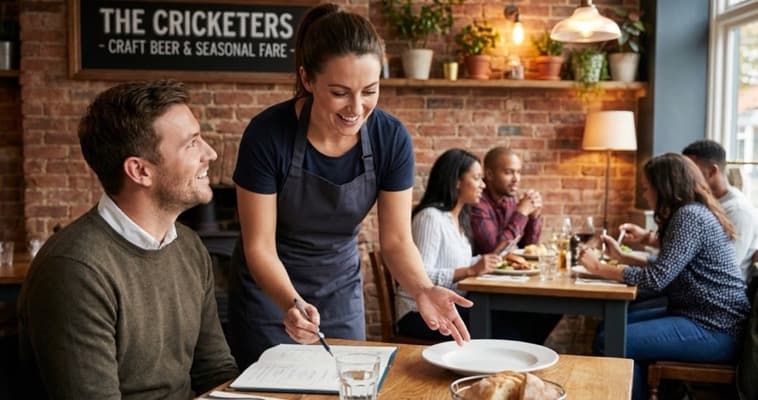 Tutorials
Restaurant Upselling Scripts: Real Examples to Copy
Ready-to-use upselling script phrases your UK team can practise tonight. Covers starters, mains, desserts and drinks with real phrasing.
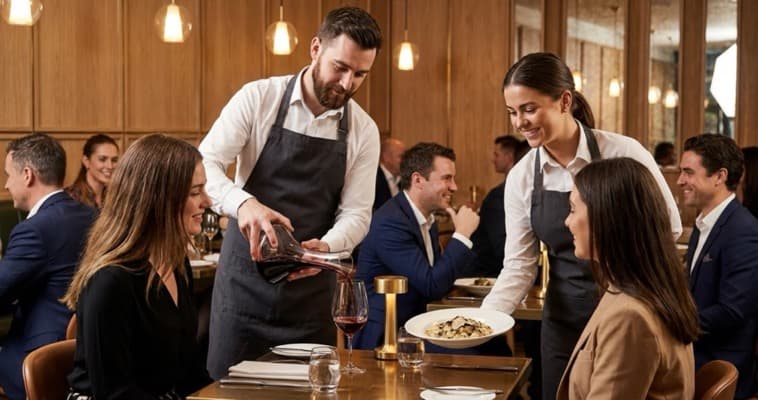 Marketing Tips
Upselling Techniques Food and Beverage Teams Really Use
The upselling techniques food and beverage teams really use, with the exact words for starters, drinks and desserts and the answer each one invites.
 Business Growth
Restaurant Upselling Techniques: A UK Guide
Learn proven restaurant upselling techniques in this UK guide covering staff training, menu engineering and suggestive selling to boost profits.