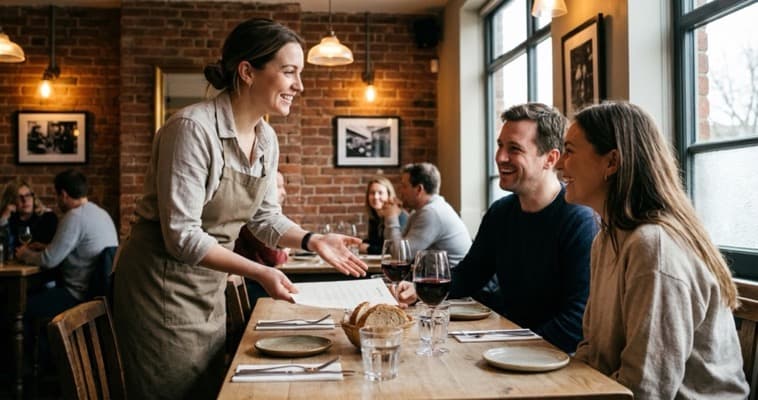
Watch the visual overview· 90 seconds
Learn proven restaurant upselling techniques in this UK guide covering staff training, menu engineering and suggestive selling to boost profits.
You have just closed after a 12-hour shift, and the till report looks identical to last month. Covers are fine but average spend is flat. Restaurant upselling techniques are the structured methods staff use to guide guests toward higher-value orders (add-ons, premium drinks and desserts) without feeling pushy.
What You'll Learn
- What restaurant upselling techniques actually are and why they matter for UK operators
- Five core suggestive selling techniques your servers should know
- How to train your team to upsell naturally without alienating guests
- Menu engineering tactics that nudge customers toward higher-margin items
- Digital upselling strategies for online ordering and kiosks
- A realistic 30-minute weekly plan to start increasing your average spend
What Are Restaurant Upselling Techniques?
First, let's get the definition right. Restaurant upselling techniques are a framework that helps front-of-house staff encourage guests to spend more per visit through thoughtful recommendations: upgrading a dish, adding a side, or choosing a premium drink. The goal is not to pressure people. It is to enhance the dining experience while increasing your revenue.
The upselling versus cross-selling distinction is a framework that helps you choose the right approach for each guest:
- Upselling moves a guest to a higher-value version of what they already want: a large glass of wine instead of a small, or the 10oz sirloin instead of the 8oz
- Cross-selling adds something new to the order: a starter before the main, or a dessert to finish
Both fall under restaurant upselling techniques.
For example, a gastropub server might say: "the house Malbec is lovely, but the Argentinian reserve is exceptional and only £3 more." That is upselling. A server who says "the sticky toffee pudding pairs beautifully with that steak" is cross-selling. Both boost your average spend per head.
Info
Related: Restaurant Menu Pricing: our guide to setting prices that protect your margins
Why Upselling Matters More Than Ever for UK Restaurants
With that foundation in place, let's look at why restaurant upselling techniques matter right now more than ever. The numbers have shifted against you.
Average restaurant profit margins in the UK typically sit between 3% and 6%. With rising costs on multiple fronts, those margins are under real pressure:
- Employer National Insurance contributions increasing
- Minimum wage rises
- Ingredient costs climbing
You cannot always raise menu prices: customers notice, and competitors undercut you.
Restaurant upselling techniques offer a different path. Instead of charging more for the same meal, you help guests choose to spend more by genuinely improving their experience.
Restaurants with structured upselling programmes often see a meaningful lift in overall revenue. When guests order an entree, starter, and an alcoholic drink, their total bill is typically much higher than a main course alone. That is not a marketing gimmick. That is the difference between breaking even and having a good month. To see what even a modest lift in average spend could mean for your venue, run the numbers with a quick calculator.
If you're thinking "my customers know what they want and they don't need suggestions", that is rarely true. Based on our experience working with UK restaurant operators, most diners appreciate guidance from someone who genuinely knows the menu.
The reality for most independent restaurants is that staff default to taking orders rather than enhancing them.
Info
Related: Restaurant Profit Margin: understand your numbers before optimising them
The 5 Suggestive Selling Techniques for Restaurants
Now that the business case is clear, here are the five core suggestive selling techniques for restaurants your front-of-house team should master.
The golden rule
Suggest, do not sell. A confident recommendation feels like hospitality. A scripted pitch feels like a telemarketer interrupted dinner.
1. The Specific Recommendation
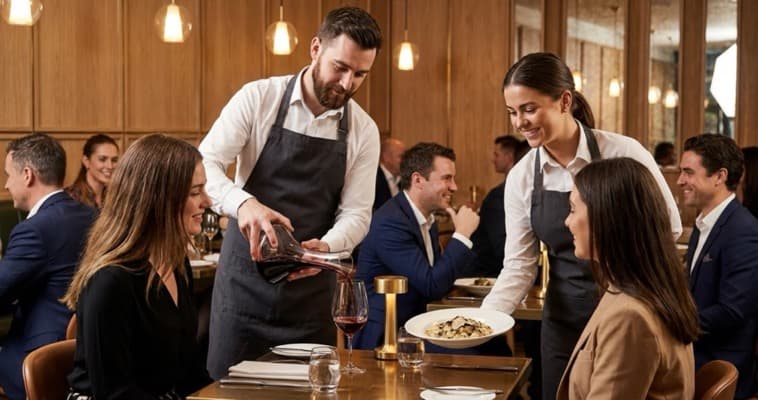
This is typically one of the highest-impact restaurant upselling techniques. Instead of asking "would you like a drink?" suggest something specific: "We've got a really good Picpoul on the wine list that goes perfectly with the sea bass." Specificity signals expertise and gives the guest a reason to say yes.
2. The Premium Upgrade
When a guest orders, offer the next level up. "Great choice, would you like the large or the regular? The large is only £2 more and it's a proper portion." This works especially well with wines, steaks, and sharing plates.
3. The Descriptive Add-On
Paint a picture of what they are missing. "The halloumi fries are hand-cut and served with a harissa yoghurt. They're probably our most popular starter if you fancy something while you wait." Descriptive language sells better than a flat "any starters?"
4. The Pairing Suggestion
Connect items that naturally complement each other. "The lamb shank comes with a red wine jus: if you're having that, the Rioja is a beautiful match." Pairing suggestions feel helpful rather than salesy because they improve the meal.
5. The Dessert Nudge
Timing matters here. Mention desserts when clearing mains, not when handing over the bill. "Before I grab the dessert menu, the chocolate fondant takes 12 minutes, so it's worth deciding now if you're tempted." Creating gentle urgency works better than a generic "room for dessert?"
For example, a neighbourhood Italian might train servers to combine restaurant upselling techniques across the meal:
- Recommend a specific Aperol Spritz on arrival (technique 1)
- Suggest upgrading the margherita to a burrata pizza (technique 2)
- Describe the tiramisu in vivid detail while clearing plates (techniques 3 and 5)
A three-technique approach across the meal can lift the average bill significantly.
Uplift estimates below are approximate and vary by venue, price point and execution.
| Technique | When | Script Example |
|---|---|---|
| Specific recommendation | Drinks | "The Sauvignon is crisp with fish" |
| Premium upgrade | Mains | "Go for the large, £2 more" |
| Descriptive add-on | Starters | "Korean wings: crispy, sticky glaze" |
| Pairing suggestion | Mains | "Malbec pairs beautifully with ribeye" |
| Dessert nudge | Clearing | "Fondant takes 12 min, decide now" |
For most UK restaurants, the specific recommendation (technique 1) and the descriptive add-on (technique 3) often offer the strongest returns because they work regardless of cuisine or price point.
Info
Related: Upselling Examples and Scripts: ready-to-use scripts your team can practise tonight
How to Train Your Staff to Upsell Naturally
Now you have the restaurant upselling techniques. But techniques only work if your team actually uses them. That is where restaurant upselling training makes or breaks the whole strategy.
Start with Menu Knowledge
Your staff cannot recommend what they do not know. Regular tasting sessions, even 15 minutes before a shift, build genuine enthusiasm. When a server has actually tasted the sticky toffee pudding, their recommendation sounds authentic because it is.
Have your kitchen prepare new or high-margin items for pre-shift tastings and encourage each team member to pick a personal favourite they can describe elaborately to guests.
For instance, a Thai restaurant might have the head chef prepare the panang curry for tasting before a Friday shift. When a server can say "I had the panang myself earlier. The peanut sauce is incredible" that is genuine restaurant upselling, not a sales pitch.
Use Role-Play, Not Lectures
Nobody retains a 20-minute upselling lecture. Instead, pair servers up and have them practise real scenarios: one plays the guest, one plays the server. Run through drinks orders, starter suggestions, and dessert nudges. Make it quick, make it fun, and do it weekly.
Quick training tip
Record the best role-play examples on a shared phone. New starters can watch these before their first shift to learn the restaurant's upselling style immediately.
Reward Results, Not Pressure
Track average spend per server, not individual upsells. If a server's average table spend is consistently higher, recognise it. Some UK restaurants run friendly competitions: highest average spend of the week wins a small bonus or a bottle of wine. This encourages consistent effort without turning service into a hard sell.
Suggestive selling can lead to a significant increase in annual tips for service staff. That is a powerful motivator: frame restaurant upselling as something that benefits your team directly.
If you're only running one training session a year you'll always lose to competitors who make upselling part of weekly service culture. Consistency beats intensity.
Info
Related: Restaurant Staff Training: build a team that sells without being told to
Menu Engineering for Upselling
Building on staff training, let's look at your menu, a silent restaurant upselling tool. The way items are positioned, described, and priced directly influences what guests order, often without any server involvement at all.
The Star-Plough-Puzzle-Dog Framework
Categorise every dish by popularity and profitability:
- Stars: Popular and profitable. Promote these heavily.
- Plough horses: Popular but low margin. Consider repricing or repositioning.
- Puzzles: Profitable but not popular. These need better descriptions or placement.
- Dogs: Neither popular nor profitable. Replace or remove.
A curry house using this framework might discover that their chicken tikka masala (plough horse) brings people in but barely covers costs, while the lamb rogan josh (puzzle) has excellent margins but nobody orders it.
The fix: position the rogan josh as a "chef's recommendation" and train servers to suggest it.
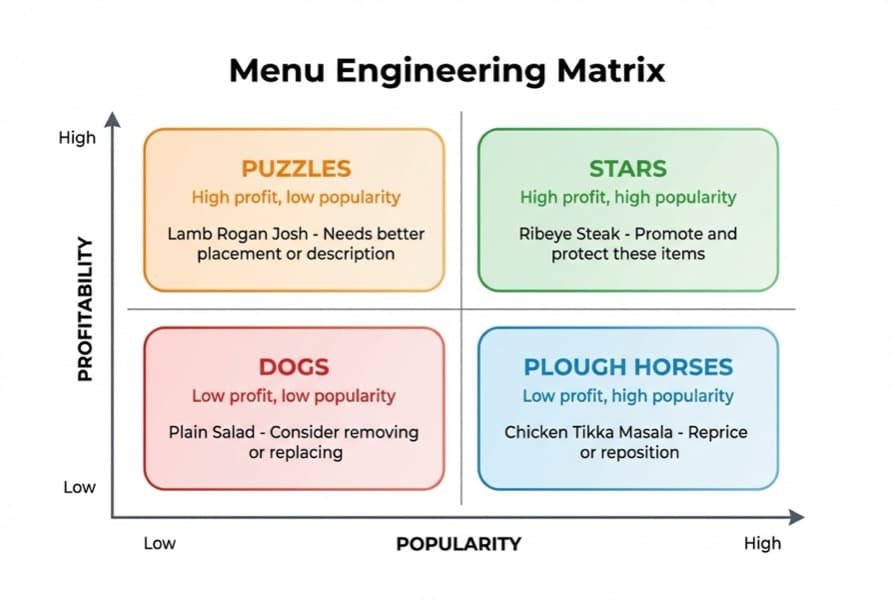
The star-plough-puzzle-dog framework helps you categorise every dish by popularity and profitability.
Strategic Menu Design
Where you place items on the menu matters. Research consistently shows that the top-right corner of a two-panel menu gets the most attention. Place your highest-margin items there. Use boxes, borders, or "chef's pick" labels to draw the eye.
Remove pound signs from prices: "Ribeye steak 28.50" feels less transactional than "Ribeye steak £28.50." And use descriptive language: "slow-braised Herefordshire beef cheek with root vegetable mash and red wine jus" typically outsells "beef cheek with mash and gravy."
For instance, a bistro might redesign its menu to place the high-margin sea bass in the top-right corner with a "chef's favourite" tag. That single change can shift orders toward higher-margin dishes without any server intervention, a key restaurant upselling technique.
Info
Related: Menu Engineering: the complete guide to designing menus that sell
Pricing Psychology
Anchor pricing is one of the subtlest restaurant upselling techniques. It works well for upselling in a restaurant. Place a premium item at the top of a category to make the mid-range option look reasonable by comparison. A wine list that starts at £45 makes the £28 bottle feel like a sensible choice, even though it is your highest-margin option.
Digital and Technology-Driven Upselling
Consequently, what about orders that never involve a server? Digital ordering now accounts for a growing share of UK restaurant revenue.
Technology-driven restaurant upselling techniques can deliver results around the clock, no staffing required.
Online Ordering Prompts
Online ordering is where automated restaurant upselling techniques shine. Restaurants that promote add-ons during digital checkout often see basket sizes increase.
The key is well-timed prompts:
- "Add garlic bread for £3.50?"
- "Upgrade to a large for £1.50 more?"
These digital restaurant upselling techniques work because customers have more time to browse without social pressure.
Self-Order Kiosks
Kiosks are among the most effective automated restaurant upselling techniques, particularly for quick-service venues. Restaurants using kiosks often see average checks climb. Kiosks never forget to suggest a drink. They never feel awkward asking about dessert. And they display images that trigger impulse purchases.
Digital Menu Boards
Dynamic digital boards are another powerful form of restaurant upselling. They allow you to feature different items at different times of day: breakfast add-ons in the morning, lunch meal deals at midday, and premium dinner options in the evening, all automatically.
Results below are typical industry ranges and vary by restaurant type and implementation.
| Upselling Channel | Often Suited For | Typical Investment |
|---|---|---|
| Staff training | Full-service restaurants | Low (time only) |
| Menu engineering | Most restaurant types | Low to medium |
| Online order prompts | Delivery and takeaway | Medium |
| Self-order kiosks | QSR and fast casual | Higher upfront |
| Digital menu boards | Counter-service venues | Medium |
For most independent UK restaurants, staff training combined with menu engineering often offers the best return because the investment is minimal and the impact is immediate.
Info
Related: Upselling Techniques in Food and Beverage: strategies across the full F&B spectrum
Common Upselling Mistakes to Avoid
However, even well-chosen restaurant upselling techniques can fail when applied badly. Here are the five pitfalls to avoid:
- Pushing too hard: one suggestion per course is enough
- Being vague: "anything else?" is not upselling
- Ignoring the mood: read the room before pitching
- Wrong items: match recommendations to what the guest already ordered
- Neglecting training: one session a year is not enough
Pushing too hard. If a guest says no to a starter, do not circle back. Persistent upselling feels like pressure, and pressure kills repeat visits.
Being vague. "Would you like anything else?" is a yes-or-no question that gets a no. Specificity is the difference between suggestive selling techniques for restaurants and generic order-taking.
Ignoring the table's mood. A couple on a quiet date does not want the same energetic pitch as a birthday group of eight. Read the room.
For instance, a fine dining restaurant might find that enthusiastic upselling during a quiet anniversary dinner backfires, while the same energy works brilliantly for a large Friday birthday group.
Upselling the wrong items. Recommending your most expensive dish regardless of what the guest ordered is transparent. Match suggestions to their choices.
If someone orders a light salad, suggesting the triple-cooked chips with truffle mayo feels tone-deaf. Match the recommendation to the mood of the order.
Neglecting training. If you trained your team once six months ago and never revisited it, that's usually a sign your restaurant upselling techniques have quietly died. Regular five-minute refreshers typically beat annual workshops.
- Review your team's upselling habits this week
- Identify your top three high-margin items for recommendations
- Run a 10-minute role-play session at the next pre-shift meeting
- Check your online ordering platform for upselling prompt settings
- Audit your menu layout for strategic item placement
Info
Related: Restaurant Special Offers: combine upselling with promotions for maximum impact
If You Only Have 30 Minutes a Week
Finally, not every restaurant owner has time for a full upselling overhaul. If you only have 30 minutes a week, here is your minimum viable approach to restaurant upselling techniques:
This week, start building your upselling foundation
- Day 1-2: Identify your three highest-margin dishes. Check your recipe costs and find the items where the gap between cost and selling price is biggest.
- Day 3-4: Write one specific recommendation script for each of those three items. Keep it natural: "The [dish] is [descriptive phrase] and it's one of our best sellers" works.
- Day 5-7: Run a five-minute role-play at pre-shift. Have each server practise recommending those three items. Track average spend for the week and compare to the previous week.
For example, a fish and chip shop might identify that their mushy peas (high margin, low uptake) are a perfect upsell candidate. A simple "the mushy peas are made fresh this morning. Shall I add a pot?" could lift the average order by £1.50 across dozens of daily transactions.
If you're reading this thinking "I don't have time for upselling training", you are leaving money on the table with every single service. Even a five-minute conversation with your team before a Saturday rush can shift your average spend.
Weekly Action
Once the foundation is set, maintain your restaurant upselling techniques with a simple weekly routine:
- Monday: Review last week's average spend per cover (10 minutes)
- Tuesday-Thursday: Pick one new technique or menu item to focus on
- Friday: Listen to how servers take orders during a busy service
- Weekend: Note which recommendations guests respond to
Rotate through the five suggestive selling techniques so your team builds a full repertoire over time. When was the last time you actually listened to how your servers take orders? If the answer is "I can't remember," you have found this week's priority.
Key Takeaway
If you run a restaurant and want to see how Local Brand Hub can support your marketing, explore our restaurant marketing tools.
Key Takeaway
Restaurant upselling techniques increase revenue from customers you already have, no extra marketing spend required. Meaningful revenue lifts are common with structured upselling programmes. The five suggestive selling techniques (specific recommendations, premium upgrades, descriptive add-ons, pairing suggestions, and dessert nudges) cover every stage of the meal. Staff training is the highest-ROI restaurant upselling technique: menu knowledge, role-play, and weekly refreshers beat one-off workshops. Menu engineering silently upsells through strategic placement, descriptive language, and pricing psychology. Digital upselling through online prompts and kiosks can increase check sizes. Consistency matters: five minutes of practice before every shift beats an hour-long training once a quarter. Restaurant upselling techniques are not about squeezing more money from guests. They are about helping people have a better meal.
FAQ
What are upselling techniques in restaurants?
Restaurant upselling techniques are structured methods front-of-house staff use to encourage guests to choose higher-value items or add extras to their order. This includes suggesting premium versions of dishes, recommending drink pairings, describing add-ons in appetising language, and timing dessert suggestions effectively. The goal is to enhance the dining experience while increasing average spend per cover.
What are the 5 suggestive selling techniques for restaurants?
The five core suggestive selling techniques are:
- Specific recommendations: naming a particular dish or drink rather than asking a vague question
- Premium upgrades: offering a higher-value version of what the guest ordered
- Descriptive add-ons: using vivid language to sell starters or sides
- Pairing suggestions: connecting complementary items like wine with mains
- The dessert nudge: mentioning sweets at the right moment with gentle urgency
Most UK restaurants see the best results from specific recommendations and descriptive add-ons.
How much can upselling increase restaurant revenue?
Restaurants with structured upselling programmes typically see a meaningful increase in overall revenue. When guests add a starter and an alcoholic drink to their main course, the total bill can be substantially higher.
Digital channels often deliver even stronger results: online ordering prompts increase basket sizes, while self-order kiosks have been shown to lift average checks.
How do I train restaurant staff to upsell without being pushy?
Focus on menu knowledge first: staff who have tasted the food recommend it genuinely. Use short role-play sessions rather than lectures. Track average spend per server rather than individual upsell counts to encourage consistent effort without pressure. Reward top performers. The key to restaurant upselling techniques is framing them as enhancing the guest's experience, not as a sales target.
What is the difference between upselling and cross-selling in restaurants?
The upselling versus cross-selling split is a framework that helps servers choose the right approach. Upselling moves a guest to a more expensive version of what they already want: a large wine instead of a small, or a premium burger instead of the classic. Cross-selling adds something new entirely: a starter, a side, or a dessert. Both are valuable restaurant upselling techniques, and effective servers blend them naturally across the meal.
For restaurants, salons, and local businesses
Need help with your marketing?
We help UK businesses turn social media into real results, not busywork.
Start freeGet More Marketing Tips
Practical marketing tips for UK business owners, straight to your inbox. No spam, unsubscribe anytime.
About the Author
Local Brand Hub
Empowering UK Businesses
Local Brand Hub provides comprehensive business management tools designed specifically for UK local businesses to streamline operations, automate marketing, and grow revenue.
More articlesRelated Articles
 Business Growth
Upselling in a Restaurant: Ways to Lift Spend
Learn how upselling in a restaurant works with real examples, staff scripts and menu tactics to increase average spend per head in UK venues.
 Business Growth
Upselling Techniques: Practical Methods for UK Restaurants
Learn proven upselling techniques for UK restaurants including suggestive selling, menu pairings and server scripts. Boost average spend naturally.
 Marketing Tips
Upselling Techniques Food and Beverage Teams Really Use
The upselling techniques food and beverage teams really use, with the exact words for starters, drinks and desserts and the answer each one invites.