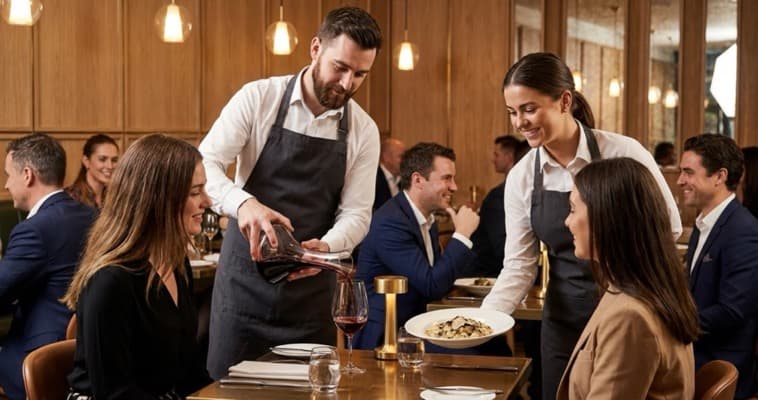
The upselling techniques food and beverage teams really use, with the exact words for starters, drinks and desserts and the answer each one invites.
The upselling techniques food and beverage teams really use are specific sentences said at fixed points in service, moving a guest toward a better version of what they wanted or a course they had not considered. The technique is not enthusiasm. It is naming one thing, at the right moment, and answering what comes back.
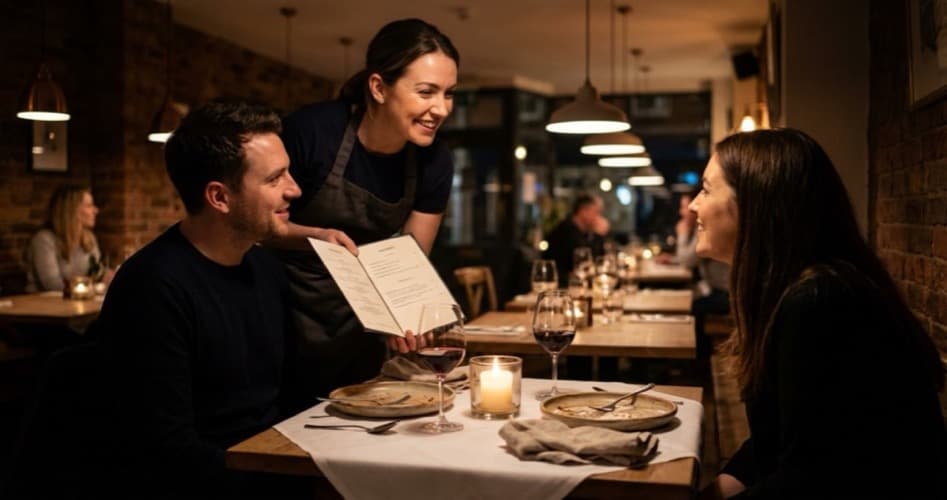
Watch a good server and the upsell is almost invisible. They put the menus down, say the squid is worth ordering tonight, and move on before anyone decides anything.
Watch a nervous one and you get the version a guest can hear coming. Any drinks? See the dessert menu? Every one is a yes or no question, and no is the easy answer to all of them.
The difference is not confidence. One named something. The other asked the guest to do the imagining.
What are some effective techniques for upselling?
Effective upselling techniques share a shape. They name one item, they land where the guest is already deciding, and whoever says them can answer the next question without going to the kitchen.
The third of those is the one that turns a script into a liability when it is missing. In a UK dining room a recommendation is not only a sales move. It is food information.
Picture a server who says the special is worth having and cannot say what is in it. That server has not been trained, they have been handed a problem.
Related: Restaurant upselling techniques. Read our full guide for the wider strategy this sits inside.
Every bracket below is a placeholder. Replace it with something genuinely on your menu tonight, and check the description is accurate before anyone says it out loud.
Food upselling techniques worth briefing
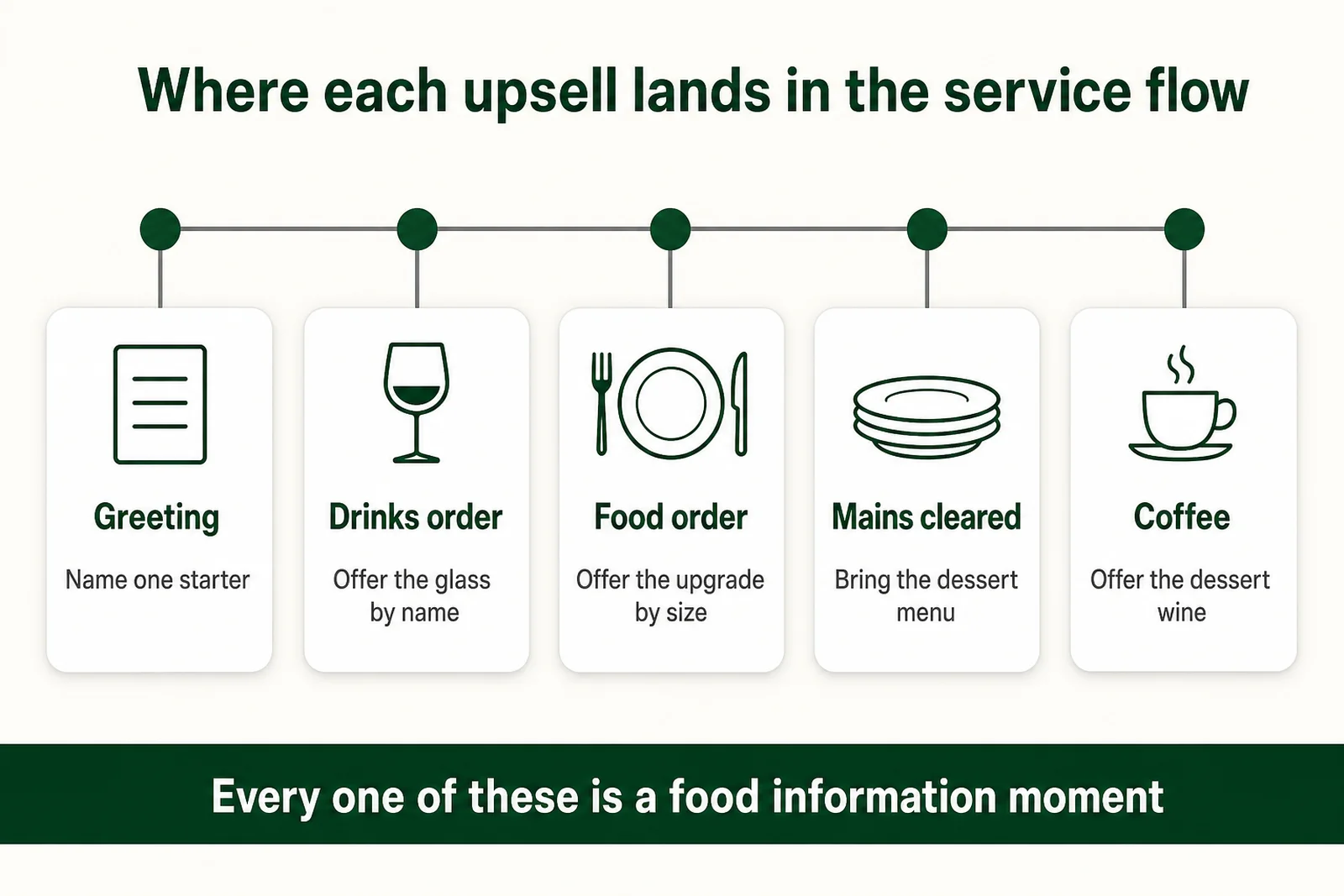
Five fixed points in a shift, each with one sentence that belongs there.
Name one starter at the greeting. Not the category, one dish. "The [named starter] is going out well tonight if you want something while you look." It lands while the menus are going down, before the table has decided to be efficient.
Offer the upgrade by size, not by the word upgrade. "The [larger cut] is [X]oz if you are hungry" describes a thing. "Would you like to upgrade?" describes a transaction. One is a question about dinner, the other about money.
Put the dessert menu down as you clear the mains. Not at the bill, not on request. A table that has to ask for it is deciding without a menu in front of them.
Offer a smaller version after a no. "We do a [small dessert] if you just want something with the coffee" reaches the tables refusing the portion, not the course.
Beverage upselling techniques worth briefing
The step up is smaller in a guest's head with drinks. A house pour to a named one is a small decision made several times a night, where a starter is one bigger decision made once.
Offer the glass before the bottle. "We have the [named wine] by the glass if you want to try it first" asks for a glass of commitment instead of a bottle of it.
Pair it with what they just ordered. "The [wine] goes well with the [dish] if you fancy it" gives a reason that is not price. Say it right after the food order.
Give two named choices, not a yes or no. "House gin or the [premium gin]?" is a question about preference. "Would you like a premium gin?" is a question about money.
Take the soft drinks seriously. "We have a [local soft drink] if you want something other than a cola" is the same move without the alcohol, and it reaches the drivers and lunch tables a wine-led script never speaks to.
The question that follows every recommendation
A list of sentences is only half the job. The moment a server recommends a dish, they have made a statement about food, and rules attach.
Food Standards Agency guidance for food businesses states that if you provide non-prepacked foods you must supply allergen information for every item containing any of the 14 regulated allergens. Non-prepacked covers a meal cooked and served loose in a restaurant, which is the food anyone on your floor will recommend.
You can give that information out loud. FSA technical guidance says that where a business chooses to provide it orally, it must use clear signposting directing the customer to where the information can be found, for example by asking members of staff. The duty is an accurate answer and a visible pointer to it. A folder, a wall matrix or a card by the pass are all your call.
So the test is not whether the line sounds natural. The upsell worth teaching is the one your server could still answer if the guest asked what is in it.
What is the 30/30/30 rule and how does it work for restaurants?
The 30/30/30 rule is a cost rule of thumb, and it says nothing about how anyone sells an extra course. The version passed around the trade puts food cost, labour and overheads at three near equal shares of revenue, with whatever is left over as profit.
Treat it as trade folklore rather than a benchmark. We could not find a UK body that publishes it, and a wet-led pub and a fine dining room do not have the same cost shape. It turns up next to upselling advice, which is why it is here at all. For the real mechanics, look at your own costs rather than at scripts.
Related: Menu engineering and restaurant menu pricing, where the numbers are yours and real.
Who the extra money on the bill belongs to
This one belongs in the briefing. It changes what the ask means for the person saying the sentence. Under the Employment (Allocation of Tips) Act 2023, workers keep 100% of their tips, gratuities and service charges.
If you apply a discretionary service charge as a share of the bill, the table that took the dessert wine produces a larger charge than the one that did not, and that difference belongs to the team. Not a motivation trick. A fact about where the money goes, which beats any talk about targets.
Upselling techniques food and beverage teams learn fastest
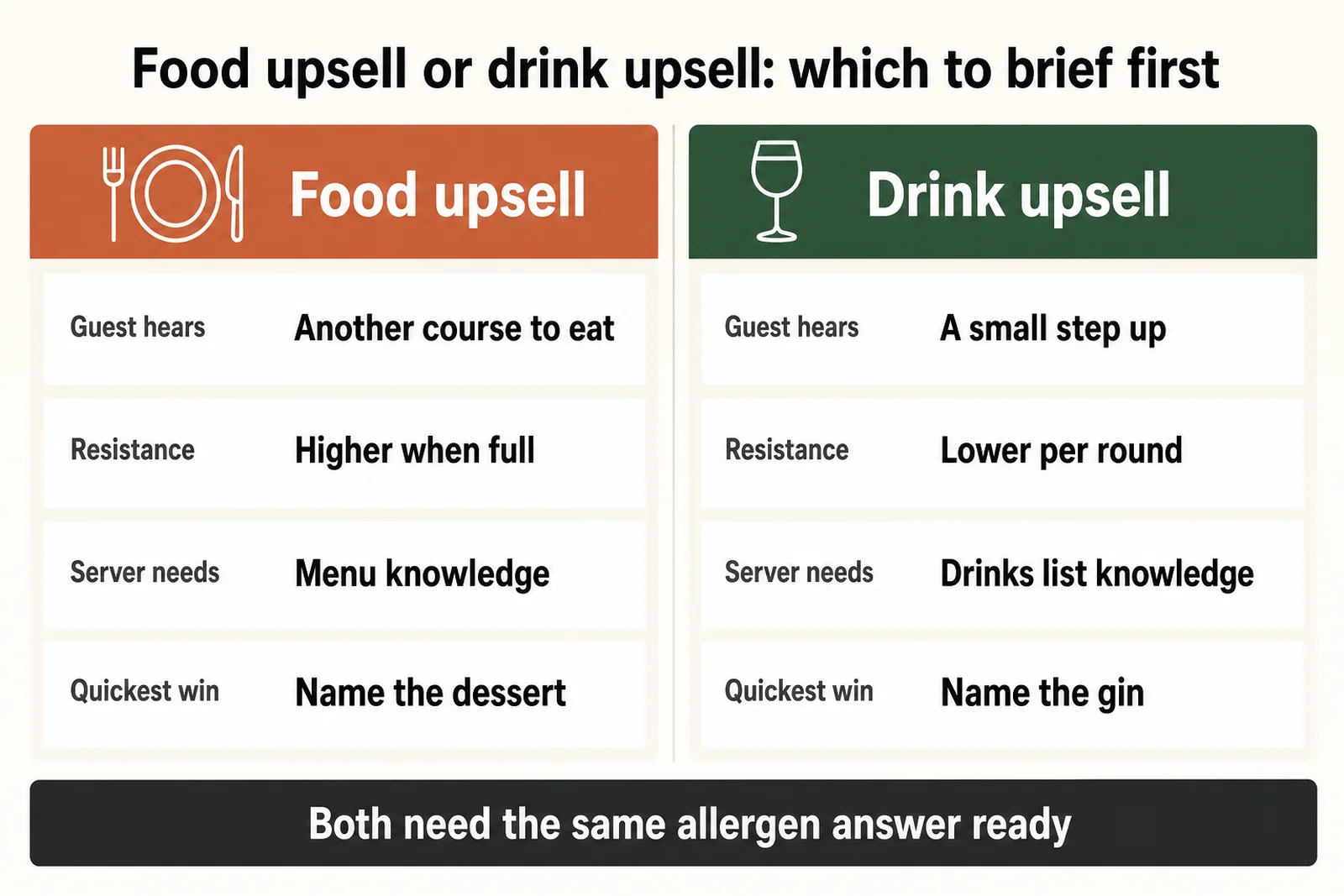
The two behave differently at the table, and one is easier to teach in a week.
Brief the drinks first: the sentences are shorter, the knowledge is a drinks list rather than a kitchen, and a nervous new server can manage "house or the [named gin]" on a second shift. Describing a dish well means having eaten it.
That is sequencing, not a claim that one earns more. What each is worth depends on your prices.
How to tell if the upselling worked
Two numbers tell you whether a briefed sentence is earning its place, and your till holds the raw material for both.
Average spend per head. Total sales divided by covers. Watch the direction over four weeks, not the day to day, which moves for reasons unrelated to any script.
Attachment rate. Bills containing the one item you briefed, divided by total bills. Count bills rather than portions sold, and take one item at a time, or a combined rate hides which sentence is working. A busy Saturday lifts average spend whether or not anybody upsells. It does nothing at all to the share of bills carrying a starter.
Imagine a bistro that briefs one line, the named starter at the greeting, and nothing else. Four weeks on, starter attachment has not moved. Before rewriting the sentence, find out whether anybody said it. A script nobody uses and a script that does not work look identical in the numbers.
A wide gap between your strongest and weakest server on the same shifts is a difference in the people, not the trading conditions. Check whether the weaker one was ever told the sentence before you conclude anything about temperament.
Related: Restaurant server training, for turning one briefed line into a habit.
Frequently Asked Questions
What are good examples of upselling in a restaurant?
Four you can hear on any good shift. Use your own dishes in place of these. "The salt and pepper squid is going out well tonight." "The sirloin is 10oz if you are hungry." "We have the Picpoul by the glass if you want to try it first." And at the bar, "house gin or the small batch one?" Each of the four names a thing rather than asking yes or no.
How do you upsell drinks without sounding pushy?
Give a real choice between two named things instead of an invitation to spend more. House tonic or the elderflower one asks about preference. Would you like to upgrade asks about money.
What are the 5 suggestive selling techniques for restaurants?
Name one dish rather than a category. Offer a drink that suits what was just ordered. Put the dessert menu down before it is asked for. Mention the small production item while it lasts. Offer a smaller size of whatever was refused.
Do I have to show calorie information on the items my team recommends?
In England the calorie labelling requirement extends to any business with 250 or more employees selling non-prepacked food or drink for immediate consumption, with certain exemptions. An independent under that headcount sits outside it. These are England rules, so check your own headcount and your own nation rather than assuming either way.
Does upselling change how tips are shared?
It changes the size of the pot, not the rules for splitting it. If your service charge is a share of the bill, a bigger bill produces a bigger charge, and that money belongs to the team.
Is upselling the same as suggestive selling?
No. Upselling improves a decision the guest has already made, such as the larger cut of steak. Suggestive selling introduces something they had not thought about, such as a dessert wine. More wording sits in our upselling examples and restaurant scripts guide.
Start with one sentence
Key Takeaway
Pick one food line and one drink line, fill the brackets with something real, and say them at the next briefing. A team that reliably says one good sentence beats a team handed ten and remembering none.
Why this matters: a sentence your team can defend is worth more than one that merely sells. It survives the follow-up question, the busy Saturday and the guest with a nut allergy.
This week, in about twenty minutes:
- Write down your average spend per head and starter attachment rate
- Choose one food line and one drink line and fill in every bracket
- Check both descriptions are accurate, including what is in them
- Say them at Friday's briefing and write them on the pass
- Confirm your allergen signposting is visible to guests
- Pull the same two numbers in a fortnight
LocalBrandHub can keep your products and offers up to date and launch a promotion in minutes. The sentence your server says at the table is yours to write.
Related: Restaurant marketing. See how the room fills in the first place.
Written from our experience with independent UK restaurant operators. Consult the linked government guidance, or a hospitality professional, for your own nation and headcount before relying on any of it.
For restaurants, salons, and local businesses
Need help with your marketing?
We help UK businesses turn social media into real results, not busywork.
Start freeSources
Get More Marketing Tips
Practical marketing tips for UK business owners, straight to your inbox. No spam, unsubscribe anytime.
About the Author
Local Brand Hub
Empowering UK Businesses
Local Brand Hub provides comprehensive business management tools designed specifically for UK local businesses to streamline operations, automate marketing, and grow revenue.
More articlesRelated Articles
 Business Growth
Restaurant Upselling Techniques: A UK Guide
Learn proven restaurant upselling techniques in this UK guide covering staff training, menu engineering and suggestive selling to boost profits.
 Business Growth
Upselling in a Restaurant: Ways to Lift Spend
Learn how upselling in a restaurant works with real examples, staff scripts and menu tactics to increase average spend per head in UK venues.
 Tutorials
Restaurant Upselling Scripts: Real Examples to Copy
Ready-to-use upselling script phrases your UK team can practise tonight. Covers starters, mains, desserts and drinks with real phrasing.