
Master the four quadrants matrix: Stars, Plough Horses, Puzzles and Dogs. Learn how menu engineering boosts UK restaurant profits by 15% or more.
You've spent thousands on your menu design. The photos look beautiful, the layout seems professional, and your chef is proud of every dish. But week after week, customers order your lowest-margin items while ignoring the dishes that actually make you money. Sound familiar?
Menu engineering changes that. It's the difference between hoping customers order profitably and systematically designing your menu so they almost can't help it. Based on restaurant industry data and practical implementation experience, this framework transforms menus into profit engines.
Menu engineering is the strategic practice of analysing your menu's profitability and popularity data, then using psychology and design to guide customers toward your most profitable items. When implemented correctly, this framework delivers measurable results: typically within 4-6 weeks of implementing changes. Research shows that menus crafted with these principles can increase profits by more than 15%. For UK restaurants facing average net margins of just 4.2%, that difference can mean survival versus closure.
Info
Related: Restaurant Profit Margin covers the broader financial picture. Return here for the menu-specific tactics.
What You'll Learn
This guide covers the proven techniques restaurant operators use to optimise their menus for profitability:
- The three core elements of menu engineering (and how they work together)
- How to use the four quadrants matrix to classify every dish
- The four-step process for engineering a profitable menu
- Practical psychology tricks that guide customer choices
- How to apply this framework without expensive software
So you know the impact. But how does it actually work? Let's break down the three core elements.
The Three Core Elements: Data, Psychology, and Design
First, let's understand the fundamentals. This framework rests on three pillars: data analysis, menu psychology, and strategic design. Based on our experience helping UK restaurants optimise their menus, these work together to transform a simple price list into a profit-generating tool that guides customer decisions while enhancing their experience.
1. Data Analysis
Everything starts with numbers. You need to know two things about every menu item: its contribution margin (selling price minus food cost) and its menu mix percentage (how often it sells compared to other items).
Without this data, you're guessing. With it, you can categorise every dish and make informed decisions: the kind restaurant operators who've been doing this for years make intuitively. This approach just makes that intuition data-backed and repeatable. Pricing, placement, whether items deserve their spot: all driven by facts, not hunches.
Info
Related: Restaurant Food Cost Percentage explains how to calculate these numbers accurately.
2. Menu Psychology
Eye-tracking research reveals that customers follow predictable patterns when reading menus. The "golden triangle" describes how eyes move from the centre, to the top right, then to the top left. Strategic placement of high-margin items in these zones can increase sales by as much as 30%.
Psychology also covers pricing tactics (removing pound signs, using charm pricing), descriptive language, and the "paradox of choice" that suggests limiting options to around 7 items per category.
3. Strategic Design
Design brings data and psychology together visually. This includes:
- Whitespace: Items surrounded by space draw the eye naturally
- Typography: Boxes, bold text, or different fonts highlight profitable dishes
- Colour: Green suggests freshness, orange stimulates appetite, red encourages action
- Layout: Clean organisation reduces cognitive load so customers focus on dishes, not comparisons
If you're thinking "I don't have time to redesign my menu," start smaller. Even repositioning your three most profitable items to the golden triangle positions makes a measurable difference.
For example, a Manchester curry house moved their high-margin lamb karahi from the bottom of the mains list to the top-right position on their menu. Orders increased 40% in the first month without any recipe or pricing changes, pure psychology and positioning at work.
Pro Tip
If you're only looking at your menu when you've got a quiet Wednesday night, you'll always lose to competitors who treat menu analysis as part of their weekly operations routine.
With the three elements clear, the next step is understanding how to classify every item on your menu. That's where the four quadrants come in.
The Four Quadrants System: Stars, Plowhorses, Puzzles, and Dogs
Here's where the framework gets practical. Every menu item falls into one of four quadrants: Stars, Plowhorses, Puzzles, and Dogs. This classification system, derived from the Boston Consulting Group's growth-share matrix, plots every menu item based on two axes: profitability (contribution margin) and popularity (menu mix percentage).
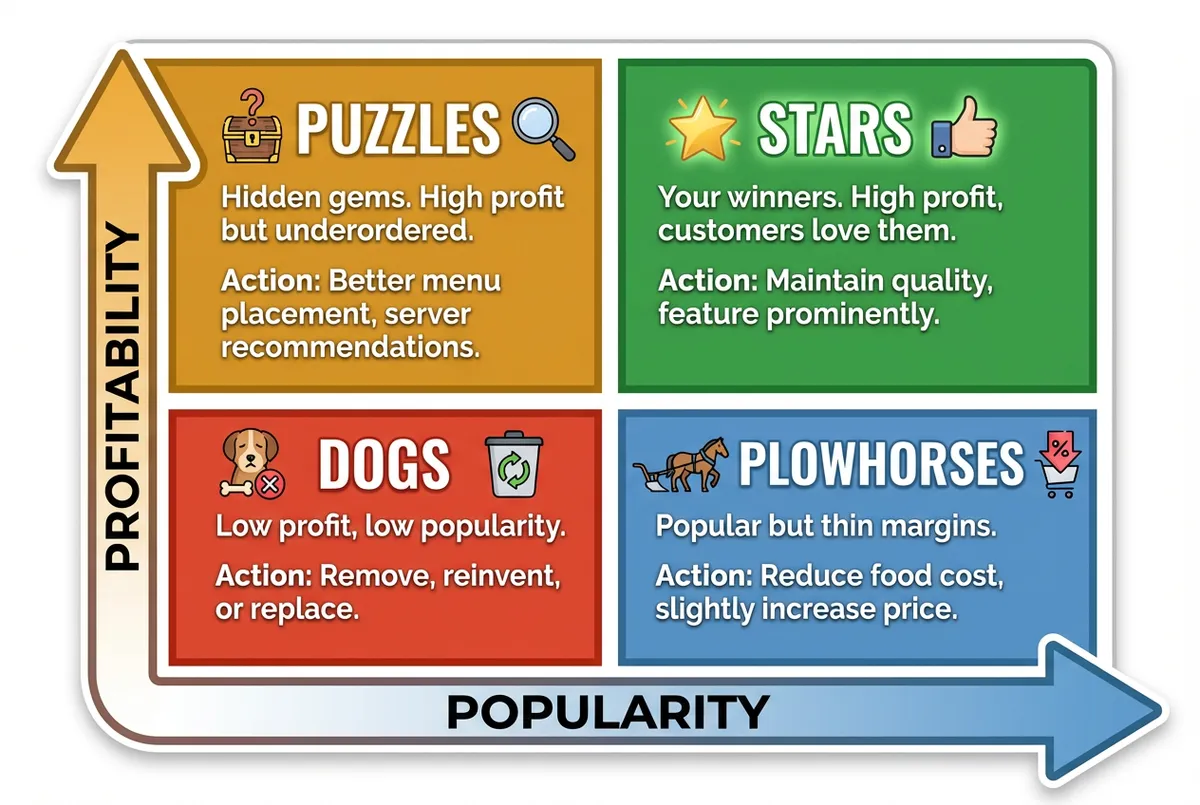
The four quadrants of the menu engineering matrix
| Category | Profitability | Popularity | Strategy |
|---|---|---|---|
| Stars | High | High | Protect and promote |
| Plowhorses | Low | High | Improve margins |
| Puzzles | High | Low | Increase visibility |
| Dogs | Low | Low | Remove or reinvent |
Stars: Your Menu Champions
Stars are high profit and high popularity. These are your best-performing items that customers love and that make you money. Your job is simple: don't mess with them.
For example, a gastropub's signature burger that sells 40 units daily with a 68% margin is a Star. Keep it prominent, maintain quality, and resist the urge to "improve" what already works.
Star strategy: Feature prominently in golden triangle positions. Never discount. Train staff to mention these items first.
Plowhorses: Popular but Problematic
Plowhorses are crowd-pleasers with low profit margins. Customers order them constantly, but each sale contributes less to your bottom line than it should.
A fish and chips that sells brilliantly but costs you nearly as much to make as you charge is a classic Plowhorse. You can't remove it because customers expect it, but you need to improve its profitability.
Plowhorse strategy: Reduce portion sizes slightly, substitute cheaper ingredients without compromising quality, increase prices gradually, or pair with high-margin sides and drinks.
Puzzles: Hidden Profit Waiting
Puzzles have excellent margins but poor sales. The profit potential is there; customers just aren't ordering them. This is usually a marketing problem, not a product problem.
Your lamb shank special with a 72% margin that only sells 5 portions weekly is a Puzzle. The dish is profitable when it sells. It just needs help getting noticed.
Puzzle strategy: Move to better menu positions, improve descriptions with sensory language, have servers recommend them, or include them in prix fixe menus.
Dogs: Decision Time
Dogs score low on both profitability and popularity. They're taking up menu space, complicating inventory, and contributing nothing meaningful to your business.
That prawn cocktail starter from 1987 that sells twice weekly with a 35% margin? That's a Dog.
Dog strategy: Remove entirely, rebrand as a limited-time special, completely reinvent the recipe, or use ingredients in other more successful dishes.
Info
Related: Restaurant Menu Pricing covers the calculations behind these margin decisions.
So you understand the quadrants. But how do you actually implement this approach in your restaurant? Here's the four-step process.
The Four-Step Menu Engineering Process
Understanding the quadrants is half the battle. The real value comes from implementing them systematically. Your process should have four clear steps: analyse your data, classify your items, implement changes, and measure results. This cyclical approach should happen quarterly at minimum, though top-performing restaurants review monthly.
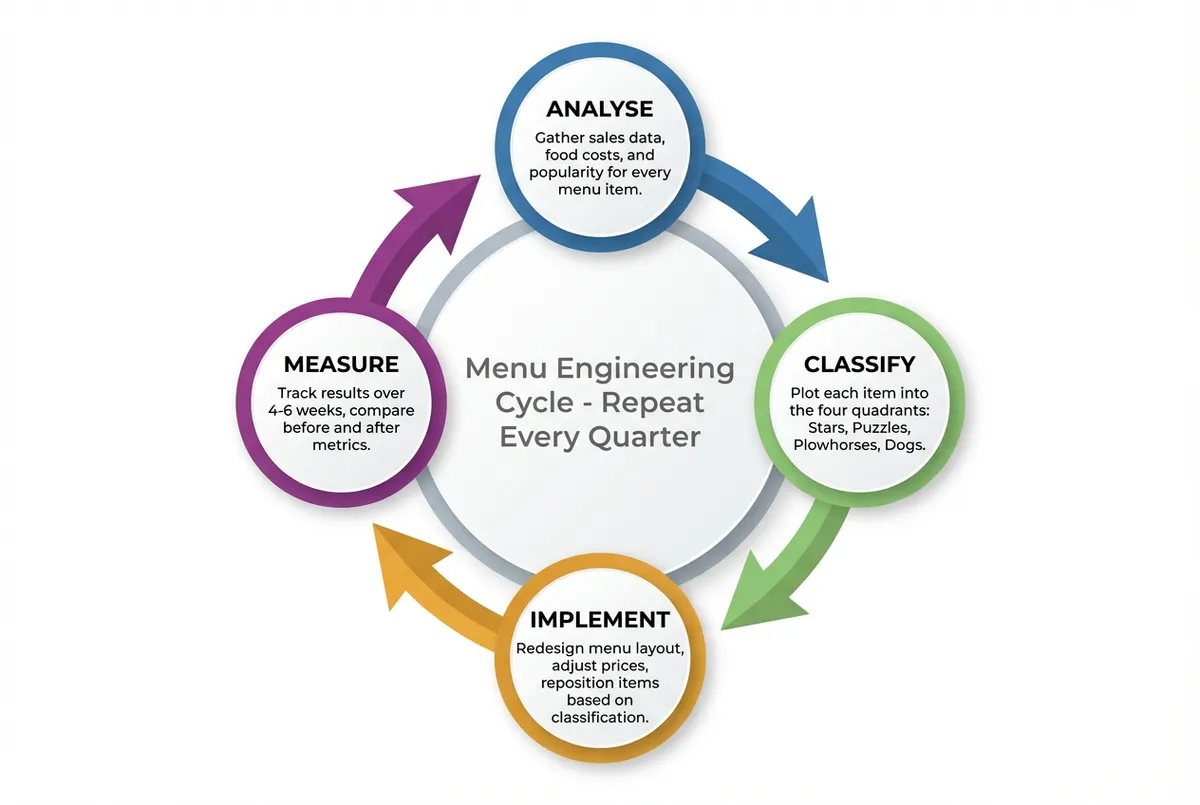
The four-step menu engineering process
Step 1: Analyse Your Data
Pull sales reports for the past 8-12 weeks. For each menu item, calculate:
- Food cost percentage: (ingredient cost / selling price) x 100
- Contribution margin: selling price - ingredient cost
- Menu mix percentage: (item units sold / total units sold) x 100
This analysis forms the foundation of everything that follows. If you're reading this thinking "I don't have time for spreadsheets after a 12-hour shift," you're not alone. But restaurants that track these numbers consistently achieve gross profit margins above 70%. If you're only checking your menu numbers once a year you'll always lose to competitors who review monthly. The data work is non-negotiable if you want results.
Step 2: Classify Your Items
Plot every item on a matrix with contribution margin on the Y-axis and menu mix on the X-axis. Draw a line at the average for each axis. Items fall naturally into the four quadrants.
Quick classification method: If you only have 30 minutes this week, do this:
- Day 1-2: List your top 10 sellers by volume
- Day 3-4: Calculate the food cost for each of those 10 items
- Day 5-7: Sort into quadrants and identify one Plowhorse to improve and one Dog to remove
Step 3: Implement Changes
Based on your classifications, make targeted changes, keeping your live menu and offers current in our menu and offers tools as you go:
- Reposition Stars and Puzzles to golden triangle areas
- Adjust Plowhorse pricing or portions
- Remove or reinvent Dogs
- Update descriptions for Puzzles
- Train staff on which items to recommend
Step 4: Measure Results
After 4-6 weeks, repeat the analysis. Compare menu mix percentages and contribution margins. Did the Puzzle you repositioned sell more? Did the Plowhorse price increase stick without losing volume?
This isn't a one-time project. Think of it as an ongoing process of optimisation. Persistent food inflation means dishes that were profitable six months ago often turn unprofitable. Quarterly reviews keep your menu profitable.
You might be wondering whether the "categories" and "quadrants" are different things. They're not. Here's why understanding the categorisation process matters.
Categories vs Quadrants: Understanding the Terminology
You'll also hear these groupings called "categories." The four categories are identical to the four quadrants: Stars, Plowhorses, Puzzles, and Dogs. Understanding how to categorise items correctly requires knowing where to set your thresholds.
Setting Your Thresholds
The line between "high" and "low" profitability isn't universal. It depends on your restaurant's average contribution margin.
Calculate your menu's weighted average contribution margin:
- For each item: (contribution margin) x (number sold)
- Add all results together
- Divide by total items sold
Items above this average are "high margin." Items below are "low margin."
For popularity, use the same approach with menu mix percentages. The weighted average becomes your dividing line.
Category-Specific Tactics
| Category | Do This | Avoid This |
|---|---|---|
| Stars | Highlight, train staff, protect recipe | Discounting, major changes, hiding |
| Plowhorses | Engineer margins, subtle price increases | Removing popular items, dramatic changes |
| Puzzles | Better placement, improved descriptions | Ignoring them, assuming they'll sell eventually |
| Dogs | Remove or completely reinvent | Keeping out of sentimentality, half-measures |
If you're struggling to let go of a Dog that's been on your menu for years, ask yourself: would you add this dish if you were building your menu fresh? If the answer is no, it's taking up space that could go to something better.
For instance, a Bristol bistro discovered their vegetable soup starter (a Dog) was using expensive organic stock but only selling 3 portions weekly. They replaced it with a seasonal soup that used the same prep time but cost 40% less to make. Sales tripled because the new description ("roasted butternut squash with sage and toasted seeds") was far more appealing than "vegetable soup." That's the power of combining data with smart menu copywriting.
Now let's look at the practical tool that brings all of this together: the matrix.
What Is a Menu Engineering Matrix?
Now let's talk about the practical tool that brings this all together. A menu engineering matrix is a framework that plots every menu item on a two-dimensional grid to reveal profitability patterns. The vertical axis represents contribution margin (profitability), and the horizontal axis represents menu mix percentage (how often the item sells). It's a diagnostic tool, one that reveals exactly which items earn their place and which are taking up valuable real estate for no reason.
The matrix provides clarity that raw data cannot. Seeing all your dishes plotted visually makes patterns obvious. You might discover that your entire dessert section consists of Dogs, or that your highest-margin items are buried in the worst menu positions.
How to Build Your Matrix
Materials needed: Sales data (8-12 weeks), food cost data, spreadsheet software or graph paper
Steps:
- List all menu items with units sold and contribution margin
- Calculate average contribution margin and average menu mix
- Draw a vertical line at your average menu mix
- Draw a horizontal line at your average contribution margin
- Plot each item as a point on the grid
- Label items falling into each quadrant
Reading Your Matrix
A healthy matrix shows:
- Stars scattered across the high-profit, high-popularity quadrant: you should have multiple Stars generating reliable profits
- Few Dogs: a menu full of Dogs indicates fundamental problems
- Puzzles that represent opportunity: having some Puzzles is normal; they're chances to improve through marketing
- Manageable Plowhorses: some Plowhorses are inevitable in any menu
A concerning matrix often shows:
- Majority of items clustered in Dogs: typically signals urgent action needed
- Few or no clear Stars: usually indicates pricing or product problems
- Excessive Plowhorses: usually suggests your margins need work
If you can't immediately tell which items are your Stars and which are your Dogs, that's usually a sign your data tracking needs attention before you can engineer anything meaningful.
For example, a Leeds tapas restaurant built their first matrix and discovered 60% of their menu was Plowhorses. Their popular small plates were priced to compete with chains, sacrificing margin for volume. By raising prices on their five best-sellers by just £1.50 each, they increased monthly profits by £2,400 without losing a single customer. That's the kind of real, measurable improvement that happens when you use data.
Info
Related: Restaurant Pricing Strategy helps you fix margin problems identified in your matrix.
With your matrix built and items classified, the next step is making sure customers actually order your most profitable dishes. That's where menu psychology comes in.
Menu Psychology: Design Tactics That Work
However, understanding the four quadrants is only half the battle. Getting customers to actually order your Stars and Puzzles requires menu psychology. UKHospitality research shows that strategic menu design can significantly impact sales. If you're only updating your menu when it's quiet and you happen to notice something isn't selling, you'll always lose to competitors who treat menu optimisation as part of weekly operations.
The Golden Triangle
Customers spend an average of 109 seconds looking at a menu. Their eyes follow a predictable path: centre first, then top right, then top left. These three zones form the "golden triangle."
Place your highest-margin items in these positions. If your best Star is buried in the middle of page three, it's fighting against natural eye movement patterns.
Pricing Psychology
Small pricing tweaks influence perception:
- Remove pound signs: Customers who see "15" instead of "£15.00" spend up to 30% more
- Use charm pricing: £14.95 feels cheaper than £15, even though the difference is negligible
- Price anchoring: A £52 premium item makes your £34 mains feel reasonable
- Avoid price columns: Trailing dots leading to prices encourage comparison shopping
Descriptive Language
Sensory-rich descriptions can increase item selection by up to 27%. Compare these approaches:
| Basic | Engineered |
|---|---|
| Chicken breast with vegetables | Slow-roasted free-range chicken with seasonal garden vegetables |
| Chocolate cake | Warm Belgian chocolate torte with Madagascan vanilla cream |
| Fish and chips | Line-caught North Sea haddock in crispy beer batter |
Don't fabricate claims because customers have become sceptical of generic superlatives. "World's best" is ignored. Specific, genuine details ("28-day aged," "locally sourced from Sussex farms") create trust. The biggest mistake is using the same tired descriptions every competitor uses.
Key Takeaway
Key Takeaway
Menu engineering combines data analysis, psychology, and strategic design to transform your menu into a profit engine. The four quadrants (Stars, Plowhorses, Puzzles, and Dogs) classify every item by profitability and popularity, giving you clear strategies for each. Quarterly analysis keeps your menu optimised as costs change, and small changes in placement and pricing create measurable profit improvements. UK restaurant margins hover around 4-6% for many independents, making menu engineering one of the few profit levers you control completely. If you only do one thing from this guide, build your matrix: seeing your menu visualised makes every future decision clearer.
If you run a restaurant and want to see how Local Brand Hub can support your marketing, explore our restaurant marketing tools.
This Week's Action Plan
Day 1-2: Export your last 8 weeks of sales data by item.
Day 3-4: Calculate contribution margin for your top 20 sellers.
Day 5-7: Plot items on a matrix and identify one Plowhorse to improve and one Dog to consider removing.
You don't need software or consultants. A spreadsheet and two hours of focused work will show you exactly where your menu is making money and where it's leaking profit.
Frequently Asked Questions
What is the difference between menu engineering and menu design?
Menu engineering is a framework that uses data analysis to optimise menu profitability, while menu design is a visual discipline focused on aesthetics. Menu design focuses on layout, fonts, colours, and presentation. Menu engineering focuses on profitability and popularity metrics. Menu design asks "How do I make this look good?" Menu engineering asks "How do I make this make money?" The best restaurants do both. They use profitability data to decide which dishes deserve the best design positions.
How often should I analyse my menu?
Review your menu matrix quarterly at minimum. However, after any significant cost changes (supplier price increases, portion adjustments, new dishes), rerun your analysis. Many successful restaurants review monthly.
Can small restaurants benefit from menu engineering?
Absolutely. In fact, smaller restaurants often see the biggest percentage improvements because they can implement changes quickly. You don't need sophisticated software. A spreadsheet, your sales data, and a few hours of analysis deliver results.
What if all my items are Dogs?
This indicates a fundamental pricing or cost problem. Start by identifying which items are closest to the Plowhorse line (high popularity) and focus on improving their margins first. Consider whether your overall pricing aligns with your local market.
For instance, a Newcastle cafe discovered their entire breakfast menu was plotting as Dogs because their eggs had doubled in price but their menu hadn't changed in 18 months. After analysing local competitors and adjusting prices by £0.75-£1.25 per dish, five items moved into the Plowhorse quadrant within six weeks.
Should I remove all Dogs from my menu?
Not necessarily. Some Dogs serve strategic purposes: a children's pasta dish might have low margins but keeps families coming. Evaluate Dogs individually. Remove those with no strategic value; keep those that support overall business goals.
For UK restaurant owners
Turn Your Menu Into a Profit Engine
LocalBrandHub helps independent UK restaurants systemise their marketing, from menu optimisation to social media, without adding hours to your week.
Start FreeGet More Marketing Tips
Practical marketing tips for UK business owners, straight to your inbox. No spam, unsubscribe anytime.
About the Author
Local Brand Hub
Empowering UK Businesses
Local Brand Hub provides comprehensive business management tools designed specifically for UK local businesses to streamline operations, automate marketing, and grow revenue.
More articlesRelated Articles
 Marketing Tips
Four Quadrants of Menu Engineering: A Complete UK Guide
Master the four quadrants of menu engineering to boost restaurant profits. Learn how Stars, Plough Horses, Puzzles and Dogs increase your margins.
 Marketing Tips
Menu Design Principles: 7 Rules That Drive Sales
Master menu design principles that guide customer choices. Learn golden triangle placement and strategic pricing layouts that boost restaurant profits.
 Marketing Tips
Menu Engineering Matrix: Stars, Plowhorses, Puzzles, Dogs
The menu engineering matrix explained: classify Stars, Plowhorses, Puzzles and Dogs with a printable matrix, worked examples and UK actions.