Learn what a good restaurant food cost percentage is, how to calculate yours, and practical UK strategies to reduce food costs today.
You're staring at last month's supplier invoices after a long close. Revenue looked decent. Then the numbers hit: money leaking through your kitchen faster than it comes in. Understanding your restaurant food cost percentage is where you take back control.
Info
If you're thinking "I sort of know what food costs should be, but I've never actually calculated mine properly," you're in good company. Most independent restaurant owners run on instinct until a bad quarter forces them to dig into the detail. This guide gives you the formula, the benchmarks, and the practical steps to get food costs under control.
What You'll Learn
- What a good food cost percentage looks like for different restaurant types
- The simple formula to calculate your food cost percentage
- How the 30/30/30 rule works as a food cost benchmark
- Whether 32.8% food cost is acceptable (spoiler: it depends)
- Practical ways to reduce that number without cutting quality
What Is a Good Food Cost Percentage for a Restaurant?
First, let's define the core metric. Restaurant food cost percentage is a method that measures the proportion of total revenue spent on ingredients and food supplies. A good figure for most venues falls between 28% and 35% of total revenue.
Here is how benchmarks typically break down:
- Fine dining: 30-35% (premium ingredients, higher menu prices offset)
- Casual dining: 28-32% (balance between quality and volume)
- Fast casual: 25-30% (simpler menus, bulk purchasing)
- Quick service: 25-28% (standardised portions, high volume)
- Pubs and gastropubs: 30-35% (varied menus, seasonal sourcing)
For example, a gastropub sourcing locally reared beef might run at 33%. That looks high compared to a burger chain. But the gastropub's gross profit per plate is actually higher because of higher menu prices.
If you're thinking "my food costs bounce around month to month and I can never pin them down," that's usually a sign you need better stock tracking, not necessarily cheaper ingredients. Consistency matters more than hitting a perfect number.
UK Context
The Restaurant Food Cost Percentage Formula
Now that you know the benchmarks, let's get into the actual maths. The food cost percentage formula is straightforward, and every restaurant owner should be running this calculation at least monthly.
The formula:
Food Cost Percentage = (Cost of Goods Sold / Total Food Revenue) x 100
Where:
- Cost of Goods Sold (COGS) = Opening Stock + Purchases - Closing Stock
- Total Food Revenue = All food sales for the period (excluding drinks unless you combine them)
Worked Example
A small bistro calculates their monthly food cost percentage:
- Opening stock: £3,200
- Purchases: £8,500
- Closing stock: £2,800
- Food revenue: £28,000
COGS = £3,200 + £8,500 - £2,800 = £8,900
Food Cost % = (£8,900 / £28,000) x 100 = 31.8%
That bistro is running at 31.8%, comfortably within the typical range for casual dining.
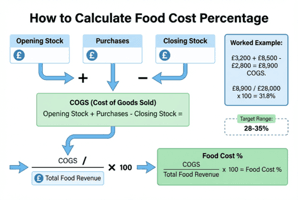
Food cost percentage formula diagram showing how to calculate COGS and arrive at your percentage.
Working Backwards From a Target
If you want to hit a specific number, work backwards from menu pricing. For example, a Thai restaurant wanting to price a green curry might divide its ingredient cost by the target percentage to find the minimum menu price. This ensures every dish on the menu supports the overall target.
If you're only looking at purchase invoices without tracking opening and closing stock you'll always lose to competitors who know their actual COGS down to the penny. Your food cost percentage depends on accurate numbers, not guesswork.
What Is the 30/30/30 Rule for Restaurants?
Now that you can calculate your food cost percentage, here's a benchmark framework to put it in context. The 30/30/30 rule is a cost allocation framework that suggests restaurants should aim for roughly:
- 30% food costs: ingredients and supplies
- 30% labour costs: wages, NI, pensions, training
- 30% overheads: rent, utilities, insurance, marketing
- 10% profit: what's left after everything else
This is not a rigid rule. It is a sanity check. If your food and labour costs together exceed 65% of revenue, you are leaving very little room for overheads and profit. Something has to change.
| Cost Category | Healthy Range | Warning Sign |
|---|---|---|
| Food costs | Under 35% | Above 35% |
| Labour costs | Under 32% | Above 35% |
| Overheads | Under 30% | Above 35% |
These ranges are rules of thumb and vary by restaurant type and concept.
For example, a fish and chip shop might run food costs higher than average because fresh fish is expensive, but compensates with much lower labour costs since the operation is simpler. Overheads carry marketing too, so work out the return you're getting on your marketing spend to make sure it earns its place in that 30%.
Where to Start
Diagnostic, Not a Target
Read more about how labour costs interact with food costs in our guide to restaurant labour cost percentage.
Is the 32.8% Food Cost Percent Acceptable?
With that framework in mind, let's tackle a specific number. This question comes up repeatedly on restaurant forums. The short answer: a 32.8% food cost percentage is acceptable for most casual and fine dining restaurants. It sits within the standard range and leaves room for healthy margins when other costs are controlled.
However, context is everything.
32.8% is healthy when:
- Your average cover price justifies premium ingredients
- Your labour and overhead costs are well controlled
- You are delivering consistent quality that justifies your prices
32.8% is a problem when:
- You're running a fast-casual concept where lower figures are standard
- Labour costs have also crept above healthy ranges simultaneously
- Waste is driving the number up rather than intentional ingredient quality
Ask yourself: would you feel confident showing your food cost breakdown to an investor? If the answer is no, you need better data.
For example, a cafe owner might panic seeing 32.8%, but for a restaurant using premium, locally sourced ingredients and charging accordingly, that same number represents a deliberate choice.
What Should Cost of Goods Percentage Be for a Restaurant?
Building on your food cost percentage, let's broaden the picture. Cost of goods sold (COGS) includes both food and beverage costs. The standard combined COGS for a UK restaurant typically falls between 25% and 32%.
Drinks carry much higher margins than food:
- Alcoholic beverages typically run lower COGS than food
- Soft drinks offer the highest margins of all categories
- Blended COGS across food and drink is usually lower than food alone
For instance, a pub generating half its revenue from drinks has a much healthier blended number than a food-only restaurant. If you're only tracking your food cost percentage without looking at beverage margins, you are missing the full picture.
For a deeper look at how all your costs interact, explore our complete restaurant profit margin guide.
What Is a Good Profit Percentage for a Restaurant?
Here's the number everyone actually wants to know. The profit percentage approach is a framework that assesses your net margin, typically between 5% and 15% of total revenue for UK restaurants (Deloitte, 2025).
For example, a casual dining restaurant keeping its food cost percentage at 30% and labour at 28% has a solid foundation for double-digit profit margins. A venue where both numbers have crept higher is often left with slim margins.
Pro Tip
Info
The relationship between food costs, labour costs, and break-even point determines whether your profit margin is sustainable or just lucky.
How to Reduce Your Restaurant Food Cost Percentage
So you've calculated your food cost percentage and it is too high. Here's what to do about it. These strategies work for most UK restaurants without sacrificing the quality that keeps customers coming back.
1. Menu Engineering
For example, a pizza restaurant might discover its margherita is hugely popular but barely profitable, while its seafood linguine has great margins but rarely gets ordered. Review every dish by its food cost percentage and popularity:
- Stars (high profit, high popularity): Promote these aggressively
- Puzzles (high profit, low popularity): Improve positioning on menu
- Plough horses (low profit, high popularity): Reduce portions slightly or renegotiate ingredient costs
- Dogs (low profit, low popularity): Remove from menu
2. Portion Control
Standardise recipes with exact weights. A chef adding "a generous handful" of prawns to every dish can swing your food cost percentage significantly over a month. Spec cards with gram weights remove guesswork.
3. Supplier Negotiation
Review supplier contracts quarterly. Get quotes from at least three suppliers for your highest-cost ingredients. Even a small reduction on your top items can shift your overall food cost percentage noticeably.
4. Waste Tracking
Track waste daily in three categories: prep waste, spoilage, and plate waste. Many restaurants lose a significant portion of purchased food to waste (WRAP, 2025). Reducing that directly improves your food cost percentage.
5. Stock Management
Run weekly stock takes rather than monthly. Monthly stocktaking means you only discover problems after 30 days of losses. Weekly checks catch issues before they compound. If you're only running monthly stocktakes without weekly checks you'll always lose to competitors who catch waste and theft early. Stop guessing and start counting.
Actionable Checklist
- Calculate your current food cost percentage using the formula above
- Compare against benchmarks for your restaurant type
- Run a menu engineering analysis (star, puzzle, plough horse, dog)
- Standardise your top 10 dish recipes with gram-weight spec cards
- Get competing quotes for your five highest-cost ingredients
- Implement daily waste tracking by category
- Switch to weekly stock takes
- Review and adjust menu prices against current supplier costs
Minimum Viable Action Plan
Finally, here's the simplest starting point. If you only have 30 minutes a week to work on your food cost percentage, start here:
This week, get a baseline on your food costs:
- Day 1-2: Gather your last month's supplier invoices and total your food purchases. Check your opening and closing stock values from your last count.
- Day 3-4: Pull your total food revenue from your POS system. Apply the formula: (Opening Stock + Purchases - Closing Stock) / Food Revenue x 100.
- Day 5-7: Compare your result against the benchmarks in this guide. Identify the single biggest area for improvement: waste, pricing, or supplier costs.
One number. One comparison. One action. That is enough to start.
If you run a restaurant and want to see how Local Brand Hub can support your marketing, explore our restaurant marketing tools.
Key Takeaway
Key Takeaways: Restaurant Food Cost Percentage
Here's what matters most when managing your food cost percentage:
- Target the right range for your restaurant type and pricing strategy
- Use the formula COGS / Revenue x 100, calculated monthly at minimum
- Apply the 30/30/30 rule as a sanity check across all cost categories
- Track waste separately from intentional ingredient spending
- Engineer your menu to push customers toward high-margin dishes
- Review suppliers quarterly and benchmark against competitors
- Monitor weekly rather than monthly to catch problems early
Your food cost percentage is not just a number on a spreadsheet. It is the difference between a restaurant that survives and one that thrives.
Your next step? Calculate your food cost percentage for last month using the formula above. If it is above the healthy range, start with menu engineering and waste tracking. If it is unusually low, check that quality is not suffering.
For the bigger picture on restaurant profitability, return to our restaurant profit margin guide. To understand how staffing affects your bottom line, read our guide to restaurant labour cost percentage.
For restaurants, salons, and local businesses
Need help with your marketing?
We help UK businesses turn social media into real results, not busywork.
Start freeFrequently Asked Questions
What is the basic food cost ratio?
The basic food cost ratio is a method that expresses the cost of goods sold as a proportion of total food revenue. Most UK restaurants aim for a ratio between 0.28 and 0.35, depending on concept and pricing.
What is the formula for food cost percentage for restaurants?
The food cost percentage formula is a method that divides your cost of goods sold by total food revenue: (Opening Stock + Purchases - Closing Stock) / Total Food Revenue x 100. Run this monthly to track trends.
What is a good food cost percentage for catering?
A good food cost percentage for catering is a principle that targets lower numbers than dine-in restaurants, typically in the twenties. Catering benefits from advance ordering and batch preparation. However, labour and transport costs are typically higher, so overall margins tend to balance out.
How often should I calculate food cost percentage?
Calculate your restaurant food cost percentage at least monthly, but weekly is better for active cost management. Weekly calculations require weekly stock takes (about 30-45 minutes) but give you four times the visibility into cost trends.
Does food cost percentage include drinks?
Food cost percentage typically refers to food only. Beverage cost percentage is usually calculated separately because drinks carry much higher margins. Combined food and beverage COGS gives you your total cost of goods sold percentage, which is a different and equally important metric.
Get More Marketing Tips
Practical marketing tips for UK business owners, straight to your inbox. No spam, unsubscribe anytime.
About the Author
Local Brand Hub
Empowering UK Businesses
Local Brand Hub provides comprehensive business management tools designed specifically for UK local businesses to streamline operations, automate marketing, and grow revenue.
More articlesRelated Articles
 Business Growth
Restaurant Pricing Strategy: 7 Proven Methods
Master these 7 restaurant pricing strategy methods used by profitable UK restaurants. From cost-plus to psychological pricing, protect your margins.
 Business Growth
Restaurant Profit Margin: UK Guide to Your Numbers
UK restaurant profit margins range from 3-9% net. Learn what's normal for your type, how to calculate margins, and ways to improve profitability.
 Business Growth
Most Profitable Restaurant Types in the UK
Compare the most profitable restaurant types in the UK. See net margins, startup costs and scalability for pizza, coffee shops, pubs and more.