
Calculate your restaurant break even point with UK formulas and worked examples. Learn what good looks like and how to reach profitability faster.
You're staring at the books three months after opening. The dining room fills up on weekends, reviews are positive, but your accountant says the business is losing money. That gap between "feeling busy" and "actually profitable" is exactly what your restaurant break even point explains.
According to the UK Government's business guidance (2025), restaurants that calculate their break-even point before opening are significantly more likely to survive their first two years.
Info
Related: Restaurant Profit Margin Guide, this guide covers the financial fundamentals that determine your bottom line.
What You'll Learn
- The exact formula to calculate your restaurant break even point
- Worked examples for different UK restaurant types
- How long it typically takes to reach break-even
- What counts as fixed costs versus variable costs
- How to lower your break-even target to reach profitability faster
What Is the Break-Even Point of a Restaurant?
First, let's define the core concept. The restaurant break even point is a framework that identifies the level of total sales where revenue exactly equals total costs. At break-even, your business makes zero profit and zero loss. Every pound above it becomes profit; every pound below represents a loss.
Understanding your break-even target answers three critical questions:
- How much must I sell each month to cover all costs?
- How many covers per day do I need to avoid losing money?
- How much room do I have before a slow month puts me in the red?
For example, a 40-cover bistro with moderate monthly fixed costs and a healthy contribution margin might need roughly £37,500 in monthly revenue to break even.
If you're thinking "I've heard of break-even analysis but never actually done one for my restaurant," you're in the majority. This guide walks you through the formula with real UK numbers.
What Is the Formula to Calculate Your Break-Even Point?
Now that you understand the concept, here's the core formula. The restaurant break even point formula is a method that divides your fixed costs by your contribution margin ratio. There are two ways to express it: in revenue (pounds) or in units (covers).
Break-even in revenue:
Restaurant Break Even Point (£) = Fixed Costs / Contribution Margin Ratio
Where:
- Fixed Costs = costs that don't change with sales volume (rent, insurance, base salaries)
- Contribution Margin Ratio = (Revenue - Variable Costs) / Revenue
Break-even in covers:
Restaurant Break Even Point (covers) = Fixed Costs / Contribution Margin Per Cover
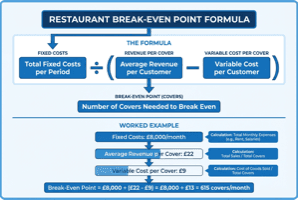
The restaurant break even point formula explained visually
Before calculating, you need to separate your costs into fixed and variable:
- Fixed costs stay the same regardless of sales: rent, business rates, insurance, management salaries, base utilities, loan repayments
- Variable costs increase with each sale: food ingredients, hourly wages, packaging, card processing fees
For example, a neighbourhood pizza restaurant might have £10,000 in monthly fixed costs and variable costs around 55% of revenue, giving a contribution margin of 45%. Its break-even target would be roughly £22,200 per month.
How to Calculate Break Even for a Restaurant
Let's put the restaurant break even point formula into practice with a worked example. This is where abstract maths becomes a real number for your business.
Worked Example: 40-Cover Casual Dining Restaurant
Step 1: List your fixed costs
- Rent: £4,500
- Business rates: £800
- Insurance: £350
- Management salaries: £4,200
- Base utilities, loans, licences: £2,950
- Total fixed costs: £12,800
Step 2: Estimate variable cost percentage
- Food costs, hourly wages, card processing, and variable utilities typically total around 54% of revenue for this type of venue.
Step 3: Calculate contribution margin
Contribution Margin Ratio = 1 - 0.54 = 0.46 (46%)
Step 4: Calculate your restaurant break even point
Break-Even (£) = £12,800 / 0.46 = £27,826 per month
Step 5: Convert to daily covers
Daily covers needed = roughly 38 per day (based on 26 trading days and £28 average spend)
That means this 40-cover restaurant needs nearly full occupancy to reach its restaurant break even point. If that seems tight, it is. For many UK restaurant owners, this level of occupancy pressure is more common than expected, which is why understanding these numbers early matters so much. If you would rather not run the maths by hand, you can crunch the same figures with an ROI calculator in seconds.
If you're only calculating this once at launch you'll always lose to competitors who recalculate quarterly as costs and revenue shift. Your break-even target is a living number, not a one-time exercise.
How Long Does a Restaurant Break Even?
Next, let's tackle the timeline question. Most UK restaurants take between 12 and 24 months to reach their operational break-even point, where monthly revenue consistently covers costs.
There's an important distinction between two types:
Monthly Break-Even
When your monthly revenue covers all monthly operating costs. This is the survival metric.
Investment Break-Even
When total cumulative profits have paid back setup costs (fit-out, equipment, deposits). This typically takes longer.
Typical timeline by restaurant type:
- Small cafe / takeaway: Monthly break-even in 3-6 months
- Casual dining: Monthly break-even in 6-12 months
- Fine dining: Monthly break-even in 12-18 months
- Large format: Monthly break-even in 12-24 months
For instance, a small cafe might recover its initial investment within two years, while a fine dining restaurant could take considerably longer.
If you're thinking "we're 18 months in and still not consistently profitable," that's usually a sign you need to examine whether you're on a trajectory toward break-even or simply treading water.
Info
According to UKHospitality (2025), many UK restaurants fail within their first three years. Many of these failures trace back to insufficient working capital to survive until break-even.
What Is the Break-Even Point in the Hospitality Industry?
Building on the restaurant-specific view, let's look at the broader picture. The break-even point in hospitality is a framework that calculates the revenue needed for any food or drink business to cover its total costs, but the target varies significantly by sub-sector.
- Quick service: Higher contribution margins make the break-even target easier to reach
- Casual dining: Moderate margins, moderate difficulty
- Fine dining: Lower margins and higher fixed costs make it harder
- Pubs (wet-led): Drink margins help reach break-even faster
The critical insight is that your contribution margin, not your total revenue, determines how fast you reach break-even. Understanding how your food cost percentage and labour cost percentage combine is essential.
What Is Considered a Good Break-Even Point?
Here's the practical benchmark most owners want. If you're thinking "just tell me if my numbers are normal," this is the section for you. A good restaurant break even point is a principle that targets monthly operational break-even within 6-12 months, requiring no more than 60-70% of your maximum seating capacity.
What "good" looks like:
- Occupancy needed at break-even: Below 65%
- Timeline to reach it: 6-12 months
- Safety margin above it: At least 20%
Ask yourself: if trade drops by 20% in a quiet month, would you still cover costs? If the answer is no, your break-even target is too high.
For example, a gastropub that averages well above break-even has resilience. A fine dining restaurant operating just above it is one quiet weekend away from a loss month.
Your break-even point is not a goal. It's a floor. The lower you push it, the more profit you keep and the more resilient your restaurant becomes.
How to Lower Your Restaurant Break-Even Point
So your break-even analysis shows you need high occupancy to cover costs. Here's how to fix that. There are two approaches, and most restaurants should use both.
Approach 1: Reduce Fixed Costs
Fixed costs are the numerator in the formula, so reducing them directly lowers your break-even target.
- Renegotiate rent: many landlords prefer a reduction to a vacant unit
- Review insurance annually: brokers can often find meaningful savings
- Audit subscriptions: most restaurants carry some they don't use
Approach 2: Increase Contribution Margin
The contribution margin is the denominator, so increasing it also lowers break-even.
- Menu engineering: push customers toward high-margin dishes
- Reduce food waste: waste directly increases variable costs (WRAP, 2025)
- Adjust pricing strategy: even small price increases improve margins
- Increase average spend: upselling starters and drinks adds revenue at higher margins
If you're only cutting costs you'll always lose to competitors who also improve their contribution margin. Work both sides of the equation.
Pro Tip
A combined approach, reducing fixed costs AND improving contribution margin, can lower your break-even target significantly in a single quarter.
| Approach | Impact on Break-Even | Effort Required |
|---|---|---|
| Reduce rent | Moderate | Low (negotiate) |
| Cut subscriptions | Small | Low (audit) |
| Improve food margins | Significant | Medium (menu work) |
| Increase average spend | Significant | Medium (training) |
These are rules of thumb: actual impact depends on your specific cost structure.
Break-Even Improvement Checklist
- List all fixed costs and total them
- Calculate variable cost percentage from POS and supplier data
- Apply the break-even formula to find monthly revenue target
- Convert to daily covers needed
- Calculate safety margin (actual revenue vs break-even revenue)
- Identify one fixed cost to reduce this quarter
- Identify one variable cost improvement to implement this month
- Recalculate break-even quarterly as costs change
- Compare break-even occupancy against actual occupancy trends
If You Only Have 30 Minutes a Week
Finally, here's the simplest starting point. If you only have 30 minutes a week, this is enough to start.
Info
This week, calculate your restaurant break even point:
- Day 1-2: List your fixed monthly costs: rent, rates, insurance, management salaries, base utilities, loan repayments. Total them up.
- Day 3-4: Estimate your variable cost percentage. Quick method: add food cost percentage to hourly wage cost percentage plus 5% for other variables. Subtract from 100% to get your contribution margin.
- Day 5-7: Divide total fixed costs by contribution margin ratio. Compare the result to your actual average monthly revenue.
For example, a cafe owner might spend 10 minutes listing fixed costs from their bank statements, 10 minutes estimating variable costs from supplier invoices, and 10 minutes running the formula on a calculator. That is genuinely all it takes.
One calculation. One comparison. That single number will tell you more about your restaurant's financial health than any other metric.
Frequently Asked Questions
Here's where we answer the questions UK restaurant owners ask most about break-even analysis.
What is the formula for profit in a restaurant?
The formula for profit in a restaurant is a method that subtracts total costs from total revenue: Net Profit = Total Revenue - (Fixed Costs + Variable Costs). The break-even point is where net profit equals zero. Most UK restaurants target a net profit margin between 5% and 15% (UKHospitality, 2025).
What is a good break-even point?
A good restaurant break even point is a principle that targets operational break-even within 6-12 months of opening, requiring no more than 60-70% of maximum capacity. A break-even point demanding very high occupancy is risky because it leaves almost no safety margin.
How do I calculate break-even for a new restaurant before opening?
For example, estimate fixed costs from lease agreements and salary plans. Estimate variable costs using industry benchmarks. Use conservative revenue assumptions. The break-even calculation shows how much working capital you need before revenue covers costs.
Can I use Excel to calculate restaurant break-even?
Yes. The basic formula is: =Fixed_Costs/(1-Variable_Cost_Percentage). For a dynamic model, build a monthly projection subtracting costs each month. The month where cumulative profit turns positive is your investment break-even month.
How does seasonality affect break-even?
Quiet months can push you below break-even even if peak months are comfortable. Calculate break-even annually and ensure peak months generate enough surplus to cover deficit months. Maintain cash reserves equal to at least two months of fixed costs.
If you run a restaurant and want to see how Local Brand Hub can support your marketing, explore our restaurant marketing tools.
Key Takeaway
Key Takeaways: Restaurant Break Even Point
Here's what matters most:
- Know the formula: Fixed Costs / Contribution Margin Ratio = Break-Even Revenue
- Separate costs correctly: fixed costs stay constant, variable costs change with sales
- Target 6-12 months to reach monthly break-even
- Aim for 60-70% occupancy at break-even to build a safety margin
- Lower your break-even target by reducing fixed costs AND improving contribution margin
- Recalculate quarterly as costs shift
Your Next Step
Calculate your restaurant break even point using the worked example as a template. If your break-even occupancy is above 75%, prioritise reducing it before focusing on growth.
For the complete picture on restaurant profitability, return to our restaurant profit margin guide. To understand the cost levers, read our guides to restaurant food cost percentage and how to increase restaurant profit.
For restaurants, salons, and local businesses
Need help with your marketing?
We help UK businesses turn social media into real results, not busywork.
Start freeGet More Marketing Tips
Practical marketing tips for UK business owners, straight to your inbox. No spam, unsubscribe anytime.
About the Author
Local Brand Hub
Empowering UK Businesses
Local Brand Hub provides comprehensive business management tools designed specifically for UK local businesses to streamline operations, automate marketing, and grow revenue.
More articlesRelated Articles
 Business Growth
Most Profitable Restaurant Types in the UK
Compare the most profitable restaurant types in the UK. See net margins, startup costs and scalability for pizza, coffee shops, pubs and more.
 Business Growth
Restaurant Cost Control: Protect Your Margins
Master restaurant cost control with five key rules that keep costs in check. Practical steps to manage food, labour, and overhead costs for UK restaurants.
 Business Growth
Restaurant Pricing Strategy: 7 Proven Methods
Master these 7 restaurant pricing strategy methods used by profitable UK restaurants. From cost-plus to psychological pricing, protect your margins.