
UK restaurant profit margins range from 3-9% net. Learn what's normal for your type, how to calculate margins, and ways to improve profitability.
You've just finished a solid week. Tables full on Friday and Saturday. Kitchen kept pace. The till looked healthy. Then you checked the bank account on Monday and wondered where it all went. That gap between busy nights and actual profit is the reality for most UK restaurant owners.
The average restaurant profit margin sits in the single digits for most operations (OpenTable, 2025). For every hundred pounds in revenue, you might keep as little as three.
This guide breaks down what restaurant profit margins actually look like in the UK, what is considered a healthy profit margin for your type of business, and the specific levers you can pull to keep more of what you earn.
Info
Related: Average restaurant profit margin benchmarks for UK restaurants.
What You'll Learn
- The difference between gross and net restaurant profit margin and why both matter
- Typical UK restaurant profit margins by restaurant type
- Whether a 30% or 50% profit margin for a restaurant is realistic (or a red flag)
- How to calculate your own restaurant profit margin step by step
- Practical ways to increase your restaurant profit
What Is Restaurant Profit Margin?
First, let's get the basics right. The restaurant profit margin method is a framework that tells you exactly how much of every pound in revenue you actually keep after costs. There are two types you need to track, and confusing them is where problems start.
Gross profit margin is your revenue minus the cost of goods sold (ingredients and drinks), expressed as a percentage. UK restaurants typically report gross margins in the mid-sixties to mid-seventies (CLFI, 2025). Looks healthy on paper.
Net profit margin is what remains after everything: rent, wages, utilities, insurance, marketing, and that broken dishwasher you replaced in January. This is the number that actually matters. For a full-service UK restaurant, net restaurant profit margins typically fall into single digits (UKHospitality, 2025).
The gap between those two numbers is where restaurant owners feel the squeeze. If you're tracking only one, that's usually a sign you're missing the full picture of your restaurant finances.
For example, a gastropub might report a healthy gross margin but find that wages, rent, and utilities consume almost everything. The net restaurant profit margin ends up around four percent.
Info
Restaurant profit margin is the percentage of revenue remaining after all expenses are deducted. UK restaurants typically achieve high gross margins but keep only a small fraction as net profit, with full-service restaurants averaging the lowest and quick-service operations performing better.
UK Restaurant Profit Margins by Type
Now let's get specific. Not all restaurants operate on the same margins, and comparing your gastropub to a fast-food chain is like comparing your rent to someone in a different postcode.
| Restaurant Type | Net Margin | Key Cost Driver |
|---|---|---|
| Full-service restaurant | 3-5% | Labour, rent |
| Quick-service (QSR) | 6-9% | Volume-dependent |
| Fine dining | 5-10% | Premium pricing |
| Pub/gastropub | 3-6% | Alcohol margins |
Sources: TheForkManager, 2026; OpenTable, 2025; Lightspeed, 2025. Note: figures are industry rules of thumb and may vary by location and business model.
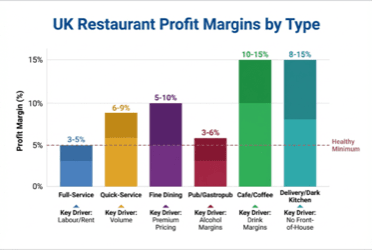
UK restaurant profit margins by type comparison
A quick-service restaurant might hit the higher end because it runs fewer staff per cover. Fine dining can charge premium prices but carries higher wage and ingredient costs. For most independent UK restaurants, a margin between five and ten percent net puts you in a strong position.
Not Where You Expected?
If you're reading this thinking "mine is lower than all of these", you're not alone. Many UK restaurants operated at razor-thin margins during 2022-2023. The important thing is knowing your current number so you can improve it.
For a detailed breakdown of how these averages compare, read our guide on average restaurant profit margins.
Is a 50% Profit Margin Too Much?
Let's clear this up. A 50% net restaurant profit margin would be extraordinary. Very few businesses in any industry achieve that. If your net margin is genuinely 50%, you're likely miscalculating by not including all your costs, or you're running a very unusual operation.
Pro Tip
Confusing markup with margin is often the cause of inflated profit calculations.
However, a 50% gross profit margin is actually below the UK restaurant average. Many restaurants aim for gross margins well above that (Sage, 2025). If your gross margin is sitting at fifty percent, your food costs are likely too high relative to your menu pricing.
For instance, a bistro spending £5 on ingredients for a dish selling at £10 has a fifty percent gross margin. Price that same dish at £15 and the margin jumps significantly. That extra margin is what covers your rent, staff, and everything else.
If you're only tracking revenue and thinking you're at 50% profit you'll always lose to competitors who understand the difference between gross and net margins.
Is a 30% Profit Margin Too Much?
Building on the 50% question, let's look at the 30% mark. A 30% net margin is well above average but not impossible. Some highly efficient dark kitchens and delivery-only operations achieve margins in this range because they eliminate front-of-house costs entirely (Epos Now, 2026).
For a traditional sit-down restaurant, 30% net is unrealistic. The combination of rent, business rates, staff wages, and rising food cost percentages typically caps net margins well below that.
Check Your Numbers
If your accountant is reporting 30% net, double-check that all costs are included, especially owner's salary, depreciation, and VAT obligations.
What About a 30% Gross Margin?
A thirty percent gross margin would be concerning. If you're unsure whether your gross margin is healthy, that's usually a sign your menu items need recosting. You're spending most of your food revenue on ingredients alone. Almost nothing left for overheads.
The sweet spot for many UK restaurants: aim for a gross restaurant profit margin in the high sixties to mid-seventies, and a net margin in the mid-single digits or better.
How to Calculate Your Restaurant Profit Margin
Now that you know the benchmarks, here's the formula you need. It takes five minutes once you have your numbers.
Gross Profit Margin:
(Revenue - Cost of Goods Sold) / Revenue x 100
Net Profit Margin:
(Revenue - All Expenses) / Revenue x 100
For example, a restaurant turning over half a million pounds annually with about a third going to food and drink costs has a gross margin in the mid-sixties. Once you add wages, rent, utilities, and everything else, the net profit might be around five percent.
Track Monthly
If you're thinking "I don't have time to calculate this every month", you don't have time not to. Restaurants that track margins monthly catch problems before they become crises.
A restaurant profit margin calculator can speed this up significantly. Understanding your break-even point is equally important: it tells you the minimum revenue needed before you start making any profit at all.
Profit Margin Improvement Checklist
- Calculate your current gross profit margin
- Calculate your current net profit margin
- Compare against UK benchmarks for your restaurant type
- Identify your three biggest cost categories
- Review menu pricing strategy quarterly
- Track labour cost percentage weekly
- Implement cost control measures for food waste
- Set a target net margin and review monthly
Why Are Restaurant Profit Margins So Low?
So you've got the numbers. But what happens when they're lower than expected? Here's where the typical cost breakdown tells the story.
The average UK restaurant spends roughly a third on food and drink, a third on labour, and the remaining third on rent, rates, utilities, insurance, and marketing (TheForkManager, 2026). Add those up and you're already past ninety percent of revenue before you've paid yourself.
That is why the restaurant industry carries some of the tightest restaurant profit margins of any sector.
For example, a neighbourhood Italian restaurant might find ingredients, wages, rent, and utilities consume almost everything. The net margin ends up in the low single digits before the owner takes a penny.
Restaurant profit margin isn't about cooking. It's about running a business that happens to serve food.
Info
Restaurant profit margins are not a fixed number, they're a score you can improve every single week.
Rising costs make it harder. But small improvements compound. Reducing food waste or increasing average spend per cover can shift your net margin meaningfully. So can spending less on marketing without losing results: work out how much time and money you could save and every pound trimmed lands straight in your net margin.
For practical strategies to move these numbers, our guide on how to increase restaurant profit covers the specific actions that make the biggest difference.
If You Only Have 30 Minutes This Week
If you only have 30 minutes a week to work on your restaurant profit margin, this is enough:
- Day 1-2: Pull your last month's total revenue and total food/drink costs. Calculate gross margin.
- Day 3-4: Add up all other costs (wages, rent, utilities, insurance). Calculate net margin.
- Day 5-7: Compare both figures against the benchmarks above. Identify the one cost category furthest from target.
That's enough to give you a clear picture. That single number, your net profit margin, tells you more about your restaurant's health than any other metric.
Frequently Asked Questions
What is the average profit per restaurant in the UK?
The average profit per restaurant in the UK is roughly twenty to thirty thousand pounds per year on a typical turnover (UKHospitality, 2025). This varies by size, location, and restaurant type. A small independent might net less, while a busy high-street restaurant could earn considerably more.
What is the typical profit margin for a restaurant?
For a UK full-service restaurant, the typical net profit margin is in the low single digits. Quick-service restaurants perform better, often reaching the high single digits (OpenTable, 2025). Gross profit margins are considerably higher, but overheads consume the majority of that gross profit.
Which type of restaurant is most profitable?
Quick-service and fast-casual restaurants often achieve the highest net margins due to lower labour costs per customer (Lightspeed, 2025). Fine dining can also deliver strong margins through premium pricing. The most profitable restaurant types tend to be those that control costs ruthlessly while maintaining value perception.
How much profit should a restaurant make per month?
A healthy UK restaurant should aim for a net margin of at least five percent per month. During peak months like December, margins often improve, while January and quieter periods may see breakeven or slight losses.
If you run a restaurant and want to see how Local Brand Hub can support your marketing, explore our restaurant marketing tools.
Key Takeaway
Key Takeaway
Your restaurant profit margin is the clearest indicator of business health:
- Gross margin target: mid-sixties to mid-seventies for many UK restaurants
- Net margin target: mid-single digits or better for a well-run operation
- Track both: gross margin without net margin gives you false confidence
- Compare against your type: a QSR and a fine dining restaurant operate on different models
- Small improvements compound: even a two-point improvement in net margin adds thousands to your annual profit
If you're only tracking revenue and not margins you'll always lose to competitors who know exactly where their money goes. The real secret is consistency. Track monthly. Adjust quarterly. Compound annually.
Start with your food cost percentage, review your pricing strategy, and work through the checklist above. Every percentage point you gain goes straight to your bottom line.
For restaurants, salons, and local businesses
Need help with your marketing?
We help UK businesses turn social media into real results, not busywork.
Start freeGet More Marketing Tips
Practical marketing tips for UK business owners, straight to your inbox. No spam, unsubscribe anytime.
About the Author
Local Brand Hub
Empowering UK Businesses
Local Brand Hub provides comprehensive business management tools designed specifically for UK local businesses to streamline operations, automate marketing, and grow revenue.
More articlesRelated Articles
 Business Growth
Restaurant Pricing Strategy: 7 Proven Methods
Master these 7 restaurant pricing strategy methods used by profitable UK restaurants. From cost-plus to psychological pricing, protect your margins.
 Business Growth
Restaurant Food Cost Percentage: Calculate and Control
Learn what a good restaurant food cost percentage is, how to calculate yours, and practical UK strategies to reduce food costs today.
 Business Growth
Most Profitable Restaurant Types in the UK
Compare the most profitable restaurant types in the UK. See net margins, startup costs and scalability for pizza, coffee shops, pubs and more.