
The average UK restaurant profit margin is 3-9% net. See 2026 benchmarks by type for full-service, QSR, fine dining, and pubs.
You've been running the numbers after a decent month. Revenue is up, the kitchen ran smoothly, and you even managed a quiet Sunday off. But when you look up the average restaurant profit margin to see how you compare, every article gives a different number.
Every source gives a different figure. The truth is there's no single average restaurant profit margin. It shifts depending on your type of restaurant. And UK figures differ from US ones, which is where most online data comes from.
Info
Related: Restaurant profit margin guide: the complete overview of how margins work and what drives them.
This guide gives you the actual UK benchmarks for 2026, broken down by restaurant type, so you can see exactly where your average restaurant profit margin sits.
What You'll Learn
- Current average profit margins for UK restaurants in 2026
- The difference between gross and net margin averages
- How your restaurant type compares to industry benchmarks
- Why UK margins differ from global averages
- What McDonald's and chain margins look like versus independents
What Is the Average Profit Margin for Restaurants in the UK?
Let's start with what actually matters for UK operators. The average restaurant profit margin method is a framework that compares your net profit to total revenue as a percentage. Across all UK restaurant types, the average sits in the low single digits net (UKHospitality, 2025).
Pro Tip
Always compare like-for-like. A QSR margin is not the same benchmark as a full-service restaurant.
Full-service restaurants typically operate with net margins in the three-to-five percent range (AccountantSilkeston, 2025). Quick-service restaurants often achieve higher average restaurant profit margins because they run fewer staff per customer (OpenTable, 2025).
If you're thinking "that sounds painfully thin," it is. Restaurant margins are among the lowest in any industry. The goal isn't to be average; it's to know where average sits so you can aim higher.
Many UK restaurants report healthy gross margins, yet only retain a small fraction as net profit once all costs are factored in (CLFI, 2025). According to UKHospitality, the hospitality sector consistently ranks among the most cost-pressured in the UK economy. The gap is where rent, wages, utilities, and rates consume most revenue.
For example, a pub turning over half a million with a strong gross margin might still keep only twenty thousand or so after all costs. That's the reality of the average restaurant profit margin.
Ask yourself: would you invest in a business with these returns if you weren't passionate about food?
Average Restaurant Profit Margin by Type
Here's where the detail matters. Different restaurant types operate on different economics. Comparing your average restaurant profit margin to the wrong benchmark leads to unnecessary panic, or false confidence.
| Restaurant Type | Average Net Margin | Key Differentiator |
|---|---|---|
| Full-service (sit-down) | 3-5% | Labour and rent heavy |
| Quick-service (QSR) | 6-9% | Volume-driven efficiency |
| Fine dining | 5-10% | Premium pricing offsets costs |
| Pub/gastropub | 3-6% | Alcohol margins help |
| Cafe/coffee shop | 5-8% | High-margin drinks |
| Delivery/dark kitchen | 10-15% | No front-of-house costs |
Sources: TheForkManager, 2026; OpenTable, 2025; Lightspeed, 2025. Note: figures are industry rules of thumb and may vary by location.
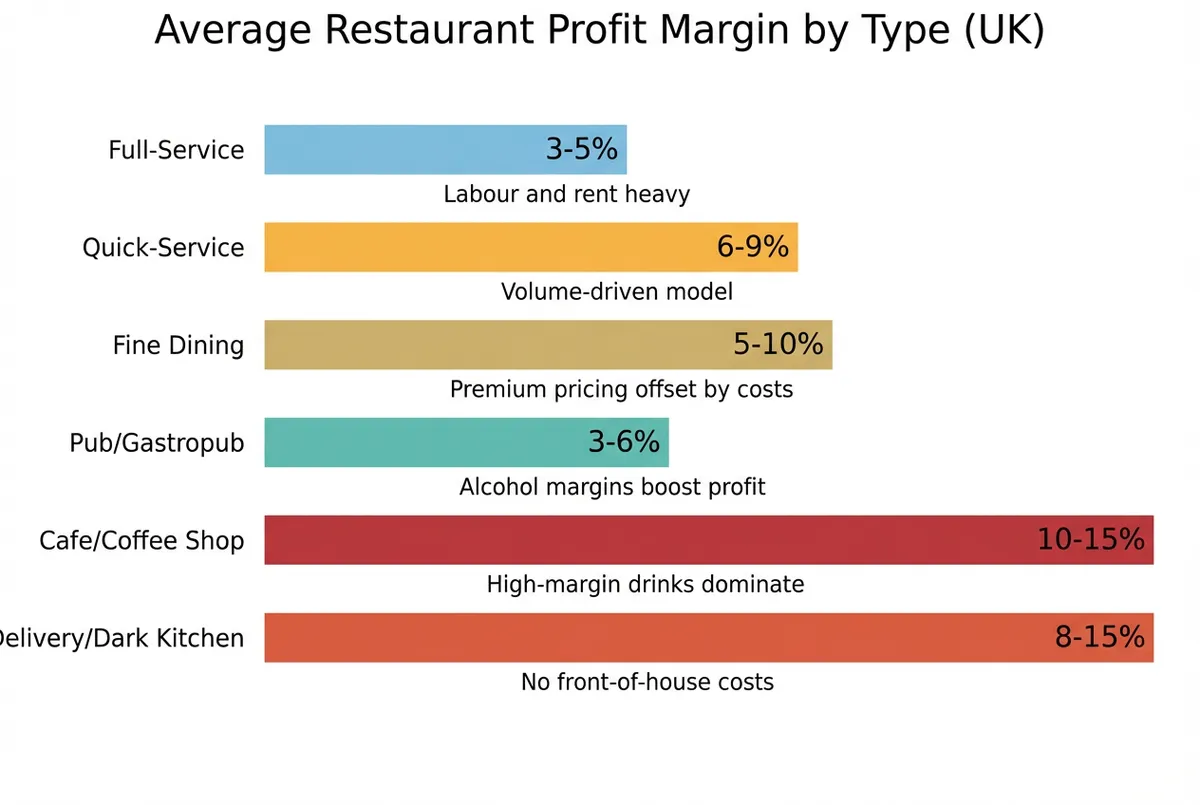
Average net margin percentages by restaurant type in the UK
Key Patterns
- Dark kitchens achieve the highest net margins because they eliminate front-of-house costs entirely
- Cafes perform well because drinks carry exceptionally high gross margins
- Full-service restaurants sit at the lower end because they carry the heaviest labour and premises costs
For instance, a family-run Italian restaurant in a market town might achieve a five percent net average restaurant profit margin and consider that a strong result. A fast-casual burger chain achieving only five percent would see that as underperformance. Context matters more than any single number.
Is a 50% Profit Margin Too Much?
Now let's tackle a question that comes up frequently. The answer depends on whether you mean gross or net.
A fifty percent net average restaurant profit margin would be virtually unheard of. Even efficient operations rarely exceed the mid-teens.
However, a fifty percent gross margin is actually below average. Many UK restaurants target gross margins well above that (Sage, 2025). If your gross margin is sitting at fifty percent, that's usually a sign your food costs are consuming too much revenue.
For example, a bistro buying ingredients for £6 and selling the dish at £18 delivers a strong gross margin. Drop that price to £12 and the margin halves. That difference is what separates restaurants that survive from those that thrive.
The confusion often arises when owners mix up markup and margin. Doubling the cost price gives you a fifty percent gross margin, not a hundred percent margin.
Get this wrong and your targets will be off. Understanding this distinction matters for setting average restaurant profit margin goals.
Is a 30% Profit Margin Too Much?
Building on the fifty percent question, let's look at thirty percent. A thirty percent net average restaurant profit margin would place you well above almost every industry benchmark (UKHospitality, 2025).
Achieving that would require either very low overheads or premium pricing that few markets support.
Some delivery-only and dark kitchen models approach the mid-teens net, but thirty percent remains unusual even there.
Common Calculation Mistakes
If you're calculating a thirty percent margin, check whether all costs are genuinely included. Common mistakes include forgetting owner's drawings, ignoring depreciation, excluding VAT, or missing pension contributions.
If you're reading this thinking "my margins are nowhere near thirty percent," you're not alone. Most operators are working to reach the high single digits, and that's strong.
For example, a dark kitchen might approach the mid-teens by cutting rent and labour. But a sit-down restaurant achieving that level would be remarkable.
What About a 30% Gross Margin?
A thirty percent gross margin would be concerning. It means you're spending most of your food revenue on ingredients alone. Almost nothing left for wages, rent, and overheads. If your gross margin has dropped that low, that's usually a sign of supplier pricing problems or menu items that aren't costed properly.
What Is McDonald's Profit Margin?
Next, let's look at the chain everyone asks about. McDonald's margin is a framework that requires careful context because direct comparison with independents is misleading. The company's global operating margin is far higher than any independent restaurant (McDonald's Corporation Annual Report, 2025). But that reflects franchise fees and rent income. Not individual restaurant performance.
Individual franchise restaurants achieve net margins significantly higher than the average restaurant profit margin for independents. This comes from structural advantages:
- Massive purchasing power driving ingredient costs down
- Highly systematised operations reducing labour waste
- Brand recognition delivering consistent footfall
For example, a McDonald's franchisee benefits from national advertising campaigns, centralised supply chains, and standardised processes: advantages that would cost an independent hundreds of thousands to replicate.
For an independent UK restaurant, these margins aren't achievable. But the principles are. Ruthless cost standardisation. Tight waste controls. Menu simplification.
You don't need McDonald's scale to apply their discipline to your cost control processes.
If you're only tracking your revenue without benchmarking against similar operations you'll always lose to competitors who know their average restaurant profit margin cold.
Your own time is a cost too: work out how much you could save by cutting the hours you spend on admin and marketing each week.
What's a Good Gross Profit Margin for a Restaurant?
Here's a key distinction. A good gross profit margin for a UK restaurant falls in the mid-sixties to mid-seventies (CLFI, 2025). This means for every pound of food or drink sold, roughly a quarter to a third covers ingredient costs.
The strategic insight is that your overall gross margin depends on your menu mix:
- Drinks carry the highest margins, coffee and soft drinks especially
- Desserts and starters are strong margin contributors
- Main courses typically carry the lowest food margin
- Alcohol falls in between, with spirits often outperforming beer
A gastropub with significant drink revenue will naturally have a higher gross margin than a restaurant where most sales come from food. Neither is wrong. Understanding your mix helps you set realistic average restaurant profit margin targets.
For example, a seafood restaurant where mains account for most revenue might have a lower gross margin than a wine bar where drinks dominate. Both could be performing well within their category.
The real secret is knowing your mix. Track monthly. Adjust quarterly. Compound annually.
For practical strategies on improving your margins across all categories, read our guide on how to increase restaurant profit.
Profit Margin Comparison Checklist
- Calculate your current net margin (all costs included)
- Calculate your gross margin by menu category
- Identify your highest and lowest margin categories
- Compare against benchmarks for your specific restaurant type
- Check if your menu mix is optimised for margin
- Review whether owner's salary is included in your calculations
- Set quarterly margin targets
If You Only Have 30 Minutes This Week
If you only have 30 minutes a week to benchmark your average restaurant profit margin, this is enough:
- Day 1-2: Calculate your gross margin from last month's figures (revenue minus food/drink costs, divided by revenue, times one hundred).
- Day 3-4: Calculate your net margin by subtracting all expenses from revenue. Include wages, rent, utilities, insurance, and your own drawings.
- Day 5-7: Compare both figures to the tables in this guide. Identify whether your gap is in gross margin (ingredient costs) or in overheads eating your gross profit.
That's enough to give you a clear picture. If your gross margin is healthy but net is thin, your overheads need attention. If gross margin is low, start with your food cost percentage and menu pricing.
Frequently Asked Questions
What is the average restaurant profit per month in the UK?
The average restaurant profit per month in the UK varies significantly by season. On a typical turnover with a net margin in the low single digits, most UK restaurants make roughly two thousand pounds per month in net profit (UKHospitality, 2025). December is often the strongest month and January typically the weakest.
Why are restaurant profit margins so low?
Restaurant margins are low because costs pile up from every direction. Rent. Rates. Insurance. Ingredients. Labour. Together they consume the vast majority of revenue.
Unlike digital businesses, restaurants cannot scale without adding costs. Every extra cover needs more food, more staff time, and more energy.
How does the average profit margin in the restaurant business compare to other industries?
The average restaurant profit margin ranks among the lowest of any sector. Software companies, professional services firms, and retail businesses all typically achieve significantly higher net margins (Statista, 2025). The restaurant industry's thin margins explain why a large proportion of UK restaurants close within their first three years.
What's the average restaurant profit per year for a small independent?
A small independent UK restaurant typically generates a modest annual profit, often supplemented by the owner's salary which is included in expenses. Total owner income (salary plus profit) is usually higher than the profit figure alone suggests.
How can I improve my restaurant's average profit margin?
The most effective approaches are reducing food waste, optimising menu pricing based on actual food cost percentages, managing labour scheduling more tightly, and increasing average spend per cover through upselling and menu engineering. Even a small improvement in net margin translates to meaningful additional profit on a typical restaurant turnover.
If you run a restaurant and want to see how Local Brand Hub can support your marketing, explore our restaurant marketing tools.
Key Takeaway
Key Takeaways: Average Restaurant Profit Margin
Understanding where your average restaurant profit margin sits against industry benchmarks is the first step to improvement:
- UK average net margin: low single digits for full-service, high single digits for QSR (UKHospitality, 2025)
- UK average gross margin: mid-sixties to mid-seventies across all restaurant types
- Context is everything: compare against your specific restaurant type, not generic averages
- Net margin is the real number: gross margin without net margin analysis creates blind spots
- Small improvements matter: even a two-point improvement translates to meaningful income
Numbers don't lie. But they need context. Know your type. Track monthly. Focus on the cost categories where you're furthest from benchmark.
For the complete overview of how restaurant profit margins work and strategies to improve yours, visit our restaurant profit margin hub.
For restaurants, salons, and local businesses
Need help with your marketing?
We help UK businesses turn social media into real results, not busywork.
Start freeGet More Marketing Tips
Practical marketing tips for UK business owners, straight to your inbox. No spam, unsubscribe anytime.
About the Author
Local Brand Hub
Empowering UK Businesses
Local Brand Hub provides comprehensive business management tools designed specifically for UK local businesses to streamline operations, automate marketing, and grow revenue.
More articlesRelated Articles
 Business Growth
Most Profitable Restaurant Types in the UK
Compare the most profitable restaurant types in the UK. See net margins, startup costs and scalability for pizza, coffee shops, pubs and more.
 Business Growth
Restaurant Break Even Point: How to Calculate Yours
Calculate your restaurant break even point with UK formulas and worked examples. Learn what good looks like and how to reach profitability faster.
 Business Growth
Restaurant Cost Control: Protect Your Margins
Master restaurant cost control with five key rules that keep costs in check. Practical steps to manage food, labour, and overhead costs for UK restaurants.