
Discover nine data-backed strategies to increase restaurant profit in the UK. Menu engineering, labour scheduling, and practical steps you can start today.
You're working seven days a week. The dining room fills on Saturdays. Reviews look decent. Yet at the end of every month, the bank balance barely moves. Learning how to increase restaurant profit starts with understanding that small, targeted changes deliver outsized results.
With average UK restaurant net margins sitting in the low single digits (UKHospitality, 2025), even a modest improvement makes a real difference. A two-to-three percentage point gain on a typical turnover means thousands more per year. Same kitchen. Same hours. More restaurant profit in your pocket.
Info
Related: Our complete guide to restaurant profit margins explains how healthy margins compare across restaurant types.
What You'll Learn
- The four core levers for increasing restaurant profit (and which to pull first)
- How to increase profit margins through menu engineering
- Cost control tactics that save money without cutting quality
- Revenue strategies that boost average spend per cover
- A 30-minute weekly plan to start improving restaurant profit immediately
How Can a Restaurant Increase Profit?
First, let's be clear about the fundamentals. There are only two ways to increase restaurant profit: earn more revenue or reduce costs. Every strategy in this guide falls into one of those categories, and the best operators work both sides simultaneously.
The Four Core Levers
A restaurant can increase profit by optimising menu pricing, reducing food waste, managing labour costs more tightly, and increasing average spend per customer. These four levers, applied consistently, can improve net margins meaningfully (The Access Group, 2025).
For instance, a neighbourhood Italian restaurant in Manchester focused solely on menu engineering for one quarter. They reclassified every dish, removed three low-margin items, and repositioned their two highest-margin pasta dishes. The result was a meaningful improvement in gross margin without changing a single recipe.
Start Small
If you're reading this thinking "I don't have time to analyse all this", you're not alone. Most owner-operators feel that way after a 12-hour shift. That's exactly why we've structured this as small, stackable wins you can tackle one at a time.
The mistake most owners make is trying to fix everything at once. Don't. Pick the one area where you're leaking the most restaurant profit, fix that, then move to the next.
What Are the 4 Ways to Increase Revenue?
Here's a framework that simplifies everything. There are fundamentally four ways to increase restaurant profit through revenue growth:
- Get more customers: marketing, visibility, reviews, and local SEO
- Increase spend per visit: upselling, premium options, menu engineering
- Increase visit frequency: loyalty programmes, seasonal menus, events
- Improve operational efficiency: reduce waste, optimise scheduling, renegotiate suppliers
These categories are a general rule of thumb: effort and cost vary by restaurant type, location, and current setup.
| Revenue Lever | Effort Level | Speed to Impact | Cost |
|---|---|---|---|
| More customers | High | Slow (weeks-months) | ££-£££ |
| Higher spend per visit | Medium | Fast (days-weeks) | £ |
| More repeat visits | Medium | Medium (weeks) | £-££ |
| Better efficiency | Low-Medium | Immediate | £ or free |
Which Lever Should You Pull First?
For most UK restaurants, increasing average spend per visit and improving operational efficiency offer the fastest, cheapest path to higher restaurant profit. If you're only chasing new customers you'll always lose to competitors who also maximise what existing customers spend. Before you pour money into winning new covers, it's worth working out the likely return so you back the lever that actually pays.
For example, a bistro in Birmingham increased average table spend significantly simply by training waiting staff to suggest a specific wine pairing with each main course. No extra marketing spend. No new customers needed. Just better execution with the customers already in the room.
Strategy 1: Engineer Your Menu for Profit
Let's start where most efforts to increase restaurant profit begin: your menu. If your best-selling dishes are also your lowest-margin items, you've got a structural problem that no amount of marketing will fix.
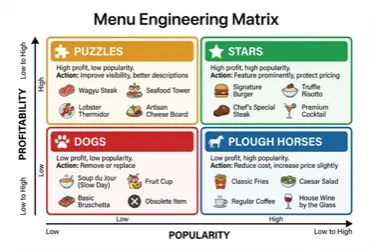
Menu engineering matrix for restaurant profit
Classify Every Dish
Use the menu engineering matrix to place each item into one of four categories:
These classifications are a general rule of thumb: adjust based on your specific restaurant's margins and customer base.
| Category | Popularity | Profitability | Action |
|---|---|---|---|
| Stars | High | High | Feature prominently, protect pricing |
| Puzzles | Low | High | Improve visibility, add descriptions |
| Plough horses | High | Low | Reduce portion cost, increase price |
| Dogs | Low | Low | Remove or replace |
For example, a gastropub might discover their fish and chips (a plough horse: popular but low margin) is outselling their lamb shank (a puzzle: high margin but rarely ordered). Moving the lamb shank to a prominent menu position with a better description could shift the sales mix toward higher restaurant profit per table.
Three Quick Wins
- Reposition Stars into the "golden triangle" (centre, top right, top left of the menu)
- Raise Plough horse prices gradually over two to three months
- Remove Dogs that haven't improved after one menu cycle
For a deeper dive, see our guide on restaurant menu optimisation.
Strategy 2: Reduce Food Waste Systematically
Next, let's tackle one of the biggest restaurant profit leaks. UK restaurants waste nearly a fifth of the food they purchase (WRAP, 2025). On a typical annual food spend, that adds up to tens of thousands going straight in the bin.
Practical Steps That Work
- Track waste daily with a simple waste log (a notebook by the bin is enough)
- Cross-utilise ingredients: vegetable trimmings become stock, bread ends become croutons
- Implement FIFO (first in, first out) storage rigorously
- Right-size portions using scales for expensive proteins
- Review ordering frequency: ordering twice a week instead of weekly reduces spoilage
For instance, a seafood restaurant in Bristol started tracking their waste and discovered they were throwing away hundreds of pounds per week in unused fish. By switching to smaller, more frequent deliveries and adding a daily specials board for ingredients nearing their use-by date, they cut fish waste by over half, a direct boost to restaurant profit.
If you're thinking "I don't have time to weigh every portion", start with your three most expensive ingredients. That's usually enough to increase restaurant profit noticeably within a month.
Info
Related: Our guide to restaurant food cost percentages shows exactly how to calculate and benchmark your food costs.
Strategy 3: Optimise Labour Scheduling
However, food isn't the only cost worth scrutinising when learning how to increase restaurant profit. Labour typically consumes roughly a third of restaurant revenue (UKHospitality, 2025). With the National Living Wage continuing to rise (UK Government, 2025), that percentage keeps climbing.
This isn't about cutting staff or paying less. It's about matching staffing levels to actual demand. If you're only scheduling on instinct you'll always lose to competitors who use actual booking data to plan every shift.
Match Staff to Demand
For example, a family-run Thai restaurant might schedule three servers every evening regardless of bookings. By analysing covers per day of the week over three months, they could find early weeknights averaging far fewer covers than the weekend rush. Adjusting schedules to match saves hours without affecting service, and protects restaurant profit on quieter nights.
Ask yourself: do you actually know which shifts are overstaffed relative to covers served? If not, that's worth investigating before your next rota.
For detailed labour benchmarks, see our guide on restaurant labour cost percentage.
Strategy 4: Increase Average Spend Per Cover
Now let's look at the revenue side of how to increase restaurant profit. Increasing how much each customer spends is often easier and cheaper than getting more customers through the door.
Simple Techniques That Work
- Upselling drinks: train staff to suggest a specific wine with the main, not just "any drinks?"
- Dessert prompts: bring the dessert menu automatically rather than asking if they want to see it
- Side suggestions: "our truffle fries go perfectly with that" beats "any sides?"
- Premium options: offer an upgraded version of popular dishes at a higher margin
For example, a pizza restaurant in Leeds introduced a "premium pizza" tier with buffalo mozzarella and imported San Marzano tomatoes at a small premium. The upgrade costs them a fraction of what customers pay extra, and around a third of diners now choose it, adding meaningfully to restaurant profit every week.
Pro Tip
Even small per-cover gains compound fast. Train your team on specific suggestions rather than generic upselling scripts.
Strategy 5: Add Revenue Streams and Reduce No-Shows
Building on the revenue theme, most UK restaurants rely almost entirely on dine-in revenue. Diversifying creates resilience, protects restaurant profit during quiet periods, and often delivers higher margins:
- Click-and-collect takeaway: no third-party commission fees
- Private events and catering: higher margins with guaranteed revenue
- Meal kits and retail: sauces, marinades, and pre-prepared meals
For example, a Vietnamese restaurant in Cardiff launched a weekend meal kit service during a quiet January. The kits delivered better margins than most dine-in mains, and within two months accounted for roughly 10% of their weekly revenue, a meaningful way to increase restaurant profit without additional covers.
No-shows are another silent restaurant profit killer. Deposits and automated reminders can cut no-shows significantly (TheForkManager, 2025). If you're not taking deposits for tables of four or more, you're likely absorbing losses that are entirely preventable.
Strategy 6: Review Menu Pricing Quarterly
Let's address the elephant in the room when it comes to how to increase restaurant profit. Many UK restaurants haven't raised prices in over a year despite ingredient costs rising steadily (ONS, 2026). If you're absorbing rising costs without adjusting prices, that's usually a sign your margins are shrinking invisibly.
Diners generally accept modest annual menu price increases without reducing visit frequency, provided quality perception remains consistent.
What a Price Increase Looks Like
For example, a brunch cafe in Glasgow raised prices modestly across their menu in early 2026. They lost no measurable footfall and the price adjustment added meaningfully to their bottom line each month. The key was raising every item at once rather than singling out popular dishes. Pricing is one of the simplest levers for how to increase restaurant profit, yet it's the one most owners avoid longest.
For pricing psychology and implementation, see our guide on restaurant pricing strategy.
Strategy 7: Negotiate Supplier Costs
Here's where many operators leave money on the table. If you haven't reviewed your supplier terms in the past 12 months, that's usually a sign you're overpaying. Supplier relationships shouldn't be set-and-forget when you're working to increase restaurant profit:
- Get three quotes for every major ingredient category annually
- Join a buying group: independent restaurant purchasing cooperatives exist across the UK
- Negotiate payment terms: 30-day terms instead of 14 improve cash flow
- Buy seasonal: seasonal ingredients are cheaper and taste better
- Review specifications: do you need premium fillet steak, or would bavette work for that stew?
For instance, a curry house in Leicester switched from a national wholesaler to a regional supplier for their spice blends and saved substantially on their biggest ingredient category. The quality was comparable, and the shorter delivery distances meant fresher stock. Small changes like this are exactly how to increase restaurant profit without requiring any extra revenue.
Strategy 8: Control Utilities and Overheads
Finally, don't overlook costs that seem "fixed" when trying to increase restaurant profit. Many have negotiable or reducible components:
- LED lighting throughout (payback typically under 12 months)
- Smart thermostats for heating and cooling zones
- Equipment maintenance: a poorly maintained fridge uses significantly more energy (Carbon Trust, 2025)
- Insurance review: get competitive quotes annually, not just at renewal
- Subscription audit: cancel any software unused in the last 90 days
For example, a tapas bar in Brighton audited their monthly subscriptions and discovered they were paying for three different booking platforms, two of which were redundant. Cancelling the extras saved hundreds per month, money flowing straight to restaurant profit.
If you're thinking "none of this is exciting", that's the point. Profitable restaurants are usually boring behind the scenes. The excitement is on the plate and in the bank account.
Restaurant profit isn't about one big change. It's about twenty small ones that compound every week.
Weekly Action
- Pick one line item from the checklist below
- Spend 30 minutes investigating it: pull the numbers, make one call, or check one invoice
- Note what you find and schedule the fix
One item per week. By the end of the quarter, you'll have covered every major cost category that affects restaurant profit.
Cost Control Checklist
- Calculate food cost percentage for every menu item
- Implement daily food waste tracking
- Review labour schedules against actual covers per shift
- Get three supplier quotes for top five ingredient categories
- Audit utility costs and identify quick wins
- Set a target net profit margin for the next quarter
- Train staff on upselling specific items (not generic prompts)
- Review menu prices against current food costs
- Introduce a no-show policy (deposits or reminders)
If you're only reviewing numbers yearly you'll always lose to competitors who check theirs monthly and adjust in real time.
What Are the 5 P's of Service in Restaurants?
Moving on to a broader framework, the 5 P's of restaurant service ties service quality directly to restaurant profitability. The five elements are People, Product, Place, Process, and Promotion. Each one influences how much customers spend and whether they return.
How the 5 P's Drive Profit
- People: well-trained staff who upsell naturally and create positive experiences
- Product: consistent food quality that justifies your pricing
- Place: an atmosphere that makes customers want to stay (and order another round)
- Process: efficient workflows from booking to bill that maximise covers without rushing
- Promotion: targeted marketing that brings the right customers at the right times
For example, a fine-dining restaurant in Edinburgh improved their "Process" P by reducing the time between courses significantly. The result: they could fit in an extra seating on busy nights without customers feeling rushed, directly boosting restaurant profit per evening.
The profitable restaurants aren't necessarily those with the best food. They're the ones where all five P's work together to increase restaurant profit consistently.
If You Only Have 30 Minutes This Week
Here's your starting point if time is tight. You don't need to overhaul everything, just find the biggest restaurant profit leak first.
This Week's Action Plan
- Day 1-2: Check your food cost percentage. Divide total food purchases last month by total food revenue. If it's above 35%, that's your starting point.
- Day 3-4: Check your labour percentage. Divide total wage costs by total revenue. If it's above 30%, review scheduling for your quietest shifts.
- Day 5-7: Pick whichever percentage is furthest from target. Choose one strategy from this guide to address it this month.
One focused change per month. Twelve changes per year. That's how restaurant profit margins improve.
Frequently Asked Questions
What's the typical profit margin for a restaurant?
The typical net profit margin for a UK full-service restaurant sits in the low single digits, while quick-service restaurants often achieve higher (UKHospitality, 2025). For detailed benchmarks by restaurant type, see our guide on restaurant profit margins.
How quickly can I see results from these changes?
Menu repositioning and pricing adjustments typically show results within a few weeks. Labour scheduling changes take effect immediately. The compounding effect of multiple small changes to increase restaurant profit creates substantial improvement within a single quarter.
What are the three C's in a restaurant?
The three C's are Cuisine, Customer experience, and Cost management. Cuisine drives repeat business and justifies pricing. Customer experience generates reviews and referrals. Cost management ensures revenue translates into profit rather than being consumed by waste and inefficiency. Mastering all three is fundamental to how to increase restaurant profit sustainably.
How much can a restaurant save by reducing waste?
UK restaurants waste nearly a fifth of purchased food (WRAP, 2025). Even modest waste reduction efforts can save thousands annually, with most of those savings flowing directly to restaurant profit.
What's the single most effective way to increase restaurant profit?
Menu engineering: analysing each dish by both profitability and popularity, then adjusting your menu design, pricing, and promotions accordingly. This addresses both revenue and costs simultaneously, and many restaurants see measurable improvement within three months of implementing it.
If you run a restaurant and want to see how Local Brand Hub can support your marketing, explore our restaurant marketing tools.
Key Takeaway
Key Takeaway
Increasing restaurant profit isn't about working harder; it's about working on the right things.
The Essentials
- Four core levers: reduce food costs, manage labour, increase average spend, and review pricing
- Menu engineering delivers the highest single impact for most restaurants
- Food waste reduction can save thousands in ingredient costs with minimal effort
- Revenue diversification protects restaurant profit during quiet periods
- Price increases are often long overdue: customers rarely notice a well-executed 5% adjustment
- Systematise cost control: make it a weekly discipline, not an annual panic
Your Next Step
Start with whichever strategy addresses your biggest cost leak. Build from there. And revisit your restaurant profit margins quarterly to track progress. The path to better restaurant profit is achievable through these strategies, applied consistently over 6-12 months.
For restaurants, salons, and local businesses
Need help with your marketing?
We help UK businesses turn social media into real results, not busywork.
Start freeGet More Marketing Tips
Practical marketing tips for UK business owners, straight to your inbox. No spam, unsubscribe anytime.
About the Author
Local Brand Hub
Empowering UK Businesses
Local Brand Hub provides comprehensive business management tools designed specifically for UK local businesses to streamline operations, automate marketing, and grow revenue.
More articlesRelated Articles
 Business Growth
Most Profitable Restaurant Types in the UK
Compare the most profitable restaurant types in the UK. See net margins, startup costs and scalability for pizza, coffee shops, pubs and more.
 Business Growth
Restaurant Break Even Point: How to Calculate Yours
Calculate your restaurant break even point with UK formulas and worked examples. Learn what good looks like and how to reach profitability faster.
 Business Growth
Restaurant Cost Control: Protect Your Margins
Master restaurant cost control with five key rules that keep costs in check. Practical steps to manage food, labour, and overhead costs for UK restaurants.