
Calculate your restaurant labour cost percentage in the UK, see what an hour of staff time costs after NI, pension and holiday, and set your own ceiling.
Restaurant labour cost percentage is total staff cost divided by total revenue, times 100. Total staff cost means wages plus employer National Insurance, pension contributions, holiday pay, agency cover and staff meals. There is no single correct figure. Your ceiling is whatever is left after food cost, fixed overheads and the profit you actually need.
It is Tuesday morning. Last week's rota is still pinned to the corkboard with Saturday crossed out twice, and the payroll figure in your inbox is not the one you budgeted for. Somewhere between those two pieces of paper is the number this page is about.
Nearly every guide answers this with a comfortable band. Twenty-something to thirty-something percent, depending on who is writing and whether they have ever run a Saturday service. None of them know your rent. So this guide does something else: it works out what an hour of your labour genuinely costs, then the ceiling your own profit and loss can carry. Every figure below links to the government page it came from.
What you'll learn:
- What belongs in total labour cost, and what most owners leave out
- What an hour of staff time really costs after National Insurance, pension and holiday
- How to calculate the percentage, and how to derive your own ceiling
- Which levers move the number, and three things that make it lie
What counts as labour cost in a restaurant?
Total labour cost is every pound that leaves your account because a human being worked a shift. The formula is the easy half.
Labour cost percentage = (total labour cost / total revenue) x 100
The numerator is where restaurants go wrong.
| Counted by most owners | Usually forgotten |
|---|---|
| Basic wages and salaries | Employer National Insurance |
| Overtime | Employer pension contributions |
| Agency invoices | Holiday pay accrual |
| Casual and bank staff | Staff meals and uniforms |
| Owner and manager hours | Training and recruitment |
These groupings are a rule of thumb, not an accounting standard; your accountant may post some lines differently.
Everything in the right hand column is real money landing on the same bank statement. For example, an owner counting only the left hand column reads a percentage a couple of points below the truth, then spends a year wondering where the profit went.
Why does an hour cost more than the rate on your rota?
From 1 April 2026 the National Living Wage for workers aged 21 and over is £12.71 an hour (GOV.UK). That is the figure you write on the rota. It is not the figure that leaves the bank.
Employer National Insurance is stacked on top first. For the current tax year, employers pay secondary Class 1 contributions at 15% on a standard employee's earnings above the secondary threshold of £5,000 a year (GOV.UK). The threshold applies per employee, not per business, which is why two rotas with identical hours can carry very different NI bills: one built from full timers, one from students doing a single shift a week.
What do pension and holiday add?
Pension and holiday add a second layer that never appears on a rota, because payroll handles both quietly.
Under automatic enrolment the minimum employer contribution is 3% of a jobholder's qualifying earnings, within a total minimum of 8% (The Pensions Regulator). Qualifying earnings is a band rather than gross pay, so the cash cost lands under three percent of the payslip.
Holiday distorts every mental calculation. Almost all people classed as workers are legally entitled to 5.6 weeks of paid holiday a year (GOV.UK). You pay for a full year and roster roughly forty-six weeks of it, so an hour worked costs more than an hour paid for.
What does one hour really cost? A worked example
Put a hypothetical full time kitchen porter through that, on the National Living Wage. Gross pay, employer National Insurance and the minimum pension come to roughly £30,200 across the year.
Holiday takes weeks out of the roster, so about 1,850 hours are actually worked. That is £16.30 an hour of worked time.
The rota said £12.71. The bank says otherwise, and the bank is the one you answer to.
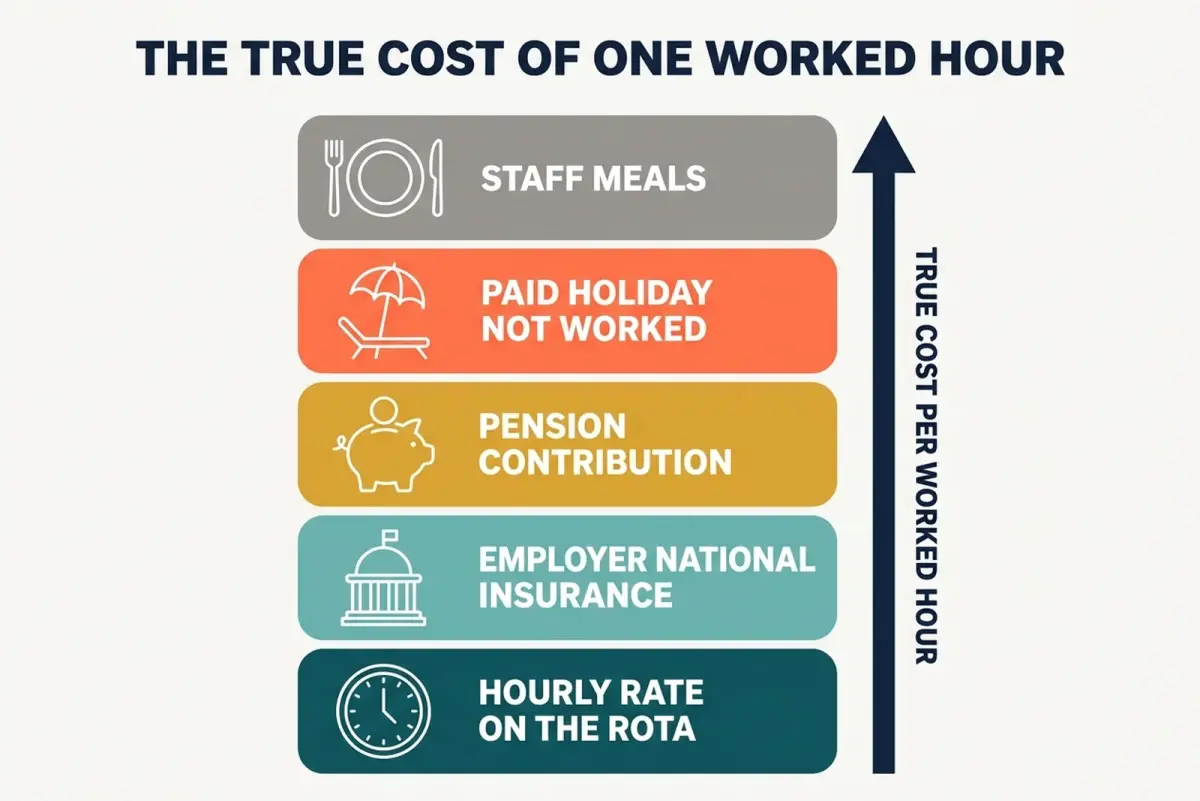
The rate on the rota is the bottom block, not the whole column.
How do you calculate your restaurant labour cost percentage?
Run it monthly at minimum, weekly if you are actively fixing something. A manager rebuilding a Saturday rota wants the figure before the next rota is published, not at the end of the quarter.
- Total labour cost for the period. Payroll gross, plus employer NI and pension from the same report, plus agency invoices dated in that period.
- Total revenue for the same period. Use the figure your accountant uses on the profit and loss.
- Divide and multiply by a hundred.
- Write it beside last month's. One figure on its own tells you little. A trailing thirteen weeks tells you whether the rota is drifting.
For a per hour view, divide total labour cost by hours actually worked. That is the number to have in your head when someone asks for an extra body on Thursday.
Your labour cost checklist:
- Add employer NI and pension to the payroll gross figure
- Add agency invoices and staff meals for the same period
- Divide by revenue from the profit and loss, not the till total
- Work out your true cost per worked hour
- Put sales by hour next to hours rostered for one week
So what should your labour cost percentage be?
Work backwards. Your ceiling is a residual, not a benchmark. Start with a pound of sales and take away what is already spoken for: what the food and drink cost you, what the building costs you whether you open or not, and the profit you need to service the loan and pay yourself.
Picture a forty five seat neighbourhood restaurant. Its costs break down like this:
- Food and drink cost: 30%
- Rent, rates, energy, insurance, repairs and marketing: 22%
- The profit needed to cover the loan and take a wage: 10%
That accounts for 62%, leaving 38% for labour. Their actual figure last month was 34%, so they have headroom and a decision: a second chef, or bank it.
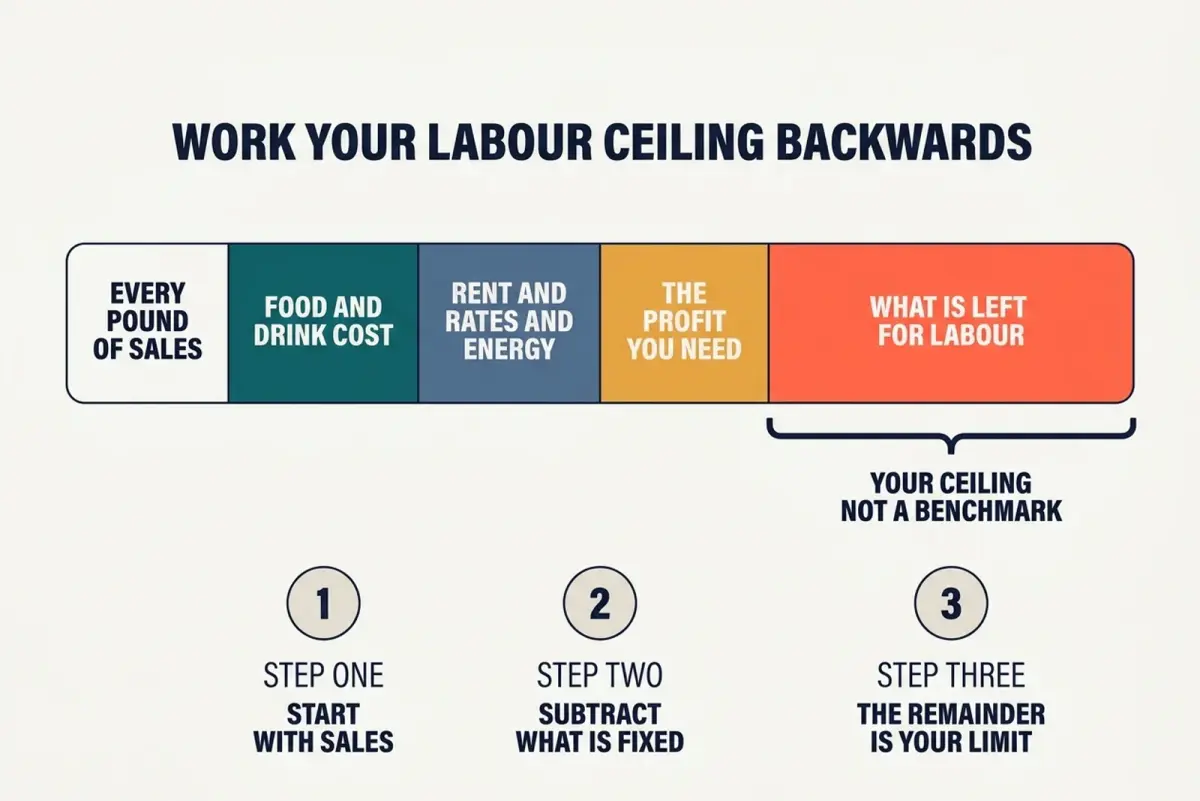
Two restaurants can run the same labour percentage and only one of them is fine.
Why is the same percentage fine in one restaurant and fatal in another?
Rent does not care what your rota looks like. Move that same restaurant into a high street unit at double the rent and the fixed block swallows a third of every pound before anyone picks up a knife. Same menu, same team, same service, and the ceiling drops by roughly ten points. The rota that was comfortable is now the thing killing them.
Pair your figure with your restaurant food cost percentage and you have prime cost. The two move against each other: cooking from scratch pushes food cost down and labour up, buying prepped does the reverse. Optimise the pair, never one alone.
Where does the number actually move?
Match the rota to demand using two data sets, not one. Sales by hour on its own cannot tell you a shift was overstaffed. Put sales by hour next to hours rostered by hour and the mismatch surfaces immediately: for instance, the Tuesday lunch carrying three people for eleven covers, or the Saturday at eight where two staff are drowning.
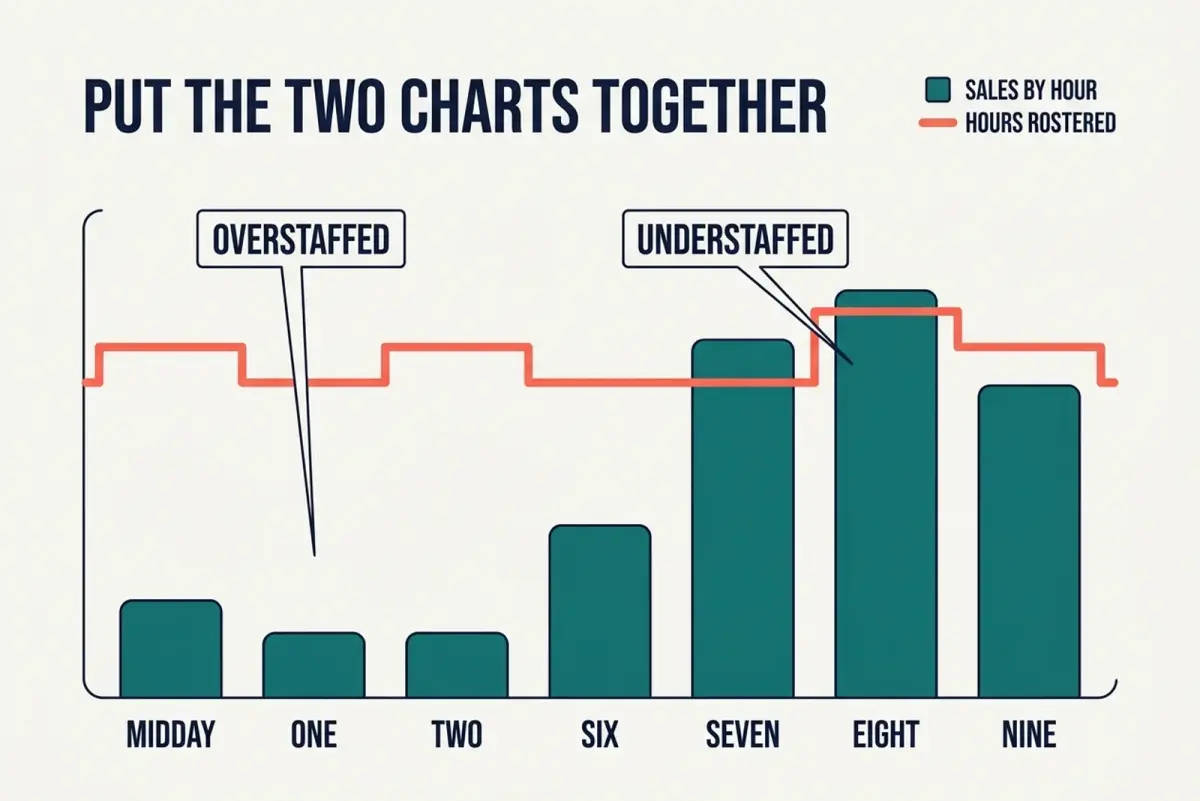
The gap between the bars and the line is the money.
Cross train before you recruit, and treat agency spend as a symptom. A server who can plate desserts and a KP who can run a section give you cover without a headcount. Agency cover is usually a retention problem wearing a costume, so build a direct bank of former staff and part timers and call them first.
Grow the denominator. Labour percentage has two halves and everyone forgets the bottom one. Twenty extra covers on a Tuesday you are already staffed for improve the ratio without touching the rota. That is a marketing job: LocalBrandHub's seasonal campaign library and social calendar exist for exactly that, filling the quiet nights you already pay for. It does not touch your payroll figures, and no marketing tool should pretend to. See what it covers.
Three things that make the number lie
Tips are not a wage subsidy. Since 1 October 2024, employers are required to pass all tips, gratuities and service charges on to their employees (GOV.UK). If your labour line is quietly netted against service charge, the percentage you are reading is fiction. Ask your payroll provider how your tronc is set up rather than guessing.
The owner's hours count. If you work sixty hours a week and pay yourself in dividends and hope, your labour cost is flattered by exactly the value of those hours. Cost your own time at what a manager would charge you. The number will hurt, and it will be true.
Calendars are not equal. A month with five Saturdays against one with four is a calendar, not a trend. Compare like periods before you change the rota.
Pro Tip: Keep two numbers on the office wall, not one. The percentage tells you what happened last month. Your true cost per worked hour tells you what to do about Thursday.
Frequently asked questions
What percentage should labour cost be in a restaurant?
There is no universal figure, and any guide quoting one has not seen your lease. Work it out as a residual: take your food and drink cost, your fixed overheads and the profit you need out of total sales, and whatever remains is the ceiling labour can occupy.
What counts as labour cost in a restaurant?
Wages and salaries, overtime, holiday pay, employer National Insurance, employer pension contributions, agency and casual cover, staff meals, uniforms, training and recruitment. If the cost exists because a person worked a shift, it belongs in the numerator.
How do I work out my true cost per labour hour?
Divide total labour cost for a period, including employer NI, pension and holiday pay, by the hours actually worked in it. Worked hours, not paid hours, because paid holiday is time you fund and never roster.
Do tips and service charge reduce my labour cost?
No. Since 1 October 2024, employers are required to pass all tips, gratuities and service charges on to their employees (GOV.UK). Treat tips as money passing through the business, and check with your payroll provider that your tronc reflects that.
How often should I check my labour cost percentage?
Monthly for a stable site, weekly if you are fixing a rota, opening, or trading through a season that swings hard. Keep a trailing thirteen week view alongside it so a five Saturday month does not read as progress.
Does a National Living Wage rise mean my percentage has to rise?
Not automatically, but the pressure is real: from 1 April 2026 the rate for workers aged 21 and over is £12.71 an hour (GOV.UK). Holding the percentage steady means the same hours producing more revenue, or fewer hours producing the same.
Key takeaways
Key Takeaway
- Total labour cost includes employer NI, pension and holiday pay, not just wages.
- The rate on your rota is the bottom of the column, not the cost of an hour.
- Your ceiling is a residual from your own profit and loss, not a borrowed band.
Thirty minutes with last month's payroll report is enough to get a true labour cost percentage and change one shift. Add employer NI and pension to last month's payroll gross; if you have been counting wages alone, expect that single addition to move your figure by a couple of points. Divide by last month's revenue and write the result on the office wall. Then take one shift, put sales by hour beside hours rostered, and cut or add one person.
That last step is the method in miniature: a small, reversible experiment you adjust next week rather than a policy you have to defend.
Get started with last month's payroll report, then read the restaurant profit margin guide to see where the rest of every pound goes.
Guide reviewed and last updated 13/08/2026. Every figure quoted here is sourced to the government page it came from, listed below; the hourly and ceiling arithmetic is illustrative, not a benchmark.
For restaurants, salons, and local businesses
Need help with your marketing?
We help UK businesses turn social media into real results, not busywork.
Start freeSources
Get More Marketing Tips
Practical marketing tips for UK business owners, straight to your inbox. No spam, unsubscribe anytime.
About the Author
Local Brand Hub
Empowering UK Businesses
Local Brand Hub provides comprehensive business management tools designed specifically for UK local businesses to streamline operations, automate marketing, and grow revenue.
More articlesRelated Articles
 Business Growth
Most Profitable Restaurant Types in the UK
Compare the most profitable restaurant types in the UK. See net margins, startup costs and scalability for pizza, coffee shops, pubs and more.
 Business Growth
Restaurant Break Even Point: How to Calculate Yours
Calculate your restaurant break even point with UK formulas and worked examples. Learn what good looks like and how to reach profitability faster.
 Business Growth
Restaurant Cost Control: Protect Your Margins
Master restaurant cost control with five key rules that keep costs in check. Practical steps to manage food, labour, and overhead costs for UK restaurants.