
Master restaurant cost control with five key rules that keep costs in check. Practical steps to manage food, labour, and overhead costs for UK restaurants.
You've just finished last month thinking revenue was solid. Covers were up, the dining room felt busy most nights. Then the bank statement arrived, and somehow you ended up with less than you started with. That gap between busy and profitable is exactly what restaurant cost control is designed to close.
Related: Restaurant profit margin, this guide is part of our series covering every lever that affects your bottom line.
If you're reading this thinking "I know my costs are too high, but I don't know where to start", that's usually a sign you need a system, not just willpower. Most independent restaurant owners rely on gut instinct until a bad month forces them to act. This guide gives you the framework, the rules, and the practical steps to get costs under control before they control you.
What You'll Learn
- What cost control actually means in a restaurant context and why it matters
- The five rules of restaurant cost control that keep margins healthy
- How to control food costs using recipe costing and inventory management
- Practical strategies for managing labour and overhead expenses
- Software tools that make cost tracking easier for small operations
What Is Cost Control in a Restaurant?
First, let's define what we mean. Restaurant cost control is a framework that systematically monitors, analyses, and reduces operating expenses to protect profit margins. It covers everything from food purchasing and recipe costing to labour scheduling and utility management. The goal is not to spend as little as possible; it is to spend the right amount on the right things.
Here is the distinction that matters: cost cutting is reactive. Restaurant cost control is proactive.
Ask yourself: do you know your exact food cost percentage this week, or are you guessing?
Cost control is not about being cheap. It is about making every pound you spend earn its place on the P&L.
For example, a casual dining restaurant spending 33% on food, 30% on labour, and 20% on overheads is running at 83% total costs, leaving a thin but workable margin. A well-run restaurant typically operates within three major cost buckets:
| Cost Category | Target % of Revenue | What It Includes |
|---|---|---|
| Food costs | 28-35% | Ingredients, waste, spoilage |
| Labour costs | 25-35% | Wages, NI, pensions, agency staff |
| Overheads | 15-25% | Rent, utilities, insurance, marketing |
These three categories together make up your prime costs and operating expenses. When they creep above 85-90% of revenue, that's usually a sign your margins are being squeezed to a point where one bad week tips you into a loss (UKHospitality, 2025).
For a deeper look at food-specific benchmarks, see our guide to restaurant food cost percentage.
The Five Rules of Restaurant Cost Control
Now that you understand what restaurant cost control means, here are the five rules. Every restaurant operates differently, but these five rules apply whether you are a fine dining spot in Mayfair or a fish and chip shop in Whitby.
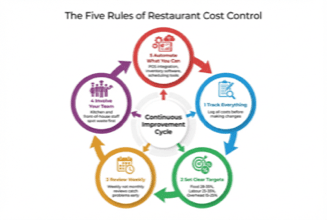
The five rules of restaurant cost control work as a continuous cycle.
Rule 1: Track Everything Before You Try to Change Anything
You cannot control what you do not measure. Before making any cuts, spend two weeks recording exactly where money goes. This means logging deliveries, counting stock, and reviewing labour against covers.
Many owners skip this step. For instance, a bistro owner might jump straight to "we need cheaper suppliers" without knowing whether waste, over-portioning, or scheduling is the real problem.
Rule 2: Set Clear Cost Targets by Category
Once you have data, set targets. Industry benchmarks suggest keeping total prime costs (food + labour) below 60-65% of revenue (Deloitte Hospitality Report, 2025). But your specific targets depend on your format.
| Restaurant Type | Food Cost Target | Labour Cost Target | Prime Cost Target |
|---|---|---|---|
| Fine dining | 30-35% | 30-35% | 60-70% |
| Casual dining | 28-32% | 28-32% | 56-64% |
| Quick service | 25-28% | 25-30% | 50-58% |
| Pub/gastropub | 30-35% | 25-30% | 55-65% |
Rule 3: Review Weekly, Not Monthly
Monthly reviews catch problems too late. By the time you spot a cost spike in March's accounts, you have already lost four weeks of margin. Weekly reviews take 30 minutes and catch issues within days.
Rule 4: Involve Your Team
If your kitchen team does not understand portion control or waste targets, your cost control efforts stop at the office door. Share relevant numbers with your chefs and front-of-house managers. Based on our experience, people manage what they feel responsible for. Industry professionals consistently recommend transparency with your team about cost targets.
Rule 5: Automate What You Can
Manual tracking works, but it does not scale well when you are already working a 12-hour shift. Even basic tools like spreadsheets or free inventory apps reduce the admin burden enough to keep the process sustainable.
Pro Tip
How to Control Food Cost in Your Restaurant
With that foundation in place, let's tackle the biggest cost category. Food cost is typically the single largest controllable expense in a restaurant. The UK restaurant industry averages around 30-32% food cost as a percentage of revenue (CGA by NIQ, 2025). Here is how to bring yours in line.
Recipe Costing
Recipe costing is the foundation of food cost control. Every dish on your menu should have a costed recipe card showing the exact ingredient quantities, supplier prices, and total cost per portion.
For example, a gastropub running a Sunday roast menu might discover their beef joint costs £4.20 per portion, but the accompanying vegetables and Yorkshire puddings add another £1.80, making the true plate cost £6.00, not the £4.20 they assumed.
Action Step
Inventory Management
Effective stock control prevents over-ordering and reduces spoilage. The British Hospitality Association estimates that UK restaurants waste approximately 18% of the food they purchase (BHA, 2025).
Three steps to tighten inventory:
- Count stock weekly: same day, same time, every week
- Use FIFO (First In, First Out): rotate stock so oldest items get used first
- Track waste separately: know the difference between prep waste and plate waste
Portion Control
Inconsistent portioning is a silent margin killer. A 10% over-pour on your most popular dish across 200 covers a week adds up to thousands of pounds over a year.
For instance, if your chicken breast portion should weigh 200g but your cooks regularly plate 220g, you are giving away 10% of that ingredient cost on every single serve.
If you're thinking "my chefs know what they're doing", that is fair. But even experienced chefs develop portion drift over time without scales and standardised guides to keep them honest.
For more on managing food costs specifically, see our detailed guide to restaurant food cost percentage.
Managing Labour Costs Without Cutting Staff
Next, let's address the other half of your prime cost equation. Labour costs matter just as much. UK hospitality businesses now face a National Living Wage of £12.21 per hour from April 2025 (UK Government, 2025), plus employer NI contributions and pension auto-enrolment. Controlling labour costs is not about paying people less; it is about scheduling smarter.
Match Staffing to Demand
If you're reading this thinking "I either have too many staff or not enough, never the right number", that's usually a sign your scheduling needs data rather than instinct. You are describing the core scheduling challenge every restaurant faces.
Use your EPOS data to map covers by hour, by day, by season. Then build rotas that match staffing levels to actual demand rather than habit.
Cross-Train Your Team
A kitchen porter who can prep during quiet spells, or a front-of-house team member who can cover the bar, gives you flexibility without adding heads. Cross-training reduces the need for agency staff, which typically costs 15-25% more per hour than permanent employees.
Monitor Overtime
Overtime is often invisible until payroll hits. If you're only checking labour costs at month end you'll always lose to competitors who monitor them weekly. Set alerts when any team member approaches their contracted hours and build buffer into your rota rather than relying on extra shifts.
For a deeper breakdown of labour benchmarks, see our guide to restaurant labour cost percentage.
Overhead and Operating Cost Control
Additionally, overheads are the costs that keep coming whether you serve 50 covers or 500. Controlling them requires a different restaurant cost control approach than food or labour. For example, a restaurant paying high rent might negotiate terms at renewal, while another might focus on energy reduction for quicker savings. Marketing sits in this bucket too, and it is the one overhead that should pay for itself. Before you trim it, work out the return your marketing spend is actually delivering.
Energy Costs
UK restaurant energy bills rose significantly between 2025 and 2026. While prices have stabilised somewhat, energy remains a major overhead. Practical steps include:
- Switch to LED lighting: reduces lighting costs by up to 75% (Energy Saving Trust, 2025)
- Maintain equipment regularly: a poorly maintained fridge uses considerably more energy
- Install smart thermostats: programme heating to match opening hours, not run 24/7
Rent and Rates
Negotiating rent is possible, especially at lease renewal. Business rates relief may be available for smaller premises: check GOV.UK for current eligibility criteria.
Supplier Negotiations
Review supplier contracts at least twice a year. Get three quotes for major categories. Even a 3-5% reduction on your biggest supplier line saves meaningful money over 12 months.
Quick Win
For more strategies on improving your bottom line, explore our guide on how to increase restaurant profit.
Restaurant Cost Control Software and Tools
Moving on to tools, you do not need enterprise-level management software to track costs effectively. But moving beyond pen-and-paper does make a significant difference. For example, a single-site restaurant might start with a spreadsheet, while a multi-site operation would benefit from dedicated restaurant cost control software.
What to Look For
Good restaurant cost control software should handle:
- Recipe costing: automatic cost calculations when supplier prices change
- Inventory tracking: stock counts with variance alerts
- Waste logging: categorised waste tracking with trend reports
- Integration: connects to your EPOS and accounting system
Options by Budget
| Tool Type | Examples | Starting Cost | Suited To |
|---|---|---|---|
| Spreadsheet templates | Excel, Google Sheets | Free | Sole traders, single-site |
| Basic inventory apps | MarketMan, Lightspeed | £50-150/month | Small restaurants wanting automation |
| Full management systems | Fourth, Procure Wizard | £200-500/month | Multi-site or high-volume operations |
| EPOS with cost features | Square, Toast | Varies | All-in-one approach |
Food Costing Software Specifically
Dedicated food costing software automates one of the more tedious parts of cost control: updating recipe costs when supplier prices change. Instead of manually recalculating every dish, the software adjusts automatically and flags any recipe where margins have dropped below your target.
If you only have a single site and fewer than 10 suppliers, a well-built restaurant cost control Excel sheet can work just as effectively. The key is using it consistently, not which tool you choose.
Understanding your cost structure also feeds into your restaurant pricing strategy, because you cannot set profitable prices without knowing your true costs.
Cost Control Checklist
Here's a practical checklist to audit your current restaurant cost control practices:
- Every menu item has a costed recipe card with current supplier prices
- Food cost percentage is calculated and reviewed weekly
- Stock counts are conducted on the same day each week
- FIFO rotation is implemented in all storage areas
- Waste is logged separately (prep waste vs plate waste vs spoilage)
- Labour rotas are built from EPOS cover data, not guesswork
- Overtime hours are tracked and flagged before payroll
- Supplier contracts are reviewed at least twice per year
- Energy usage is monitored monthly with reduction targets
- Team members understand their role in cost management
If You Only Have 30 Minutes This Week
If you only have 30 minutes a week, do this:
Info
This week, start your restaurant cost control audit:
- Day 1-2 (10 minutes): Pull your last three months of supplier invoices and calculate total food spend as a percentage of revenue. Write down the number.
- Day 3-4 (10 minutes): Pick your three best-selling dishes and cost them from scratch, ingredient by ingredient, at today's supplier prices.
- Day 5-7 (10 minutes): Compare your actual food cost percentage against the 28-35% benchmark. If you are above 35%, circle your highest-cost dish and look at portion sizes this weekend.
That gives you a baseline. Everything else builds from there.
Frequently Asked Questions
What are examples of cost control in a restaurant?
Common examples include recipe costing (calculating exact ingredient costs per dish), portion standardisation (using scales and guides), FIFO stock rotation, weekly inventory counts, labour scheduling based on demand data, and negotiating better supplier terms. Each targets a different cost category but works together as a system.
What are the five rules of cost control?
The five rules are: track before you change, set clear targets by category, review weekly not monthly, involve your team, and automate where possible. These apply regardless of restaurant type or size, and they work because they create accountability and visibility across every cost area.
What is the role of a cost controller in a restaurant?
The cost controller role is a framework that monitors purchasing, stock levels, waste, and recipe costs to ensure the restaurant stays within budget targets. In larger operations, this is a dedicated role reporting to the general manager. In smaller restaurants, the owner or head chef typically handles these responsibilities alongside their other duties.
How much does pest control cost for a restaurant?
Commercial pest control for UK restaurants typically costs between £150 and £500 per year for a routine contract covering quarterly inspections (BPCA, 2025). Emergency call-outs cost more, usually £80-200 per visit. Most local authorities require restaurants to have documented pest management as part of food safety compliance.
Do restaurants need pest control?
Yes. UK food hygiene regulations require all food businesses to have adequate pest control measures. Environmental health officers check for pest prevention during inspections, and evidence of pests can result in a lower food hygiene rating or closure notice. A routine pest control contract is both a legal requirement and a cost control measure: preventing infestations is far cheaper than dealing with them.
If you run a restaurant and want to see how Local Brand Hub can support your marketing, explore our restaurant marketing tools.
Key Takeaway
Key Takeaways
Finally, here is what to remember about restaurant cost control:
- Restaurant cost control is a proactive system for managing food, labour, and overhead costs, not just reactive cost cutting
- Keep total prime costs (food + labour) below 60-65% of revenue as a general target
- Recipe costing and weekly stock counts are the two highest-impact habits you can build
- Labour scheduling should be driven by EPOS data, not guesswork or habit
- Review costs weekly, not monthly: catching issues four weeks late costs real money
- Even basic tools like spreadsheets work if you use them consistently
- Involve your team: cost control that stays in the office never reaches the kitchen
Your margins are not fixed. They are the result of hundreds of small decisions made every week, and restaurant cost control is how you make those decisions deliberately rather than by accident.
For restaurants, salons, and local businesses
Need help with your marketing?
We help UK businesses turn social media into real results, not busywork.
Start freeGet More Marketing Tips
Practical marketing tips for UK business owners, straight to your inbox. No spam, unsubscribe anytime.
About the Author
Local Brand Hub
Empowering UK Businesses
Local Brand Hub provides comprehensive business management tools designed specifically for UK local businesses to streamline operations, automate marketing, and grow revenue.
More articlesRelated Articles
 Business Growth
Most Profitable Restaurant Types in the UK
Compare the most profitable restaurant types in the UK. See net margins, startup costs and scalability for pizza, coffee shops, pubs and more.
 Business Growth
Restaurant Break Even Point: How to Calculate Yours
Calculate your restaurant break even point with UK formulas and worked examples. Learn what good looks like and how to reach profitability faster.
 Business Growth
Restaurant Pricing Strategy: 7 Proven Methods
Master these 7 restaurant pricing strategy methods used by profitable UK restaurants. From cost-plus to psychological pricing, protect your margins.