
Master restaurant menu optimisation with UK strategies. Learn the 30/30/30 rule, menu engineering matrix, and data-driven approaches that boost profits.
You know there's money left on the table somewhere. Your menu looks fine (customers genuinely enjoy it, prices seem reasonable) but profit isn't matching what it should be. Research shows optimised menus boost profits by 10-15% without changing food costs or prices.
Most UK restaurants update menus only when prices change, missing thousands in annual revenue. A well-executed menu optimisation strategy transforms profitability, and keeping your dishes and offers organised in our menu and product tools makes it easier to sustain.
Restaurant menu optimisation is the systematic process of analysing your menu's performance data and making strategic changes to increase profitability, reduce waste, and improve customer satisfaction. It combines menu engineering principles with data-driven insights to transform your menu from a simple price list into your hardest-working sales tool.
If you're thinking "I don't have time for complex analysis," you're not alone. Restaurant menu optimisation doesn't require expensive software or consultants: it starts with understanding what's already working in your restaurant and making targeted improvements.
Info
Related: Menu Engineering explains the four quadrants framework that forms the foundation of menu optimisation.
What You'll Learn
- How to optimise your restaurant menu using proven techniques
- The 30/30/30 rule and how UK restaurants apply it
- Five principles of effective menu planning
- The three C's framework for restaurant success
- Practical steps you can implement this week
Let's start with the fundamental question every restaurant owner asks.
How to Optimise a Restaurant Menu?
Let's start with the fundamentals. To optimise a restaurant menu, analyse your sales data to identify high-profit and low-profit items, then strategically reposition, reprice, or remove dishes based on their performance. The process combines financial analysis with design psychology to guide customers toward choices that benefit both their experience and your bottom line.
Here's a step-by-step approach that works for UK restaurants of any size:
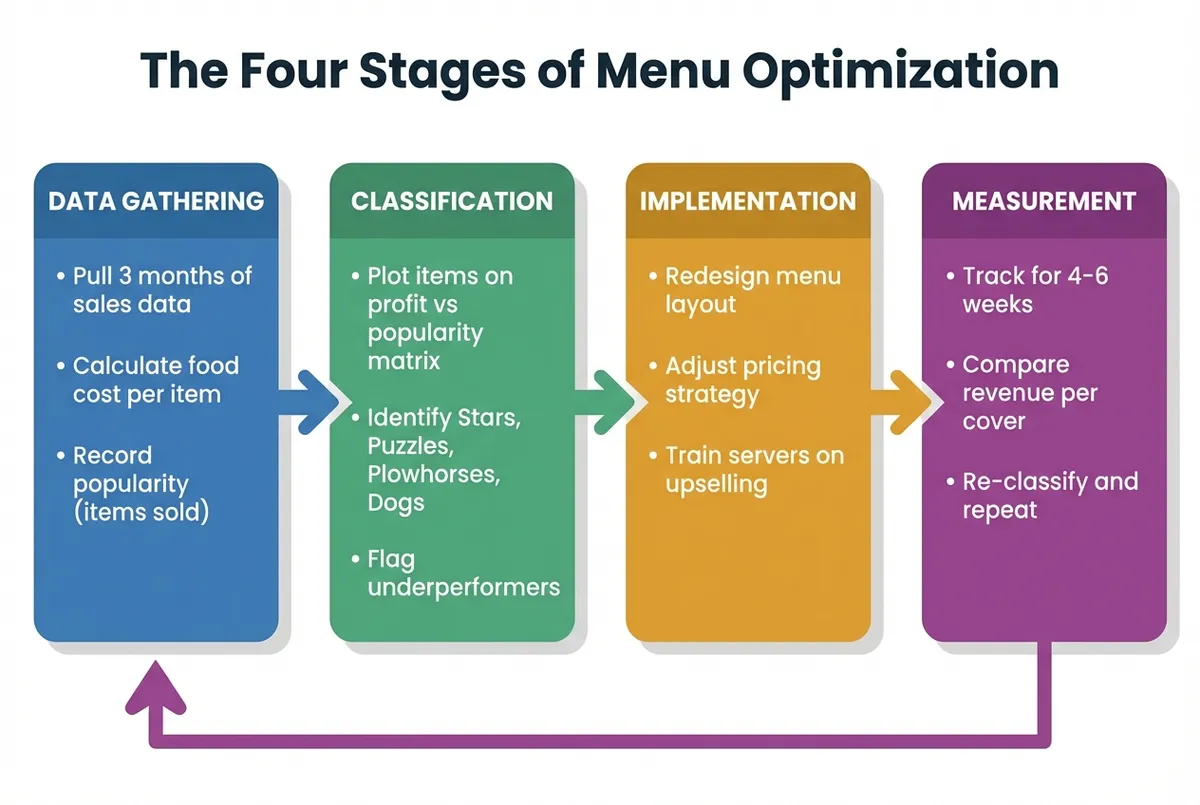
The four-stage menu optimisation process
Step 1: Gather Your Data
Before making any changes, you need two numbers for every menu item:
- Contribution margin: Selling price minus food cost
- Menu mix percentage: How often the item sells versus total sales
Most POS systems generate these reports instantly. If yours can't, track manually for two weeks during normal trading.
Step 2: Classify Your Items
Using the menu engineering matrix, sort every item into four categories:
| Category | Profit | Popularity | Action |
|---|---|---|---|
| Stars | High | High | Protect and promote |
| Plowhorses | Low | High | Improve margins |
| Puzzles | High | Low | Increase visibility |
| Dogs | Low | Low | Remove or reinvent |
For example, a Bristol gastropub might find their fish and chips is a Plowhorse (sells well but thin margins) while their lamb shank is a Puzzle (great margins but underordered).
Step 3: Take Strategic Action
Once classified, apply targeted strategies:
- Stars: Feature in golden triangle positions. Never discount.
- Plowhorses: Reduce portion sizes slightly, negotiate better supplier prices, or increase prices gradually.
- Puzzles: Move to prominent menu positions, train staff to recommend, improve descriptions.
- Dogs: Remove quietly or completely reinvent the dish.
If you're only updating your menu when it's quiet on Wednesday night and treating optimisation as an afterthought, you'll always lose to competitors who make menu engineering part of their weekly routine.
Step 4: Test and Measure
Restaurant menu optimisation isn't a one-time project. After implementing changes, track results for 4-6 weeks before drawing conclusions. Compare metrics like average spend per head, gross profit percentage, and star item sales velocity.
Info
Related: Menu Design Principles covers the visual and psychological elements that support optimisation efforts.
Now that you understand the basic process, let's look at a specific framework that many successful UK restaurants use.
What Is the 30/30/30 Rule for Restaurants?
The 30/30/30 rule is a framework for structuring your menu into profit tiers: roughly 30% high-profit items, 30% moderate-profit items, and 30% value-driven items, with the remaining 10% for signature or loss-leader dishes. This balanced approach ensures profitability while maintaining customer choice and satisfaction.
Here's how the rule breaks down in practice:
| Category | Menu Share | Purpose |
|---|---|---|
| Premium (Stars) | 30% | Profit drivers |
| Mid-range | 30% | Balanced workhorses |
| Value items | 30% | Traffic builders |
| Signature/Specials | 10% | Brand builders |
Applying the 30/30/30 Rule to UK Menus
A Manchester curry house might structure their menu like this:
Premium (30%): Signature lamb karahi, mixed grill platter, lobster biryani Mid-range (30%): Chicken tikka masala, korma dishes, standard biryanis Value (30%): Vegetable dishes, dal options, simple rice combinations Signature (10%): Chef's special tasting menu, seasonal dishes
The key is balance. Customers who see only premium items feel the restaurant is overpriced. Those seeing only value items question quality. Ignoring the 30/30/30 structure rarely works: most restaurants that skip this balance either limit sales or damage margins.
Common Misconceptions
Misconception 1: "Higher prices mean higher profits." Reality: A premium-priced dish with moderate margins often generates less total profit than a lower-priced dish with strong margins and higher sales velocity.
Misconception 2: "I need to remove all low-margin items." Reality: Some low-margin items bring customers in the door. Fish and chips might break even, but the table orders drinks and desserts.
If you're only looking at individual dish margins and ignoring the full customer transaction, you'll always lose to competitors who understand the entire profit picture.
Moving on to content planning, let's examine the foundational principles.
What Are the 5 Principles of Menu Planning?
Moving on to content selection, the five principles of menu planning are: balance, variety, nutrition, feasibility, and cost control. Together, these ensure your menu is not only profitable but also operationally practical and appealing to customers.
1. Balance
Every menu needs balance across multiple dimensions:
- Flavours: Mix rich and light, spicy and mild
- Textures: Combine crispy, creamy, chewy elements
- Cooking methods: Don't overload any single station
- Price points: Include options for different budgets
2. Variety
Variety ensures something for everyone without creating decision paralysis. Most restaurants find 7-10 items per category is the sweet spot. More creates confusion; fewer feels limiting.
3. Nutrition
Nutritional balance matters more than ever as UK diners increasingly seek diverse options. For example, a Bristol steakhouse might feature grilled fish or vegetable platters alongside premium steaks, following menu design principles that appeal to diverse preferences. Include:
- Vegetarian and vegan options in every category
- Lower-calorie alternatives
- Allergen-friendly choices clearly marked
4. Feasibility
The best menu means nothing if your kitchen can't execute it consistently. Consider:
- Equipment limitations
- Staff skill levels
- Peak service capacity
- Prep time requirements
A Sheffield restaurant learned this the hard way when their stunning soufflé kept tickets backing up. Moving it to a pre-order dessert fixed the problem.
Pro Tip
If you're only thinking about what sells and ignoring what your kitchen can execute under pressure, you'll always lose to competitors who match their menu to their operational capacity.
5. Cost Control
Every dish needs a food cost calculation before menu inclusion. Most UK restaurants target food costs between 25-35% for mains, with lower percentages for beverages.
Info
Related: Restaurant Food Cost Percentage provides detailed calculations for UK pricing.
Now let's look at structure. Here's a simple framework that keeps focus on what matters.
What Are the Three C's in a Restaurant?
Now let's examine the operational side. The three C's in a restaurant are: Cost, Consistency, and Customer satisfaction. Mastering all three creates a sustainable, profitable operation that builds long-term success.
Cost
Cost control underpins everything. Without healthy margins, even busy restaurants fail. Most UK restaurants target food costs between 28-35%, with prime cost (food plus labour) staying under 65%.
If you're only celebrating high sales numbers without checking whether those sales are actually profitable, you'll always lose to competitors who understand that revenue means nothing without margin.
Consistency
Consistency builds trust. Customers return when they know exactly what they'll get through standardised recipes, precise portions, quality suppliers, and regular audits.
For instance, if your burger portion varies between Tuesday and Saturday service, you're losing money through inconsistency and confusing customers.
Customer Satisfaction
Ultimately, satisfied customers drive revenue through Google reviews, return visits, and repeat orders.
The three C's interconnect. Poor cost control leads to inconsistency. Inconsistency breeds dissatisfaction. Dissatisfaction means lower revenue and strained costs.
The restaurants that excel at all three C's build sustainable profit engines. They attract the right customers profitably instead of chasing every customer.
If you can't tell whether your menu optimisation is working, that's usually a sign you need to track the three C's more closely.
With all these principles in hand, here's how to put them into practice.
Implementing Restaurant Menu Optimisation: Your Action Plan
Here's how to put this all into practice. Understanding theory is one thing. Applying restaurant menu optimisation to your actual menu is another. Here's a structured approach for busy UK restaurant operators.
The 30-Minute Weekly Audit
If you're thinking "I don't have time for this," you're right. You probably don't have hours. But you can make meaningful progress in small chunks.
Monday-Tuesday (10 minutes): Pull your top 10 and bottom 10 selling items from POS. Calculate contribution margin for each (selling price minus food cost).
Wednesday-Thursday (10 minutes): Identify one Puzzle item (high margin, low sales). Plan one promotion: better description, staff brief, or position change.
Friday-Sunday (10 minutes): Move that item to a prominent position. Brief your team to recommend it. Track sales for two weeks and measure results.
Quick Menu Audit Checklist
Use this checklist to assess your current menu optimisation status:
- I know the contribution margin for every menu item
- Items are classified as Stars, Plowhorses, Puzzles, or Dogs
- High-margin items appear in golden triangle positions
- Prices are nested in descriptions, not in columns
- Each category has 7-10 items maximum
- Staff can recommend alternatives when items are unavailable
- Menu updates are planned quarterly, not just when prices change
Real-World Example
A Leeds gastropub applied these principles over three months. They discovered:
- Their popular burger was a Plowhorse (great sales, 32% food cost)
- Their lamb shank was a Puzzle (62% margins, but 8th in sales)
Actions taken:
- Moved lamb shank to the top-right of the mains section
- Added "slow-braised for 6 hours" to the description
- Trained staff to recommend it when guests asked for suggestions
- Reduced burger portion slightly, saving £0.40 per serve
Results after 8 weeks:
- Lamb shank sales up 45%
- Burger sales unchanged (customers didn't notice portion change)
- Overall food cost dropped from 34% to 31%
That 3% improvement translated to roughly £15,000 additional annual profit.
Key Takeaway
Key Takeaway
Restaurant menu optimisation transforms a static price list into a dynamic profit tool. Analyse every item's contribution margin, then use the menu engineering matrix (Stars, Plowhorses, Puzzles, Dogs) to classify items. Apply the 30/30/30 rule to balance premium, mid-range, and value offerings. Follow the five principles of menu planning (balance, variety, nutrition, feasibility, cost control) and track the three C's: Cost, Consistency, Customer satisfaction. The restaurants that commit to ongoing optimisation consistently outperform those that don't, typically seeing 5-15% profit increases within three months.
If you run a restaurant and want to see how Local Brand Hub can support your marketing, explore our restaurant marketing tools.
This Week's Action Plan
Day 1-2: Identify your top three Puzzle items (high margin, low sales) and pick one to focus on.
Day 3-4: Move that item to a golden triangle position (top-right of its section) and improve its description: "slow-braised for 6 hours" works better than "lamb shank."
Day 5-7: Brief your staff to recommend it when guests ask for suggestions and start tracking sales daily.
The easiest wins in your restaurant are hiding in plain sight on your menu. One repositioned item often proves the principle works; then adjust more items systematically.
For UK restaurant owners
Automate Your Menu Optimisation
LocalBrandHub helps UK restaurants track which items drive profit and identify optimisation opportunities, without manual spreadsheets.
Start FreeGet More Marketing Tips
Practical marketing tips for UK business owners, straight to your inbox. No spam, unsubscribe anytime.
About the Author
Local Brand Hub
Empowering UK Businesses
Local Brand Hub provides comprehensive business management tools designed specifically for UK local businesses to streamline operations, automate marketing, and grow revenue.
More articlesRelated Articles
 Marketing Tips
Four Quadrants of Menu Engineering: A Complete UK Guide
Master the four quadrants of menu engineering to boost restaurant profits. Learn how Stars, Plough Horses, Puzzles and Dogs increase your margins.
 Marketing Tips
Menu Design Principles: 7 Rules That Drive Sales
Master menu design principles that guide customer choices. Learn golden triangle placement and strategic pricing layouts that boost restaurant profits.
 Marketing Tips
Menu Engineering: Complete UK Restaurant Guide
Master the four quadrants matrix: Stars, Plough Horses, Puzzles and Dogs. Learn how menu engineering boosts UK restaurant profits by 15% or more.