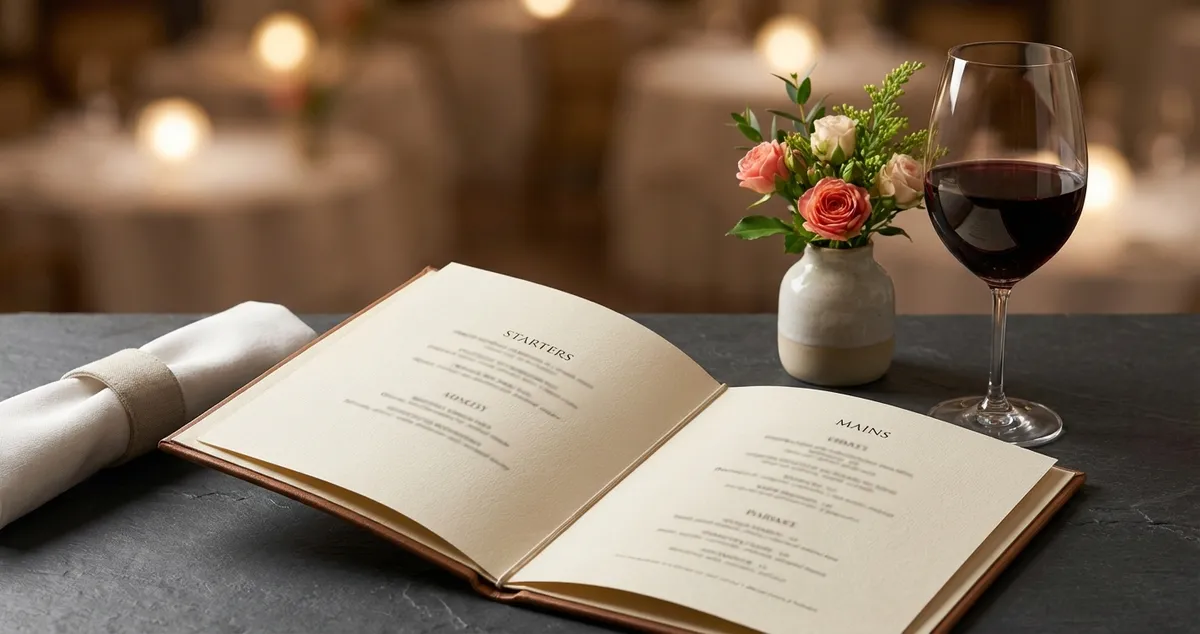
Master menu design principles that guide customer choices. Learn golden triangle placement and strategic pricing layouts that boost restaurant profits.
You've spent hours perfecting your signature dish. The presentation is stunning, the flavours balanced, the margins healthy. Yet it sits at the bottom of your sales reports while basic fish and chips flies out every service. This isn't a kitchen problem: it's a menu design problem.
Here's what stings: 73% of restaurants never optimise their menu after launch. Meanwhile, restaurants that strategically redesign their menus increase profits by up to 15% without changing a single recipe. The difference between a menu that's a price list and a menu that's a selling tool comes down to seven core design principles.
The problem isn't your food. It's where that dish sits on your menu, how it's described, and whether customers can actually find it during the thirty seconds they spend scanning before ordering. Restaurant menu design principles are the invisible rules that guide customer decisions, and restaurants that master these menu design principles consistently outperform those that don't.
Industry research confirms that strategic menu design can increase per-person spending by 8-10% on average. For a UK restaurant serving 200 covers daily with a £22 average spend, that translates to roughly £130,000 in additional annual revenue from the same customers ordering from a better-designed menu.
Info
Related: Menu Engineering covers the data analysis and four quadrants framework. Return here for the visual and psychological design elements.
What You'll Learn
- The core principles that make menus persuasive rather than just informative
- How the golden triangle captures customer attention
- Strategic pricing presentation that removes purchase barriers
- Typography and colour choices that guide the eye
- Practical layout rules you can apply this week
With those goals in mind, let's start with the foundational framework that makes everything else work.
What Are the Five Menu Principles?
Let's start with the fundamentals. The five core menu design principles are: visual hierarchy, strategic placement, descriptive language, pricing psychology, and balanced variety. Together, these create a menu that feels natural to read while subtly guiding customers toward your most profitable items.
Let me break each one down with practical applications.
1. Visual Hierarchy
Starting with the most fundamental principle, not everything on your menu deserves equal attention. Visual hierarchy uses size, weight, colour, and spacing to tell customers what matters most. Your Stars (high-profit, high-popularity items) should stand out through larger fonts, boxes, or icons. Your Dogs can fade into the background with standard formatting.
For example, a bistro might set their signature ribeye in a slightly larger font with a chef's hat icon, while listing basic sides in a smaller typeface below. The customer's eye naturally gravitates to what appears most important.
2. Strategic Placement
Building on visual hierarchy, eye-tracking studies reveal customers follow predictable patterns when reading menus. The "golden triangle" describes how eyes move from the centre to the top right, then to the top left on a standard two-panel menu. Placing high-margin items in these positions can increase their sales by up to 30%.
If you're reading this thinking "I've never even considered where I place dishes," you're not alone. Most restaurants list items in the order they were added to the menu system, not by strategic intent.
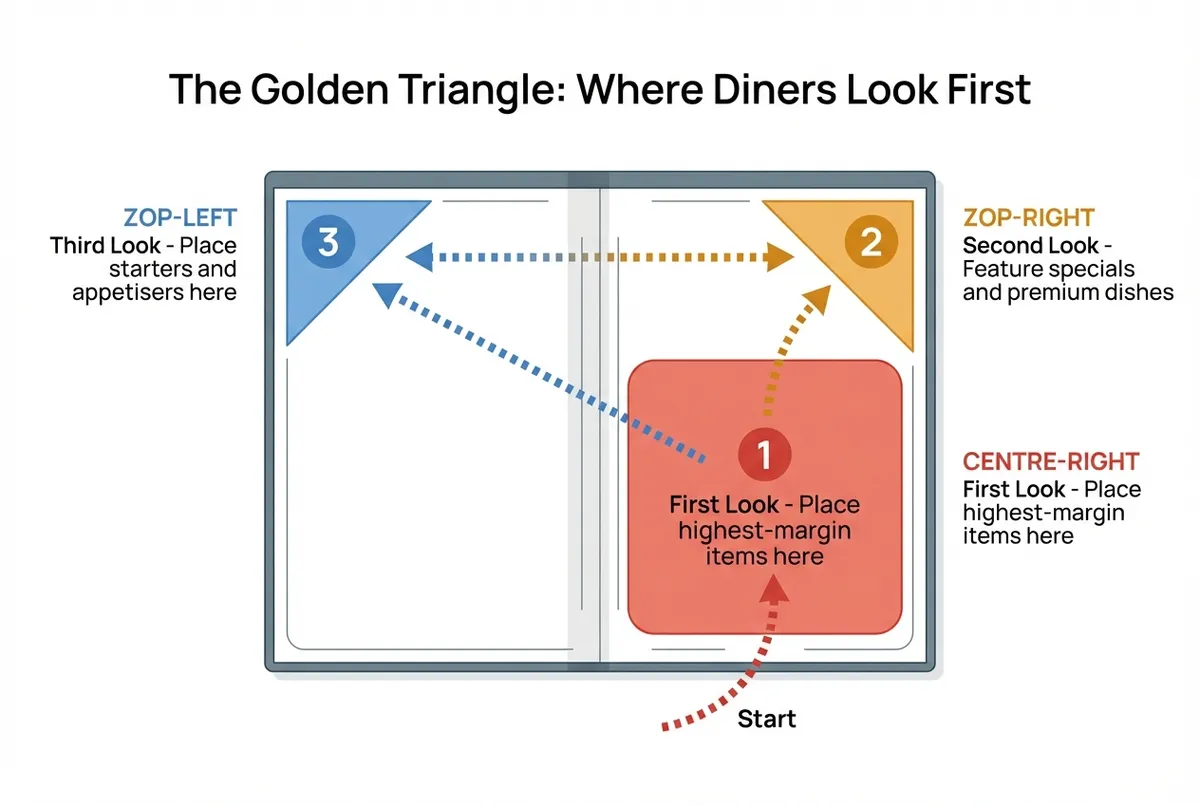
Golden triangle hotspot zones and eye movement flow
3. Descriptive Language
Beyond positioning, the words you use matter enormously. Research published in the International Journal of Hospitality Management found that descriptive menu labels increase sales by 27% compared to basic names. "Slow-braised lamb shank with rosemary jus and buttery mash" outsells "lamb shank with mash" even when the dish is identical.
Effective descriptions include:
- Provenance: Where ingredients come from (Cornish crab, Scottish salmon)
- Preparation method: How it's cooked (chargrilled, slow-roasted, hand-rolled)
- Sensory words: Texture and flavour hints (crispy, tender, rich, zesty)
4. Pricing Psychology
Moving from words to numbers, how prices appear affects how they feel. Research from hospitality experts demonstrates that removing currency symbols and decimal points reduces the "pain of paying." A price shown as "22" triggers less resistance than "£22.00".
Other proven tactics include:
- Nested pricing: Embedding prices within descriptions rather than aligning them in columns (which invites comparison shopping)
- Charm pricing: Using .95 or .99 endings for value-positioned items, round numbers for premium dishes
- Decoy pricing: Placing a high-priced item near your target dish to make it seem reasonable
If you're still listing prices in a neat right-aligned column, that's usually a sign you're leaving money on the table. Customers naturally scan for the lowest price when it's easy to compare: your goal is to make them read the description first, then notice the price second.
5. Balanced Variety
Finally, the "paradox of choice" suggests that too many options create decision paralysis. Most research recommends 7-10 items per category as the sweet spot. Fewer options help customers decide faster and feel more satisfied with their choice. Our guide to restaurant menu pricing covers how to set the right prices once you've streamlined your offerings.
This doesn't mean limiting your actual offerings. It means curating what appears on your main menu while keeping additional items available on request or seasonal specials boards.
Pro Tip
If you're only reviewing your menu on quiet Wednesday nights, you'll always lose to competitors who treat menu design as part of weekly operations.
Now that you understand the five core principles, the next step is learning how to implement them visually. That's where layout design comes in.
What Are the 7 Principles of Layout Design?
When it comes to visual execution, the seven principles of menu layout design are: alignment, contrast, hierarchy, balance, proximity, repetition, and whitespace. These graphic design fundamentals apply directly to restaurant menus, making them easier to read and more effective at guiding customer choices.
Here's how these design principles translate into practice; each is a rule of thumb that works across different restaurant types, though you'll adapt based on your specific layout and audience:
| Principle | Menu Application | Example |
|---|---|---|
| Alignment | Consistent text positioning | Left-align all descriptions, right-align all prices |
| Contrast | Making key items stand out | Bold headings, regular body text |
| Hierarchy | Establishing importance | Category names larger than dish names |
| Balance | Visual weight distribution | Equal spacing between sections |
| Proximity | Grouping related items | Keeping starters together, mains together |
| Repetition | Consistent styling throughout | Same font for all descriptions |
| Whitespace | Breathing room around content | Padding around high-margin items |
For instance, a Birmingham cafe owner redesigned their menu following these principles and saw breakfast sales increase 18% in three weeks. The menu content was identical. Only the layout changed. Their full English moved from a crowded list to a boxed feature with breathing room, and orders jumped immediately. This illustrates why menu engineering works best when combined with strong visual design.
Info
Related: Restaurant Menu Optimisation explains how to test and measure these changes.
Layout handles how your menu looks. But before you can design anything, you need to plan what actually belongs on it. That's a different discipline entirely.
What Are the 6 Principles of Good Menu Planning?
Moving on to content selection, the six principles of menu planning are: nutritional balance, variety, colour appeal, texture contrast, equipment consideration, and cost control. While menu design focuses on presentation, menu planning addresses what actually appears on the menu in the first place.
These menu design principles matter because the best design cannot save a poorly planned menu. If your offerings lack variety, require equipment you don't have, or cost more than customers will pay, no amount of golden triangles will help.
Key Planning Considerations
Nutritional Balance: Ensure options exist for different dietary needs. With 42% of UK diners now reducing meat consumption, vegetarian and vegan options are essential, not optional.
Variety: Offer different proteins, cooking methods, and flavour profiles within each category. If every starter is fried, customers notice.
Colour Appeal: A plate with beige protein, beige starch, and beige sauce looks unappetising regardless of taste. Plan dishes that naturally include visual contrast. Read more about restaurant branding for additional visual strategies.
Equipment Consideration: Don't design menu items that create bottlenecks. If your grill station can handle 20 covers per hour, don't put five grilled items in your top sellers positions.
Cost Control: Every dish needs a food cost calculation before it earns menu space. Items with beautiful margins on paper mean nothing if they spoil before selling.
Real-World Example
A Leeds gastropub discovered their impressive-looking charcuterie board had a 45% food cost due to spoilage. Moving it to a "pre-order only" item improved margins immediately. The lesson: no amount of design can overcome operational constraints.
With planning principles covered, let's look at how traditional menu structure helps customers navigate your offerings.
What Are the 7 Classic Parts of a Menu?
Now let's examine structure. The seven classic menu sections are: appetisers, soups, salads, main courses, side dishes, desserts, and beverages. This traditional structure exists because it mirrors the natural progression of a meal and helps customers navigate options logically.
Modern menus often adapt this framework based on restaurant type:
- Casual dining: May combine soups and salads, add a "sharing" section
- Fine dining: Often adds amuse-bouche, cheese course, petit fours
- Quick service: Typically simplifies to mains, sides, drinks
- Ethnic cuisine: May use culturally specific categories (tapas, dim sum, thali)
The key design principle here is consistency. Whatever structure you choose, maintain it throughout. A menu that jumps between "Starters" and "Small Plates" and "To Begin" confuses rather than guides.
Section Order Best Practice
When applying menu design principles to section order, for most UK restaurants this flow typically works well:
- Starters / Small plates
- Mains / Large plates
- Sides (if separate)
- Desserts
- Drinks (or separate beverage menu)
Place your highest-margin category first. If your starters have better margins than mains, the starter section appearing prominently makes commercial sense.
A Manchester tapas bar discovered their small plates averaged 72% margins compared to 58% for mains. They restructured their menu to lead with sharing plates, and average spend per table increased by £8.
Theory only matters if you can apply it. Here's how to put all seven principles into practice without hiring a designer.
Applying Menu Design Principles: A Practical Framework
Understanding menu design principles is one thing. Applying them to your actual menu is another, whether you lay it out on paper or manage it through our menu and offers tools. Here's a structured approach for putting these menu design principles into practice at UK restaurants.
The 30-Minute Menu Audit
If you're thinking "I don't have time to redesign my entire menu," you're right. You probably don't. But you can make meaningful changes in small chunks.
Day 1-2: Print your current menu. Circle items that sell well and are profitable (your Stars). Mark items that rarely sell.
Day 3-4: Check your Star positions. Are they in the golden triangle? If not, plan to move them.
Day 5-7: Review your descriptions. Do your top three profitable items have compelling, sensory language? Rewrite at least one.
That's it. One small improvement each week compounds into a significantly better menu over a quarter.
Quick Audit Checklist
Use this checklist to assess your current menu:
- High-margin items positioned in golden triangle areas
- Descriptions include provenance and sensory words
- Prices nested in descriptions (not aligned in columns)
- Maximum 7-10 items per category
- Consistent fonts throughout (maximum two typefaces)
- Adequate whitespace around featured items
- No generic stock photography
Info
Related: Menu Engineering Categories explains how to identify Stars, Plowhorses, Puzzles and Dogs using your sales data.
Common Design Mistakes to Avoid
Mistake 1: Price columns. Aligning all prices in a neat column invites customers to shop by price rather than appeal. Nest prices within descriptions using the techniques from restaurant menu optimisation instead.
Mistake 2: Crowded layouts. Every restaurateur wants to showcase everything. Resist. If you're cramming items together without whitespace you'll always lose to competitors who understand that less really is more on a well-designed menu.
Mistake 3: Inconsistent fonts. Using five different typefaces looks chaotic. Stick to two: one for headings, one for body text.
Mistake 4: Stock photography. Generic food images scream "we don't take this seriously." Either use professional photos of your actual dishes or no photos at all.
Real-World Application
Moving from theory to practice, a Sheffield curry house applied these menu design principles in stages. First, they audited their menu and found their lamb karahi (65% margin) buried in the middle of a 25-item mains list. They moved it to the golden triangle, added "slow-cooked for 4 hours in traditional copper pots," and reduced the mains section to 15 items. Sales of that dish increased 35% in the first month.
If you can't tell whether your menu is helping or hurting sales, that's usually a sign you need to run the numbers. Pull your top ten sellers and check their positions. Are they in the golden triangle, or buried?
Key Takeaway
Key Takeaway
Strong menu design principles transform a simple price list into a strategic selling tool. The golden triangle (centre, top-right, top-left) captures the most attention on standard menus. Descriptive language with provenance and sensory words increases item sales by up to 27%. Removing currency symbols and avoiding price columns reduces comparison shopping. Seven to ten items per category prevents decision paralysis, and whitespace makes items appear more valuable, not less important. The restaurants that treat menu design as a strategic function consistently outperform those that don't.
If you run a restaurant and want to see how Local Brand Hub can support your marketing, explore our restaurant marketing tools.
This Week's Action Plan
Day 1-2: Print your current menu and circle items that sell well and are profitable (your Stars). Mark items that rarely sell.
Day 3-4: Check your Star positions. Are they in the golden triangle? If not, plan to move them.
Day 5-7: Take one high-margin item currently buried in your menu and reposition it to the golden triangle. Add a more descriptive name and surround it with whitespace. Track orders before and after.
That single change often produces measurable results within days.
Frequently Asked Questions
What's the difference between menu design and menu engineering?
Menu design focuses on the visual and psychological presentation: how items are positioned, described, and priced. Menu engineering is the data analysis side: tracking which items sell most profitably using the four-box matrix (Stars, Plowhorses, Puzzles, Dogs). Both matter. Great design without data-driven decisions wastes effort. Great data without compelling presentation still underperforms. Our guide to menu engineering covers the analytical framework if you're ready to dig into your numbers.
Can I apply these principles to a digital menu?
Absolutely. The golden triangle translates to "above the fold" on mobile. Visual hierarchy becomes font size and icons. Strategic placement means featured items appear first. Whitespace becomes breathing room between sections. The principles are universal; the medium changes the execution.
How often should I redesign my menu?
Most restaurants benefit from a quarterly review. Check your sales data monthly: if a dish is underperforming, it might be positioning, description, or pricing, not quality. Make small tweaks (rewrite a description, move an item, adjust a price) weekly. A complete redesign might happen annually or when introducing new items.
What if my menu is digital and printed?
Keep them in sync. If your top sellers are in the golden triangle on printed menus, they should be above the fold on your digital menu. Descriptions should match. Prices should be consistent. Customers shouldn't wonder why the online menu looks different.
Should every restaurant use the same menu principles?
The core principles apply universally: visual hierarchy, strategic placement, descriptive language, pricing psychology, balanced variety, layout design, and menu planning. But execution changes. A fine dining restaurant might use different fonts and whitespace than a casual cafe. A quick-service menu prioritises speed over description. Adapt the principles to your restaurant type.
How do menu design principles affect pricing strategy?
Menu design principles directly influence how customers perceive prices. Removing currency symbols, nesting prices in descriptions, and using the golden triangle to feature high-margin items all work together to reduce price sensitivity. A well-designed menu can increase perceived value without changing actual prices: that's the power of applying menu design principles strategically.
What's the most important menu design principle?
If you could only implement one, strategic placement (the golden triangle) delivers the fastest ROI. Moving your top three high-margin items to premium positions on your menu can increase sales of those dishes by 20-30% within weeks. That single menu design principle often pays for any redesign investment within a month.
For UK restaurant owners
Optimise Your Menu Design
LocalBrandHub helps UK restaurants identify their Stars and optimise placement (from menu design to social media) without spreadsheet gymnastics.
Start FreeGet More Marketing Tips
Practical marketing tips for UK business owners, straight to your inbox. No spam, unsubscribe anytime.
About the Author
Local Brand Hub
Empowering UK Businesses
Local Brand Hub provides comprehensive business management tools designed specifically for UK local businesses to streamline operations, automate marketing, and grow revenue.
More articlesRelated Articles
 Marketing Tips
Four Quadrants of Menu Engineering: A Complete UK Guide
Master the four quadrants of menu engineering to boost restaurant profits. Learn how Stars, Plough Horses, Puzzles and Dogs increase your margins.
 Marketing Tips
Menu Engineering: Complete UK Restaurant Guide
Master the four quadrants matrix: Stars, Plough Horses, Puzzles and Dogs. Learn how menu engineering boosts UK restaurant profits by 15% or more.
 Marketing Tips
Menu Engineering Matrix: Stars, Plowhorses, Puzzles, Dogs
The menu engineering matrix explained: classify Stars, Plowhorses, Puzzles and Dogs with a printable matrix, worked examples and UK actions.