Compare the most profitable restaurant types in the UK. See net margins, startup costs and scalability for pizza, coffee shops, pubs and more.
You've been looking at restaurant concepts for weeks. Pizza, Indian, coffee shop, gastropub: every article says something different about which one actually makes money. The truth is that the most profitable restaurant types depend far more on your operating model than your cuisine. This guide breaks down exactly why.
Related: Restaurant profit margin, this guide is part of our series covering every lever that affects your bottom line.
If you're thinking "I just want someone to tell me which restaurant type to open", that's usually a sign you're asking the wrong question. There is no single most profitable format. But there are formats that produce better margins, and knowing why is worth more than any "top 10" list ever could be.
What You'll Learn
- Which restaurant formats deliver the highest profit margins in the UK
- How startup costs, food costs, and labour needs compare across the most profitable restaurant types
- Why some low-revenue formats outperform high-revenue ones on profit
- The hidden factors that make or break each profitable restaurant concept
- A practical framework for choosing the right format for your situation
What Makes a Restaurant Type Profitable?
First, let's clear up the biggest myth about the most profitable restaurant types. Based on our experience working with UK restaurant owners, profitability is not about which cuisine you serve. It is about the gap between four variables: food cost percentage, labour intensity, average ticket size, and volume.
A pizza restaurant and a fine dining restaurant both serve food to paying customers. But their profit mechanics are completely different.
The most profitable restaurant type is not the one with the highest revenue. It is the one with the widest gap between what it costs to operate and what it earns.
Here are the four levers that determine which restaurant types are most profitable:
- Food cost, labour, average spend, and volume, get at least two of these working in your favour
| Profit Lever | What It Means | Example |
|---|---|---|
| Food cost % | Ingredient cost as % of revenue | Pizza: low vs Fine dining: high |
| Labour intensity | Staff hours per cover served | Takeaway: low vs Full-service: high |
| Average spend | Revenue per customer | Coffee: low vs Gastropub: high |
| Volume capacity | Covers per day | Quick service: high vs Fine dining: low |
The most profitable restaurant types score well on at least two of these four levers. They either keep costs very low or push volume very high, and the strongest formats manage both.
Why This Matters
Understanding these four levers helps you evaluate any format objectively, rather than relying on anecdotes or assumptions about which restaurant types make money.
For a detailed look at what healthy margins look like, see our guide to average restaurant profit margin.
Most Profitable Restaurant Types Compared
Here's the big picture. This table shows how the main UK restaurant formats stack up on profitability.
Info
These figures represent typical ranges for well-run independents, not chains or struggling operations.
| Restaurant Type | Net Margin | Food Cost | Startup Investment | Labour |
|---|---|---|---|---|
| Coffee shop | High (10-18%) | Low | Low | Low-Med |
| Pizzeria | High (10-15%) | Low-Med | Medium | Medium |
| Takeaway/delivery | Medium-High | Medium | Very Low | Low |
| Fish and chips | Medium (8-14%) | Medium | Low-Med | Low-Med |
| Indian restaurant | Medium (7-12%) | Medium | Medium | Medium |
| Pub/gastropub | Variable (5-12%) | Med-High | High | Med-High |
| Casual dining | Low-Med | Medium | High | High |
| Fine dining | Low (3-8%) | High | Very High | Very High |
Key Pattern
The formats with the lowest startup costs tend to deliver the highest percentage margins, while the most expensive formats often produce the thinnest margins.
These margins are general benchmarks. Your results will vary by location, management, and market conditions. Sources: UKHospitality Industry Report, 2025; CGA by NIQ On-Premise Market Analysis, 2025; Lumina Intelligence UK Foodservice Report, 2025
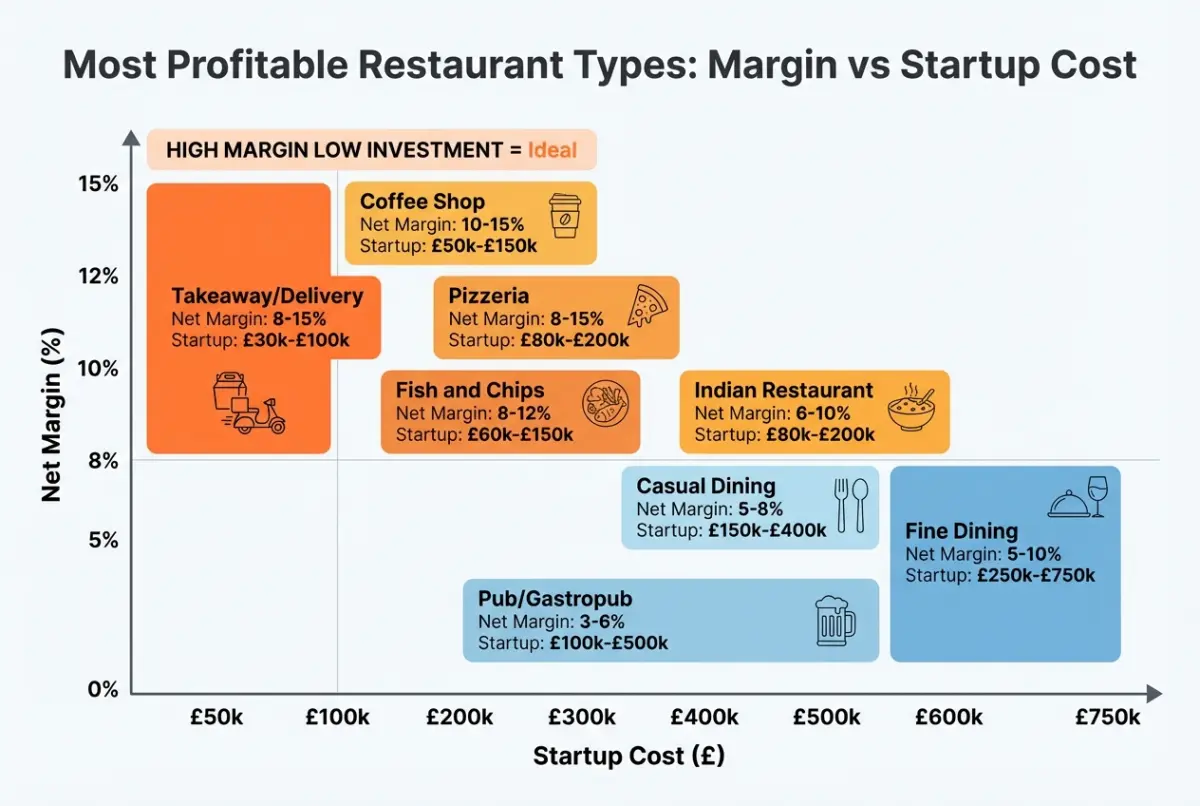
Net profit margins and startup costs compared across the most popular UK restaurant formats
Two things stand out. Coffee shops and pizzerias top the most profitable restaurant types charts despite lower ticket sizes. And fine dining, the format people assume makes the most money, actually operates on the thinnest margins.
If you pick just one format to explore first, a coffee shop or pizzeria typically offers the most forgiving margin structure for first-time operators.
High-Margin Formats: Coffee Shops, Pizza, and Takeaways
Let's start with the formats that consistently rank among the most profitable restaurant types in the UK.
Coffee Shops
Coffee is one of the highest-margin products in the food industry. A flat white costs pennies to make but sells for several pounds, delivering a gross margin well above most food products (Allegra World Coffee Portal, 2025).
What makes coffee shops a profitable restaurant business:
- Very low food costs on core beverages
- Minimal kitchen needs: lower equipment and setup costs
- High frequency visits: regulars come daily, not weekly
- Lower staffing needs than full-service restaurants
The catch? Average spend is low. A coffee shop needs steady volume to make meaningful profit. If you're only relying on the morning rush you'll always lose to competitors who build an all-day trade. Quiet afternoons can wipe out the morning rush gains.
Pro Tip
If you can't tell whether your afternoon trade covers its own staff costs or just drains the morning profits, that's usually a sign your scheduling needs a rethink, not your menu.
Pizzerias
Pizza is structurally one of the most profitable restaurant types because the core ingredients (flour, tomato sauce, mozzarella) are among the cheapest per portion in the industry.
For example, a margherita pizza costs well under £2 in ingredients but sells for several times that on most UK high streets. Even a loaded pizza with premium toppings keeps ingredient costs remarkably low relative to menu price.
What makes pizzerias profitable:
- Low ingredient costs relative to menu price
- Simple, scalable prep: one oven can produce high volume
- Strong delivery potential: pizza travels well
- Flexible format: works as sit-down, takeaway, or delivery-only
Takeaway and Delivery-Only
The delivery-only model (sometimes called "dark kitchens" or "ghost kitchens") has grown rapidly. By cutting front-of-house entirely, operators slash rent, decor, and service staff costs.
The trade-off is commission fees from platforms like Deliveroo and Just Eat, which can take a substantial share of each order (CMA UK Restaurant Delivery Market Study, 2025). Those fees eat into margins unless operators price accordingly or build direct ordering channels.
Mid-Margin Formats: Pubs, Indian, and Fish and Chips
Moving on to the middle tier of most profitable restaurant types. These formats still perform well but require more careful cost management than the high-margin group.
Indian Restaurants
Indian cuisine is firmly established in British dining, with around 12,000 restaurants and takeaways across the UK (The Caterer, 2025). The format can be highly profitable because spice-based dishes use affordable base ingredients.
A well-run Indian restaurant achieves healthy margins. The key drivers:
- Spice-based cooking keeps ingredient costs moderate
- Strong takeaway integration: many generate a large share of revenue from takeaway orders
- Loyal repeat customer base: regulars ordering weekly is common
The challenge is labour. Traditional Indian cooking requires skilled chefs, and the ongoing UK shortage of experienced tandoori and curry chefs has pushed wage costs up.
Pubs and Gastropubs
Pubs occupy a unique position among profitable restaurant formats because they combine wet sales (drinks) with food. Drink margins are substantially higher than food margins, which gives pubs a structural advantage.
However, pubs carry higher fixed costs: larger premises, more staff, licensing, and maintenance. The average restaurant profit margin for pubs varies widely, with wet-led pubs often outperforming food-led ones on margin percentage.
For most UK operators weighing profitable restaurant options, a food-and-drink hybrid format like a gastropub often offers a strong combination of margin flexibility and customer appeal.
Fish and Chips
The traditional British chippy remains a surprisingly profitable restaurant concept and ranks among the most profitable restaurant types for operators with limited budgets. Simple menus, minimal waste, and high throughput create a solid business model.
If you're reading this thinking "fish and chips seems too traditional to be a real business opportunity", consider that the UK fish and chip sector remains one of the largest takeaway categories in the country (Seafish, 2025). Tradition is not a weakness. It is built-in demand.
Lower-Margin, Higher-Revenue: Fine Dining and Full-Service
Here's where it gets counterintuitive. Fine dining generates the highest revenue per cover but often the lowest profit percentage, a surprise when comparing the most profitable restaurant types we have covered.
Fine Dining
A fine dining restaurant charges a premium price per head. That sounds enormously profitable until you factor in premium ingredients, high staffing ratios, prestige rents, and low cover counts per service.
Net margins for fine dining are typically the lowest of any restaurant format (Deloitte UK Hospitality Report, 2025). Some months, particularly January, fine dining restaurants operate at a loss, relying on peak periods to balance the year.
Full-Service Casual Dining
Chains and independents in the casual dining space face similar challenges to fine dining but with lower average spend. The result is thin margins when run well, and losses when costs drift.
If you're only choosing based on revenue you'll always lose to competitors who choose based on what it costs to serve each customer.
Ask yourself: "Would I rather earn a higher percentage of modest turnover, or a tiny percentage of high turnover?" The answer depends on your capital, your risk tolerance, and how many sleepless nights you can handle.
Emerging Profitable Concepts for 2026
Building on the established formats above, here's what is new. Industry professionals are watching several concepts that could join the list of most profitable restaurant types in coming years.
Plant-Based and Vegan Restaurants
Plant-based ingredients typically cost less than meat equivalents for similar dishes. For example, a vegan burger can command the same menu price as a beef burger despite noticeably lower ingredient costs. Early data suggests well-positioned vegan restaurants are achieving strong net margins (Lumina Intelligence, 2025).
Street Food and Market Stall Concepts
Lower overheads, flexible locations, and minimal staffing make street food vendors some of the most profitable food businesses per pound invested. Many UK operators start at markets, build a following, then move to a permanent site.
Hybrid Models
Among the most profitable restaurant types emerging in 2026, the most interesting trend is combining multiple revenue streams: dine-in plus delivery plus retail (sauces, meal kits, branded products). Each additional channel uses the same kitchen and staff but generates extra revenue.
How to Choose the Right Format for You
Now that you've seen how the most profitable restaurant types compare, here's the practical part. Rather than asking "which format is best?" ask these five questions about your own situation.
If you're thinking "this is overwhelming. I just want a clear answer", you are not alone. Most aspiring owners feel the same way. The good news is that narrowing it down is simpler than it looks.
1. How Much Capital Do You Have?
Your startup budget narrows the field fast. For example, an aspiring owner with a modest budget might focus on a takeaway or street food stall rather than stretching into casual dining territory.
- Low budget: Takeaway, street food, or delivery-only
- Medium budget: Coffee shop, pizzeria, or small restaurant
- Higher budget: Pub or Indian restaurant
- Premium budget: Gastropub, large format, or fine dining
2. What Are Your Labour Skills?
If you plan to cook yourself, your cuisine skills matter. For instance, someone with barista training might find a coffee shop the most profitable restaurant path, while a chef trained in Italian cuisine could leverage those skills in a pizzeria.
3. What Does Your Local Market Need?
For example, a pizzeria in a town with five existing pizza shops is a harder proposition than one in a town with none. Walk your high street and count the gaps before committing.
4. What Is Your Risk Tolerance?
The most profitable restaurant types (coffee, pizza, takeaway) generally have lower startup costs and faster breakeven. Lower-margin formats (fine dining, full-service) take longer to recover your investment. If you're thinking "I can't afford to wait two years to break even", that rules out several options.
5. Do You Want to Scale?
Some formats scale better than others. Pizza and coffee concepts replicate relatively easily. Fine dining is nearly impossible to scale without the founding chef.
Understanding your restaurant pricing strategy matters regardless of which profitable restaurant format you choose. Pricing directly determines whether you operate at the margins shown above or below them.
Cost Control Across All Formats
Additionally, regardless of which of the most profitable restaurant types you operate, the same cost control principles apply. The difference is which costs matter most for each format. Marketing is one cost you can control from day one. It's worth working out the return before you commit a budget.
| Format | Biggest Cost Risk | Control Focus |
|---|---|---|
| Coffee shop | Rent per sq ft | Location ROI, throughput |
| Pizzeria | Cheese/dough drift | Recipe standards, portions |
| Takeaway | Platform commissions | Direct ordering, pricing |
| Indian | Skilled chef wages | Cross-training, simpler menu |
| Pub | Wet stock shrinkage | Stock control, pour monitoring |
| Fine dining | Labour + ingredients | Menu engineering, seasonal sourcing |
These are general starting points. Your specific operation may have different cost priorities.
For a detailed breakdown, see our guide to restaurant food cost percentage and the broader principles in our restaurant cost control article.
- Calculate your food cost percentage for your planned menu
- Map labour needs per service period
- Research local rent benchmarks for your format
- Identify your top three cost risks and mitigation plans
- Model breakeven at partial and full capacity
- Review delivery platform commission rates if applicable
- Compare equipment costs across at least three suppliers
If You Only Have 30 Minutes This Week
Here's a practical starting point. If you only have 30 minutes a week, do this:
This Week's Action Plan
- Day 1-2 (10 minutes): Write down your total available startup budget and your monthly personal income requirement. These two numbers eliminate formats you cannot afford.
- Day 3-4 (10 minutes): Walk your target high street or area and count every restaurant by type. Note which formats are underrepresented and which are oversaturated.
- Day 5-7 (10 minutes): Pick your top two format options and look up their typical food cost percentage and net margin from the comparison table above. Calculate roughly what your monthly revenue would need to be to meet your income target.
That gives you a shortlist based on reality, not aspiration.
Frequently Asked Questions
What type of restaurant is most profitable in the UK?
Based on industry data (2025), coffee shops and pizzerias typically deliver some of the highest net margins among UK restaurant formats. However, profitability depends on execution, location, and cost management. A well-run Indian restaurant can outperform a poorly managed coffee shop. Among the most profitable restaurant types, the format matters less than how tightly you control costs.
Is opening a restaurant a good investment in the UK?
It can be, but it is higher risk than many investments. A significant proportion of new UK restaurants close within their first three years (UKHospitality, 2025). The ones that survive typically have strong cost control, realistic projections, and a clear understanding of their local market. The UK Government's business support page offers practical guidance for new food businesses.
What food business has the highest profit margin?
Among food businesses, coffee often delivers the highest gross margins on beverages. For full restaurant operations, pizza and takeaway formats tend to deliver the strongest net margins because they combine low food costs with lower labour needs.
How much does the average UK restaurant owner make?
Owner earnings vary enormously by format and scale. A small independent restaurant owner typically takes home a modest salary after all costs. Higher-performing operations in strong locations can generate significantly more, while struggling restaurants often see the owner earning below minimum wage when hours are factored in (The Caterer, 2025).
Which restaurant type has the lowest startup cost?
Among the most profitable restaurant types, delivery-only (dark kitchen) operations typically have the lowest entry point. Street food and market stalls are similarly affordable. Traditional takeaways and small coffee shops require moderate investment. Full-service restaurants with dining rooms need significantly more capital.
If you run a restaurant and want to see how Local Brand Hub can support your marketing, explore our restaurant marketing tools.
Key Takeaway
Key Takeaways
- Coffee shops and pizzerias consistently deliver the highest profit margins among UK restaurant types, thanks to low food costs and scalable operations
- Fine dining generates the highest revenue per cover but often the lowest profit percentage due to premium ingredients and high labour costs
- Profitability depends on four levers: food cost percentage, labour intensity, average ticket size, and volume. The strongest formats score well on at least two
- Takeaway and delivery-only formats offer the lowest startup costs but face pressure from platform commission fees
- Hybrid models combining dine-in, delivery, and retail are an emerging profitable restaurant trend for 2026
- Your choice should match your capital, skills, local market, and risk tolerance, not just which format sounds most appealing
The most profitable restaurant is not a type. It is a system: one where every cost is measured, every price is justified, and every decision is made with margins in mind.
For restaurants, salons, and local businesses
Need help with your marketing?
We help UK businesses turn social media into real results, not busywork.
Start freeGet More Marketing Tips
Practical marketing tips for UK business owners, straight to your inbox. No spam, unsubscribe anytime.
About the Author
Local Brand Hub
Empowering UK Businesses
Local Brand Hub provides comprehensive business management tools designed specifically for UK local businesses to streamline operations, automate marketing, and grow revenue.
More articlesRelated Articles
 Business Growth
Restaurant Break Even Point: How to Calculate Yours
Calculate your restaurant break even point with UK formulas and worked examples. Learn what good looks like and how to reach profitability faster.
 Business Growth
Restaurant Cost Control: Protect Your Margins
Master restaurant cost control with five key rules that keep costs in check. Practical steps to manage food, labour, and overhead costs for UK restaurants.
 Business Growth
Restaurant Pricing Strategy: 7 Proven Methods
Master these 7 restaurant pricing strategy methods used by profitable UK restaurants. From cost-plus to psychological pricing, protect your margins.