Watch the visual overview· 86 seconds
Master restaurant marketing with the 30/30/30/10 budget rule and 4 Ps framework. Proven tactics for UK independent restaurants.
It's 10pm, the kitchen just closed, and you're staring at an empty Instagram feed wondering why your competitor down the road always has a queue. You've tried posting photos of your food. You've handed out flyers. You even paid for a local newspaper ad that brought in exactly zero new customers. Sound familiar?
Short on time? Here's the quick version
- The 30/30/30/10 rule determines your marketing budget, typically £300-600/month for independent restaurants
- The 4 Ps (Product, Price, Place, Promotion) must all work together
- Focus on Google Business Profile + reviews + social media for 80% of results
- Consistency beats perfection: three posts weekly outperforms sporadic brilliance
- Measure bookings, not followers: vanity metrics don't pay rent
Full breakdown below
Here's the uncomfortable truth: restaurant marketing isn't about posting pretty pictures or throwing money at ads. It's about understanding how your customers make decisions, and positioning your restaurant at every step of that journey. According to UK Hospitality research, independent restaurants that implement structured marketing strategies see measurable improvements in customer acquisition within 90 days.
The good news? You don't need a marketing degree or a massive budget. You need a system.
Related: Restaurant social media marketing: once you've got the fundamentals here, dive into platform-specific tactics.
What You'll Learn
- The 30/30/30/10 budget rule that keeps restaurants profitable
- Four core marketing strategies every restaurant needs (the 4 Ps)
- How to build a restaurant marketing plan that actually works
- Budget-friendly tactics for when you're watching every pound
- Common mistakes that waste your time and money
- How to measure whether your marketing is working
Contents:
- What Is Restaurant Marketing?
- Best Marketing Strategy
- The 4 Ps Framework
- The 30/30/30/10 Rule
- Building Your Marketing Plan
- Marketing Costs
- Common Mistakes
- Getting Help
- FAQ
What Is Restaurant Marketing?
First, let's define what we're actually talking about. Whether you're running a food business for the first time or refining your approach, these fundamentals apply.
Restaurant marketing is the process of attracting, retaining, and engaging customers through strategic communication and promotional activities. It encompasses everything from your Google Business Profile to your Instagram posts, from your menu design to how your staff describe specials.
Effective restaurant marketing works across three stages:
| Stage | Goal | Tactics |
|---|---|---|
| Awareness | Get discovered | Local SEO, social media, PR |
| Consideration | Stand out | Reviews, menu appeal, website |
| Conversion | Drive bookings | Offers, CTAs, easy reservation |
The mistake most owners make is jumping straight to conversion tactics: running discount campaigns and hoping for the best.
Warning
If nobody knows you exist, no offer will save you.
For example: A Thai restaurant in Leeds launched a "20% off first visit" campaign. The problem? Their Google Business Profile was unclaimed, their last Instagram post was six months old, and they had no reviews. The discount attracted nobody because nobody could find them. Fix awareness first, then convert. Our guide to how to attract customers to restaurant tables shows how to work out which stage is failing before you spend.
What Is the Best Marketing Strategy for a Restaurant?
Now that you understand the fundamentals, what approach actually works?
The best restaurant marketing strategy combines digital visibility (local SEO and social media), reputation management (reviews), and customer retention (loyalty programmes) into one cohesive system. No single tactic works in isolation, they reinforce each other.
If you only have 30 minutes a week for marketing, prioritise these three actions:
- Respond to every Google review (good and bad) within 24 hours
- Post twice weekly on Instagram with food photos and behind-the-scenes content
- Update your Google Business Profile with current hours, photos, and posts
Real-world result
A gastropub in Birmingham saw a 23% increase in weekday bookings after consistently implementing just these three tactics for 12 weeks. No paid ads, no influencer deals, just showing up consistently.
The biggest mistake is treating marketing as something you do when it's quiet, rather than an ongoing system that runs regardless of how busy you are.
For restaurants wanting to go deeper, the best approach depends on your goals:
| Goal | Primary Strategy | Supporting Tactics |
|---|---|---|
| More local customers | Google Business Profile optimisation | Local SEO, citations |
| Higher average spend | Menu engineering + upselling training | Instagram for premium perception |
| Repeat visits | Loyalty programme + email marketing | SMS reminders, special events |
| Fill quiet nights | Targeted promotions + local partnerships | Social media, community events |
Related: Restaurant marketing ideas: 50+ tactics to try once you've nailed the fundamentals.
What Is the 30/30/30/10 Rule for Restaurants?
With strategy covered, let's talk about money, specifically, how much you should actually spend.
Info
Budget planning is where most restaurant marketing fails before it starts.
The 30/30/30/10 rule is a financial framework that allocates 30% of revenue to food costs, 30% to labour, 30% to overhead (including marketing), and 10% to profit. It tells you how much you can actually spend on marketing.

Here's how it breaks down:
| Category | % of Revenue | What's Included |
|---|---|---|
| Food Costs | 30% | Ingredients, beverages, supplies |
| Labour | 30% | Wages, benefits, training |
| Overhead | 30% | Rent, utilities, insurance, marketing |
| Profit | 10% | What you keep |
What this means for your marketing budget: Marketing comes out of that 30% overhead pot, competing with rent, utilities, and insurance.
Budget calculation
For a restaurant turning over £25,000 monthly, your total overhead is £7,500. After rent and utilities, you might have £300-600 for marketing.
Your mileage varies. Fine dining typically has higher labour costs. Takeaways have lower overhead but need more delivery marketing. The rule is a guideline, not gospel.
A worked example: Maria runs a casual Italian restaurant in Manchester. After applying the 30/30/30/10 rule to her monthly revenue, she allocates around £500 monthly to marketing from her overhead pot. This covers Instagram ads, loyalty programme software, and quarterly professional photos.
Related: Restaurant marketing on a budget: tactics that cost little or nothing when your overhead is squeezed.
What Are the 4 Marketing Strategies?
Budget sorted. Now let's look at the framework that underpins everything else.
The 4 Ps of marketing (Product, Price, Place, and Promotion) form the foundation of any restaurant marketing strategy. Also called the "marketing mix," these four elements must work together for your marketing to succeed.
| Element | Restaurant Application | Questions to Ask |
|---|---|---|
| Product | Your food, service, atmosphere | Is your menu differentiated? What's your signature dish? |
| Price | Menu pricing, value perception | Does your pricing match your positioning? |
| Place | Location, delivery, online presence | Can customers find and reach you easily? |
| Promotion | Advertising, social media, PR | How do customers discover you? |
Here's how a fish and chip shop in Whitby might apply the 4 Ps:
- Product: Fresh, locally-caught fish with homemade batter recipe. Gluten-free option available.
- Price: Premium pricing (£2 above average) justified by quality and portion size.
- Place: Harbour-front location, Just Eat listing, click-and-collect from website.
- Promotion: TripAdvisor reviews, Instagram posts of daily catch, local radio mention.
Most restaurants obsess over Promotion while neglecting the other three. But no amount of Instagram posts will save a restaurant with a confusing menu (Product), perceived-as-expensive pricing (Price), or impossible parking (Place). Don't just focus on advertising because it feels like "real" marketing: the other three Ps often matter more.
Quick assessment
If you're reading this thinking "I don't have time to analyse all four," start with one question: What's the weakest link? That's where your marketing energy should go first.
What Is the 3-3-3 Rule in Marketing?
The 4 Ps tell you what to work on. But timing matters just as much.
The 3-3-3 rule states that you have 3 seconds to grab attention, 3 minutes to communicate your value, and 3 days to follow up before a potential customer forgets you. It's a timing framework that applies to everything from social media to email marketing.
Here's how it works for restaurants:
| Timeframe | Context | Restaurant Application |
|---|---|---|
| 3 seconds | First impression | Menu headline, social media image, signage |
| 3 minutes | Deeper engagement | Website visit, review scanning, menu browse |
| 3 days | Follow-up window | Post-visit email, review request, retargeting ad |
In practice for a Manchester curry house:
- 3 seconds: Instagram Reel thumbnail shows sizzling lamb karahi, stops the scroll
- 3 minutes: Viewer watches full video, clicks profile, sees menu highlights and reviews
- 3 days: Viewer gets retargeted ad with 10% off first visit (they were on the website)
The 3-3-3 rule explains why most restaurant marketing fails. Owners create content that takes 30 seconds to understand (too long for attention), ignore customers who visited their website (no follow-up), and wonder why nothing converts.
Test your 3-second rule
Show your Instagram feed to someone who's never been to your restaurant. If they can't tell what you serve within 3 seconds of scrolling, simplify your content.
How to Do Marketing for a Restaurant
Now that you understand the frameworks, here's how to actually implement restaurant marketing step by step.
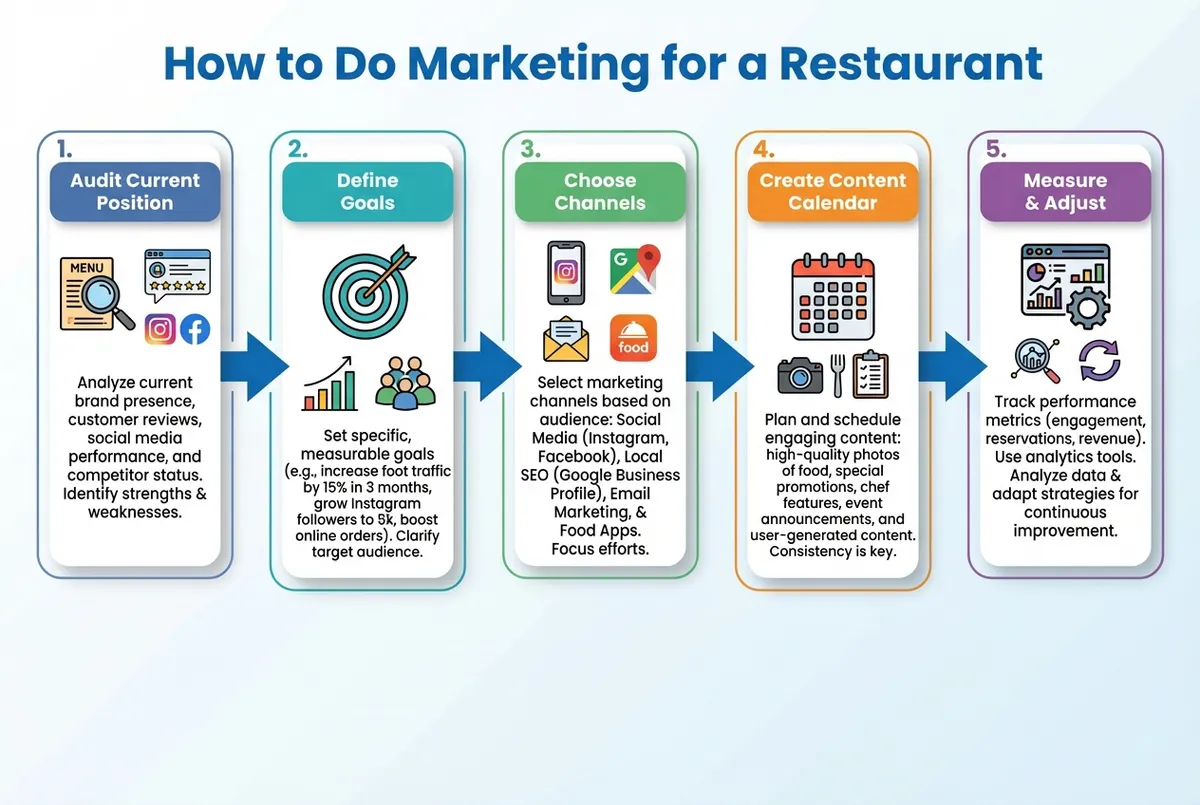
Step 1: Audit Your Current Position
Before spending a pound, understand where you stand:
- Google yourself. What shows up? Is your Business Profile claimed and optimised?
- Check your reviews. What's your average rating? What do negative reviews mention repeatedly?
- Audit your website. Does it load on mobile? Can customers book or order easily?
- Track current sources. Ask new customers "How did you hear about us?"
Step 2: Define Your Goals
Get specific. "More customers" isn't a goal. These are:
- Increase weekday lunch covers by 20% over 3 months
- Grow Instagram followers from 500 to 1,500 in 6 months
- Generate 10 new Google reviews monthly
- Reduce customer acquisition cost from £8 to £5
Step 3: Choose Your Channels
Don't try everything. Pick 2-3 channels and do them well:
| Channel | Best For | Time Investment |
|---|---|---|
| Google Business Profile | Local discovery | 30 mins/week |
| Food-focused audiences, under 45 | 2-3 hours/week | |
| Community building, 35+ audience | 1-2 hours/week | |
| Email marketing | Retention, repeat visits | 1 hour/week |
| Local SEO | Long-term organic traffic | 2 hours/month |
Related: Restaurant marketing plan: a template to structure your approach.
Step 4: Create a Content Calendar
Random posting doesn't work. Plan your content:
- Monday: Behind-the-scenes (kitchen prep, deliveries)
- Wednesday: Customer feature or review share
- Friday: Weekend special promotion
This isn't rigid, adjust based on what works. But having a framework, or a tool that schedules your posts in advance, prevents the "I should post something" anxiety that leads to nothing getting posted.
Step 5: Measure and Adjust
Track these metrics monthly:
- Website traffic (Google Analytics)
- Google Business Profile views and actions
- Social media engagement rate (not just followers)
- Review volume and average rating
- Actual bookings/orders attributed to marketing
If something isn't working after 8-12 weeks, change it. If it's working, double down.
Marketing Strategies by Restaurant Type
Additionally, what works depends on what you serve, not all restaurants need the same approach.
Different restaurant formats need different approaches:
Fine Dining
- Focus: Experience and exclusivity
- Channels: Instagram (aspirational), PR, influencer partnerships
- Tactics: Chef's table experiences, seasonal tasting menus, wine pairing events
Casual Dining
- Focus: Value and consistency
- Channels: Google Business Profile, Facebook, email
- Tactics: Loyalty programmes, midweek offers, family deals
Quick Service
- Focus: Speed and convenience
- Channels: Delivery apps, Google Maps, local advertising
- Tactics: Meal deals, app-exclusive offers, drive-through promotions
Takeaway/Delivery
- Focus: Visibility on platforms
- Channels: Just Eat, Deliveroo, Uber Eats optimisation
- Tactics: Platform-specific promotions, packaging for unboxing, review management
For example: A casual dining family restaurant in Newcastle switched from Instagram (which wasn't working) to Facebook Groups and email. They joined local parent groups, offered "kids eat free" on Tuesdays, and built an email list with a simple "birthday club." Within four months, their Tuesday covers tripled.
Related: Restaurant promotions: ideas for every restaurant type.
Common Restaurant Marketing Mistakes
However, even the best frameworks fail if you make these errors. If you recognise yourself in any of these, you're not alone.
If you're only doing marketing when it's quiet, you're losing to competitors who treat it as part of operations, not an afterthought. Here are the mistakes that waste time and money:
Mistake 1: No Consistent Presence
Posting three times one week, then disappearing for a month, trains customers to forget you. Algorithms punish inconsistency too. Avoid this trap: it rarely works to post only when you remember.
Mistake 2: Ignoring Reviews
An unanswered negative review tells potential customers you don't care. Respond to everything, professionally.
For instance: A café in Edinburgh ignored a 2-star review about cold coffee. Potential customers saw the unaddressed complaint and chose competitors. A simple "We're sorry to hear this. We've retrained our barista team" would have shown accountability.
Mistake 3: Wrong Channel Focus
A fine dining restaurant spending hours on TikTok while ignoring their Google reviews is targeting the wrong audience in the wrong place. A wine bar owner in Edinburgh spent months building a TikTok following of 5,000, almost entirely teenagers who couldn't legally visit. Meanwhile, her Google Business Profile showed two-year-old photos and unanswered questions. Know where your actual customers are.
Mistake 4: No Clear Call to Action
"Check us out" isn't a CTA. "Book your table for Saturday" is. Every post should tell people what to do next.
Mistake 5: Measuring the Wrong Things
Follower counts feel good but don't pay rent. Track actions: bookings, calls, direction requests, website clicks.
Warning
Ask yourself: Would I book a table at my own restaurant based on what someone sees online? If you hesitate, that's your answer.
Related: Restaurant marketing mistakes: the full breakdown with how to fix each one.
Minimum Viable Restaurant Marketing
Finally, if you genuinely have no time, start here. This is the floor, not the ceiling.
If you only have 30 minutes a week, do this:
| Day | Action | Time |
|---|---|---|
| Monday | Respond to any Google reviews from the weekend | 5 mins |
| Wednesday | Post one Instagram photo (food or behind-scenes) | 10 mins |
| Friday | Schedule a weekend promotion post | 10 mins |
| Ongoing | Ask one happy customer for a Google review | 5 mins |
This isn't ideal, it's the floor.
Consistency wins
Restaurants doing this consistently will outperform those doing elaborate campaigns sporadically.
For instance: A small café owner in Brighton followed just this 30-minute routine for three months. Her Google reviews went from 12 to 47, her Instagram grew from 200 to 600 followers, and, most importantly, she started seeing familiar faces from Instagram walk through the door.
If you can't tell whether your marketing brings bookings or just likes, that's usually a sign the strategy needs tightening. Start tracking "How did you hear about us?" at the point of booking.
Getting Help with Restaurant Marketing
Furthermore, sometimes the smartest move is admitting you need support.
Not every restaurant owner has time for marketing. If you're thinking "I barely have time to run service", you're not alone. Here are your options:
Typical costs, your mileage may vary based on location and scope:
| Option | Cost | Best For |
|---|---|---|
| DIY | Time only | Tight budgets, social-savvy owners |
| Freelancer | £200-500/month | Specific tasks (social media, photography) |
| Marketing Agency | £1,000-3,000/month | Comprehensive strategy, multiple channels |
| Platform Tools | £50-200/month | Automation, scheduling, basic analytics |
For example: A pizzeria owner in Bristol tried DIY marketing for six months. When he calculated the hours spent (10+ weekly), he hired a freelancer for £300/month to handle social media. His time freed up, and content quality improved. Don't assume DIY is always cheapest: calculate your time cost too.
For most independent restaurants, a hybrid works best: DIY the daily social media, hire a photographer quarterly, use tools to automate what you can.
For UK restaurant owners
Simplify Your Restaurant Marketing
LocalBrandHub brings together social media scheduling, menu promotion, and local SEO tools specifically designed for restaurants. If managing multiple platforms feels overwhelming, a purpose-built solution can save hours while keeping your marketing consistent.
Start freeKey Takeaways: Restaurant Marketing
If you run a restaurant and want to see how Local Brand Hub can support your marketing, explore our restaurant marketing tools.
Key Takeaways: Restaurant Marketing
As a result, here's what to remember:
- Restaurant marketing is a system, not random acts of promotion
- The 30/30/30/10 rule determines your marketing budget, typically £300-600/month for independent restaurants
- The 4 Ps (Product, Price, Place, Promotion) must all work together
- The 3-3-3 rule reminds you to grab attention fast, communicate value quickly, and follow up within days
- Consistency beats perfection: three posts weekly outperforms sporadic brilliance
- Measure what matters: bookings, not followers
Weekly Action
This week, complete this 30-minute audit:
- Day 1-2: Google your restaurant name. Is your Google Business Profile complete with current hours, photos from the last month, and a description? If not, update it.
- Day 3-4: Check your reviews. Reply to any unanswered reviews from the past 30 days, even just "Thank you for visiting!"
- Day 5-7: Post one piece of content to Instagram or Facebook. If you're stuck, take a photo of today's special.
That's it. Not a complete marketing strategy, just the foundation. Build from there.
Frequently Asked Questions
What is the average marketing cost for a restaurant?
UK independent restaurants typically spend 2-5% of revenue on marketing, or £200-600 monthly for a restaurant turning £20,000-30,000/month. This comes from the overhead portion of the 30/30/30/10 budget framework.
How do I market my restaurant with no budget?
Focus on free channels:
- Optimise your Google Business Profile
- Ask happy customers for reviews
- Post consistently on one social platform
- Partner with local businesses for cross-promotion
These tactics cost time, not money.
What social media platform is best for restaurants?
For most UK restaurants, Instagram often delivers strong results due to its visual focus and local discovery features. Facebook works well for the 35+ demographic. TikTok suits restaurants with video content capability.
How long until restaurant marketing shows results?
Expect 4-6 weeks for improved engagement, 3-6 months for noticeable booking increases. SEO improvements can take 6-12 months. Consistency matters more than intensity, steady effort beats sporadic campaigns.
Should I hire a marketing agency for my restaurant?
Consider an agency if you're spending more than 10 hours weekly on marketing without results, have a budget of £1,000+/month, or lack expertise in key areas like paid ads or SEO. Otherwise, DIY with occasional freelance help often works better for independents.
Get More Marketing Tips
Practical marketing tips for UK business owners, straight to your inbox. No spam, unsubscribe anytime.
About the Author
Local Brand Hub
Empowering UK Businesses
Local Brand Hub provides comprehensive business management tools designed specifically for UK local businesses to streamline operations, automate marketing, and grow revenue.
More articlesRelated Articles
 Marketing Tips
3 3 3 Rule in Marketing: Restaurant Framework Guide
Master the 3 3 3 rule in marketing for your restaurant. Focus on 3 messages, 3 audiences, and 3 channels for simpler, more effective marketing.
 Marketing Tips
7 P's of Restaurant Marketing: A Complete UK Guide
Master the 7 P's of restaurant marketing: Product, Price, Place, Promotion, People, Process, and Physical Evidence to attract more diners to your UK venue.
 Marketing Tips
12 Cafe Marketing Ideas That Actually Work in 2026
Try these 12 cafe marketing ideas used by top UK independents to grow footfall, boost repeat visits, and increase average spend.