15 restaurant promotions that work for UK independents. Seasonal events, loyalty programmes, and offers that drive bookings without killing margins.
You're running promotions but can't tell if they work. Maybe a 20% off voucher that attracted the wrong crowd, or a loyalty card nobody remembered. You've tried discounts before, and now you're stuck wondering whether promotions even work, or just eat into your margins. The biggest mistake is running promotions without knowing whether they actually make money.
Short on time? Here's the quick version
- Value-add beats discounts: A free dessert costs you £3-4 but feels like £8-10 to customers
- Match promotion to goal: Discounts for quiet periods, experiences for new audiences, loyalty for retention
- Track profitability: Use the promotion profit formula to ensure you're actually making money
- Plan seasonally: Valentine's, Mother's Day, Halloween, and Christmas are your four biggest opportunities
- Start simple: One value-add promotion for your quietest night is enough to begin
15 specific ideas below
Restaurant promotions are special offers, discounts, and events designed to attract diners during specific periods or increase spending per visit. The most effective promotions for UK restaurants combine seasonal timing with value-add offers that create perceived value without destroying margins, such as a free dessert with two mains rather than a blanket percentage discount.
The reality? Promotions typically influence dining decisions. But the gap between running promotions and running profitable restaurant promotions is where independent restaurants lose money. Whether you're running a food business for the first time or you've been in the industry for years, getting promotions right requires strategy.
If you're thinking "I've tried discounts and they just attracted deal-seekers", you're not alone. The key is choosing the right type of promotion for your goals.
This guide covers 15 proven restaurant promotions organised by type, with specific guidance on timing, margins, and measurement. Whether you're planning seasonal events or building a loyalty programme, you'll find practical ideas you can implement this month.
Related: Restaurant marketing, the complete framework for attracting and retaining customers.
What You'll Learn
- The 4 types of restaurant promotions and when to use each
- 15 specific promotion ideas with timing and margin guidance
- How to calculate whether a promotion is profitable
- Year-round seasonal calendar with UK-specific dates
- Common mistakes that kill promotion profitability
What Is the Best Promotion for a Restaurant?
The best promotion is a strategy that creates perceived value without destroying margins, like a free starter with mains. Value-add promotions typically outperform straight percentage discounts because they cost less and feel more special. The best choice depends on your goal: filling quiet periods, attracting new customers, or increasing average spend.
However, there's no single "best" promotion. Industry research consistently shows that restaurants using a mix of promotion types throughout the year generate significantly more revenue than those relying on discounts alone.
Info
The key is matching the right promotion to the right situation.
The four promotion types:
| Type | Best For | Example | Margin Impact |
|---|---|---|---|
| Discount-based | Filling quiet periods | 25% off Tuesdays | High (reduces margin) |
| Value-add | Increasing perceived value | Free starter with mains | Medium (controlled cost) |
| Experience-based | Attracting new audiences | Themed dinner events | Low (premium pricing) |
| Loyalty | Retention and frequency | Points programme | Very low (long-term ROI) |
Quick start
If you're thinking "I just want one simple promotion that works", start with value-add. A free dessert with two mains costs you £3-4 in ingredients but can feel like £8-10 of value to the customer.
Seasonal Restaurant Promotions
Furthermore, seasonal promotions align your marketing with what customers are already thinking about. Here's a year-round calendar with specific ideas for UK restaurants, and if you'd rather not build each one from scratch, you can start from ready-made seasonal campaigns.
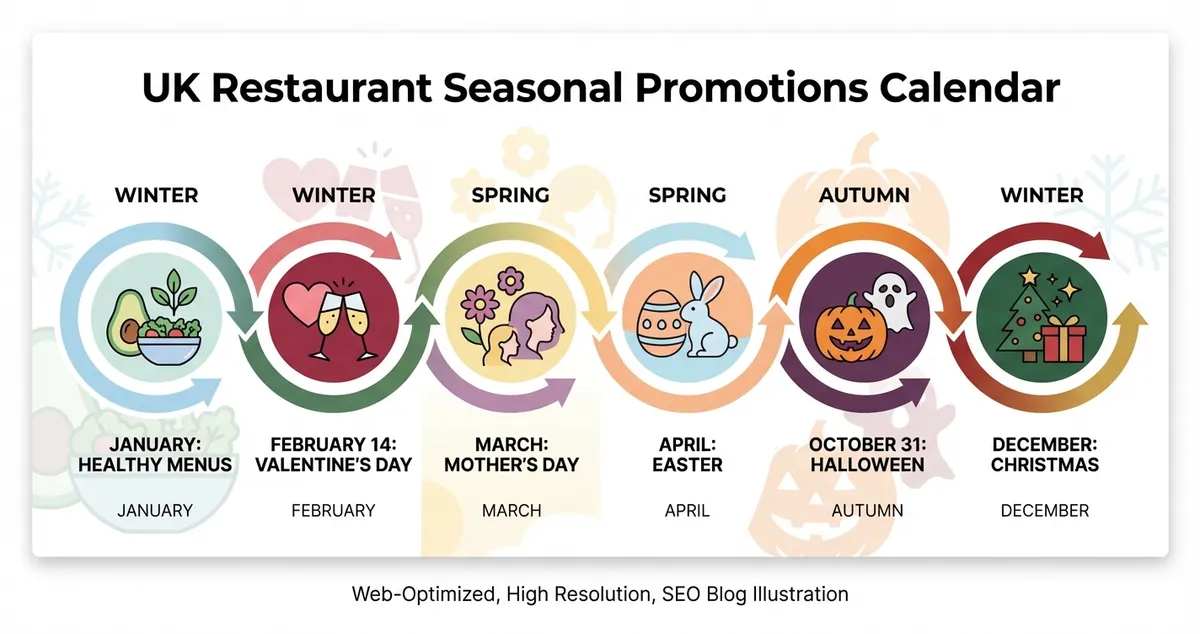
Valentine's Day Restaurant Promotions
Valentine's Day is the second-busiest restaurant day in the UK (after Mother's Day). Book up quickly, and you can charge premium prices.
Promotion ideas:
- Set Valentine's menu: Fixed price menu removes decision fatigue and guarantees average spend
- Early bird special: Early evening seating at a discount fills the "first sitting" most restaurants struggle with
- Post-Valentine's offer: "Couldn't book on the 14th? Book the following week for a complimentary bottle"
Timing
Promote several weeks ahead. Valentine's bookings are often made well in advance. See our seasonal restaurant marketing guide for a complete calendar approach.
Mother's Day Restaurant Promotions
Mother's Day generates the highest UK restaurant revenue of any single day. Expect significantly higher covers than a typical Sunday.
Promotion ideas: 4. Three-generation discount: Discount when three generations dine together (grandmother, mother, child) 5. Free flowers or chocolates: Partner with a local florist for table flowers; low cost, high perceived value 6. Kids eat free: Encourages family bookings; control cost with a limited kids' menu
Real-world example
A family pub in Surrey ran "Mums Eat Free" (with two paying adults) last Mother's Day. They lost margin per table but saw a 40% increase in bookings, netting considerably more profit on the day than a typical Sunday.
Halloween Restaurant Promotions
Halloween has grown significantly in UK dining culture. The key is matching your promotion to your venue style.
Promotion ideas: 7. Themed cocktails: Renamed or recoloured versions of existing cocktails; minimal ingredient cost increase 8. Costume discount: Discount for customers in costume; creates shareable social media moments 9. Kids' Halloween tea: Early seating for families before trick-or-treating
Warning
Don't go overboard on decorations if your brand is upscale. A few tasteful touches beat full transformation for fine dining. See restaurant marketing ideas for more themed event concepts.
Track your results
Always track which restaurant promotions bring new customers vs. regulars. A promotion that only attracts existing customers isn't growing your business. It's just discounting for people who'd come anyway.
Related: Seasonal restaurant marketing, planning your annual marketing calendar.
Christmas Restaurant Promotions
Christmas party season (late November to mid-December) is crucial for revenue. However, don't forget the quieter post-Christmas period.
Promotion ideas: 10. Early booking discount: 10% off party menus booked before October 31st 11. Twixmas offer: Special menu for December 27th-30th when many restaurants are quiet 12. New Year's resolution menu: January healthy options to capture diet-conscious diners
Loyalty and Repeat Visit Promotions
Beyond seasonal events, loyalty programmes turn one-time visitors into regulars. Here's what actually works.
What Makes Restaurant Loyalty Programmes Work?
Restaurant loyalty programmes work when they're simple to use and offer achievable rewards. According to a 2025 survey by Provoke Insights, 68% of UK diners belong to at least one restaurant loyalty programme, but only 34% actively use them.
The difference? Programmes that fail require too many visits for reward, use complicated point systems, or require a separate app customers forget about.
Warning
Avoid making the reward feel too far away: if customers need 20 visits before getting anything, they'll quit within a month.
Promotion ideas: 13. Stamp card: Simple, tangible, requires no app. "9 coffees, 10th free" or "5 mains, dessert free" 14. Birthday club: Free dessert or bottle of fizz on their birthday. Captures email addresses. 15. Midweek loyalty: Double points/stamps for visits Monday-Thursday; shifts demand to quiet periods
Example structure
A gastropub might structure their loyalty like this:
- Collect stamps (1 per £30 spent)
- 5 stamps = free dessert
- 10 stamps = £10 off any bill
- Birthday month = complimentary glass of champagne
This creates achievable milestones (5 stamps = roughly 5 visits at £30 average) while encouraging higher spend. Learn more about tracking promotion results in our restaurant marketing ROI guide.
How to Calculate Promotion Profitability
However, running promotions without tracking profitability is like cooking without tasting. Here's a simple framework that takes five minutes to set up.
The Promotion Profit Formula
Promotion Profit = (New Revenue × Your Margin) - Promotion Cost - Cannibalization
Breaking this down:
- New Revenue: Money you wouldn't have made without the promotion
- Your Margin: After food cost and labour (typically 30-40% for restaurants)
- Promotion Cost: Discount value, free items, marketing spend
- Cannibalization: Sales you would have made anyway at full price
Worked example
A Tuesday discount brings extra covers. After calculating new revenue minus your margin, then subtracting the discount cost and cannibalization, you might net only £30-40 profit. That's still positive, but barely.
The same restaurant running a "free starter" promotion often nets significantly more, because the ingredient cost is lower than a percentage discount.
Info
If you can't tell whether your promotions are profitable, that's a sign the strategy needs tightening.
What Are Some Examples of Good Food Promotion?
With the theory covered, let's look at specific promotions you can adapt for your restaurant.
Good food promotions create perceived value without destroying margins. The best examples use psychology: bundling, exclusivity, and urgency work better than straight discounts.
Warning
Don't just discount because competitors are. That's a race to the bottom that rarely works for independent restaurants.
Bundling Examples
- Date night bundle: Two mains + bottle of house wine + shared dessert at a set price (saves vs à la carte)
- Sunday family roast: Set price for two adults, two kids, including starters and desserts
- Business lunch express: Two courses + coffee in 45 minutes guaranteed
Exclusivity Examples
- Chef's table experience: Monthly ticketed event, limited to a small group, premium pricing
- Wine dinner: Multi-course meal with paired wines, quarterly, premium pricing
- Secret menu: Items only available to loyalty members or social followers
Urgency Examples
- Flash sale: Half off tomorrow's lunch (posted day before on social media)
- Weather trigger: "It's sunny! First tables today get free ice cream"
- Last tables: "Only a few tables left for Saturday; book by midnight"
Related: Restaurant marketing ideas, 50+ tactics beyond promotions.
Common Promotion Mistakes to Avoid
Now that you understand what works, here are the pitfalls that trip up even experienced operators.
Mistake 1: Training Customers to Wait for Discounts
If you run the same discount promotion every Tuesday, regulars learn to only visit Tuesdays. Vary your promotions and avoid predictable patterns.
Warning
If you're only running discounts without tracking profitability, you'll always lose to restaurants who understand their margins.
Real-world example
A bistro in Manchester ran "Wine Wednesday" (half-price bottles) for two years. When they stopped, Wednesday revenue dropped 60%. Customers had been trained to wait for deals.
Mistake 2: No Exit Strategy
Promotions should have clear end dates. "Happy Hour forever" becomes an expectation. "January Happy Hour" creates urgency.
Mistake 3: Ignoring Labour Costs
A promotion that triples covers but requires two extra staff members might lose money. Calculate fully-loaded costs before celebrating a "successful" promotion.
Mistake 4: Discounting to the Wrong Audience
Heavy discounters attract price-sensitive customers who won't return at full price. Target promotions at people likely to become regulars. See our restaurant marketing plan template for audience targeting guidance.
Better approach
A gastropub found their deep discount voucher brought crowds who never returned. Switching to a "credit on your next visit" (given with full-price meals) created repeat customers instead. Learn more about measuring restaurant marketing ROI.
Mistake 5: No Tracking
If you only have 30 minutes this week for promotion planning, spend it setting up tracking. Use a simple spreadsheet: promotion name, dates, cost, extra covers, estimated new revenue.
Warning
If you're running promotions without knowing which ones actually make money, you're just guessing. Most restaurants that track properly discover one or two promotions doing the heavy lifting while others quietly lose money.
Minimum Viable Promotion Plan
If you're overwhelmed by all these options, start here.
This week, set up one promotion:
- Day 1-2: Choose one quiet period (probably Tuesday or Wednesday evening)
- Day 3-4: Create a simple value-add offer: "Free dessert when you order two mains"
- Day 5-6: Post it on Google Business Profile and your one main social platform
- Day 7: Track how many tables mention or use the offer
That's enough to start. You can build from there.
Key Takeaways
If you run a restaurant and want to see how Local Brand Hub can support your marketing, explore our restaurant marketing tools.
Key Takeaways
Ask yourself: Can you name which of your promotions actually made money last year? If you can't answer confidently, you're not alone, but it's the first thing to fix.
- Match promotion type to goal: Discounts for quiet periods, value-add for margins, experiences for new audiences, loyalty for retention
- Plan seasonally: Valentine's, Mother's Day, Halloween, and Christmas are your four biggest opportunities
- Track profitability: Use the promotion profit formula to ensure you're actually making money
- Avoid training discount-seekers: Vary promotions and include end dates
- Start simple: One value-add promotion for your quietest night is enough to begin
Your next step this week:
- Identify your quietest trading period (usually Tuesday or Wednesday evening)
- Create one value-add offer: "Free dessert when you order two mains"
- Tell your team to track redemptions
- After two weeks, calculate: did it make money?
That single action puts you ahead of most restaurants running restaurant promotions blind. Start today, not next month.
Weekly Action
This week, audit your current promotions:
- Day 1-2: List every promotion you've run in the past 6 months
- Day 3-4: For each one, estimate: how many extra covers, what it cost you, whether you'd do it again
- Day 5-7: Identify your quietest regular period and design one value-add promotion for it
Frequently Asked Questions
What are the 4 P's of marketing for restaurants?
The 4 P's of marketing are:
- Product (your menu and food quality)
- Price (what you charge)
- Place (your location and online presence)
- Promotion (how you communicate offers and value)
Promotions are just one part of your marketing mix. They work best when your product, pricing, and presence are already strong.
What is the 30/30/30/10 rule for restaurants?
The 30/30/30/10 rule is a budget framework allocating revenue to food costs, labour, overhead (including rent, utilities, and marketing), and profit. When planning restaurant promotions, remember they come from overhead, competing with rent and utilities for budget.
How do I promote my restaurant with no budget?
Focus on free channels:
- Optimise your Google Business Profile with current photos and offers
- Encourage happy customers to leave reviews
- Post consistently on one social platform
- Build an email list by collecting addresses at point of sale
Partner with local businesses for cross-promotion: you feature their products, they mention your restaurant. See our restaurant marketing on a budget guide for more free tactics.
What makes a restaurant promotion successful?
Successful promotions have three elements:
- Clear goals (filling quiet times vs. attracting new customers vs. increasing spend)
- Measurable tracking (you know exactly how many extra covers it generated)
- Controlled costs (you've calculated whether the promotion is actually profitable)
Real-world example
A gastropub ran a "free dessert with mains" offer on Tuesdays, tracking redemptions against that day's revenue. They found it added around 15 extra covers at a cost of roughly £50 in desserts, netting significant profit on a previously quiet night.
For UK restaurant owners
Track Your Promotions
LocalBrandHub helps independent restaurants plan, schedule, and track promotions alongside their regular social media content. If you're juggling promotions across multiple channels, having everything in one dashboard makes measurement much simpler.
Start freeGet More Marketing Tips
Practical marketing tips for UK business owners, straight to your inbox. No spam, unsubscribe anytime.
About the Author
Local Brand Hub
Empowering UK Businesses
Local Brand Hub provides comprehensive business management tools designed specifically for UK local businesses to streamline operations, automate marketing, and grow revenue.
More articlesRelated Articles
 Marketing Tips
Restaurant Loyalty Offers That Keep Customers Coming Back
Create restaurant loyalty offers that reward regulars and capture valuable data. From stamp cards to digital programmes for UK restaurants that work.
 Marketing Tips
Restaurant Special Offers: UK Guide to Deals That Work
Restaurant special offers that boost bookings without killing margins. Midweek deals, loyalty schemes, vouchers, and seasonal promotions that work.
 Marketing Tips
Restaurant Interior Signage: Menu Boards & Upselling
Plan your restaurant interior signage strategy. Compare menu boards, wayfinding signs, hygiene displays and upselling signage with UK costs and rules.