Build your restaurant marketing plan using this practical 7-step template. Includes the 30/30/30/10 budget rule, 7 Ps framework, and UK-specific tactics.
You've been meaning to create a restaurant marketing plan for months. Every time you sit down to write one, you stare at a blank page and wonder where to start. Meanwhile, your competitor down the road seems to have a clear direction, and full tables.
Short on time? Here's the quick version
- 7 steps: Analysis, audience, goals, budget, channels, content, measurement
- The 30/30/30/10 rule determines your realistic marketing budget
- The 7 Ps framework ensures you're delivering, not just promoting
- Simplicity beats complexity: a one-page plan you use beats a detailed plan you don't
- Review quarterly and adjust based on results
Template and framework below
A restaurant marketing plan doesn't need to be a 50-page document. It needs to be practical enough to actually use, and specific enough to guide your decisions. Whether you're running a food business or an established venue, the principles are the same. This guide walks you through creating a restaurant marketing plan in seven steps, with a template you can adapt to your own venue.
Related: Restaurant marketing: the complete framework this plan builds upon.
What You'll Learn
- The 7 essential steps to create a restaurant marketing plan
- How to set realistic goals and budgets using the 30/30/30/10 rule
- The 7 Ps framework for restaurant service marketing
- A practical template you can adapt for your venue
- How to measure and adjust your plan quarterly
Quick Navigation:
- 7 Steps of a Marketing Plan
- 30/30/30/10 Rule
- 7 Ps Framework
- Restaurant Marketing Plan Template
- Key Takeaways
What Are the 7 Steps of a Marketing Plan?
The 7 steps of a restaurant marketing plan are: (1) situational analysis, (2) target audience definition, (3) goal setting, (4) budget allocation, (5) channel selection, (6) content planning, and (7) measurement and adjustment. Each step builds on the previous one.
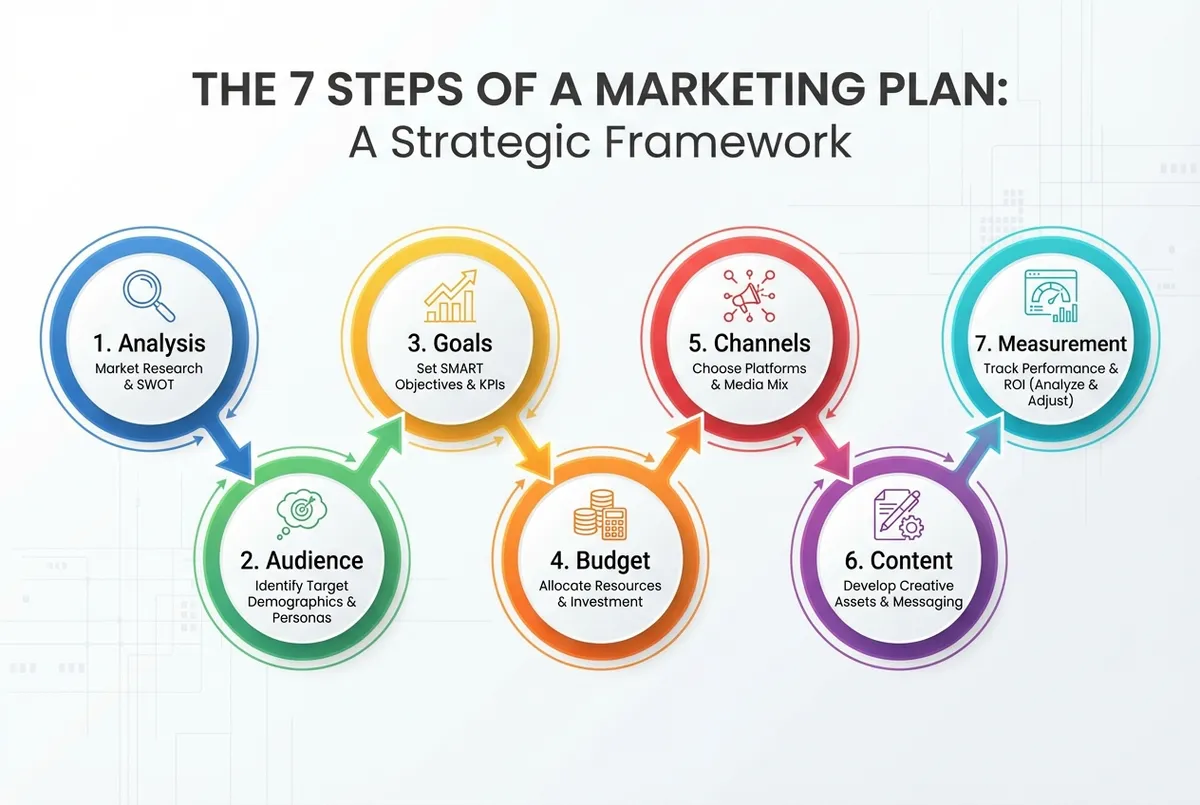
Let's walk through each step in detail.
Step 1: Situational Analysis
First, understand where you are now. Answer these questions honestly:
- Current performance: How many covers do you serve weekly? What's your average spend per head?
- Online presence: What's your Google rating? How many reviews do you have? What does your social media engagement look like?
- Competition: Who are your main competitors? What are they doing well that you're not?
- Strengths and weaknesses: What do customers love about you? What complaints come up repeatedly?
Real-world example
A gastropub in Bristol discovered through this analysis that their Google rating (4.2) was lower than competitors (4.5+) because of slow service complaints. This became a priority to address before investing in marketing.
Step 2: Target Audience Definition
Next, define who you're trying to reach. Be specific.
| Audience Segment | Characteristics | Primary Channel |
|---|---|---|
| Local families | 0.5-2 mile radius, parents with children | Facebook, Google |
| Date night couples | 25-45, looking for evening experience | |
| Business lunches | Office workers, weekday 12-2pm | LinkedIn, email |
| Weekend brunchers | 25-40, urban, Instagram-active | Instagram, TikTok |
Don't try to appeal to everyone. A neighbourhood Italian restaurant has different customers than a city-centre cocktail bar. Pick 2-3 primary segments and focus your marketing plan accordingly.
Step 3: Goal Setting
Now set specific, measurable goals. "More customers" isn't a goal: these are:
- Increase weekday lunch covers from 15 to 25 over 3 months
- Grow Instagram followers from 500 to 1,500 in 6 months
- Achieve 50 new Google reviews in Q1
- Increase average Friday/Saturday booking rate from 60% to 80%
SMART goals
SMART goals work best: Specific, Measurable, Achievable, Relevant, Time-bound. Write down 3-5 goals for your restaurant marketing plan.
Related: Restaurant marketing ROI: how to measure if your goals are being met.
If you're thinking "I don't have time to track all this," start with just one goal. One clear target is better than five vague intentions.
Step 4: Budget Allocation
How much can you actually spend? Use the 30/30/30/10 rule (explained below) to determine your marketing budget, then allocate it across channels.
A typical allocation for an independent restaurant (Rule of Thumb):
These percentages are starting points. Adjust based on your priorities and what's working for your venue.
| Category | % of Marketing Budget | Example (£500/month) |
|---|---|---|
| Social media ads | 40% | £200 |
| Photography/content | 20% | £100 |
| Email/CRM tools | 10% | £50 |
| Events/partnerships | 20% | £100 |
| Reserve/testing | 10% | £50 |
If your budget is £200/month, focus on one or two channels rather than spreading too thin.
Budget tip
Keep 10% of your budget as reserve for testing. When something works, double down on it. When it doesn't, cut it quickly.
Step 5: Channel Selection
Choose your marketing channels based on where your audience actually is, not where you think they should be. If you can't tell whether your marketing brings bookings or just likes, that's usually a sign your restaurant marketing plan needs clearer metrics.
For most UK restaurants, prioritise:
- Google Business Profile (free, essential)
- One social platform, usually Instagram or Facebook
- Email marketing (once you have a list)
- Review management
Avoid trying to be everywhere. A small team managing five platforms poorly delivers worse results than one platform managed well.
Info
The reality for most independents: you have maybe 3-5 hours a week for marketing. Pick channels that fit that constraint.
Related: Restaurant marketing ideas: 50+ tactics to implement once your plan is in place.
Step 6: Content Planning
Plan what you'll actually post and promote. If you're only creating content when you remember to, you'll always lose to competitors who schedule it in advance.
Create a simple monthly calendar:
Week 1:
- Monday: Behind-the-scenes kitchen photo
- Wednesday: Customer review share
- Friday: Weekend special promotion
Week 2:
- Monday: Team member spotlight
- Wednesday: New menu item teaser
- Friday: Event or booking reminder
Consistency matters more than creativity. A simple plan you execute beats an elaborate plan that sits in a drawer.
Step 7: Measurement and Adjustment
Finally, track what's working and adjust quarterly.
Monthly metrics to track:
- Google Business Profile views and actions
- Social media engagement rate (not just followers)
- Website visits and booking conversions
- Review volume and average rating
- Actual covers attributed to marketing
Real-world example
A wine bar in Edinburgh tracked their marketing sources for three months. They discovered Google Business Profile drove 60% of new customers while Instagram, despite having more followers, drove only 15%. They shifted effort to Google and saw a 25% increase in bookings. Your restaurant marketing plan should evolve based on data, not assumptions.
What Is the 30/30/30/10 Rule for Restaurants?
The 30/30/30/10 rule allocates restaurant revenue as: 30% food costs, 30% labour, 30% overhead (including marketing), and 10% profit. This widely-used financial framework, referenced by industry bodies like UKHospitality, tells you how much you can realistically spend on your restaurant marketing plan.
| Category | Percentage | For £25k Monthly Revenue |
|---|---|---|
| Food costs | 30% | £7,500 |
| Labour | 30% | £7,500 |
| Overhead | 30% | £7,500 |
| Profit | 10% | £2,500 |
What this means for marketing: Your marketing budget comes from the overhead pot, alongside rent, utilities, and insurance. After fixed costs, most independents have £200-600 monthly for marketing.
Adjust to fit
Fine dining may have higher labour percentages. Takeaways may have lower overhead. Adjust the ratios to fit your operation, but understand that marketing competes with other overhead expenses.
What Are the 7 Ps of Service Marketing in Restaurants?
The 7 Ps framework, Product, Price, Place, Promotion, People, Process, and Physical Evidence, provides a comprehensive lens for restaurant marketing planning. It extends the classic 4 Ps to cover service-specific elements.
Info
Understanding each P helps you see where marketing efforts might be undermined by operational gaps.
The 7 Ps Applied to Restaurants (Framework Overview):
| P | Definition | Restaurant Application |
|---|---|---|
| Product | What you sell | Menu, signature dishes, specials |
| Price | What you charge | Menu pricing, value perception |
| Place | Where customers find you | Location, delivery, online presence |
| Promotion | How you communicate | Social media, ads, PR |
| People | Who delivers the service | Staff training, hiring, culture |
| Process | How service is delivered | Booking, ordering, payment flow |
| Physical Evidence | Tangible elements | Interior design, table setting, branding |
In your restaurant marketing plan, consider all 7 Ps. Promoting a restaurant with poor service (People) or confusing booking processes (Process) won't deliver results.
Warning
Fix operational gaps before spending on promotion: no amount of marketing fixes bad service.
Related: Restaurant promotions: tactical ideas once your plan is in place.
How to Do Marketing for a Restaurant
Additionally, once you have a plan, how do you actually execute it? The reality for most owner-operators: you're already stretched thin running service.
Info
Marketing feels like one more thing on an endless list, but it doesn't have to take much time.
The weekly rhythm that works:
| Day | Action | Time Required |
|---|---|---|
| Sunday | Plan the week's content | 30 minutes |
| Monday | Reply to weekend reviews | 15 minutes |
| Wednesday | Post mid-week content | 15 minutes |
| Friday | Post weekend promotion | 15 minutes |
| Daily | Monitor and reply to comments | 10 minutes |
Total time: ~2.5 hours/week. That's manageable for most owner-operators.
Real-world example
A fish and chip shop in Liverpool built review requests into their checkout flow. Staff simply say "If you enjoyed your meal, we'd love a Google review" while handing over the receipt. No extra time, no special campaign, just consistent execution that doubled their reviews in three months.
The key is making marketing part of operations, not a separate project:
- Build review requests into the end-of-meal flow
- Train staff to mention Instagram-worthy moments
- Capture content during natural service moments
Related: Restaurant social media marketing: detailed platform strategies.
Restaurant Marketing Plan Template
Furthermore, here's a simple template you can adapt for your venue. Print it, fill it in, and keep it visible: a plan in a drawer helps no one.
Section 1: Current Situation (Where Are We Now?)
Business overview:
- Restaurant name:
- Concept/cuisine:
- Covers per week:
- Average spend per head:
Online presence audit:
- Google rating: / reviews:
- Instagram followers: / engagement rate:
- Website monthly visitors:
Competitive position:
- Main competitors:
- Their strengths:
- Our differentiation:
Section 2: Target Audience (Who Are We Reaching?)
Primary segment:
- Demographics:
- What they value:
- Where they are online:
Secondary segment:
- Demographics:
- What they value:
- Where they are online:
Section 3: Goals (What Do We Want to Achieve?)
Goal setting
Set SMART goals: Specific, Measurable, Achievable, Relevant, Time-bound.
Q1 Goals:
Annual Goals:
Section 4: Budget (What Can We Spend?)
Monthly marketing budget: £____
Allocation by category:
- Social media ads: £____
- Content/photography: £____
- Tools/software: £____
- Reserve/testing: £____
Section 5: Channels (Where Will We Focus?)
Channel selection
Pick 2-3 channels maximum. Doing fewer channels well beats spreading thin.
Primary channel: ____ Secondary channel: ____ Why these channels: ____
Section 6: Content Calendar
| Week | Monday | Wednesday | Friday |
|---|---|---|---|
| 1 | |||
| 2 | |||
| 3 | |||
| 4 |
Section 7: Measurement
Monthly tracking:
- Google views:
- Social engagement:
- Website visits:
- Reviews:
- Covers attributed to marketing:
Quarterly review date:
Common Restaurant Marketing Plan Mistakes
However, even good plans fail when these mistakes happen. If you're only marketing when things are slow, you'll always lose to restaurants who plan ahead and stay consistent.
Warning
Watch for these patterns, they're more common than you'd think among independent restaurants.
Mistake 1: Too Ambitious
If you're thinking "I need a comprehensive document to do this properly," that instinct is actually hurting you. A 30-page marketing plan that never gets implemented is worse than a one-page plan that does. Start simple. Add complexity later.
Mistake 2: No Budget Reality
Planning expensive campaigns without checking the 30/30/30/10 numbers leads to overspending or abandoned plans. Know your budget before setting tactics.
Mistake 3: Wrong Channels
Spending months building TikTok when your audience is on Facebook wastes time. Research where your actual customers are: see our guide on online vs offline restaurant marketing for channel selection.
Mistake 4: No Measurement
"We did some marketing" isn't useful feedback. Track specific metrics so you know what's working.
Mistake 5: Set and Forget
Markets change. Competitors adapt. If you're only reviewing your plan once a year, you'll always lose to restaurants who adjust quarterly based on results.
Warning
The biggest mistake? Spending weeks on a plan, then forgetting it exists. The restaurants that succeed treat their marketing plan as a living document, reviewed monthly, adjusted quarterly.
Minimum Viable Restaurant Marketing Plan
Finally, if you're short on time, start with this simplified version:
Your one-page restaurant marketing plan:
- Goal: [One specific goal for the next 90 days]
- Budget: £[monthly budget]
- Primary channel: [One channel you'll focus on]
- Weekly actions:
- Monday: Reply to reviews
- Wednesday: Post one piece of content
- Friday: Promote weekend special
- Monthly review: Track [one key metric]
Real-world example
A café owner in Manchester used this simplified plan: Goal: 20 new Google reviews in 90 days. Budget: £100/month (QR code cards). Channel: Google Business Profile. Weekly: Ask 5 happy customers for reviews. Metric: Review count. She hit 32 reviews in 8 weeks. Simple works.
Key Takeaways: Restaurant Marketing Plan
If you run a restaurant and want to see how Local Brand Hub can support your marketing, explore our restaurant marketing tools.
Key Takeaways: Restaurant Marketing Plan
As a result, here's what to remember:
- A restaurant marketing plan needs 7 steps: analysis, audience, goals, budget, channels, content, measurement
- The 30/30/30/10 rule determines your realistic marketing budget
- The 7 Ps framework ensures you're not just promoting, you're delivering
- Simplicity beats complexity: a one-page plan you use beats a detailed plan you don't
- Review quarterly: adjust based on what's actually working
Weekly Action
This week, complete Step 1 of your restaurant marketing plan:
- Day 1-2: Google yourself. Check your rating, review count, and what competitors look like.
- Day 3-4: Audit your social media. Note your follower counts and last 10 posts' engagement.
- Day 5-7: Write a one-paragraph situational analysis: "We are [type of restaurant] in [location] serving [covers/week]. Our Google rating is [X] with [X] reviews. Our main competitors are [X]. Our biggest strength is [X]. Our biggest weakness is [X]."
That's your foundation. Build from there.
Frequently Asked Questions
How long should a restaurant marketing plan be?
For an independent restaurant, one to three pages is sufficient. Focus on actionable content: goals, budget, channels, and calendar. A plan you'll actually use is more valuable than a comprehensive document that sits in a drawer.
How often should I update my restaurant marketing plan?
Review and adjust quarterly. Markets change, competitors adapt, and you'll learn what works for your specific venue. Major updates (new concept, significant investment) may require a fresh plan.
Do I need a marketing plan if I'm just starting out?
Yes, even a simple one-page plan helps focus your limited resources. New restaurants often waste money on ineffective marketing. A plan forces you to think about audience, budget, and channels before spending.
Starting point
The minimum viable version: one goal, one channel, one metric. That's enough to start.
What's typically the most important part of a restaurant marketing plan?
Goal setting and measurement are often the foundation. Without specific goals, you can't know if your marketing is working. Without measurement, you're guessing. Everything else supports these two elements.
For UK restaurant owners
Build Your Marketing Plan
LocalBrandHub helps independent restaurants create and execute marketing plans with integrated social media scheduling, promotions, and analytics, all in one place. If building a restaurant marketing plan feels overwhelming, having the right tools makes execution much simpler.
Start freeGet More Marketing Tips
Practical marketing tips for UK business owners, straight to your inbox. No spam, unsubscribe anytime.
About the Author
Local Brand Hub
Empowering UK Businesses
Local Brand Hub provides comprehensive business management tools designed specifically for UK local businesses to streamline operations, automate marketing, and grow revenue.
More articlesRelated Articles
 Marketing Tips
3 3 3 Rule in Marketing: Restaurant Framework Guide
Master the 3 3 3 rule in marketing for your restaurant. Focus on 3 messages, 3 audiences, and 3 channels for simpler, more effective marketing.
 Marketing Tips
7 P's of Restaurant Marketing: A Complete UK Guide
Master the 7 P's of restaurant marketing: Product, Price, Place, Promotion, People, Process, and Physical Evidence to attract more diners to your UK venue.
 Marketing Tips
12 Cafe Marketing Ideas That Actually Work in 2026
Try these 12 cafe marketing ideas used by top UK independents to grow footfall, boost repeat visits, and increase average spend.