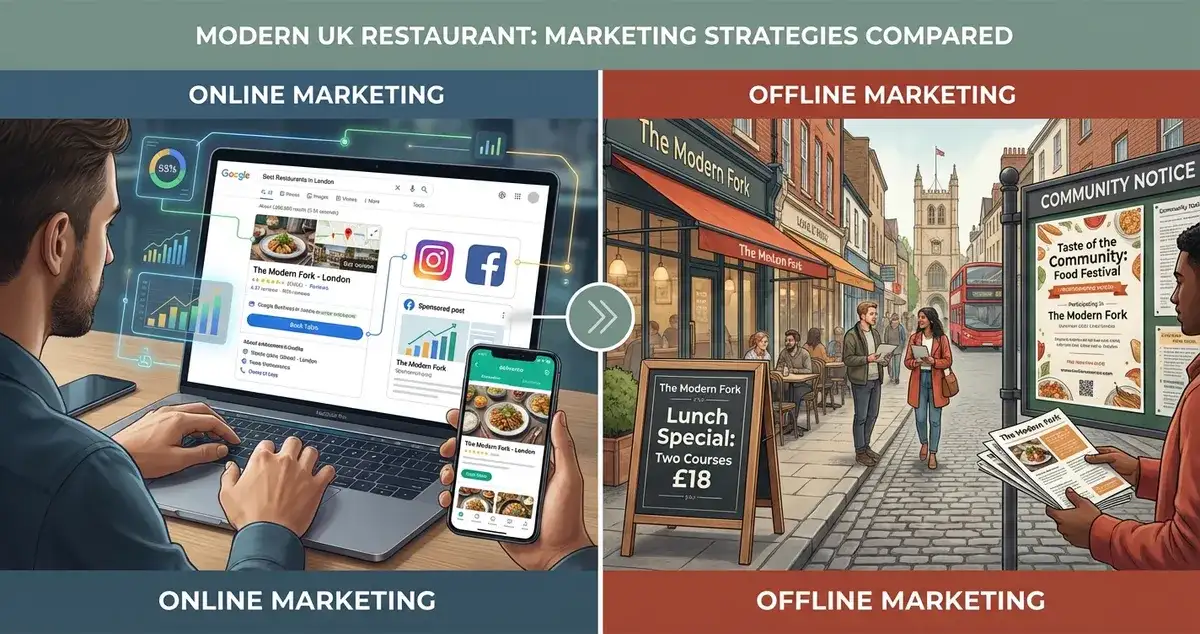
Compare online vs offline restaurant marketing channels for UK restaurants. Discover where to invest your time and budget to acquire customers effectively.
You're spreading yourself across five platforms but can't tell which one actually fills tables. Every marketing guru has different advice: "be on TikTok," "invest in signage," "email is dead, no wait, email is back." Meanwhile, your competitor seems to get full tables without trying.
Online vs offline restaurant marketing isn't about choosing sides. It's about knowing which channels work for your situation. Online includes Google, social media, and email. Offline covers signage, flyers, and word-of-mouth. For most UK restaurants, you don't pick one. You learn where each works best and put your time there.
Short on time? Here's the quick version
- Google Business Profile is usually essential: Free, high-intent, measurable, start here
- Online wins on measurability: Digital channels let you track what works
- Offline wins on local presence: Signage and community matter for walk-ins
- Integration beats separation: Connect your channels for maximum impact
- Don't spread thin: Master 2-3 channels before adding more
Full comparison below
The digital vs traditional debate misses the point. Your customers don't see channels. They see your Instagram, walk past your sign, hear from friends, and check Google reviews. All before booking.
Restaurant customers typically hit 5-7 touchpoints before choosing where to eat. Effective marketing connects these points. It doesn't treat online and offline as separate battles.
This guide compares online and offline restaurant marketing channels. You'll see honest takes on which typically deliver the strongest return for UK restaurants.
Warning
Don't make this mistake: Restaurants that spread thin across every channel rarely succeed. You're better off mastering 2-3 channels than being mediocre everywhere.
Related: Restaurant marketing, the complete framework combining all channels.
What You'll Learn
- The key differences between online and offline marketing for restaurants
- Honest comparison of ROI for each channel type
- Which channels work best for different restaurant types
- How to integrate online and offline for maximum impact
- Where to focus with limited time and budget
Contents:
- Online Restaurant Marketing Channels
- Offline Restaurant Marketing Channels
- Head-to-Head Comparison
- What Works for Different Restaurant Types
- How to Integrate Online and Offline
- Where to Focus With Limited Resources
- Key Takeaways
- FAQ
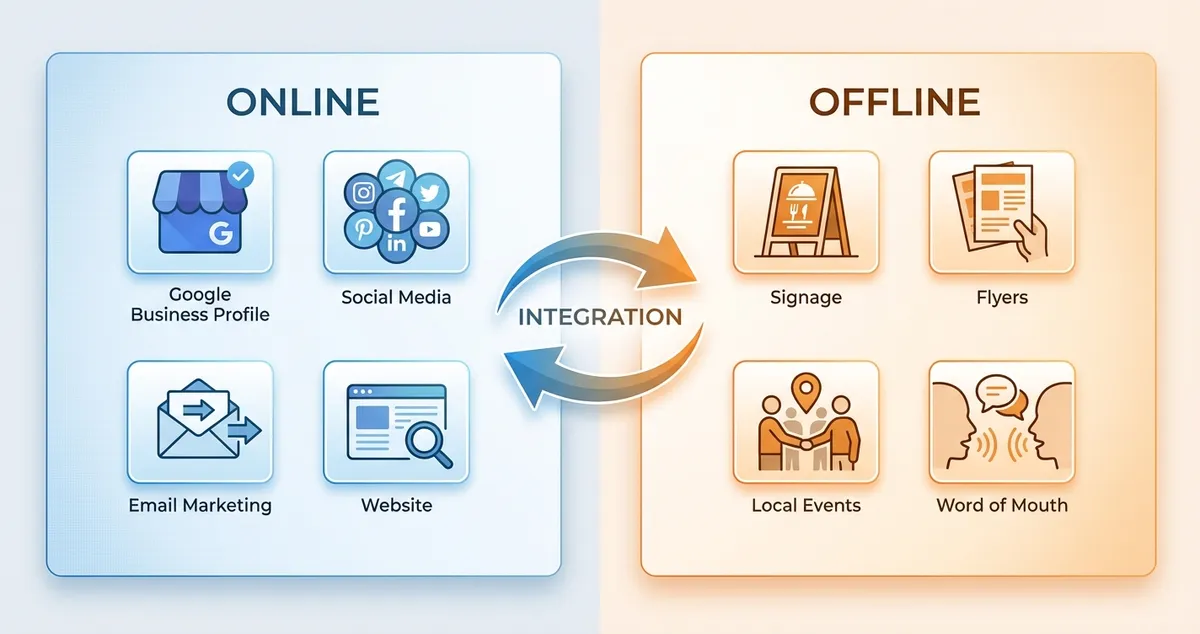
Online Restaurant Marketing Channels
Furthermore, online channels often offer reach, targeting, and measurability that offline marketing typically can't match. Here's what typically works in the online vs offline restaurant marketing mix.
Note: "Works best for" recommendations are general patterns. Your results will vary based on location and audience.
Google Business Profile
Your free listing in Google Search and Maps. Most restaurants treat this as essential. It's typically the first thing to set up when weighing online vs offline restaurant marketing options. Without an optimised Google Business Profile, you're likely missing one of your highest-ROI channels. Working through a simple local SEO checklist is the quickest way to make sure yours is fully set up.
Investment: Free Works best for: Nearly all restaurants
How GBP typically performs for most restaurants:
| Strengths | Challenges |
|---|---|
| Free to use | Needs regular updates |
| High-intent audience | Reviews affect how you look |
| Drives bookings directly | Competitive in busy areas |
| Measurable results | Google can change visibility |
Expected return: Often the highest of any online vs offline restaurant marketing channel. Free marketing to people actively looking for a place to eat.
Social Media (Organic)
The channel: Instagram, Facebook, TikTok without paid promotion Investment: Time only (3-5 hours/week typical) Works best for: Visual concepts, younger audiences, community building
General patterns, your results may vary:
| Strengths | Challenges |
|---|---|
| Free (time cost only) | Algorithm limits organic reach |
| Builds community | Time-intensive to maintain |
| Showcases food visually | Takes months to show results |
| Direct customer chat | Needs consistent content |
Expected return: Medium. Great for awareness, but hard to tie directly to bookings.
Info
If you're only posting without engaging with comments and messages, you'll build followers who never become customers.
Social Media (Paid)
The channel: Facebook/Instagram ads and promoted posts Investment: £100-500/month typical for independents Works best for: Launches, local targeting, events
Typical paid social patterns:
| Strengths | Challenges |
|---|---|
| Precise local targeting | Ongoing spend required |
| Quick results | Learning curve |
| Measurable outcomes | Easy to waste budget |
| Scales up easily | Costs rise over time |
Expected return: Variable. Highly effective when targeted well.
Warning
If you're running ads without tracking which bookings they generate, you'll waste budget on campaigns that feel productive but deliver nothing measurable.
Email Marketing
The channel: Newsletters and promos to your subscriber list Investment: £10-30/month for software Works best for: Driving repeat visits from past customers
Typical email marketing patterns:
| Strengths | Challenges |
|---|---|
| Often highest ROI of any channel | Need a list first |
| You own this audience | People ignore or unsubscribe |
| Very targeted messaging | List shrinks over time |
| Low monthly cost | Needs good content |
Expected return: Very high. But you need an existing customer list to start.
Start small
The biggest mistake is waiting until you have a "big enough" list: start with 50 email addresses and grow from there.
Related: Restaurant marketing on a budget, maximising free and low-cost online channels.
Offline Restaurant Marketing Channels
However, physical marketing remains powerful for restaurants, especially for building local awareness and trust.
Signage and Kerb Appeal
Your physical presence: exterior signs, A-boards, window displays. For busy streets, this is often among your most effective marketing.
Investment: £200-5,000+ depending on scale Works best for: Walk-in traffic and local awareness
Typical patterns for high-footfall locations:
| Strengths | Challenges |
|---|---|
| Works 24/7 | One-time high cost |
| Captures walk-by traffic | Regulations may restrict |
| Builds brand recognition | Hard to change or test |
| Creates professional look | Limited to your location |
Expected return: High for busy spots. Signage often outperforms digital for footfall locations.
Real-world example
A café in Manchester invested £800 in new A-board signage with daily specials. Walk-in traffic increased 25% within a month. For high-footfall locations, this offline tactic often beats online advertising.
Local Print Advertising
The channel: Newspaper ads, magazine features, local publications Investment: £50-500 per placement Works best for: Older customers, established local magazines
General patterns for print, effectiveness varies widely:
| Strengths | Challenges |
|---|---|
| Trusted by some audiences | Readership declining |
| Reaches non-digital people | Expensive for reach |
| Builds credibility | Hard to measure |
| Magazines last longer | Long lead times |
Expected return: Low to medium. Declining for most restaurants, but still reaches older customers.
Info
If you're only investing in print because "that's how we've always done it," you'll miss the audiences who've moved online.
Flyers and Leaflets
The channel: Physical handouts to local homes and businesses Investment: £100-300 for printing + distribution Works best for: New restaurant launches, very local targeting
| Strengths | Challenges |
|---|---|
| Very local targeting | Low response (0.5-2% typical) |
| Tangible reminder | Environmental concerns |
| Can include offers | Often ignored or binned |
| Quick to produce | Manual distribution needed |
Expected return: Low. Typically best for one-off campaigns, not ongoing marketing.
Warning
If you're only relying on flyers without tracking results, you'll waste money on what feels productive but often isn't.
Local Sponsorships and Events
The channel: Sponsoring sports teams, charities, community events Investment: £100-1,000+ depending on scope Works best for: Building goodwill and local reputation
Typical patterns for community-focused venues:
| Strengths | Challenges |
|---|---|
| Builds community ties | Hard to measure ROI |
| Positive brand association | Can get expensive |
| Networking chances | Not scalable |
| Local PR potential | Long-term investment |
Expected return: Indirect. Builds reputation rather than direct bookings. Worth it for community-focused restaurants.
Info
If you're only sponsoring for the logo visibility without building genuine relationships, you'll get minimal return on investment.
Word of Mouth
The channel: Customer recommendations and referrals Investment: Free (but needs great service) Works best for: Nearly every restaurant, this is often the ultimate goal
Warning
If you're only focusing on paid channels while ignoring service quality, you'll always lose to restaurants where customers can't stop talking about their experience.
| Strengths | Challenges |
|---|---|
| Often the most trusted marketing | Can't control it directly |
| Free (costs nothing) | Takes time to build |
| Creates loyal fans | Negative WoM spreads faster |
| Compounds over time | Needs consistently great experience |
Expected return: Often the highest long-term. But only works if your service is excellent.
Info
If you're only doing online marketing and ignoring your physical presence, you'll lose to competitors who invest in both. Walk-in customers matter, especially for busy locations.
Related: Restaurant marketing ROI, how to measure what's working.
Head-to-Head Comparison: Online vs Offline Restaurant Marketing
Now let's look at how online vs offline restaurant marketing channels stack up directly.

It depends
If you're thinking "just tell me which is better", the answer depends on your specific situation. Here's how they compare.
Cost Efficiency (Rule of Thumb)
Your results will vary based on location and restaurant type. These are typical patterns, not guarantees.
| Factor | Online | Offline | Typical Winner |
|---|---|---|---|
| Startup cost | Low | Variable | Online |
| Ongoing cost | Low-medium | Low-medium | Tie |
| Time investment | High | Medium | Offline |
| Scaling cost | Low | High | Online |
Measurability (Rule of Thumb)
These are general patterns in online vs offline restaurant marketing. Specific tools and methods can change results.
| Factor | Online | Offline | Typical Winner |
|---|---|---|---|
| Tracking ease | Easy | Difficult | Online |
| Attribution clarity | Medium | Low | Online |
| A/B testing | Easy | Difficult | Online |
| Real-time data | Yes | No | Online |
Reach and Targeting (Rule of Thumb)
Location and customer demographics affect these heavily. Your online vs offline restaurant marketing mix should reflect your specific audience.
| Factor | Online | Offline | Typical Winner |
|---|---|---|---|
| Local targeting | Good | Excellent | Offline |
| Broad reach | Excellent | Limited | Online |
| Demographic targeting | Excellent | Limited | Online |
| Reaching non-digital audiences | Poor | Excellent | Offline |
What Works for Different Restaurant Types
Additionally, the ideal online vs offline restaurant marketing mix typically varies by restaurant type. Whether you're operating as a food business in a city centre or a suburban neighbourhood, here's what works for each.
City Centre/High Footfall
Best online: Google Business Profile, Instagram Best offline: Signage, A-boards, kerb appeal Why: Capture walk-by traffic; be discoverable to tourists and visitors.
Warning
If you're only investing in digital without improving your street presence, you'll lose walk-by customers to the restaurant with better signage next door.
Related: Restaurant marketing ideas, 50+ tactics for any location.
Suburban/Neighbourhood
Best online: Facebook (community groups), Google Business Profile Best offline: Local sponsorships, community events, flyers Why: Build community connection; become the "local."
Info
If you're only targeting broad audiences without building local relationships, you'll struggle to compete with established neighbourhood favourites.
Destination/Fine Dining
Best online: Instagram, email marketing, website/SEO Best offline: PR, partnerships, word of mouth Why: Build reputation and anticipation; target destination diners.
Quick Service/Casual
Best online: Google Business Profile, Facebook ads Best offline: Signage, menu boards, loyalty cards Why: Convenience and value messaging; capture impulse decisions.
Focus is key
Don't try to be everywhere. Pick 2-3 online and 2-3 offline channels. Do those well before adding more. Spreading thin is the most common online vs offline restaurant marketing mistake.
How to Integrate Online and Offline
Furthermore, the smartest approach to online vs offline restaurant marketing isn't choosing one. It's connecting them. The real opportunity is in integration.
Integration Examples
Info
If you're only measuring vanity metrics (likes, follows) without connecting them to bookings, you'll never know which channels actually work for your restaurant.
Online → Offline:
- QR codes on tables linking to review pages
- Social media competitions driving store visits
- Email offers redeemed in-restaurant
Offline → Online:
- Table cards prompting social follows
- Physical loyalty cards captured digitally
- Menu inserts encouraging Google reviews
- Receipts with survey/feedback links
Real-world example
A family restaurant prints Instagram handles on table cards and runs a monthly "tag us for a chance to win" competition. This turns offline diners into online followers. Those followers then see future posts and book again.
Info
If you can't tell which channel brings your bookings, that's a sign your online vs offline restaurant marketing needs better tracking.
Where to Focus With Limited Resources
However, most restaurants can't do everything. If you're short on time and budget, here's where to focus your online vs offline restaurant marketing efforts.
The reality for most independent restaurants is limited hours and tight budgets. Here's the priority order:
If You Have Zero Budget
- Google Business Profile (top priority for most)
- Word of mouth (operational focus)
- One social platform (Instagram usually)
If You Have £100-200/Month
All of the above, plus: 4. Email marketing (start building list) 5. Basic signage improvements
If You Have £500+/Month
All of the above, plus: 6. Targeted social ads (specific campaigns) 7. Local PR/partnerships
If You Only Have 30 Minutes a Week
Focus on the bare minimum that still works:
- Day 1-2: Update Google Business Profile (photos, hours, posts)
- Day 3-4: Post once on social media (behind-the-scenes or dish photo)
- Day 5-7: Ask 3-5 happy customers for Google reviews
That's enough to maintain visibility. When you have more time, add email and events.
Key Takeaways
If you run a restaurant and want to see how Local Brand Hub can support your marketing, explore our restaurant marketing tools.
Key Takeaways
Ask yourself: Are you spreading too thin across channels, or focused on the few that work for your restaurant? Most independents benefit from doing fewer things better. The online vs offline restaurant marketing debate isn't about picking sides. It's about picking what fits.
- Google Business Profile is usually essential: Free, high-intent, measurable, start here
- Online wins on measurability: Digital channels let you track what works
- Offline wins on local presence: Signage and community matter for walk-ins
- Integration beats separation: Connect your channels for maximum impact
- Word of mouth is the goal: All marketing should drive recommendations
Info
If you're only doing online or only doing offline, you're leaving customers on the table. The best online vs offline restaurant marketing approach uses both strategically.
Your next step this week:
- List every online and offline channel you're currently using
- For each, estimate: hours spent and bookings generated
- Cut the lowest 1-2 performers
- Reinvest that time into your top 2-3 channels
That's how you win at online vs offline restaurant marketing, not by doing more, but by doing the right things better.
Start now
Open your Google Business Profile and check when you last updated it. If it's been more than a week, update one photo and respond to one review right now. That single action takes 5 minutes and puts you ahead of restaurants who'll read this guide and do nothing.
See our restaurant marketing ideas for specific tactics once you've chosen your channels.
Weekly Action
This week, evaluate your online vs offline restaurant marketing mix:
- Day 1-2: List all channels you're active on (online and offline)
- Day 3-4: Estimate time and money spent on each, plus bookings from each
- Day 5-7: Pick 1-2 channels to stop and 1-2 to increase
Quick Channel Audit Checklist:
- Google Business Profile: Is it complete and updated weekly?
- Social media: Are you posting 3+ times per week?
- Email: Do you have a subscriber list and send monthly?
- Signage: Does your exterior attract walk-in traffic?
- Reviews: Are you asking every customer?
- Community: Are you active in local groups or events?
Frequently Asked Questions
Is digital marketing better than traditional marketing for restaurants?
Neither is always better. Digital offers better targeting and tracking. Traditional marketing, signs and word of mouth, still works well for local spots. The best approach typically uses both.
Simple rule
Digital for reach. Offline for local trust.
How much should restaurants spend on online vs offline marketing?
Put 60-70% of your budget into online (Google, one social platform, email). Put 30-40% into offline (signage, community, events).
Location matters
High-footfall areas should lean more offline. Quiet locations need more online reach.
See our restaurant marketing plan template for budget allocation guidance.
What's typically the most effective marketing channel for restaurants?
Google Business Profile is often the strongest choice:
- It's free
- It reaches people looking for places to eat right now
- Email has high ROI too, but you need a list first
Word of mouth is the most trusted, but takes time to build.
Should small restaurants advertise on social media?
Only if you can target well and track results. A £50 Facebook ad for your local area with a clear offer can work. Broad "awareness" ads with no offer or tracking? That wastes money for most small restaurants.
Real-world example
A pizza shop might run a £50 Facebook ad targeting people within 3 miles offering "20% off first online order." With a unique code, they can track exactly how many orders came from that ad. That's measurable. Running the same £50 on a "like our page" campaign? That's guesswork.
For UK restaurant owners
Manage All Your Channels
LocalBrandHub helps restaurants manage online and offline marketing in one place. One dashboard. Clear tracking. When you can see what works, the online vs offline restaurant marketing choice becomes simple.
Start freeGet More Marketing Tips
Practical marketing tips for UK business owners, straight to your inbox. No spam, unsubscribe anytime.
About the Author
Local Brand Hub
Empowering UK Businesses
Local Brand Hub provides comprehensive business management tools designed specifically for UK local businesses to streamline operations, automate marketing, and grow revenue.
More articlesRelated Articles
 Marketing Tips
Restaurant Marketing Agency: Guide to Choosing
Compare restaurant marketing agencies by cost, specialism, and results. UK agency shortlist, pricing guide, and a framework to pick the right partner.
 Marketing Tips
Digital Marketing for Restaurants: A Practical UK Guide
Learn how digital marketing helps UK restaurants attract more customers. Covers the 4 P's, 70/20/10 rule, and practical strategies you can start this week.
 Marketing Tips
Restaurant Digital Marketing: A Guide for UK Restaurants
Build a digital marketing plan for your UK restaurant with budget-friendly tactics, proven frameworks, and realistic cost breakdowns.