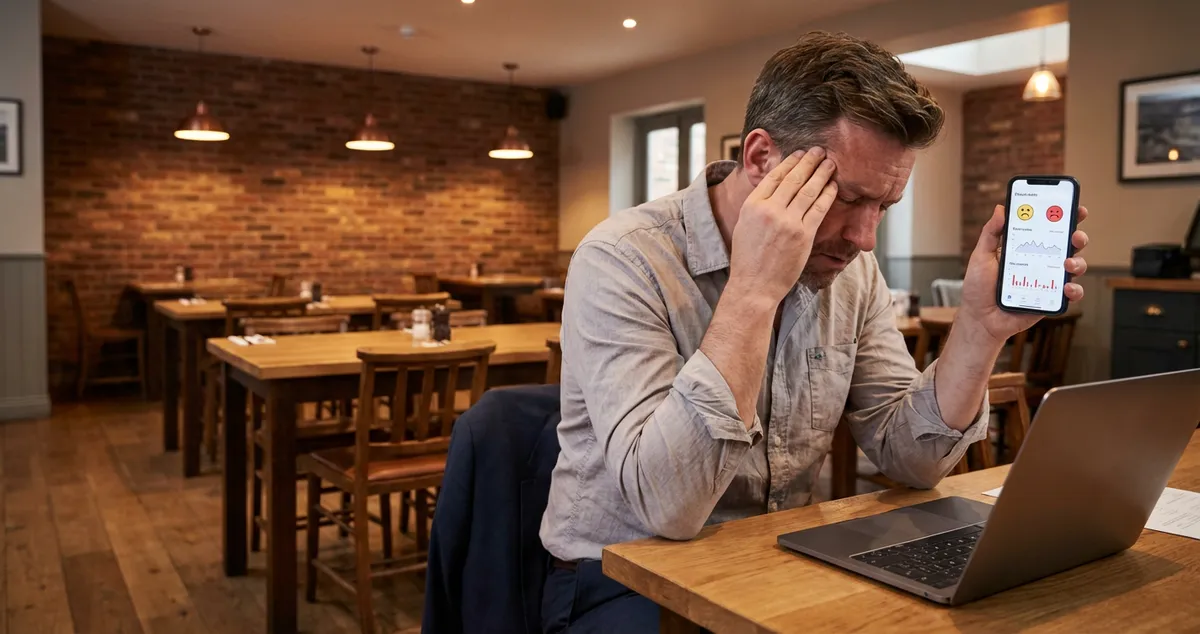
Common restaurant marketing mistakes costing UK independents customers. Learn what's wrong with social media, Google listing, and promotions.
You're posting photos, asking for reviews, maybe even running the occasional ad. Yet the restaurant down the road, with food no better than yours, has a queue every Friday night. What are they doing that you're not? If you're reading this thinking "I'm doing everything right but nothing's working," you're not alone.
Short on time? Here's the quick version
- Neglecting Google Business Profile is the #1 mistake: fix it first
- Inconsistency kills reach: algorithms punish sporadic posting
- Ignoring reviews signals you don't care about feedback
- Give strategies time: most fail from impatience, not bad tactics
- Own your audience: build an email list you control
Full breakdown of all 12 mistakes below
Restaurant marketing mistakes are avoidable errors that reduce visibility, waste budget, or damage reputation, from neglecting your Google Business Profile to posting inconsistently on social media. The most costly restaurant marketing mistakes aren't dramatic failures; they're small oversights that compound over time, quietly costing you customers while you wonder why bookings have slowed. If you're running a food business, getting marketing right matters more than ever.
Often, it's not what you're doing wrong. It's what you're not doing at all, or doing inconsistently. According to UK Hospitality data, the average independent restaurant loses an estimated £15,000-25,000 annually through marketing inefficiencies and missed opportunities.
This guide covers 12 of the most common restaurant marketing mistakes UK restaurateurs make, with practical fixes for each. Some you'll recognise immediately. Others might explain problems you've been struggling to diagnose.
Related: Restaurant marketing, the complete framework for getting it right.
What You'll Learn
- The 12 most common mistakes UK restaurants make with marketing
- Why each mistake costs you customers (with specific examples)
- Practical fixes you can implement this week
- How to audit your own marketing for these errors
- Warning signs that indicate you're making these mistakes
Table of Contents
- Mistake 1: Neglecting Your Google Business Profile
- Mistake 2: Inconsistent Social Media Presence
- Mistake 3: Ignoring Online Reviews
- Mistake 4: Marketing to Everyone Instead of Someone
- Mistake 5: Poor Food Photography
- Mistake 6: No Email List or Customer Database
- Mistake 7-12: Additional Critical Errors
- How to Audit Your Marketing
- Frequently Asked Questions
Mistake 1: Neglecting Your Google Business Profile
This is one of the most common restaurant marketing mistakes. Why it matters: Your Google Business Profile (GBP) is likely where most customers discover you. When someone searches "restaurants near me," Google decides whether to show your restaurant, and what they see.
The mistake: Leaving your profile incomplete, outdated, or unmanaged. Don't ignore this channel because it's probably your single biggest source of new customers. Common issues include:
- Incorrect opening hours (especially bank holidays)
- No recent photos or posts
- Unanswered reviews, especially negative ones
- Missing attributes (outdoor seating, vegetarian options, etc.)
Real-world example
A curry house in Birmingham had the wrong closing time listed for three months. They couldn't understand why Friday night bookings had dropped, until a regular mentioned he'd stopped coming because Google said they closed at 9pm. They actually closed at 11pm.
Warning
The hidden cost: Every hour your profile shows the wrong information, you're losing customers who wanted to visit but thought you were closed.
The fix:
- Audit your GBP monthly: hours, photos, posts, reviews
- Post weekly updates (specials, events, behind-the-scenes)
- Respond to every review within 48 hours
- Add all relevant attributes and categories
Mistake 2: Inconsistent Social Media Presence
Beyond Google, the second most common restaurant marketing mistake involves social media. Why it matters: Social media algorithms reward consistency. Posting three times in one week, then nothing for a month, teaches the algorithm your content isn't reliable, so it stops showing it to people.
The mistake: Random, reactive posting instead of planned, consistent content. Don't post only when busy or you'll train the algorithm to ignore you. Signs include:
- Posting "when you remember" rather than on a schedule
- Long gaps followed by posting bursts
- Different quality and style each time
- No content calendar or planning
Info
If you can't tell whether social media brings bookings or just likes, that's usually a sign your tracking needs work before you change tactics.
Real-world example
A gastropub had a Facebook page with 2,000 followers but posts getting only 15-20 views. They'd post enthusiastically for a week, then go quiet for three weeks. After switching to consistent Monday-Wednesday-Friday posts, their reach increased to 200-300 views per post within two months: same followers, 15x more visibility.
The consistency rule
Three posts per week for three months beats 30 posts this week and nothing next month.
The fix:
- Choose 2-3 days per week and stick to them
- Batch content creation: photograph food during service, schedule later
- Use a simple content calendar (even a spreadsheet works)
- Set phone reminders for posting times
Mistake 3: Ignoring Online Reviews
Now let's look at a restaurant marketing mistake that's surprisingly common among owners who are "too busy." Why it matters: Research shows that 94% of UK diners read reviews before choosing a restaurant. Unanswered reviews, especially negative ones, signal to both customers and Google that you don't care about feedback.
The mistake: Either not responding to reviews at all, or responding defensively to criticism. Don't argue with reviewers because every potential customer can see the exchange, and they usually side with the reviewer.
The restaurant owner's trap: Feeling personally attacked by negative reviews and responding emotionally. This often makes the situation worse and puts off potential customers reading the exchange.
The fix:
- Respond to every review, positive and negative
- For negative reviews: acknowledge, apologise, offer to resolve offline
- For positive reviews: thank them specifically, mention you hope to see them again
- Never argue or get defensive publicly
Template for negative reviews
"Thank you for your feedback. We're sorry your experience didn't meet expectations. We'd love to understand more and make it right: please email [address] and ask for [name]. We hope to have the chance to welcome you back."
Mistake 4: Marketing to Everyone Instead of Someone
Of all the restaurant marketing mistakes on this list, this one can be the hardest to spot in your own marketing. Why it matters: Trying to appeal to everyone results in appealing to no one. Your marketing becomes generic and forgettable.
The mistake: Using broad messaging like "Great food, great service" that could apply to any restaurant. No clear positioning or audience focus.
Specificity wins
Two Italian restaurants on the same street. One says "Authentic Italian cuisine." The other says "Neapolitan pizza made in our wood-fired oven, using Caputo flour and San Marzano tomatoes." The second one has a queue. The first one wonders why.
The specificity advantage
The more specific your positioning, the more memorable you become to your ideal customer.
The fix: Avoiding this particular restaurant marketing mistake requires clarity about who you serve.
- Define your ideal customer: families with young children? Date night couples? Business lunches?
- Identify your unique differentiator: what do you do that others don't?
- Make that differentiator central to all marketing
- Accept that some people aren't your target, and that's fine
Mistake 5: Poor Food Photography
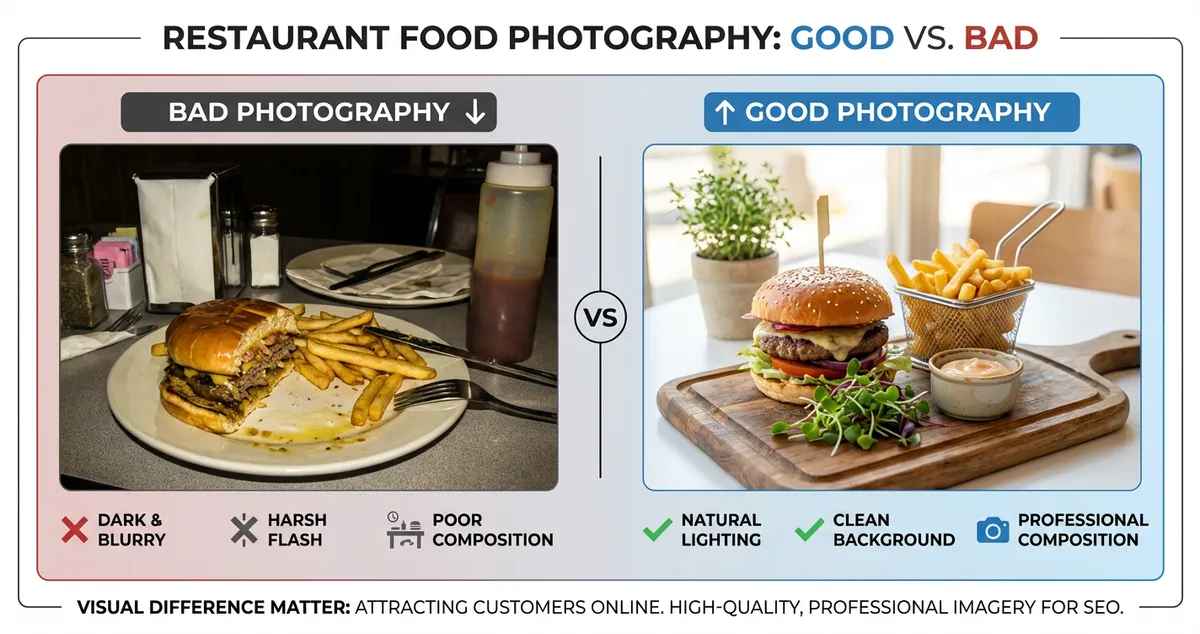
Furthermore, this restaurant marketing mistake is one of the easiest to spot, yet hardest for owners to see in their own content. See our restaurant marketing ideas for better approaches. Why it matters: Visual content gets 94% more engagement than text-only posts. Your food photos represent your food online. Poor photos actively damage perception of your restaurant.
The mistake: Dark, blurry, poorly composed photos that make good food look bad. Common errors include:
- Flash photography (harsh, unflattering)
- Cluttered backgrounds
- Cold, unappetising-looking food
- Inconsistent style and quality
The fix:
- Use natural light (near windows, during daytime)
- Clean background, minimal props
- Shoot while food is fresh and steaming
- Maintain consistent angles and style
- Consider one professional photoshoot for your core menu
Phone camera settings
The best phone camera settings for food: portrait mode, no flash, HDR off, natural/daylight white balance.
Mistake 6: No Email List or Customer Database
Of all the restaurant marketing mistakes on this list, this one can be the most costly in the long run. Why it matters: Email marketing typically delivers strong ROI: often £36 for every £1 spent according to industry estimates. Social media platforms can change their algorithms tomorrow. Email is the only channel you truly own and control.
The mistake: Having no systematic way to capture customer contact information or stay in touch after they leave.
Real-world example
A family restaurant in Cardiff built a 1,500-person email list over 18 months. Their monthly newsletter drives an average of 30 midweek bookings, worth roughly £1,200 in revenue from a tool that costs £15/month.
Warning
The opportunity cost: Every satisfied customer who walks out without giving you their email is someone you can only reach again through expensive advertising, if at all.
The fix:
- Add signup cards to tables ("Join for exclusive offers")
- Collect emails through WiFi logins
- Ask for email with reservations
- Send monthly newsletters with genuine value
- Don't spam: quality over frequency
Related: Restaurant marketing on a budget, building your email list costs nothing.
Mistake 7: Inconsistent Branding Across Platforms
Additionally, among restaurant marketing mistakes, this one often goes unnoticed because owners rarely view all their platforms side by side. Why it matters: Inconsistent branding creates confusion and reduces trust. If your Facebook looks different from your website which looks different from your menu, customers wonder if they're all the same restaurant.
The mistake: Different logos, colours, tone of voice, and quality levels across channels. Often happens when different staff manage different platforms.
The fix:
- Create simple brand guidelines (logo, colours, fonts, tone)
- Use the same profile photo and cover images everywhere
- Maintain consistent voice (formal vs casual, funny vs serious)
- Regular cross-platform audits
30-second check
Open your website, Facebook, Instagram, and Google profile in separate tabs. Do they all clearly look like the same restaurant?
Mistake 8: Promotions Without Strategy
Among restaurant marketing mistakes that damage margins, this one is particularly insidious. Why it matters: Poorly planned promotions train customers to wait for discounts, attract one-time bargain hunters, and damage margins without building loyalty.
The mistake: Running random discounts whenever business is slow, with no tracking of whether they actually work. If you're thinking "I just needed to fill seats", you're not alone, but short-term thinking here creates long-term problems.
Real-world example
A restaurant ran 30% off on Mondays to boost slow nights. It worked: Mondays got busy. But then Tuesday bookings dropped 40%. Regulars had simply shifted their visits to Mondays to save money.
Warning
Warning sign: If your promotion fills seats but doesn't increase total weekly covers, you're just shifting demand, not creating it.
The fix:
- Define clear goals for each promotion (new customers vs regulars vs average spend)
- Track results: extra covers, cost, profit
- Use value-add promotions over straight discounts
- Have exit strategies for every promotion
Related: Restaurant promotions, 15 ideas that actually work.
Mistake 9: Ignoring Local SEO
Among restaurant marketing mistakes that hurt visibility, this one is increasingly costly. With mobile searches for "restaurants near me" increasing by 150% over the past five years, you can't afford to ignore local SEO. Why it matters: When people search for restaurants in your area, local SEO determines whether you appear, and where. Running through a local SEO checklist is the quickest way to catch the gaps costing you visibility.
The mistake: Focusing only on social media while ignoring the basics of local search visibility. This restaurant marketing mistake is increasingly common among younger owners who grew up with Instagram but don't understand Google's local algorithms.
Real-world example
A cafe in Manchester appeared on page 3 of Google for "cafe Manchester" despite being in the city centre. The issue? Their address was formatted differently across Google, Facebook, and TripAdvisor. After standardising their NAP (name, address, phone), they moved to page 1 within 8 weeks.
NAP check
Name, Address, Phone must be identical on every platform: even small differences like "St" vs "Street" can hurt rankings.
Common local SEO errors:
- Inconsistent name/address/phone across directories
- Missing from key platforms (TripAdvisor, Yelp, Apple Maps)
- No location keywords in website content
- Few or no reviews on Google
The fix:
- Claim and complete profiles on all major platforms
- Ensure NAP (name, address, phone) consistency everywhere
- Ask for Google reviews specifically
- Include location terms in your website content
Mistake 10: Talking About Yourself Instead of Customers
Moreover, among restaurant marketing mistakes that kill engagement, this one appears in almost every struggling restaurant's social media. Why it matters: Customers care about what you can do for them, not about how proud you are of your restaurant.
The mistake: Marketing that focuses on "we" instead of "you." Every post is about awards, press mentions, new dishes, from the restaurant's perspective.
Example of self-focused messaging:
"We're proud to announce our new autumn menu"
Example of customer-focused messaging:
"Your cosy autumn evening just got better: warm spiced dishes now on the menu"
Quick test
Look at your last 5 social posts. If more than 3 start with "we" or "our," you're talking about yourself too much.
The fix:
- Audit recent posts: count "we/our" vs "you/your"
- Reframe everything from the customer's perspective
- Focus on benefits, not features
- Ask "why should the customer care?" before posting
Mistake 11: No Clear Call to Action
This restaurant marketing mistake turns otherwise good content into wasted effort. Why it matters: Marketing without a call to action leaves customers thinking "nice" and moving on. You need to tell them what to do next.
The mistake: Posts that show food but don't prompt any action. No booking links, no directions, no "click here."
The fix: This is one of the easiest restaurant marketing mistakes to correct immediately.
- Every piece of marketing should have one clear CTA
- Make it specific: "Book your table" not "Contact us"
- Reduce friction: link directly to booking page, not homepage
- Test different CTAs to see what works (see our restaurant marketing plan for testing frameworks)
Quick fix
Add "Book now" as the last line of every social post this week. Just that one change can increase conversions.
Good CTAs for restaurants:
- "Book your table for this weekend"
- "Reserve your spot: limited availability"
- "See our full menu"
- "Get directions"
Mistake 12: Giving Up Too Soon
Finally, this restaurant marketing mistake is perhaps the most frustrating. It turns genuinely good strategies into apparent failures when patience was all that was needed. Why it matters: Marketing compounds over time. Most restaurants quit just before their efforts would have started paying off.
The mistake: Trying something for 4-6 weeks, seeing no dramatic results, and switching to something new. Repeating this cycle indefinitely.
Real-world example
A tapas bar started Instagram with enthusiasm: posting daily for three weeks, getting 50-100 likes per post. Then they got busy and stopped for two weeks. They restarted, got discouraged by 30 likes, and tried TikTok instead. Six months later they're on their fourth platform with no traction on any. Meanwhile, their competitor posts 3x weekly on Instagram only and now has 8,000 followers.
The reality: Social media algorithms need 2-3 months of consistent posting before they start showing your content widely. SEO improvements take 3-6 months to affect rankings. Email lists need hundreds of subscribers before campaigns drive meaningful revenue.
The patience principle
Any marketing channel worth pursuing is worth pursuing for at least 90 days. If you can't commit to that, don't start.
The fix:
- Commit to any new strategy for minimum 3 months
- Set realistic expectations for each channel
- Track progress, not just results
- Look for leading indicators (engagement, reach) before lagging indicators (bookings)
Warning
If you're constantly changing marketing strategies, that's often the problem itself. This is one of the most common restaurant marketing mistakes. Pick fewer things, do them consistently, and give them time to work.
How to Audit Your Marketing for These Mistakes
Now that you understand these restaurant marketing mistakes, here's how to check whether you're making them.
- This audit takes just 30 minutes
- It will reveal your biggest restaurant marketing mistakes immediately
- Use the table below to track your pass/fail results
This week, check your restaurant marketing against this list:
Quick Audit Checklist
| Mistake | Quick Check | Pass/Fail |
|---|---|---|
| Google Business Profile | Is every field complete? Last post < 7 days ago? | |
| Social consistency | Posted 3x last week? 3x the week before? | |
| Reviews | All reviews answered within 48 hours? | |
| Food photos | Would you eat the food in your photos? |
Foundation check
First 4 checks cover your marketing foundations. Continue below for branding and strategy.
| Mistake | Quick Check | Pass/Fail |
|---|---|---|
| Branding | Same logo/colours across all platforms? | |
| Local SEO | Same address format on Google, website, and Facebook? | |
| Customer focus | More "you" than "we" in recent posts? | |
| Consistency | Been doing current strategy for 3+ months? |
Info
Scoring: 3+ fails means your restaurant marketing mistakes are likely costing you customers. Start with the first fail and work through them one by one.
Key Takeaways
If you run a restaurant and want to see how Local Brand Hub can support your marketing, explore our restaurant marketing tools.
Key Takeaways
Ask yourself: How many of these 12 restaurant marketing mistakes are you currently making? Most restaurants are making at least 5-6 of them. The good news is that each of these restaurant marketing mistakes is fixable.
- Google Business Profile is your foundation: fix it first, maintain it weekly
- Consistency beats creativity: regular average content outperforms sporadic brilliant content
- Own your customer relationships: build an email list you control
- Track what matters: if you can't measure it, you can't improve it
- Give strategies time: commit to 3 months before changing direction
Your next step: Pick the one mistake on this list that applies most to you. Fix that one thing this week. Then move to the next.
Minimum Viable Fix This Week:
If you only have 30 minutes:
- Day 1 (10 min): Check your Google Business Profile hours are correct
- Day 2 (10 min): Respond to any unanswered reviews
- Day 3 (10 min): Schedule one social media post for next week
That's enough to address the three most common restaurant marketing mistakes. Start there before tackling the rest.
Weekly Action
This week, conduct a quick marketing audit:
- Day 1-2: Check your Google Business Profile: is everything accurate and current?
- Day 3-4: Review your last 10 social posts: are they consistent in timing and quality?
- Day 5-7: Count your unanswered reviews across all platforms and respond to each one
Frequently Asked Questions
What is the biggest marketing mistake restaurants make?
The biggest marketing mistake is a pattern of neglecting Google Business Profile while focusing on trendier channels. For most restaurants, Google is where the majority of new customers discover them. An incomplete, outdated, or unmanaged profile means you're invisible to people actively searching for somewhere to eat.
Why is my restaurant marketing not working?
The most common reason restaurant marketing "doesn't work" is inconsistency. Algorithms favour accounts that post regularly; SEO takes months to show results; email lists need size before they drive revenue. If you've been trying different strategies for a few weeks each, the problem is likely patience, not tactics.
How do I know if my restaurant marketing is working?
Track these metrics:
- Google Business Profile views and direction requests
- Social media reach and engagement (not just followers)
- Website visitors from local searches
- Attributed bookings (ask new customers how they found you)
Compare month-over-month, not day-to-day.
Should restaurants be on all social media platforms?
No. Most restaurants get better results from being excellent on 1-2 platforms than mediocre on 5. Choose based on where your customers actually are:
- Instagram: Visual food content, younger audiences
- Facebook: Local community, older demographics
- TikTok: Only if you can commit to regular video content
Platform advice
Start with one platform. Master it before adding more. That alone avoids one of the biggest restaurant marketing mistakes.
For UK restaurant owners
Avoid These Marketing Mistakes
LocalBrandHub helps independent restaurants avoid these common restaurant marketing mistakes by providing templates, checklists, and scheduling tools in one dashboard. If you're struggling to stay consistent across channels, having everything in one place makes it much easier.
Start freeGet More Marketing Tips
Practical marketing tips for UK business owners, straight to your inbox. No spam, unsubscribe anytime.
About the Author
Local Brand Hub
Empowering UK Businesses
Local Brand Hub provides comprehensive business management tools designed specifically for UK local businesses to streamline operations, automate marketing, and grow revenue.
More articlesRelated Articles
 Marketing Tips
Restaurant Interior Signage: Menu Boards & Upselling
Plan your restaurant interior signage strategy. Compare menu boards, wayfinding signs, hygiene displays and upselling signage with UK costs and rules.
 Marketing Tips
Restaurant Outdoor Signage: A-Boards & More
Choose the right restaurant outdoor signage for your UK venue. Compare A-boards, projecting signs, fascia options, costs and planning permission rules.
 Marketing Tips
Restaurant Signage: Types, Costs and UK Regulations
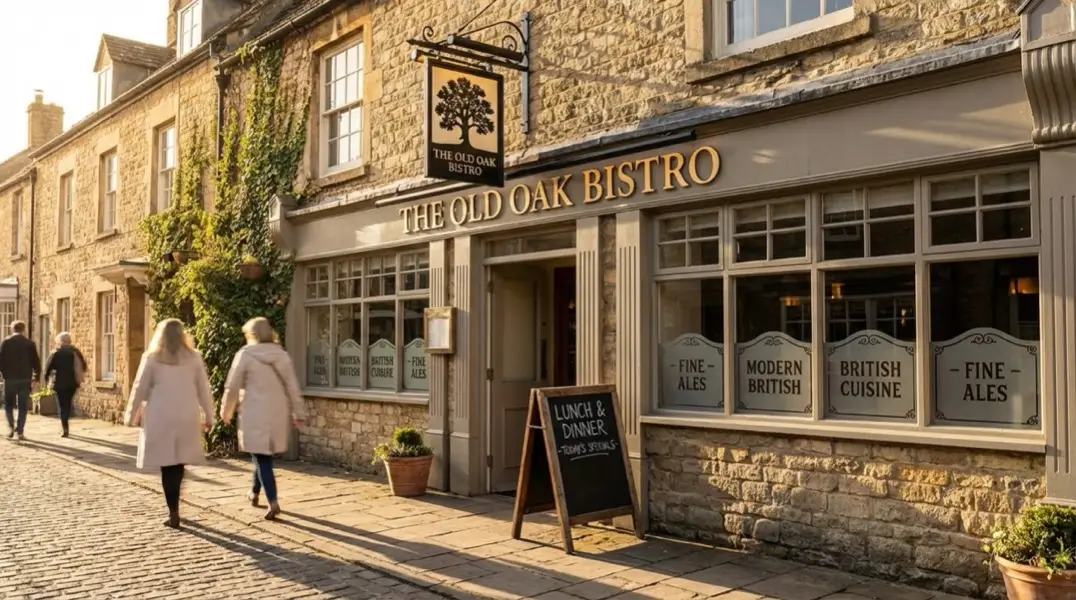
Complete guide to restaurant signage for UK owners. Covers fascia signs, A-boards, LED lighting, menu boards, costs, materials and planning regulations.